Connect with us

Business

CBN targets N2.83tn cash in private hands ahead of 2027 polls

Published

on

The Central Bank of Nigeria (CBN) has unveiled an ambitious plan to bring about N2.83tn currently held outside the banking system into formal financial channels and expand financial inclusion by onboarding 50 million additional Nigerians by 2028.

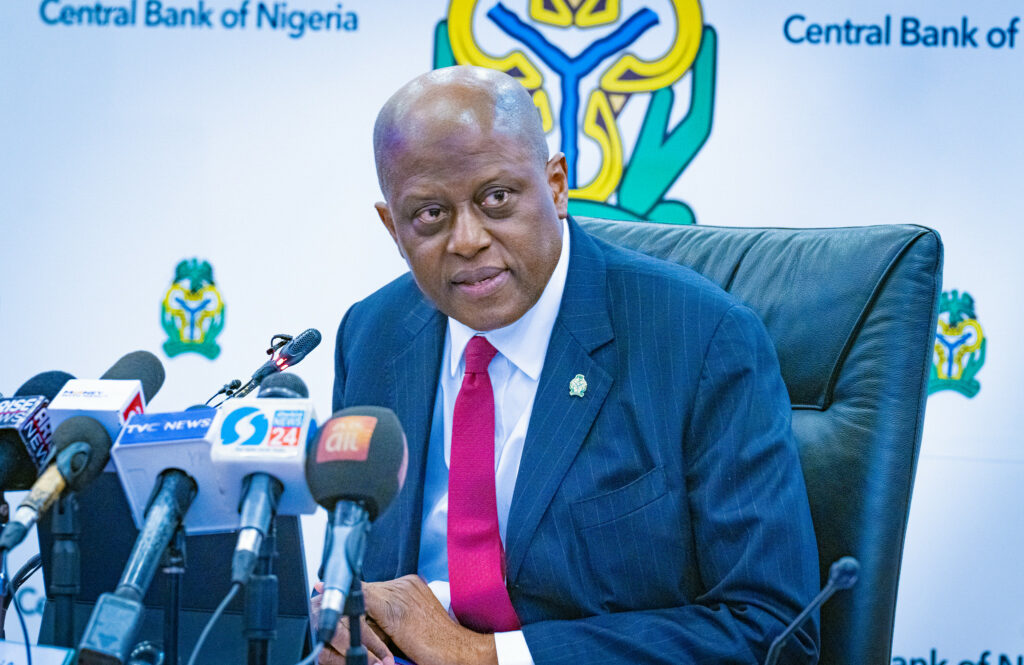
The targets form part of the Nigeria Payments System Vision 2028 unveiled by the Governor of the Central Bank of Nigeria, Olayemi Cardoso, on Monday in Abuja, as the apex bank seeks to deepen digital payments, strengthen trust in financial services, reduce cash dependence, and position Nigeria as a leading payments hub in Africa.

The target is coming a few months before Nigeria’s 2027 general elections, with the Independent National Electoral Commission scheduling the presidential and National Assembly polls for January 16, 2027, and governorship and state assembly elections for February 6, 2027, amid renewed concerns over cash-driven campaigns, vote-buying, and higher legal spending limits for candidates.

The launch brought together regulators, banks, fintech operators, telecommunications firms, development partners, and other stakeholders in the financial services ecosystem.

Cardoso said the initiative was not merely about technology or financial transactions but about creating economic opportunities, reducing poverty, and accelerating growth. According to him, efficient payment systems remain among the fastest ways to lift large numbers of people out of poverty.

“One of the fastest ways to take a large number of people out of poverty is through an efficient payments system. It’s through an efficient payment system. So let us not look at it lightly,” Cardoso said.

The governor described the Payments System Vision 2028 as a strategic roadmap that would shape how Nigerians transact, save, invest, trade, and participate in the digital economy over the next three years.

“Today, we unveil more than a payment strategy. We unveil a vision for how Nigerians will transact, trade, save, invest, and participate in an increasingly digital economy,” he said.

N2.83tn cash target

The new vision comes at a time when cash remains heavily concentrated outside the banking system despite years of financial inclusion efforts. Latest figures from the CBN’s money and credit statistics show that currency outside banks stood at N5.08tn in April 2026, representing about 90.03 per cent of the N5.65tn currency in circulation during the period.

Cardoso disclosed that the apex bank intends to reduce cash outside the banking system to less than 40 per cent of money in circulation by 2028. “I would like to see a situation where we will reduce cash outside the banking system to less than 40 per cent of money in circulation,” he said.

Using the April 2026 figures as a benchmark, achieving that target would imply reducing cash outside banks from N5.08tn to about N2.26tn, potentially returning roughly N2.83tn to the formal banking system.

See also  FG defends Tinubu’s UK visit, highlights strategic Nigeria‑UK ties

Such a shift could significantly improve monetary policy transmission, increase banking sector liquidity, enhance financial intermediation, and strengthen lenders’ ability to support economic activity.

The effort comes as Nigeria prepares for the 2027 elections, when concerns over cash-intensive campaign activities and vote-buying are expected to place renewed focus on the amount of currency held outside formal financial channels.

The Governor of the CBN and members of the Monetary Policy Committee earlier warned that rising political and election-related spending ahead of the 2027 general elections could undermine the country’s disinflation gains and trigger fresh inflationary pressures. The warnings were contained in the personal statements of MPC members released by the apex bank.

At the launch of the Nigeria Payments System Vision 2028, the governor linked the target to broader efforts to build confidence in digital payments and reduce reliance on cash transactions. “Cash should no longer be king,” he said.

He recalled being concerned after watching a programme in which traders refused to accept cash payments due to concerns about the reliability of payment channels. “We need to do a lot more work to build trust and to ensure that people have no doubt that they are dealing with a strong and reliable payments system,” Cardoso said.

50 million new users

Alongside the cash target, the CBN is seeking to expand participation in the formal financial system dramatically. Cardoso said financial inclusion under the vision would rise to 95 per cent by 2028, bringing an estimated 50 million additional Nigerians into the banking and digital payments ecosystem.

“Under Vision 2028, I would like to see this reaching 95 per cent inclusion. That means 50 million more market women, farmers, and young people will have a bank account or wallet in their name, with their name and BVN protecting them,” he said.

The target represents one of the most ambitious financial inclusion drives undertaken by the apex bank in recent years and reflects the government’s broader efforts to formalise economic activity and expand access to financial services.

According to Cardoso, financial inclusion is not an end in itself but a tool for economic transformation. “The journey is to impact the lives of the poor. That’s part of it and a major part of it. The journey is to lift people out of poverty, and the journey is to have an impact on GDP,” he stated.

The governor added that a modern payment system was indispensable to economic growth, innovation, financial inclusion, and national competitiveness. The CBN governor said the new framework was designed to strengthen infrastructure, deepen inclusion, encourage innovation, improve resilience, and increase integration with regional and global payment systems.

See also  ‘Every Lagos resident must file annual tax returns before March 31’ LIRS says

He noted that payment systems had evolved beyond simple money transfer channels and had become strategic economic infrastructure. “In a modern economy, payment infrastructure is not simply a financial utility. It is a strategic national asset,” Cardoso said.

He explained that efficient payment systems reduce the cost of doing business, improve productivity, support trade, strengthen transparency, and broaden economic participation.

The vision also aims to help Nigeria take advantage of opportunities presented by the African Continental Free Trade Area, expanding digital commerce and increasingly interconnected global markets. “This is not merely about technology or transactions. It is about opportunity,” he said.

According to him, entrepreneurs, traders, and small businesses across the country stand to benefit from faster settlement systems, broader market access, and increased participation in regional and global commerce.

“For the entrepreneur in Aba, the trader in Zaria, the fashion designer in Ilesha, or the small business owner in Kano, efficient and interoperable payment systems can mean access to new markets, faster settlement of transactions, and greater participation in regional and global commerce,” Cardoso added.

Despite the ambitious targets, Cardoso stressed that the success of the programme would depend on implementation rather than policy declarations. “The success of PSV 2028 will not be measured by the quality of this document. It will be measured by execution,” he said.

He challenged regulators, banks, fintech firms, telecom operators, and other stakeholders to work together to ensure the vision translates into measurable economic outcomes. “As the Federal Government of Nigeria builds roads, schools, and hospitals, we here must also build the invisible roads that move money,” Cardoso said.

He added, “Vision 2028 is not a government project. It is a Nigerian project. Together, we will build a payments system that is fast, inclusive, secure, and proudly Nigerian.”

Providing further details of the framework, the CBN’s Deputy Governor, Economic Policy Directorate, Dr Muhammad Abdullahi, said the Payments System Vision 2028 was built around five strategic pillars. According to him, the pillars include payment infrastructure and interoperability, digital financial inclusion, innovation and emerging technologies, cross-border payments, and regulation and cybersecurity.

Abdullahi described modern payment systems as critical economic infrastructure that supports trade, investment, innovation, productivity, and financial inclusion. “Every successful payment represents more than a financial transaction. It enables commerce, supports enterprise, facilitates trade, connects markets, and creates opportunities for economic participation,” he said.

The deputy governor explained that the first pillar focuses on modernising payment infrastructure, strengthening interoperability among banks and fintechs, deploying open APIs, and expanding real-time payments. “Efficient payment infrastructure lowers transaction costs, improves business productivity, and enables firms of all sizes to participate competitively in the digital economy,” he stated.

The second pillar centres on financial inclusion, consumer protection, and financial literacy, while the third seeks to leverage emerging technologies such as artificial intelligence, blockchain, digital assets, and open banking.

See also  Naira gains, trades 1,365/$ at official FX market

The fourth pillar focuses on cross-border payments and integration with the Pan-African Payment and Settlement System as well as the African Continental Free Trade Area framework.

According to Abdullahi, reducing payment friction across borders would strengthen trade, lower settlement costs, improve remittance efficiency, and position Nigeria as a regional settlement hub.

The fifth pillar emphasises regulation, cybersecurity, fraud prevention, and consumer trust. “No system scales without trust, and no trust exists without security,” he said.

In his opening remarks, the Director of Payments System Policy at the CBN, Musa Jimoh, traced the country’s payment transformation journey to 2007, when the apex bank launched the Payment System Vision 2020.

He recalled that Nigeria’s financial system at the time was heavily dependent on cash and had limited electronic payment infrastructure. “It started in 2007, when the Central Bank decided to set up a roadmap to modernise the payment system,” he said.

According to Jimoh, the CBN identified three major barriers to financial inclusion at the time: high banking costs, limited access to financial institutions, and stringent account-opening requirements.

To address the challenges, the bank introduced policies, including agent banking and the cashless policy. “Today, we are proud to announce that we have over two million agents spread across the country,” he said.

Jimoh said the growth of agent networks had expanded financial access while creating employment opportunities across the country.

Regulators back vision

The Director-General of the Securities and Exchange Commission, Dr Emomotimi Agama, said collaboration among financial regulators would be critical to the success of the initiative.

“For us in the capital market, it’s delivery versus payment. Delivery speaks to securities and payment means having to pay the cash,” he said.

Agama argued that Nigeria had already become a global reference point in digital payments and urged stakeholders to tell the country’s story more effectively on the global stage.

The Executive Vice Chairman of the Nigerian Communications Commission, Dr Aminu Maida, also endorsed the framework, describing it as an important step towards achieving the Federal Government’s goal of building a $1tn economy.

Maida noted that fraud and cybersecurity challenges increasingly cut across sectors and borders, making collaboration essential. “Collaboration has to be what guides us moving forward towards achieving that goal of a trillion-dollar economy,” he said.

He added that the NCC was expanding fibre infrastructure and broadband connectivity nationwide to support digital payments and financial inclusion.

punch.ng

FOLLOW US ON:

FACEBOOK

TWITTER

PINTEREST

TIKTOK

YOUTUBE

LINKEDIN

INSTAGRAM

Continue Reading
Click to comment

Leave a Reply

Your email address will not be published. Required fields are marked *

Business

Dangote to donate one-third of wealth to charity, daughter reveals

Published

on

Africa’s richest man, Aliko Dangote, plans to donate one-third of his wealth to charity as part of his succession plan, his daughter, Halima Dangote, has revealed.

Halima, a trustee of the Aliko Dangote Foundation, disclosed the arrangement in an interview with Bloomberg published on Tuesday, saying the billionaire had secured his family’s support to dedicate 33 per cent of his estate to philanthropy.

According to the Bloomberg Billionaires Index, Dangote’s net worth is estimated at $35.1 billion, meaning one-third of his current fortune would amount to about $11.7 billion if maintained at that level.

Explaining the decision, Halima said her father considers philanthropy central to his legacy and has embedded it into the family’s long-term succession plans.

“He sort of put all the structure in place whereby we focus a lot on health and education. He actually donated 25 per cent to the foundation. If you look at it, it is what we call in Sharia Code in Islam; it means he has donated 33 per cent of his whole inheritance to his foundation,” she said.

“That is how important it is to him because philanthropy needs to be in existence generation after generation.

“So giving back is part and parcel of what we do. We believe we’re here, that our business is successful because of the giving back and because of the philanthropic aspect. That is why the 33 per cent is important.

“And that is why he made an announcement and he asked myself, my two sisters and his mother to sign under that will that he is able to give that 33 per cent to humanity.”

See also  Cooking gas nears N2,000/kg ahead of Sallah celebrations

The planned donation builds on Dangote’s existing philanthropic work through the Aliko Dangote Foundation, established in 1994.

According to Halima, the foundation was endowed with $1.25 billion about a decade ago and has since received an additional $700 million in funding.

She said about 70 per cent of the foundation’s spending is directed to Nigeria, while 20 per cent supports projects across Africa and the remainder funds initiatives in other parts of the world.

The foundation’s interventions span health, education, nutrition and humanitarian relief, and include partnerships with the Bill & Melinda Gates Foundation and state governments in northern Nigeria that contributed to the eradication of wild poliovirus in Africa.

Dangote’s planned charitable commitment comes amid growing global attention on billionaire philanthropy. While the proposed 33 per cent allocation falls short of the 50 per cent threshold commonly associated with the Giving Pledge, it would rank among the largest philanthropic commitments ever announced by an African billionaire.

Earlier this year, TIME magazine named Dangote among the world’s most influential philanthropists in its inaugural TIME100 Philanthropy list, recognising his charitable work through the Aliko Dangote Foundation, which spends more than ₦50 billion annually on programmes across Africa.

punch.ng

FOLLOW US ON:

FACEBOOK

TWITTER

PINTEREST

TIKTOK

YOUTUBE

LINKEDIN

Continue Reading

Business

SEE FULL LIST: Trump’s tariffs on Nigeria, 59 other countries over forced labour claims

Published

on

The United States has announced new tariffs on imports from 60 economies, including Nigeria, over what it described as their failure to prohibit the importation of goods produced with forced labour.

The measures, announced by the Office of the United States Trade Representative on Thursday, impose tariffs of either 10 per cent or 12.5 per cent, depending on each country’s forced labour import policies.

According to the USTR, the decision followed investigations launched in May 2026 under Section 301 of the Trade Act into 60 of the United States’ largest trading partners.

The agency said it received more than 1,600 public submissions, held hearings involving over 100 witnesses, and consulted more than 45 governments before announcing the tariffs.

Nigeria is among the countries that will face a 12.5 per cent tariff, while some that USTR deems have adopted or committed to implement bans on imports linked to forced labour will attract a lower 10 per cent rate.

Below is the full list of countries and territories affected by the new US tariffs:

Country/Territory Tariff (%)
Algeria 12.5
Angola 12.5
Argentina 10
Australia 12.5
Bahrain 12.5
Bangladesh 10
Brazil 12.5
Cambodia 10
Canada 10
Chile 12.5
China 12.5
Colombia 12.5
Costa Rica 12.5
Dominican Republic 12.5
Ecuador 10
Egypt 12.5
El Salvador 10
European Union* 10
Guatemala 10
Guyana 12.5
Honduras 10
Hong Kong 12.5
India 10
Indonesia 10
Iraq 12.5
Israel 12.5
Japan* 12.5
Jordan 10
Kazakhstan 12.5
Kuwait 12.5
Libya 12.5
Malaysia 10
Mexico 10
Morocco 12.5
New Zealand 12.5
Nicaragua 12.5
Nigeria 12.5
Norway 12.5
Oman 12.5
Pakistan 10
Peru 12.5
Philippines 12.5
Qatar 12.5
Russia 12.5
Saudi Arabia 12.5
Singapore 12.5
South Africa 12.5
South Korea* 12.5
Sri Lanka 10
Switzerland* 12.5
Taiwan* 10
Thailand 12.5
The Bahamas 12.5
Trinidad and Tobago 10
Turkey 12.5
United Arab Emirates 12.5
United Kingdom 10
Uruguay 12.5
Venezuela 12.5
Vietnam 12.5
See also  2027 race: Wike, Turaki camps roll out parallel PDP candidates

For the European Union, Japan, South Korea, Switzerland and Taiwan, the tariffs are applied net of the Most-Favoured-Nation (MFN) rate, according to the USTR.

PUNCH Online reports that some products are exempted from the tariffs.

punch.ng

FOLLOW US ON:

FACEBOOK

TWITTER

PINTEREST

TIKTOK

YOUTUBE

LINKEDIN

Continue Reading

Business

World Bank loans drive Tinubu’s social spending agenda

Published

on

As Nigeria leans more on World Bank financing to support social programmes, the President Bola Tinubu administration aims to ease reform pains, with success hinging on accountability, institutional capacity and effective implementation, writes SAMI TUNJI

When President Tinubu unveiled a group of World Bank-backed programmes at the State House Banquet Hall in Abuja on  16 July, the ceremony was presented as the social-policy answer to the economic reforms that have defined his administration.

The programmes span livelihood support, food security, basic education, primary healthcare, public-sector governance and assistance for communities affected by displacement. Collectively, they reveal how the administration is increasingly relying on concessional financing and results-based World Bank programmes to extend social spending beyond the limits of the federal budget.

At the centre of the package are the $500m additional financing for the Nigeria Community Action for Resilience and Economic Stimulus programme, the $300m Solutions for the Internally Displaced and Host Communities project and the Human Capital Opportunities for Prosperity and Equity programmes covering governance, primary healthcare and education.

Although Tinubu’s address described NG-CARES as a $1.25bn programme, the figure includes the original $750m operation and $500m in fresh additional financing. The new financing being launched across NG-CARES, SOLID and the HOPE components is therefore distinct from the cumulative value of the programmes.

The Minister of State for Budget and Economic Planning, Dr Doris Uzoka-Anite, put the fresh package at about $2.42bn in her remarks at the event. That figure broadly reflects $500m for NG-CARES additional financing, $300m for SOLID, $500m for HOPE-Governance, $570m for HOPE-Primary Healthcare and about $552m for HOPE-Education, including support from the Global Partnership for Education.

Behind the numbers is a policy shift. Rather than relying solely on annual appropriations to fund health centres, schools, social registers, cash transfers and livelihood schemes, the government is embedding these interventions in multiyear programmes financed largely through the World Bank’s International Development Association.

The arrangement gives Nigeria access to longer-term and generally cheaper development financing than commercial borrowing. It also brings external performance conditions, independent verification and institutional reform requirements. But it adds to the country’s external obligations and raises a familiar question: whether borrowed money will create services and institutions durable enough to justify the repayment burden.

Reforms meet welfare

Tinubu assumed office in May 2023 and immediately removed the petrol subsidy before allowing a major adjustment in the foreign exchange market. The measures were intended to correct fiscal and monetary distortions, but they also increased transport, energy, food and production costs, leaving households to absorb much of the initial impact.

The administration has consequently faced pressure to show that macroeconomic stabilisation can produce improvements beyond government revenue, foreign reserves and investor sentiment. At the Abuja launch, Tinubu acknowledged that the political and economic sustainability of the reforms would depend on how ordinary Nigerians experienced them.

“Positive results are emerging from our reforms. Robust growth is returning. Confidence is rising. But that progress must be felt in every household, not just in national statistics,” he said in an address delivered on his behalf by the Minister of Finance and Coordinating Minister of the Economy, Mr Taiwo Oyedele.

Tinubu described NG-CARES, SOLID and HOPE as instruments for converting macroeconomic stability into “better livelihoods, in every ward, for every family.”

His remarks captured the tension in the government’s policy direction. The administration argues that subsidy removal, exchange-rate reform and revenue changes have created fiscal space, yet it is turning to the World Bank to finance a sizeable share of the programmes expected to cushion vulnerable people and rebuild essential services.

The Minister of Budget and Economic Planning, Abubakar Bagudu, admitted that the resources produced by the reforms remained insufficient for the scale of the social challenge.

“The macroeconomic reforms have released remarkable resources, some significant amount of resources for government investment in this area, but that investment is not enough, particularly in the short run,” he said.

See also  Ex-Bauchi deputy governor, Audu Sule-Katagum dies at 69

Bagudu added that this explained the need for support from the World Bank and other development finance institutions.

The scale of poverty helps explain the urgency. The World Bank’s April 2026 Nigeria Development Update projected that poverty had risen from 40 per cent, representing 81 million people, in 2019 to about 61 per cent, or 139 million people, in 2025. It said much of the increase predated the current reforms, but the subsequent cost-of-living crisis deepened pressure on vulnerable households.

The World Bank’s new Nigeria Country Partnership Framework for the 2026–2032 fiscal period similarly said more than 60 per cent of Nigerians were estimated to have lived below the national poverty line in 2025. Poor households spend as much as 70 per cent of their income on food, making them particularly exposed to food-price increases.

Against that background, the loans have become more than additional project funding. They are part of the political architecture through which the government hopes to make its reforms socially tolerable.

Results-based financing

The World Bank’s expanding role is also changing how Nigeria designs and delivers social programmes. Much of the financing is structured around measurable results rather than simply releasing funds for government expenditure.

Under such arrangements, participating states and agencies are expected to satisfy agreed conditions, document outcomes and undergo verification before receiving reimbursements or further disbursements. In principle, this reduces the likelihood that funds will be released solely on the strength of budgetary promises.

NG-CARES illustrates the model. The original programme was a $750m operation designed to help households, farmers, communities and small businesses recover from the COVID-19 shock. According to Bagudu, it reached 17.6 million direct beneficiaries between 2021 and 2025.

The World Bank approved another $500m to continue and expand the programme, taking its cumulative financing envelope to $1.25bn. Official project documents show that the additional financing was requested collectively by state governors through the National Economic Council and is intended to expand livelihood assistance, food security services and grants to vulnerable households and firms.

The programme contains safeguards intended to reduce misuse. Participating states are expected to submit audited financial statements, audit beneficiary lists and payments, report fraud and corruption allegations, and establish adequately staffed coordinating units. It also provides for independent verification, third-party monitoring and periodic reporting on environmental and social compliance.

HOPE applies a similar logic to public services. The governance component provides $500m to address institutional weaknesses that constrain education and healthcare delivery, while the primary healthcare programme received $570m in World Bank financing.

Rather than treating weak school and health outcomes only as shortages of buildings or equipment, HOPE links them to budgeting, personnel management, transparency and accountability. States may be expected to improve financial reporting, protect sectoral funding, manage teachers and health workers more effectively, and produce verified evidence of service delivery.

The Coordinating Minister of Health and Social Welfare, Prof Muhammad Pate, said the health reforms were anchored on “one plan, one budget and one report,” bringing together federal, state, local government and development-partner resources.

He said more than 3,000 primary healthcare centres had been revitalised, with another 1,900 projects expected to be completed. According to him, more than 43,000 women and newborns had been transported through the emergency medical system, 78,000 health workers had been retrained and quarterly visits to primary healthcare facilities had risen to 45.5 million from fewer than 10 million in 2023.

Those figures suggest increased activity, but the quality and sustainability of the services remain important. A renovated facility may still lack medicines, electricity, qualified workers or reliable financing after a project closes.

The World Bank’s appraisal framework recognises that risk. HOPE-PHC is designed partly to ensure that domestic resources are provided in budgets for essential medicines, vaccines, diagnostics and other lifesaving commodities, while tracking stock availability in supported facilities.

See also  FG budgets nearly N1tn for empowerment, SUVs amid rising borrowing pressure

The challenge is to prevent World Bank financing from becoming a substitute for domestic responsibility. External loans may help create systems and reward reforms, but salaries, medicines, maintenance and recurrent school expenses must eventually be sustained by Nigerian revenues.

Borrowed human-capital

The most visible change in Tinubu’s social spending agenda is the attempt to treat education, healthcare and social resilience as connected investments rather than separate ministerial projects.

HOPE is the clearest expression of that approach. Its three components address governance, primary healthcare and education, based on the argument that money spent on classrooms and clinics will produce limited results where institutions cannot manage workers, budgets and data.

The Minister of Education, Dr Maruf Alausa, said the HOPE-Education programme represented a $552m investment backed by the World Bank and the Global Partnership for Education. He said it would reach nearly 30 million children, support more than 500,000 teachers and cover tens of thousands of public schools and non-formal learning centres.

The programme is intended to improve foundational learning, expand access and encourage states to carry out institutional reforms. The World Bank has argued that investing in basic skills is essential because Nigeria’s young population cannot become an economic advantage without functional education.

Yet the reliance on credit to fund these basic functions reflects weaknesses in Nigeria’s fiscal structure. Education and healthcare are permanent constitutional responsibilities, not temporary emergency interventions. Funding them through loans can be justified where the financing builds durable systems, expands access or corrects long-standing institutional failures. It becomes harder to justify when borrowed funds repeatedly pay for activities that should be covered through predictable domestic budgets.

SOLID expands the same debate to displacement. The $300m project was approved by the World Bank in August 2025 to improve essential services and economic opportunities for internally displaced people and their host communities in selected local government areas in northern Nigeria. It is expected to benefit up to 7.4 million people, including about 1.3 million displaced persons.

The project marks a shift from short-term humanitarian assistance towards development financing. Roads, water systems, schools, clinics, livelihoods and local institutions are intended to help communities absorb displaced populations while enabling affected households to become more self-reliant.

The Minister of Humanitarian Affairs and Poverty Reduction, Dr Bernard Doro, described the older approach as episodic: “A blanket today, a pack of grain tomorrow.”

He said the government’s emerging system was designed to move households “from emergency relief to resilience, to self-reliance and productivity.”

“For me, these are not merely programmes; they are statements of national intent that no Nigerian, however remote or displaced, is beyond the reach of this government’s care,” Doro said.

That policy direction is consistent with the World Bank’s position that forced displacement should be treated as a development problem, not only as a humanitarian emergency.

For Nigeria, however, loans cannot resolve the causes of displacement. Infrastructure and livelihood support may ease pressure on communities, but insecurity, conflict, banditry, flooding and climate shocks will continue to generate new needs unless addressed directly.

This creates a risk that the state borrows to manage the consequences of failures it has not prevented. If insecurity persists, facilities built under SOLID could become overstretched, abandoned or inaccessible. If displaced people cannot safely return home or integrate into host communities, the programme may provide temporary stability without resolving the underlying crisis.

The same applies to education and health. Credit can rehabilitate schools and clinics, but cannot by itself guarantee teacher attendance, health-worker retention, safe communities, competent local administration or sustained domestic financing.

Debt, delivery test

The attraction of World Bank financing is understandable. Nigeria faces large social needs, weak revenue mobilisation and high domestic borrowing costs. Concessional external credit can provide longer repayment periods, technical support and access to global experience.

See also  Naira gains, trades 1,365/$ at official FX market

But the growing use of World Bank loans also adds to a rising debt stock.

Data from the Debt Management Office showed that Nigeria’s total public debt reached N159.28tn at the end of December 2025. Domestic debt accounted for N84.84tn, while external debt stood at N74.42tn, equivalent to about $51.85bn.

Nigeria’s obligations to the World Bank rose to about $19.89bn by the end of 2025, from $17.81bn a year earlier. The International Development Association accounted for approximately $18.51bn, while exposure to the International Bank for Reconstruction and Development made up the balance.

The World Bank is consequently not only a development adviser but also one of Nigeria’s most important external creditors.

This relationship is likely to deepen under the Bank’s Country Partnership Framework for Nigeria covering 2026 to 2032. The framework seeks to promote private-sector-led growth, job creation and improved access to energy, digital and agricultural services. The Bank approved an initial $1.25bn financing operation alongside the new strategy in June 2026.

Nigeria’s broader World Bank portfolio has been described as comprising about 30 projects with more than $16.9bn in IBRD and IDA commitments, the greater share coming from IDA.

The debt burden does not automatically make the social-sector loans undesirable. Borrowing for projects that increase productivity, reduce preventable deaths, improve learning and enable households to earn stable incomes can generate economic and social returns greater than their cost.

The danger lies in weak implementation, delayed disbursement, duplicated programmes and projects that end without functioning institutions.

The Chairman of the Nigeria Governors’ Forum and Kwara State Governor, AbdulRahman AbdulRazaq, represented by Ondo State Governor Lucky Aiyedatiwa, said the 36 states were committed to working with the Federal Government and development partners.

He argued that NG-CARES had shown what was possible when the Federal Government, states and partners held themselves to common accountability standards.

That commitment will be tested when states are required to provide counterpart resources, publish results, maintain facilities and submit to independent assessments. Programmes for results can encourage reform, but they may also favour states with stronger institutions, leaving poorer and conflict-affected states struggling to meet conditions despite having greater needs.

The National Assembly also has a role. Senate President Godswill Akpabio, represented by the Chairman of the Senate Committee on Finance, Mohammed Musa, pledged legislative support and oversight.

“We understand that appropriations must produce deliverable outcomes of impact and oversight must strengthen implementation rather than obstruction,” he said.

For that pledge to matter, lawmakers must scrutinise loan terms, disbursement conditions, implementation reports and measurable outcomes rather than treating approval as the end of the process.

The wider accountability question is whether Nigerians can trace funds from federal agreements to state budgets, local institutions and individual communities. Beneficiary registers, procurement awards, independent verification reports and state-by-state disbursements should be publicly accessible.

World Bank Country Director for Nigeria, Matthew Verghis, said the success of such programmes depended on leadership commitment and collaboration among the tiers of government.

“The World Bank is proud to partner with the Government of Nigeria, working with the other development partners in advancing this vision, and we look forward to working together to deliver tangible results that will improve the lives of millions of Nigerians,” he said.

Ultimately, the programmes will not be judged by the size of the loans, the number of launch speeches or the volume of intended beneficiaries. Their value will depend on whether a farmer receives useful support, a displaced family builds a sustainable livelihood, a child learns in a functioning school and a pregnant woman can obtain safe care at a properly staffed health centre.

punch.ng

FOLLOW US ON:

FACEBOOK

TWITTER

PINTEREST

TIKTOK

YOUTUBE

LINKEDIN

Continue Reading

Trending