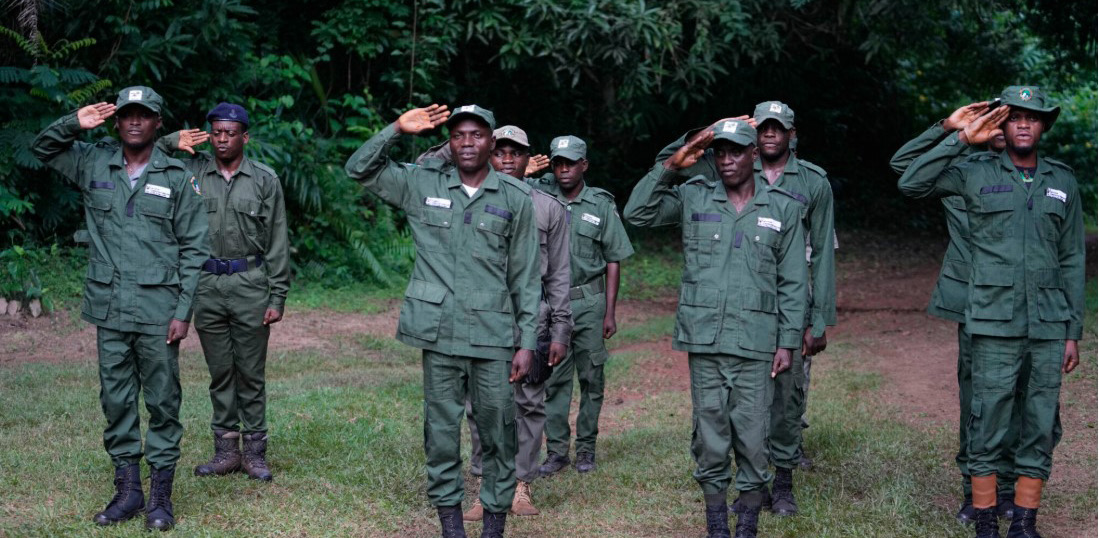
The deployment of forest guards has gathered momentum, with Kebbi, Gombe, Kwara, Kaduna, Edo, Imo, Bayelsa, Anambra and several other states scaling up operations under the Federal Government-backed initiative, although implementation remains uneven nationwide.
The renewed focus on forest security follows President Bola Tinubu’s approval of the recruitment of 1,000 forest guards after recent attacks and abductions linked to suspected bandits in Oyo and Kwara States.
Against the backdrop of the increasing attacks by criminals, President Tinubu on Sunday restated his administration’s commitment to intensify the fight against insecurity and ensure the release of all persons held captive across the country.
In Kebbi State, 819 newly trained National Forest Guards have been deployed following a nine-week intensive training programme held in Kalgo Local Government Area.
Deputy Governor Umar Tafida at the passing-out ceremony said the operatives were being deployed to deny criminal groups access to forest reserves used as hideouts.
He urged traditional rulers and local communities to support the initiative by sharing intelligence.
Representing the National Security Adviser, Mallam Nuhu Ribadu, the Commissioner of Police, Umar Hadejia, said Kebbi was among seven pilot states selected for the scheme.
“The newly trained forest guards will be deployed immediately to ungoverned spaces and vulnerable forest corridors to enhance security and support existing law enforcement efforts,” Hadejia said.
Meanwhile, in Gombe State, the government said it had commenced implementation of its forest guard programme, with recruits currently undergoing training at the Mobile Police Training School in Osun State.
The Director-General of Press Affairs at the Government House, Ismaila Misilli, told The PUNCH that about 700 recruits had been screened and selected for specialised training in surveillance, intelligence gathering and forest security operations.
He added that Governor Muhammadu Yahaya had approved N337m for the exercise.
“The state has already activated the process and is actively building the operational capacity of its forest guards as part of broader efforts to enhance security and protect forest reserves across Gombe State,” Misilli said.
Transitioning to Kwara State, the government disclosed that about 3,300 forest guards had been recruited and deployed under the Presidential Forest Guards initiative to strengthen rural security.
The programme began with over 700 operatives deployed across Kwara North and Kwara South senatorial districts, working alongside security agencies and vigilante groups.
In October 2025, Governor AbdulRahman AbdulRazaq approved the recruitment and advanced tactical training of an additional 2,600 operatives.
A statement made available to The PUNCH by the Senior Special Assistant on New Media to the Governor, Akeweje Fafoluyi, said the expansion was aimed at improving security coverage across the state.
“The new recruits will join the 700 forest guards earlier engaged, who are already working alongside security agencies at the frontline to combat banditry and restore peace in affected communities,” he said.
He added that the operatives would undergo advanced military training to improve operational effectiveness.
However, in Benue State, the Director-General of the Bureau for Homeland Security, retired Air Commodore Jacob Gbamwuan, clarified that the recruitment of forest guards is a federal responsibility.
Speaking in a telephone interview, he said recruits from the state had already commenced training.
“It is the Federal Government that recruits forest guards and not the states. Those recruited in Benue have gone for training,” he said.
The Special Adviser to the Sokoto State Governor on Security, retired Col. Ahmed Usman, said the operatives should not be deployed for frontline combat operations.
“Forest guards are primarily trained to protect forest resources, prevent illegal logging, combat poaching and support conservation efforts. While they may receive basic security training, they are not structured or equipped to undertake complex combat operations,” he said.
He stressed that high-risk operations should remain the responsibility of the military, police and other specialised agencies.
“Without adequate training and a clear operational framework, involving forest guards in sensitive security operations may create confusion and increase the burden on existing security structures,” he warned.
Katsina State Governor Dikko Umar Radda’s administration announced the recruitment of 70 forest guards under the Ministry of Agriculture and Livestock Development as part of measures to curb terrorism and other criminal activities.
The forest guards, recruited on Grade Level 01, were assigned responsibilities including protecting forest reserves, preventing illegal logging, monitoring encroachment on forest lands and supporting conservation efforts in affected local government areas.
The state government announced in January 2026 that the personnel had been deployed to strengthen surveillance and protection of forest reserves and stock routes across the state.
The deployment was said to be part of the government’s broader strategy to deny criminal groups access to forests, often used as hideouts for planning and launching attacks on communities.
Similarly, the Kano State Government has recruited 150 forest guards through the Ministry of Water Resources, Environment and Climate Change.
Confirming the development to The PUNCH, the Director of Public Enlightenment in the ministry, Hajiya Maryam Abdulkadir, said the initiative was designed to address security challenges while promoting environmental protection.
“Yes. The Kano State Government through the Ministry of Water Resources, Environment and Climate Change has recruited 150 forest guards,” she said in a WhatsApp message on Thursday night.
Abdulkadir explained that the officers had already been deployed across six operational zones to secure forest reserves, plantations and shelter belts across the state.
According to her, the zones include Dambatta, Bichi, Gwarzo, Tudun Wada, Wudil and Kano.
She said, “The recruited officers have already been deployed across the six zones to man the state’s forest reserves, plantations and shelter belts.”
The director explained that the Tudun Wada zone covers Tudun Wada, Bebeji, Rano, Kura, Garun Malam and Bunkure Local Government Areas, while the Wudil zone comprises Wudil, Gaya, Albasu, Ajingi, Takai, Sumaila and Garko LGAs.
She added that the Kano zone includes Tarauni, Kano Municipal, Gwale, Kumbotso, Dawakin Kudu, Warawa, Fagge, Nasarawa and Dala local government areas.
Abdulkadir further disclosed that major forest reserves are located in Bichi, Dawakin Tofa, Bagwai, Tsanyawa, Shanono, Gwarzo, Madobi, Karaye, Kiru, Rimin Gado and Kabo Local Government Areas.
Security concerns had heightened in several parts of Kano State following repeated attacks by bandits on rural communities.
Residents of Shanono, Tsanyawa and Bagwai local government areas, as well as parts of Gwarzo LGA, have in recent months suffered attacks that reportedly resulted in the deaths of several residents and the abduction of women and children.
The attacks, which locals alleged were carried out by armed groups operating from neighbouring Katsina State, have fuelled demands for stronger surveillance of forests and border communities.
Abdulkadir noted that apart from enhancing security, the initiative would also help tackle deforestation, desertification and the growing impact of climate change.
Ekiti State Government stated that the forest guards have been recruited to boost security in the state.
Commissioner for Information Taiwo Olatunbosun said on Thursday that “the state government has recruited forest guards, and all the local governments were involved in the recruitment. We chose the guards from the communities.
“They have been working in collaboration with the military, the police and other security agencies as well as the Amotekun Corps. We have been engaging in bush combing, which the forest guards are actively participating in.”
The commissioner further explained that the state government had done a lot in the area of security to protect the lives and property of residents.
Olatunbosun said, “We have done a lot. We are upscaling and upgrading the security activities here. We have a security council that includes the local government chairmen, and there is a regular security meeting with the traditional rulers.”
The Ondo State Government, on the other hand, said it has no plan to recruit forest guards, saying it already has the Amotekun Corps.
The government said it has already recruited 500 men into the Amotekun corps with plans to recruit 500 more.
“We already have our own Amotekun Corps, which is doing well. The governor has just approved the recruitment of 500 men into the Amotekun Corps, and he is also planning to recruit another 500. So, we don’t need FG’s forest guards.”
Similarly, the Commander of the state Amotekun Corps, Akogun Adetunji Adeleye, said the Amotekun Rangers created by the corps have been deployed in the forests across the state.
“Our men are in the forest doing the work; we have Amotekun rangers who are in the forest to flush out criminals.”
On a positive note, the forest guards’ recruitment has commenced in Kaduna State with the training of 1,000 men.
The recruits, drawn largely from security-challenged communities, are expected to complement the conventional security agencies by monitoring forests, gathering intelligence and helping to flush out criminal elements hiding in remote areas.
Speaking during the commencement of the six-week training programme at the Police College, Kaduna, Governor Uba Sani said the initiative was aimed at enhancing security, protecting lives and property, and restoring confidence among residents, particularly farmers affected by persistent attacks.
The governor, who was represented by his Chief of Staff, Sani Kila, urged the trainees to uphold discipline, professionalism and patriotism in the discharge of their duties.
According to him, the forest guards will work closely with security agencies and serve as the first line of intelligence gathering in communities prone to banditry and kidnapping.
He said, “The people of Kaduna State are ever ready to answer the call. These trainees were selected from flashpoint areas because they are familiar with the terrain and understand the security challenges confronting their communities.
“We should appreciate our Governor, Uba Sani, and also thank President Bola Tinubu for making this initiative possible. At the end of the six-week training, these men and women will be deployed back to their communities and flashpoint areas.”
Kila identified some of the local government areas expected to benefit from the deployment as Birnin Gwari, Giwa, Kagarko, Kachia, Chikun, Kajuru and Igabi, all of which have experienced repeated attacks by bandits and kidnappers.
“With the deployment of these personnel after training, the issue of insecurity in Kaduna State will drastically reduce,” he added.
Also speaking, the Commissioner for Internal Security and Home Affairs, Sule Shuaibu, said the training was being coordinated by the Office of the National Security Adviser as part of a broader national strategy to strengthen grassroots security architecture.
Shuaibu explained that the forest guards would be equipped with the skills needed to monitor forest corridors, gather actionable intelligence and support security agencies in preventing attacks.
“We have here 1,000 men and women who have gathered for a six-week training that is being organised by the Office of the National Security Adviser,” he said.
“We want to use this opportunity to thank President Bola Tinubu, who has made this possible. We also want to thank our Governor, Senator Uba Sani, who worked hard to see that this training sees the light of day.
“Despite all the challenges we have gone through, the training commenced successfully, and the participants are charged and ready to go.”
In recent years, communities in the Birnin Gwari, Chikun, Kajuru, Giwa and Kachia LGAS have suffered devastating attacks by bandits, resulting in kidnappings, killings and disruption of farming activities.
Last Thursday, the Edo State government also announced plans to commence training for newly recruited forest guards on June 5.
Commissioner for Public Safety and Security, Festus Ebea, in a statement, noted that the training would take place at the Police Training School, Ogida Barracks, Benin City.
Ebea stated that all candidates have successfully been profiled by the Department of State Services and completed medical screening at Edo Specialist Hospital.
Meanwhile, Zamfara, Rivers, Abia, Osun, Lagos and Benue, have yet to commence recruitment despite growing concerns over banditry, kidnapping and criminal activities in forested areas.
The Zamfara State Government cited the lack of federal approval for the exercise.
The Special Assistant to Governor Dauda Lawal on Media and Communication, Mustafa Jafaru, said the state was still awaiting a directive from the Federal Government.
He said although the state was prepared to begin recruitment, it could not proceed without official clearance.
“The establishment of the forest guards is now the sole responsibility of the Federal Government,” he said.
“Zamfara State has wanted to do that, but we have to wait for further directives. We are still waiting, and I am telling you that Zamfara is ready to do that, considering the security problem affecting the state,” he added.
Jafaru noted that the state already operates a Community Protection Guards structure, which has been active for about two years in supporting counter-banditry operations and forest monitoring alongside other security agencies.
Speaking with one of our correspondents, the Special Adviser on Security to Osun State Governor, Samuel Ojo, said plans were being concluded by the state government to recruit forest guards.
Ojo added that a security outfit that would include forest guards, operatives of the Nigeria Forest Security Service and members of the Oodua Peoples Congress, among others, will soon be unveiled by the state with the specific task of flushing criminals out of forests across the state.
“We are concluding plans on the recruitment of forest guards in Osun. Also, the state governor, Ademola Adeleke, will soon unveil a special security group that will have both the conventional and unconventional security outfits with the specific task of ridding our forests of criminals.
“Apart from the conventional security agencies, the new security outfit that will be unveiled will have operatives of the forest guards, hunters, Nigeria Forest Security Service, OPC men, among others.”
In Rivers State, authorities are yet to begin recruitment despite reports of criminal activities in forest communities.
Security concerns intensified after suspected bandits abducted Collins Ohahurun, commander of the local vigilante group, Ipo Security Planning and Advisory Committee, during a gun battle in Ikwerre Local Government Area in March.
Although a joint security operation combed the area, only his rifle was recovered, and his whereabouts remain unknown.
Delta State has an operational Nigerian Forest Security Service presence across its 25 local government areas. However, officials acknowledge that inadequate mobility continues to hamper effective operations.
The NFSS in the state currently focus on intelligence gathering and preventive security measures, with plans underway to deepen collaboration with local farmers and rural communities.
In Imo State, more than 400 forest guards and vigilante operatives have been trained and deployed to high-risk forests in Owerri West Local Government Area. Working alongside the police, the operatives have participated in operations targeting criminal hideouts, leading to arrests and the recovery of suspected illicit substances and unregistered motorcycles.
Bayelsa State operates both a state-backed Forest Security Service and 46 Community Forest Rangers trained under a biodiversity conservation partnership.
Beyond security patrols, the personnel play a key role in enforcing the state’s logging ban and supporting environmental conservation initiatives. However, officials say inadequate funding and logistics continue to limit their effectiveness.
Anambra State has integrated forest guards into its wider security architecture under the Homeland Security Law 2025. The operatives work alongside local vigilantes, hunters and security agencies to identify and flush out criminal elements from forests and rural communities. Security stakeholders credit the initiative with helping reclaim areas previously troubled by gunmen.
In contrast, Abia State is yet to establish a forest guard system. State officials say they are awaiting further directives and operational guidelines from the Federal Government, although they maintain that the existing Operation Crush security outfit has helped contain criminal activities.
President assures
President Tinubu has vowed that Nigeria will not bow to terrorists or bandits.
The President’s position was conveyed on Sunday by the Secretary to the Government of the Federation, Senator George Akume, at the National Inter-Denominational Church Service held at the National Christian Centre, Abuja, as part of activities marking the 2026 Democracy Day celebration.
A statement by the SGF’s media aide, Yomi Odunuga quoted Tinubu to have said that, “The government of Nigeria shall never succumb to terror, banditry or any form of criminal intimidation.”
Safeguarding lives, he said, remains the government’s top priority, noting that recent attacks and abductions underscore the need for sustained and strengthened operations by security agencies.
Tinubu added that efforts are ongoing to ensure the safe return of all kidnapped victims, while reaffirming that security forces are being adequately supported to defend communities and protect the country’s territorial integrity.
“The safety of Nigerians remains a top priority of the Federal Government. The recent attacks and abductions are painful reminders that more work remains to be done.
“The safe return of all persons in captivity remains a national priority. Security agencies and relevant institutions are being supported with the necessary resources to protect lives, secure communities and preserve Nigeria’s territorial integrity,” he added.
Tinubu said he remains committed to fulfilling his constitutional duties and would “double efforts” to ease the economic hardship facing citizens through improved delivery of democratic dividends.
According to him, the administration is aware of the rising cost of living, insecurity, kidnappings and displacement in several parts of the country, but assured that the government is working to address them decisively.
“Government is sensitive to all these pains, shares in these pains and has heard your cries,” he assured.
With political activities ahead of the 2027 elections gradually building momentum, the president urged Nigerians to reject violence, hate speech and divisive rhetoric, warning that democracy must not be turned into a battleground.
He also cautioned young people against being used for thuggery, misinformation, or political violence, urging them to protect their future.
“Do not rent out your conscience for money, drugs, political patronage or online applause. Your future is worth more than any politician’s temporary convenience,” he admonished.
Tinubu further called on religious leaders, traditional rulers, the media, civil society and families to promote peace, tolerance and unity as the nation moves toward another election cycle.
He also commended the Armed Forces and other security agencies for their sacrifices in defending the country and sustaining democratic governance, while urging Nigerians to honour the legacy of the June 12 heroes by building a safer, more accountable and peaceful nation.
Nigeria will mark 27 years of uninterrupted democratic rule on June 12, 2026, commemorating the restoration of civilian governance in 1999 and the sacrifices of pro-democracy activists linked to the June 12 struggle.
The anniversary comes amid ongoing economic challenges and persistent security threats, including terrorism, banditry and kidnappings, which have remained key concerns for citizens and the Federal Government.