
Connect with us

News

Presidential panel on State police begin their work

Published

on

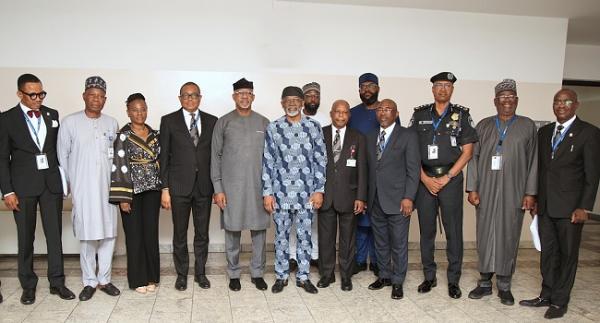
The inauguration follows the National Assembly’s passage of the Constitution Alteration (State Police) Bill, 2026, which proposes a dual policing structure comprising the Federal Police Service and 36 State Police Services. Explaining the need for the committee, Tinubu said preparations for implementation should begin before the constitutional amendment process is completed. “We must not wait until the constitutional process is concluded before beginning this important assignment,” the President said.

He explained that while the constitutional amendment establishes the framework for state policing, the National Policing Bill will provide the legal and operational structure required for implementation. “The Constitution Amendment Bill establishes the framework for dual policing, but it does not operationalise it. That work is left to the National Policing Bill,” he said.

According to the President, the proposed legislation will address key issues including minimum policing standards, state readiness certification, federal-state coordination, accountability mechanisms, human rights safeguards and fiscal requirements. “The proposed National Policing Bill will include provisions on minimum policing standards, state readiness certification, federal-state coordination, accountability, human rights safeguards and fiscal conditions,” he stated.

Tinubu added that the working group had been tasked with producing an implementation-ready draft legislation for transmission to the National Assembly immediately after the constitutional amendment process is concluded. “The Working Group has been constituted to produce a technically robust, implementation-ready draft National Policing Bill for transmission to the National Assembly,” he said.

Speaking on behalf of the Nigeria Governors’ Forum, Ogun State Governor Dapo Abiodun pledged the support of state governors for the speedy implementation of the reform, saying governors would work with their respective state assemblies to fast-track the ratification process. He described state police as a response to longstanding demands for community-based policing. “This bill has answered the cries of Nigerians about cascading policing and removing it from the Exclusive Legislative List,” Abiodun said.

See also  FG overshoots borrowing limit as new debt reaches N12.62tn

He added that the proposal builds on the success of regional security outfits such as Amotekun and could significantly increase the country’s policing capacity. “If each state deploys about 6,000 personnel, we will add nearly 200,000 officers to complement the existing federal police,” he said.

Abiodun also commended Tinubu for beginning implementation plans before the constitutional amendment process is completed. “This inauguration demonstrates the proactiveness of the Executive in preparing for effective implementation,” he added.

Attorney-General of the Federation Lateef Fagbemi described the initiative as timely, given Nigeria’s security challenges. “There is no denying the fact that we are in a critical moment security-wise, and all hands must be on deck,” he said, urging governors to ensure the constitutional amendment is promptly ratified by their state assemblies.

NBA President Afam Osigwe also backed the proposal, arguing that Nigeria’s current policing structure is no longer adequate. “Nigeria can hardly be effectively policed by one national police. We fully support the constitutional amendment providing for state police,” he said, while stressing the need for adequate legal safeguards against abuse.

Deputy Senate President Jibrin Barau defended the proposed legislation, saying it contains constitutional safeguards designed to prevent governors or other political actors from abusing state police powers. He said the bill followed years of consultations involving the Presidency, National Assembly, security agencies, policing experts and other stakeholders, as well as nationwide public hearings.

Similarly, Deputy Speaker of the House of Representatives Benjamin Kalu said concerns about possible abuse had been addressed through strict oversight provisions. He argued that Nigeria’s centralised policing system is overstretched for a country of more than 230 million people. “No other federation of our size operates this way; from Germany to India, from Canada to Australia, the world’s great federations police locally and coordinate nationally,” Kalu said.

See also  US court upholds Trump administration’s $100,000 visa fee for tech workers

He added, “Our proposal follows that settled wisdom: a constitutional framework allowing states to establish their own police services, with defined jurisdictions, independent oversight, professional recruitment standards, and coordinated command.”

FOLLOW US ON:

FACEBOOK

TWITTER

PINTEREST

TIKTOK

YOUTUBE

LINKEDIN

INSTAGRAM

Continue Reading
Click to comment

Leave a Reply

Your email address will not be published. Required fields are marked *

News

CJN bans Nigerian lawyers from using ‘Barrister’ title with immediate effect

Published

on

The Chief Justice of Nigeria, Justice Kudirat Kekere-Ekun, has directed lawyers and court officials to immediately stop using the title “Barrister” before their names in all official dealings with the Supreme Court.

The directive, which takes immediate effect, was issued as part of efforts to strengthen professionalism and standardise official documentation at the nation’s apex court.

Justice Kekere-Ekun said the practice was inconsistent with the professional standards expected in the Supreme Court.

The directive applies to litigation staff, legal practitioners, court registrars and all lawyers conducting official business with the apex court.

The decision was conveyed in a memorandum dated July 13, 2026, signed by the Chief Registrar of the Supreme Court, Kabir Akanbi.

According to the circular, the Chief Justice held that the continued use of “Barrister” as a prefix does not align with the level of professionalism the Supreme Court seeks to uphold in its official processes.

“Consequently, all officers concerned are hereby directed to discontinue the use of the title ‘Barrister’ before their names in all official correspondence, records, documents, identity materials, and any other official engagements with immediate effect,” the memo stated.

FOLLOW US ON:

FACEBOOK

TWITTER

PINTEREST

TIKTOK

YOUTUBE

LINKEDIN

INSTAGRAM

See also  PHOTOS: Wike, Military Officers Clash Over Alleged Land Grab In Abuja
Continue Reading

News

FG to phase out power sector subsidy from next year

Published

on

The Minister of Power, Joseph Tegbe, has announced plans by the Federal government to phase out subsidy payments in the power sector from 2027.

Tegbe made the announcement during a media parley with newsmen in Abuja on Friday, July 31.

According to the Minister, the subsidy will be gradually removed, but noted that Nigerians will not be deprived of any benefits.

He also ruled out any plans to increase electricity tariffs in the immediate term.

Nigeria’s power sector has long been weighed down by a gap between what distribution companies collect from consumers and what it actually costs to generate and transmit electricity, a shortfall the government has covered through subsidies over the years

FOLLOW US ON:

FACEBOOK

TWITTER

PINTEREST

TIKTOK

YOUTUBE

LINKEDIN

INSTAGRAM

See also  Naval officer in face-off with Wike breached the law — SAN
Continue Reading

News

Ban on sale of sachet alcoholic drinks remains – NAFDAC

Published

on

The National Agency for Food and Drug Administration and Control (NAFDAC) has reaffirmed that it will not reverse its ban on small-volume alcoholic drinks in Nigeria.

Speaking in an interview, the agency’s South-East Zonal Director, Dr Festus Ukadike, said enforcement of the ban is already underway, targeting manufacturers and distributors of sachet alcoholic beverages. Ukadike said the next phase of the enforcement would involve removing the remaining affected products from the market.

He added that the ban would not disrupt legitimate businesses, noting that companies can continue producing alcoholic beverages in bottles of 200ml or more. According to him, arrests and seizures have already been recorded across the South-East, including in Enugu, Imo, Abia, Ebonyi and Anambra states.

Ukadike said protecting children from early exposure to alcohol was a major reason behind the policy. “If our children are no longer exposed to sachet alcohol, they will live healthier lives, curb antisocial behaviours and promote the country’s fight against cancer and other terminal diseases,” he said.

He also urged consumers to moderate their alcohol consumption, saying the absence of sachet alcohol should not be viewed as a major setback. Addressing concerns about affordability, Ukadike maintained that public health considerations take precedence over commercial interests.

He added that within the next 12 months, Nigeria is expected to have a regulatory framework under which no alcoholic drink will be sold in packaging smaller than 200ml. Some consumers expressed mixed reactions to the ban. Charles Otubo said the restriction should apply only in motor parks to help reduce road accidents caused by drunk driving.

See also  President Bola Ahmed Tinubu, GCFR Appoints General Christopher Musa(Rtd) as Defence Minister.

Another consumer, identified simply as Godwin, said he had seen schoolchildren buying sachet alcoholic drinks, putting them in their school bags and taking them to school. He suggested that alcoholic drinks should instead be sold only at designated liquor stores.

FOLLOW US ON:

FACEBOOK

TWITTER

PINTEREST

TIKTOK

YOUTUBE

LINKEDIN

INSTAGRAM

Continue Reading

Trending