Connect with us

News

UK backs reforms as Abbas, Bamidele list safeguards for State Police

Published

on

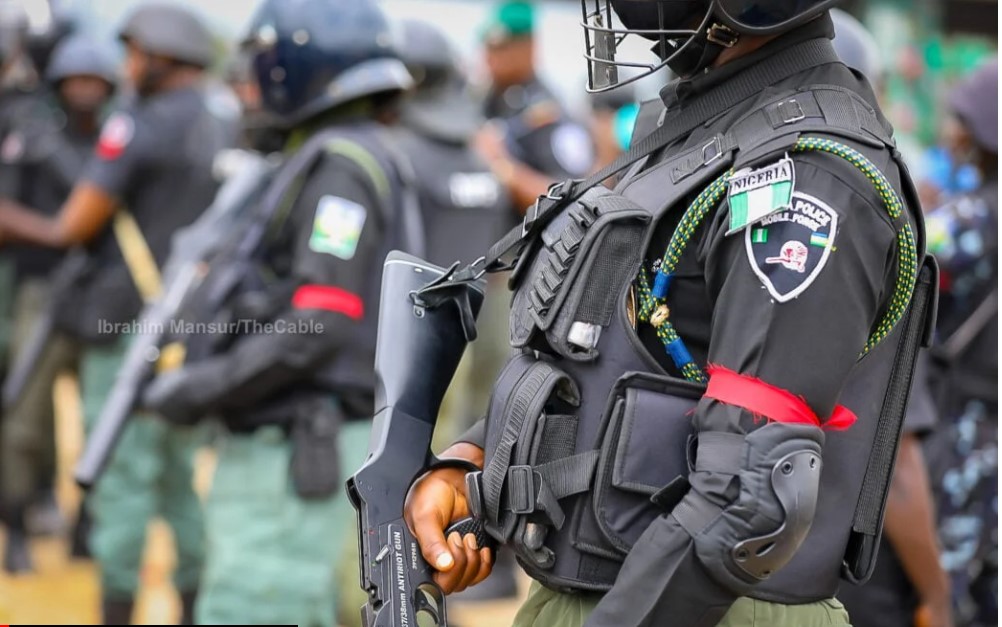
The United Kingdom on Wednesday threw its weight behind Nigeria’s ongoing efforts to establish state police, describing the National Assembly’s security reform initiative as a major step towards building a more accountable, responsive and community-focused policing system,

Similarly, the Speaker of the House of Representatives, Tajudeen Abbas and the Senate Leader, Opeyemi Bamidele, assured Nigerians that the proposed constitutional amendment contains strong safeguards to prevent abuse by governors and other powerful interests.

The endorsement came at the National Security Roundtable held as part of the 2026 National Assembly Open Week in Abuja, where lawmakers, security chiefs, governors, ministers and development partners converged to deliberate on legislative reforms aimed at addressing Nigeria’s worsening security challenges.

The roundtable, supported by the United Kingdom Government-funded Strengthening Peace and Resilience in Nigeria Programme, focused on state policing, security sector reforms, inter-agency collaboration, institutional accountability and the legislative framework required to strengthen Nigeria’s security architecture.

The discussions come at a critical period for the country as the National Assembly considers what many observers have described as one of the most far-reaching constitutional amendments since the return to democratic rule in 1999.

The proposal to establish a state police has dominated national discourse for more than two decades, with supporters arguing that decentralising policing would improve intelligence gathering and response to local security threats, while opponents have consistently warned that governors could deploy state-controlled police against political opponents.

The debate has gained renewed momentum under President Bola Tinubu following the transmission of an executive bill seeking to amend the Constitution to allow states to establish their own police services.

The proposal is widely seen as part of broader efforts to tackle persistent insecurity across the country, including banditry, kidnapping, terrorism, violent farmer-herder clashes and attacks on rural communities.

In a statement issued ahead of the roundtable, the British High Commission said the engagement was expected to shape legislative reforms, particularly the ongoing constitutional amendment process on the establishment of a state police.

The Head of Development Cooperation at the British High Commission, Cynthia Rowe, stressed that meaningful security reforms must be anchored in institutions that are accountable to citizens and capable of responding effectively to emerging threats.

He said, “Sustainable security requires strong, accountable institutions that are responsive to the needs of the people.

“The UK Government remains committed to supporting Nigeria’s legislative frameworks to ensure that security interventions are transparent, well-resourced, and firmly rooted in respect for human rights.

“This roundtable is a commendable step towards codifying reforms that will protect vulnerable communities and foster long-term stability.”

The British High Commission noted that the meeting brought together key actors in Nigeria’s security sector, including the National Security Adviser, the Chief of Defence Staff, the Inspector-General of Police and the Ministers of Defence, Interior and Police Affairs, alongside relevant committees of the National Assembly responsible for security oversight.

Governors from Kaduna, Katsina, Plateau and Benue, the four focal states under the SPRiNG Programme, as well as those of Kwara, Zamfara, Niger and Borno, also participated in the engagement to provide perspectives on the evolving security situation in their states.

According to the organisers, the objective was to assess the country’s current security landscape and identify legislative and budgetary measures capable of strengthening security institutions while supporting the proposed state police framework.

Speaking on the significance of the initiative, the Team Leader of the SPRiNG Programme, Ukoha Ukiwo, said experience from the programme’s peacebuilding interventions had demonstrated that lasting security reforms require a solid legal foundation.

“Our work across our state compacts has continually highlighted that operational peacebuilding must be backed by robust legal frameworks. The focus of this roundtable on state policing, security funding, and accountability is incredibly timely.

“By bridging the gap between grassroots realities and legislative action, we can ensure that informal and formal security architectures work cohesively to build formidable resilience in communities across Nigeria,” he stated.

The organisers added that discussions at the roundtable also centred on responses to banditry, kidnapping and farmer-herder conflicts, while exploring how technology, intelligence sharing, community engagement and improved inter-agency collaboration could enhance Nigeria’s response to emerging security threats.

See also  Nigerians top list of asylum seekers in Ireland

The meeting is expected to produce a communiqué outlining priority reforms and recommendations to guide the implementation of state policing and other legislative initiatives aimed at strengthening public safety.

Also speaking at the event, the Speaker of the House of Representatives, Abbas, assured Nigerians that the proposed constitutional amendment would contain sufficient safeguards to prevent state police from becoming instruments of political intimidation.

Abbas described the proposal as one of the most consequential constitutional reforms currently before the National Assembly, noting that it marked the first time a sitting President had formally transmitted an executive bill seeking to establish state police.

He commended President Tinubu for taking what he described as a historic step after decades of national debate on the issue.

“For the first time in our history, a sitting president has made state police a central part of national reform. He has done so not with words alone, but with a bill that now sits before the House of Representatives.”

Continuing, Abbas acknowledged widespread concerns that governors could exploit state police for partisan purposes but insisted that the proposed legislation deliberately incorporates constitutional safeguards to prevent such abuse.

“I understand the concern that many people bring to this discussion, and it is a reasonable one. It is the fear that state police could become the private army of a governor or a political godfather,” he said.

According to the Speaker, Nigeria’s growing population and increasingly complex security environment had exposed the limitations of a centrally controlled policing system.

He argued that a country of more than 200 million people could no longer rely solely on a single national police force to tackle increasingly localised security threats, citing banditry, kidnapping, violent farmer-herder clashes and attacks on schools as examples of crimes requiring local knowledge and faster response.

“A country as large and as varied as ours cannot be policed forever by one central Force run from the capital.

“More than 200 million people live across our forests, our farmlands, and our borders, and a single force cannot know every community or watch every road,” he added.

Abbas explained that under the proposed constitutional amendment, the Nigeria Police Force would be renamed the Federal Police Service, while states willing to establish their own police organisations would be empowered to do so through laws passed by their respective Houses of Assembly.

He stressed that no state police service would become operational until it satisfied national minimum standards to be prescribed by the National Assembly.

The Federal Police, he said, would continue to retain exclusive responsibility for terrorism, border security, federal offences and policing the Federal Capital Territory.

The Speaker further explained that Commissioners of Police would be appointed based on the recommendation of the National Police Council and confirmed by state legislatures.

He added that such commissioners could only be removed by a two-thirds majority of the relevant House of Assembly for just cause.

Abbas also disclosed that the proposed amendment empowers the federal police to intervene where a state police service collapses or is unlawfully deployed, but only under clearly defined constitutional conditions, with legislative notification and judicial oversight.

“If a state police breaks down, or falls into the wrong hands, or turns against the very people it should protect, the Constitution allows the federal police to step in,” he added.

The Speaker advocated a phased implementation of state policing, warning against allowing all 36 states to establish police services simultaneously without adequate institutional preparation.

“We should move step by step, state by state, learning as Germany and Canada learned, rather than switching on 36 new forces on the same day,” he counselled.

He also emphasised the importance of sustainable funding, warning that states should not establish police services they lack the financial capacity to maintain.

“We must settle the question of money from the very beginning, so that no state creates a police force it cannot pay, and no unpaid officer becomes a threat to the citizen he has sworn to protect,” he added.

See also  Ayra Starr visa denial: S’Africa demands proof as Tyla cancels Lagos show

Drawing lessons from federal systems such as Germany, Canada, India and the United States, Abbas argued that decentralised policing can only succeed where there are uniform national standards, effective intelligence sharing and robust accountability mechanisms.

He further advocated legislation to establish a national criminal and biometric database, strengthen intelligence sharing among security agencies, improve border security and enhance the welfare, training and equipment of security personnel.

Reaffirming the House of Representatives’ commitment to the reform process, Abbas said lawmakers would ensure that the legislation strikes the right balance between strengthening internal security and safeguarding democratic institutions.

“Let us build a police service that protects the citizen in the smallest village as faithfully as it protects the powerful in our cities.

“That is the country we owe our people, and it is the country the House of Representatives is determined to help build,” he said.

Also on Wednesday, the Leader of the Senate and Vice Chairman of the Senate Committee on the Review of the 1999 Constitution, Bamidele, provided further insight into the constitutional safeguards being considered by the National Assembly to shield state police services from undue political influence.

In a statement issued by his Directorate of Media and Public Affairs, Bamidele acknowledged that many of the concerns raised by Nigerians over state policing were legitimate and rooted in the country’s constitutional history.

“Nearly all public concerns on the state police proposal are well founded and obviously cannot be swept under the carpet considering their weight and enormity.”

According to him, much of the apprehension stems from Nigeria’s experience during the First Republic, when the 1960 and 1963 Constitutions empowered regional governments to establish police forces that were sometimes accused of serving partisan interests.

He said the National Assembly was, therefore, developing a comprehensive framework of constitutional safeguards that would strengthen institutional independence, enforce professional discipline and guarantee financial autonomy for state police services.

Bamidele disclosed that one of the key proposals under consideration is to make funding for state police services a first-line charge, similar to the constitutional funding arrangement currently enjoyed by the judiciary.

“That is why we called it a first line charge. In other words, the Commissioner of Police and State Police Service Commission must have a guaranteed source of funds provided for in the 1999 Constitution in a way that the police chief will not be subject to the whims and caprices of a state governor,” he said.

He argued that guaranteeing financial independence would prevent governors from starving state police services of funds whenever disagreements arise between elected officials and security agencies.

“Part of the critical issue we must resolve, even in amending the 1999 Constitution, is to guarantee the financial independence of state police services.

“In other words, it should not be at the discretion of a governor of a state entirely whether he wants to fund state police service or not.

“If a state police service is not responding well to the directives of a governor, he may choose not to fund it. We must prevent such a situation.

“We are, therefore, under the obligation to make provision for a certain percentage of a state budget specifically for the operations of state police services. Access to funds must be clearly spelt out,” he noted.

Bamidele said the proposed financial safeguards were intended not only to prevent political interference but also to shield state police services from manipulation by wealthy individuals, criminal syndicates and other vested interests.

While acknowledging that many critics of state policing had focused largely on the possibility of governors abusing the system, the Senate Leader argued that inadequate funding could expose the new security outfits to even wider forms of influence.

He said, “Business class can also abuse it. Some other organisations, even criminals or cabals, can abuse the state police service because it is a question of ‘he who pays the piper dictates the tune.

“If a state police service is not well funded by any means, we have a situation where it may as well be a highway to nowhere. That is one thing all of us must prevent.”

See also  FG Updates Terrorism Sponsors’ List

He assured Nigerians that the National Assembly remained committed to creating a state police service that would be accountable to the people, adding that concerns raised by stakeholders would be reflected in the ongoing constitutional amendment process.

Bamidele stressed that addressing the issue of funding was critical to the success of the proposed reform, warning that poorly funded police services would struggle to discharge their constitutional responsibilities effectively.

He explained that the objective of the constitutional amendment was to move policing from the Exclusive Legislative List, where it is currently vested solely in the Federal Government, to the Concurrent Legislative List, thereby empowering states to establish their own police services through legislation.

According to him, the amendment seeks to create a framework that balances operational independence with constitutional oversight while ensuring that state police services remain professionally managed and financially sustainable.

The Senate Leader maintained that the ongoing constitutional review presents an opportunity to address longstanding structural weaknesses in Nigeria’s internal security architecture, particularly as insecurity continues to evolve across different parts of the country.

The renewed push for state police follows years of growing concern over the capacity of the Nigeria Police Force to effectively respond to increasingly localised security threats in a federation of more than 200 million people.

In recent years, Nigeria has witnessed persistent attacks by bandits in the North-West, terrorist activities in parts of the North-East, widespread kidnappings for ransom, violent farmer-herder clashes across the North-Central and increasing communal conflicts in several states.

Security experts, governors, traditional rulers and civil society organisations have repeatedly argued that decentralising policing would improve intelligence gathering, strengthen community engagement and enable faster responses to emergencies because officers recruited from local communities are often more familiar with the terrain, language and social dynamics of their areas of operation.

However, the proposal has remained one of the country’s most contentious constitutional issues since the return to democratic rule in 1999.

Opponents have consistently warned that granting states control over police formations could expose security institutions to political interference, particularly during elections, recalling allegations of abuse associated with regional police structures during the First Republic.

Those concerns have featured prominently in previous constitutional amendment exercises, preventing successive administrations from securing the political consensus required to establish a state police despite repeated calls for decentralisation.

Tinubu’s decision to transmit an executive bill seeking the creation of state police has, however, placed the issue at the centre of the current constitutional review process, marking the first formal attempt by a sitting President to initiate such an amendment through an executive proposal.

Wednesday’s National Security Roundtable formed part of activities marking the 2026 National Assembly Open Week, an annual engagement designed to deepen public participation in legislative activities and promote dialogue on major national policy issues.

Beyond state policing, participants examined broader security sector reforms, including institutional accountability, security funding, intelligence sharing, technology-driven policing and improved collaboration among security agencies.

Discussions also focused on legislative and budgetary measures considered necessary to strengthen Nigeria’s security institutions and improve responses to banditry, kidnapping, farmer-herder conflicts and other emerging threats.

The organisers said the meeting would culminate in a communiqué outlining priority reforms and recommendations to guide the implementation of state policing and other legislative initiatives aimed at strengthening public safety.

The Strengthening Peace and Resilience in Nigeria Programme, which supported the event, is a United Kingdom-funded initiative that promotes conflict prevention, peacebuilding and institutional resilience in selected states through stronger community security structures, improved governance and collaboration between formal and informal security institutions.

With the House of Representatives and the Senate Constitution Review Committees expected to continue work on the executive bill in the coming months, the debate over state police is set to intensify as lawmakers seek to balance demands for decentralised policing with safeguards designed to protect democratic governance, institutional independence and the rule of law.

punch.ng

FOLLOW US ON:

FACEBOOK

TWITTER

PINTEREST

TIKTOK

YOUTUBE

LINKEDIN

Continue Reading
Click to comment

Leave a Reply

Your email address will not be published. Required fields are marked *

News

Canada’s Ontario opens new permanent residence programme for foreign workers

Published

on

A province in Canada, Ontario has opened the application process for its new Workforce Priority Stream, giving eligible foreign workers a new pathway to permanent residence through the Ontario Immigrant Nominee Program.

The province announced that, effective August 4, 2026, eligible foreign nationals can now register an Expression of Interest through Ontario’s e-Filing Portal, linked to a qualifying job offer from an eligible Ontario employer.

In a post obtained from Canada Visa’s X handle on Wednesday, according to the OINP, the new stream features three pathways: one for higher-skilled workers, one for lower-skilled workers, and another for self-employed physicians who are registered to practise in Ontario and are eligible to bill the province’s public health insurance plan, OHIP.

The province said that eligible foreign nationals must create an EOI linked to a qualifying job offer created by an eligible employer in the OINP Employer Portal to be considered for nomination.

Although the Workforce Priority Stream was launched on June 26, 2026, candidates were unable to enter the selection pool until the online portal opened this week.

Ontario said candidates with active EOIs will be ranked under a points-based scoring system introduced on July 20, 2026, with invitations to apply issued through periodic draws.

“Once submitted, an EOI remains valid for up to 12 months,” the province said, adding that candidates who do not receive an invitation within that period must register a new EOI to remain under consideration.

The province also said invited candidates will have 17 calendar days to submit a complete application, while employers must apply for approval of the employment position within 14 calendar days of the invitation.

See also  Reps, others pay tribute to ex-Speaker at valedictory session

Successful job-offer nominees will receive a provincial support letter that can be used to apply for a federal work permit while their permanent residence application is being processed.

Ontario noted that successful applicants under the higher-skilled worker stream and the self-employed physician stream may also qualify to apply through the Enhanced Provincial Nominee Program linked to Express Entry, potentially benefiting from faster permanent residence processing.

The Workforce Priority Stream is the first immigration pathway introduced under Ontario’s overhaul of the OINP after the province closed all previous streams on May 30, 2026.

Ontario said additional pathways, including a Priority Healthcare Worker Stream, an Entrepreneur Stream and an Exceptional Talent Stream, will be introduced during the second phase of the program’s modernisation.

punch.ng

FOLLOW US ON:
FACEBOOK

TWITTER

PINTEREST

TIKTOK

YOUTUBE

LINKEDIN

Continue Reading

News

FG votes N2.5tn for Abuja-Lokoja, Enugu-PH, 122 roads

Published

on

The Federal Government has earmarked N2.47tn in the 2026 budget for the rehabilitation and reconstruction of 124 roads considered critical to Nigeria’s economic activities.

An analysis of the 2026 budget shows the road projects are spread across both northern and southern Nigeria, targeting key transport corridors that support agriculture, trade and the movement of goods. Analysts say improving these routes could reduce logistics costs, enhance market access and stimulate economic growth.

Among the priority projects is the 105-kilometre road linking Borno and Kano states, for which the government has allocated N13.3 billion for dualisation. The project is expected to improve the transportation of agricultural produce from Borno, Yobe, Jigawa and Bauchi states to Kano, the commercial hub of the North-West.

Next is the Lokoja-Abuja Road, which serves as a major gateway between the North and the South. The road is divided into two sections, both of which will cost the sum of N12.6bn for construction and rehabilitation.

Another important road that the Federal Government is embarking on this year is the Enugu- Port Harcourt Road, targeted at linking the South-East to the South-South, connecting major industrial, commercial and logistics hubs.  The road, divided into sections III and IV, is expected to cost N19.6bn.

The government is also planning to rehabilitate the Gbagi-Apa-Owode Road in Badagry, which is aimed at connecting communities in Badagry to the Owode/Seme border with the Republic of Benin. The 30.6-kilometre road, which is expected to boost cross-border trade and movement and lower logistics costs for businesses, will cost N4.2bn.

The government has also earmarked N1.4bn for the construction of access roads linking the Second Niger Bridge to both Onitsha in Anambra State and Asaba in Delta State.

See also  IG cautions against indiscriminate recording of police operations

The Kano–Katsina Road is one of the most important highways in northern Nigeria, connecting two major commercial centres and serving as a gateway to the Niger Republic. The Federal Government plans to spend N23.6bn for the dualisation of the critical road.

“You know, the road links Kano’s markets with Katsina and neighbouring Niger Republic, supporting domestic and cross-border trade. Farmers of crops like sorghum, millet, groundnuts, onions, rice and tomatoes can easily find a ready market in Kano. Infrastructure can be an enabler for most of the roads in the 2026 budget,” said an emerging markets analyst, Ike Ibeabuchi.

The Federal Government is also funding the Aba-Owerri-Ikot Ekpene  Road, a strategic economic corridor linking Akwa Ibom, Abia and Imo states. It connects major commercial, industrial and agricultural centres in the South-South and South-East, making it one of the region’s most important highways. The government will spend N7.7bn on the road, which will create a ready market for Aba shoe makers.

The government will likewise spend N1.4bn to rehabilitate Ikorodu-Shagamu Road, which serves as an alternative route to the ever-busy Lagos-Ibadan  Expressway to boost trade and industries. The government also plans to spend N1.4bn to repair Iganmu Bridge in Lagos. Economists say the bridge will connect the Lagos port corridor with the rest of the city.

Moreover, there is a plan to construct rural farmers’ feeder roads in Ikirun, Kwara State, at the cost of N1.75bn. The road, analysts say, will connect farming communities with markets and processing centres while reducing post-harvest losses.

Similarly, there is N3.5bn set aside for the upgrade of Ekiti Cargo Airport, N7bn for the construction and rehab of Abeokuta-Ibooro Road, as well as N4.2bn for Ibi Bridge construction in Taraba State to connect Ibi with communities across the Benue River.

About N7bn has been set aside for the construction of Kano-Dayi Road to serve farming communities and link them to Kano. Also, N4.2bn will be used for the rehabilitation of Kunya-Kanya-Barbura-Mutum Road in farming communities of Jigawa State, while  N6.3bn is devoted to the rehab of FCET New Site-Bagwai-Gwarzo Road in Kano.

See also  Trump sends letter of support on Ukraine’s Independence Day as Zelensky declares Kyiv ‘will not lose’ the war

The government is equally setting aside N25.2bn for the construction of the four sections of Ota-Idiroko Road, including N3.5bn for the dualisation of Bende-Ohafia Road with four bridges.

The Federal Government intends to spend N3.5bn for the rehabilitation of Kabba in Kogi State (Iyamoye – Omuo – Ekiti – Ikole – Ifaki-Ado Ekiti (Omuo), with a view to linking these communities. Another N7bn is earmarked for washout sections of Rivers, Delta and Akwa Ibom states, while N17.8bn serves for the dualisation of phases 1 & 2 of the Benin-Akure-Ijesha Road.

Again, the sum of N14bn is budgeted for the Kano Bypass, while 12.6bn is earmarked for the rehab of the Onitsha-Owerri Road to make trading between Onitsha and Imo and Abia states easy.

The Punch found that if the budget is implemented religiously, there will be appreciable growth in Nigeria’s infrastructure stock, estimated at 30 per cent to 35 per cent of the Gross Domestic Product. This level falls far below the international benchmark of 70 per cent recommended by the World Bank for middle-income and growing economies.

The ex-Minister of Finance and Coordinating Minister for the Economy, Olawale Edun, disclosed that Nigeria has a $14bn annual infrastructure investment gap.

The Alvin Report says decades of underinvestment in infrastructure have led to the present predicament, and with Nigeria’s population growing by about three per cent annually, the infrastructure deficit could balloon to about $20bn-$25bn by 2035.

“Nigeria risks slower growth, higher poverty, and reduced competitiveness if it does not close this gap”, the report warned,

See also  Obasanjo bombs Atiku: You’re my biggest mistake

According to the Nigerian Economic Summit  Group, Nigeria’s weak physical and technological infrastructure continues to erode its competitiveness relative to peer economies (see Figure 1). It added that data reveal significant gaps in basic infrastructure, such as unreliable power supply, inadequate transport networks, and limited logistics capacity, which raise business costs and constrain productivity.

“These shortcomings have discouraged investment, undermined efficiency, and left Nigeria lagging behind countries that have modernised their infrastructure to drive competitiveness and economic growth.

A consultant economist, Chukwunonso Iheoma, is worried that the money will not all be released, stressing that such a situation will be another missed opportunity for Africa’s fourth biggest economy.

“It is not just about how much is budgeted; it is how much is released. We have been struggling with the implementation of the budgets since this administration came to power.

“Right now, the 2025 budget is still being implemented. So, tell me, when will this budget be implemented? There is no guarantee that half of the budget will be implemented.”

punch.ng

FOLLOW US ON:

FACEBOOK

TWITTER

PINTEREST

TIKTOK

YOUTUBE

LINKEDIN

Continue Reading

News

Fake PFIPC agency probe: Reps to grill controversial DG at undisclosed location; Read details

Published

on

The House of Representatives Ad-hoc Committee investigating the alleged establishment and operations of the Presidential Foreign Investment Promotion Council has said it will interrogate the council’s purported Director-General, Prince Adeniyi Adeyemi, at an undisclosed location while he remains in police custody, saying the move is necessary to avoid jeopardising ongoing investigations by security and anti-graft agencies.

The committee was constituted to investigate the circumstances surrounding the alleged establishment and operations of the PFIPC following allegations of impersonation, forgery, financial impropriety and the unlawful use of government facilities and official insignia.

It is also examining how the purported council allegedly operated, the identities of those involved, the source of its funding and whether public institutions or officials aided its activities. It is expected to conclude its hearings this week before submitting its report to the House of Representatives for further legislative action.

The committee summoned the Corps Marshal of the Federal Road Safety Corps, Shehu Mohammed, to appear before it on Thursday over official Federal Government number plates allegedly used on vehicles linked to the purported council, amid concerns over how the plates were obtained.

The developments came after the Managing Director of Divine Dopacy Nigeria Limited, Gbenga Collins, told lawmakers that he paid N400m to Adeyemi after allegedly being promised a contract to renovate and furnish what was presented as the official residence of the agency’s Director-General.

Collins said he believed the PFIPC was a genuine Federal Government institution because Adeyemi operated from an office in the Federal Secretariat, Abuja, moved with security personnel and official vehicles bearing government number plates, and received visitors in what appeared to be an authentic government office.

Collins, a graduate of Federal University of Agriculture, Abeokuta, said he first met Adeyemi, whom he described as a fellow indigene of Ogbomoso, during a programme in their hometown in December 2024.

According to him, Adeyemi later invited him to Abuja in early 2025 to discuss a business opportunity.

“When I arrived at the airport, he sent an official car to come and pick me from the airport to his office at the Federal Secretariat, Abuja.

“When I got to his office, I met him there. He is a well-known man in Ogbomoso. I met a lot of people, very big dignitaries in his office, and I met a group of security officers guarding the office,” he said.

Collins said Adeyemi introduced himself as the Director-General of both the Presidential Economic Advisory Council and the Presidential Foreign Investment Promotion Council.

He told lawmakers that it was his first visit to Abuja and that the official setting gave him no reason to question Adeyemi’s claims.

“I saw police officers with him. That was my first time of coming to Abuja because I’m not familiar with Abuja very well. He sent his official car to pick me from the airport. It had a Federal Government registration number attached to the Lexus SUV,” he said.

See also  Ex-CDS Musa meets Tinubu as Irabor dismisses B’Haram recruitment claim

Collins said Adeyemi later informed him that he had been allocated an official residence as Director-General and wanted Divine Dopacy Nigeria Limited to handle its renovation and furnishing.

According to him, Adeyemi personally took him to inspect the property.

“He told me that he wanted to do refurbishment and renovation of the official house assigned to him as the DG of that agency and asked whether I would be able to handle the contract.

“He took me to the house to show me the property because I slept in Abuja. We went there the following day with his staff. We went with more than four, five or six vehicles with security. They opened the house and took us round, showing me what they wanted to do,” Collins added.

He said discussions continued until April 2025 when Adeyemi allegedly handed him a contract award letter, scope of work and an agreement between the purported council and his company.

Collins told the committee that he was informed he needed to pay N400m to demonstrate his company’s financial capacity and facilitate mobilisation for the contract.

“He gave me the contract award letter, the scope of work and the agreement with my company to execute the refurbishment project.

“I had to pay N400m for the facilitation of that project to show my strength that I would be able to handle the project. At the same time, he said it would fast-track the mobilisation for the contract,” he said.

The businessman disclosed that he raised the money from business associates who trusted him because he had personally visited Adeyemi’s office.

According to him, N380m was paid in four instalments between May and June 2025 into a Guaranty Trust Bank account belonging to World Entrepreneurs Limited, while the balance of N20m was paid on July 29, 2025, into an Access Bank account belonging to Sunshine Confectionery and Catering Services.

“When I was paying the money, I kept telling him that I collected the money from my colleagues who were doing business with me.

“I was the one who told them I had gone to this man’s office, so I believed it was going to be a great opportunity for us. That was why people started giving me the money,” Collins said.

He said Adeyemi repeatedly assured him that mobilisation for the project would commence in August 2025, but the promise never materialised.

“When I finished the payment, he said they were going to do the mobilisation by August,” he said.

Collins said subsequent explanations centred on security concerns before fresh assurances were given that payment would be made in November.

See also  Ayra Starr visa denial: S’Africa demands proof as Tyla cancels Lagos show

“I continued calling him. He kept managing me, telling me they were handling security issues and that they would pay in November,” he added.

The witness said he became suspicious after repeated attempts to reach Adeyemi failed and later consulted a lawyer in Abuja.

“My lawyer was the first person who told me that I had been scammed,” he told the committee.

He disclosed that his lawyer petitioned the Economic and Financial Crimes Commission on November 13, 2025, and that he adopted the petition six days later.

“The petition was written on the 13th and I was invited to adopt it on the 19th,” he said.

He added that investigators later informed him that Adeyemi repeatedly failed to honour invitations from the EFCC, allegedly citing ill health through his lawyer.

“Since then, the EFCC has been trying to invite him. I think he has been sending his lawyer. According to the Investigating Police Officer handling the case, his lawyer kept saying he would appear.

“Since then, I have not heard anything further, but they are on top of the matter. The EFCC will be in the best position to handle the rest,” Collins said.

Appealing to lawmakers, the businessman said the incident had ruined his business and forced him to dispose of personal assets.

“I just want to beg the Chairman and the honourable members to help me talk to all the agencies involved because I have been frustrated, especially by those people who gave me the money. I have started selling my property. My business is not going well again,” he lamented.

He maintained that he acted in good faith because everything surrounding Adeyemi suggested he was dealing with a genuine government official.

“I did all this based on trust. When I went to his office, I met a lot of big dignitaries there, people waiting to see him and people he was discussing contracts with. I also did it because he is from my hometown,” Collins said.

During the hearing, committee chairman, Yusuf Gagdi, asked Collins whether the N400m amounted to a bribe paid to secure the contract.

The witness rejected the suggestion, insisting that the payment was presented to him as a prerequisite for facilitating and mobilising the contract.

Lawmakers also asked whether he complied with the provisions of the Public Procurement Act before accepting the purported contract.

Collins admitted that he did not follow any formal procurement process.

“What I just have to say is to beg the committee, or to implore the committee, to please, in all their capacity, whatever they can use to assist me with the police that are investigating him because I was invited to the Cybercrime office. He said the same thing, that he did not deny collecting the N400m,” he told lawmakers.

See also  2027: ADC faction eyes Jonathan, Saraki, Makinde alliance

He also confirmed that the money was never converted to United States dollars before it was transferred.

Adeyemi grilling

Responding to questions over Adeyemi’s absence from the public hearing, Gagdi said the committee was bound by an existing court order under which the suspect remains in police custody.

“For the benefit of the general public, we are not refusing to invite Prince Adeniyi here. We have pronounced him to appear here and police have responded that he is in their custody based on the court order,” Gagdi clarified.

He stressed that the National Assembly would not undermine the authority of the courts.

“As an arm of government, we respect the principle of federalism and separation of powers. We respect the powers of the judiciary, the executive and we equally limit ourselves within our own powers.

“We do not have the power as the National Assembly to vacate an existing court order and say that somebody who is in the custody of the Nigerian Police should leave the police to appear before the National Assembly.”

The committee chairman, however, disclosed that lawmakers would question Adeyemi at an undisclosed date and location to avoid interfering with ongoing investigations by the EFCC, the Independent Corrupt Practices and Other Related Offences Commission and the police.

“We will not announce to the general public when we will interact with Prince Adeniyi. We will not because the ICPC are investigating this matter. EFCC are investigating this matter. Part of this matter is before the court of law and many other agencies.

“To say that we will put the suspect under direct camera and interact with him the way we are interacting with everyone here will definitely undermine the ongoing investigation by the EFCC and ICPC.

“In view of that, we are meeting him on an unannounced date and at an unannounced time. We will meet him with a camera that will exonerate members of the committee on our interaction with him.

“Just as you came here with your lawyer, we will inform the police whenever we are going to meet him and, as directed by the court, it will be in the presence of his lawyers,” he added

Gagdi said the panel’s priority was to obtain necessary clarifications from Adeyemi rather than insist on his appearance at a public hearing.

“Whether he appears before this committee or this committee appears before him, the most important thing is to have an interaction with him to get some things clarified. And we are going to do just that,” he said.

punch.ng

FOLLOW US ON:

FACEBOOK

TWITTER

PINTEREST

TIKTOK

YOUTUBE

LINKEDIN

Continue Reading

Trending