Connect with us

Business

Businesses expect CBN to hold rates as MPC meets today

Published

on

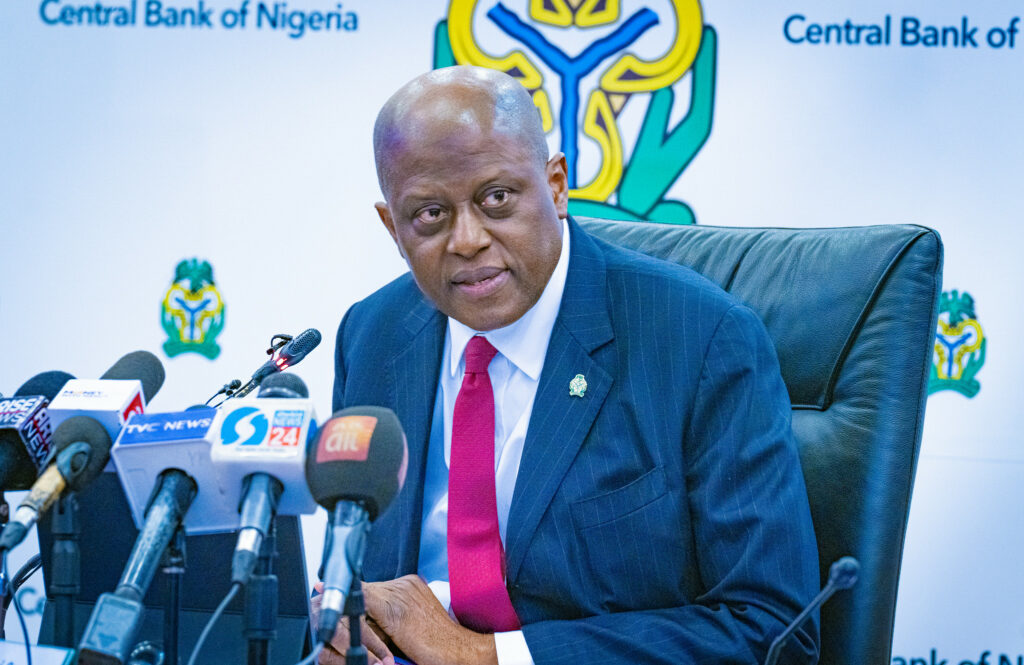
Organised Private Sector leaders and economists have projected that the Central Bank of Nigeria’s (CBN) Monetary Policy Committee will most likely retain the Monetary Policy Rate at 26.5 per cent when it meets on Monday and Tuesday, citing heightened geopolitical tensions and their potential impact on inflation.

The stakeholders noted that Nigerian businesses would welcome a rate cut to ease borrowing costs and support investment, particularly in the manufacturing sector, which has struggled under high interest rates.

Their position comes despite a recent CBN Inflation Expectations Survey showing that 61.1 per cent of Nigerians want interest rates reduced ahead of the MPC meeting.

In telephone interviews with The PUNCH, economists and business leaders, including the Chief Executive Officer of the Centre for the Promotion of Private Enterprise, Dr Muda Yusuf, said prevailing global uncertainties, particularly the renewed conflict involving the United States and Iran, made it too early for the apex bank to begin further monetary easing.

“What I expect is a hold because it is possibly too soon to relax the MPR because of the current geopolitical issues. We have seen a very dramatic escalation, and this has implications for major macroeconomic indicators, particularly the general price level. Energy prices feed strongly into inflationary pressures, and crude oil prices have risen above $84. The inflation outlook is looking very disturbing,” Yusuf said.

He added, “It is unlikely there will be a rate cut. It is also not likely that there will be a further increase because the last inflation figure showed only a marginal deceleration. Although I don’t mind a rate cut because interest rates are too high, given the prevailing global conditions, especially the Middle East conflict, people hoping for a rate cut should exercise more patience.”

See also  Oyedele reveals how tax reform will protect low-income Nigerians

The President of the Lagos Chamber of Commerce and Industry, Leye Kupoluyi, said businesses would benefit significantly from lower borrowing costs, noting that high interest rates remained a major component of the cost of doing business.

“Everyone wants a reduced interest rate. Interest rate is a major part of the cost of doing business because everybody needs funds for their business. If the interest rate is high, the cost of business will be very high. The lower the interest rate, the better. It will allow businesses to plan and borrow money instead of relying on short-term loans that ultimately increase costs for consumers,” Kupoluyi said.

He, however, urged caution ahead of the MPC decision, saying, “Let’s see what they come up with. We have to look at it both ways. But definitely, for interest rates to come down, it is for the benefit of industry, businesses, and ultimately the customer.”

A Professor of Economics and Public Policy at the University of Uyo, Prof Akpan Ekpo, also predicted that the committee would likely maintain the current rate because of the uncertainty created by the US-Iran conflict.

“Many people would like a reduced interest rate because the MPR is the anchor rate for bank lending. But my worries are the US-Iran war. We don’t know when it is going to end. For that reason, I suspect they might keep the rate the same for a while,” Ekpo said.

He warned that the conflict could worsen inflationary pressures. “If I were with the MPC, I would hold the rate the way it is for now and wait for the next meeting. With the Iran-US war, inflation may go up. When inflation goes up, the MPC would be inclined to increase rates to contain inflation. The government should instead focus on the manufacturing sector so that we can create jobs,” he added.

See also  Nigeria’s oil output hits 74-month high, beats OPEC quota

The Chief Executive Officer of Economic Associates, Dr Ayo Teriba, said while businesses and households desired lower interest rates, the MPC would likely base its decision on data unavailable to the public.

“Every reasonable person wants to see lower interest rates. We have seen stable exchange rates, and inflation has hovered around 15 per cent for six months. But the committee will determine whether this is the right time to ease policy. I don’t have access to the information they have, so I will wait for them to explain whatever decision they take,” Teriba said.

He noted that the conflict in the Middle East had not significantly altered Nigeria’s inflation trend so far but cautioned against pre-empting the committee’s decision. “I’d like to see the monetary policy rate and the CRR come down, but I accept my limitation that I don’t have access to the information available to the MPC. I will wait to be informed by them,” Teriba said.

Businesses have repeatedly argued that high borrowing costs have constrained investment, especially in the manufacturing sector, where operators say access to affordable long-term credit remains critical for expansion, job creation and increased production.

punch.ng

FOLLOW US ON:

FACEBOOK

TWITTER

PINTEREST

TIKTOK

YOUTUBE

LINKEDIN

Continue Reading
Click to comment

Leave a Reply

Your email address will not be published. Required fields are marked *

Business

NLC demands N500k minimum wage, says current N70k minimum wage is no longer sustainable

Published

on

The Nigeria Labour Congress (NLC) says it will soon begin negotiations with the Federal Government for a new national minimum wage, insisting that the current N70,000 wage is no longer sustainable.

Speaking at the Rights of Workers Summit in Birnin Kebbi on Thursday, NLC President Joe Ajaero, represented by Deputy President Audu Titus Amba, said workers should prepare for fresh negotiations.

He argued that the current minimum wage could no longer meet workers’ basic needs amid rising inflation and the increasing cost of living.

“Anything less than N500,000 cannot cater for workers. The current minimum wage is due for review, and we will soon begin negotiations with the government,” he said.

Also speaking, Trade Union Congress (TUC) President Festus Osifo, represented by Secretary-General Nuhu Toro, said worsening economic conditions had eroded workers’ purchasing power.

He cited rising food prices, transport fares, rent and inflation as factors making the current wage inadequate.

President Tinubu signed the current national minimum wage bill into law on July 29, 2024, raising it from N30,000 to N70,000 per month. The legislation followed negotiations with organized labor and included a provision to review the wage structure every three years.

FOLLOW US ON:

FACEBOOK

TWITTER

PINTEREST

TIKTOK

YOUTUBE

LINKEDIN

INSTAGRAM

See also  Nigeria’s oil output hits 74-month high, beats OPEC quota
Continue Reading

Business

Ondo artisans beg FG for inclusion in empowerment programmes

Published

on

Artisans and skilled workers in Ondo State have appealed to the Federal Government to include them in various empowerment programmes under President Bola Tinubu’s Renewed Hope Agenda.

The artisans, under the aegis of the Artisan Defender and Empowerment Foundation, said over 25,000 members of the group had been neglected despite their support for the re-election of the President.

This was contained in a statement issued on Friday by the Chairman and General Secretary of the association, Engr. Ogundipe James and Adebayo Olugbenga, respectively.

According to the statement, the group was founded and registered with the Federal Government to promote the interests of Niger Delta artisans and skilled workers, adding that its members needed government support through empowerment initiatives.

The statement read, “It was evident, the neglect of the welfare and empowerment of over 25,000 artisans that this organisation controls, for which we are advocating better welfare, skills and vocational training, empowerment, workshops and recognition of political strength and weight the coalition commands in the voting structure.

“The deteriorating situation of artisan welfare, particularly in Ondo State, is why the body is seeking immediate attention, mostly empowerment and skills upgrading from the primary concerned government agencies—the Federal Ministry of Trade and Investment, Directorate of the Office of Humanitarian Affairs and Poverty Reduction, Small and Medium Enterprises Development Agency of Nigeria, Presidential Amnesty Programme, among others.

“The neglect of this very important organisation, which plays a vital role in employment and the growth of the national economy, will cause disagreement and affect political support that comes from this coalition group.”

See also  Trump urges Turkey to stop buying Russian oil as Erdogan chases deal on F-35s

The statement urged the concerned Federal Government agencies to consider the proposals earlier submitted by the group to enhance the support of its members for the President’s administration.

The group stated, “We call on the agencies mentioned above, demanding immediate attention to the proposals that have earlier been sent to this parastatal.

“This is a public warning and general awareness that failure to listen to Niger Delta Artisan Forum’s demands will lead to a national protest and have huge political support consequences for the continuation of the Renewed Hope Agenda of President Bola Ahmed Tinubu come the 2027 election, if attention is not immediately given to the demands.”

punch.ng

FOLLOW US ON:

FACEBOOK

TWITTER

PINTEREST

TIKTOK

YOUTUBE

LINKEDIN

Continue Reading

Business

RMAFC gives NUPRC 48 hours to dissolve host community trust

Published

on

The Revenue Mobilisation Allocation and Fiscal Commission has directed the Nigerian Upstream Petroleum Regulatory Commission to dissolve a disputed Host Community Development Trust within 48 hours over concerns about its constitution and representation of affected oil-producing communities.

The directive was contained in a statement issued by the commission on Friday and signed by the Head of Information and Public Relations Unit, Maryam Umar-Yusuf, following an investigative hearing into the operations of Sterling Oil Exploration and Energy Production Company and the implementation of the Host Community Development Trust provisions of the Petroleum Industry Act.

According to the statement, the ultimatum was issued during the hearing of the commission’s Investment Monitoring Committee after concerns were raised over the establishment of the trust for affected host communities.

The Chairman of the RMAFC, Mohammed Shehu, reaffirmed the commission’s commitment to protecting the interests of oil-producing host communities, saying it would continue to strengthen the oversight of operators and institutions responsible for ensuring that communities receive benefits due to them under the law.

Shehu, who spoke at the investigative hearing held at the commission’s headquarters on Thursday, described the exercise as “an important national service and a critical national responsibility.”

He commended the committee for its diligence and urged members to remain resolute, stressing that the commission’s constitutional mandate required “firm oversight, transparency and accountability in the management of national revenue assets.”

According to the statement, he expressed confidence that the investigation would strengthen trust in the petroleum sector and ensure that host communities received the full benefits guaranteed under the Petroleum Industry Act.

Leading the hearing, the Chairman of the Investment Monitoring Committee and Federal Commissioner representing Anambra State, Ekene Enefe, conducted an extensive investigation into SEEPCO’s compliance with the statutory provisions governing Host Community Development Trusts.

See also  Amazon to cut 16,000 jobs worldwide

He maintained that host communities should no longer bear the environmental and social consequences of oil exploration without corresponding development, adding that the commission would ensure operators and regulatory institutions discharged their statutory obligations.

The committee also criticised SEEPCO for repeatedly failing to honour invitations to appear before it despite previous engagements.

Addressing officials of the NUPRC during the hearing, Enefe said the commission would hold every institution in the petroleum value chain accountable for the effective discharge of its responsibilities.

He consequently ordered the regulator to address concerns surrounding the trust established for the affected communities, declaring, “We are going to give you 48 hours to dissolve that host community development trust.”

The committee chairman also faulted SEEPCO over what he described as its failure to meet obligations owed to host communities.

“We are going to write them and we are going to give them an ultimatum to pay up what is owed the host communities,” Enefe said.

He added that the committee would conclude its investigation and submit its findings to the appropriate authorities, insisting that the commission would carry out its constitutional oversight responsibilities “without fear or favour.”

Earlier, the NUPRC delegation, led by the Director of Host Communities, Ufondu Ejiro, defended the implementation of the Host Community Development Trust established under the Petroleum Industry Act.

According to the statement, Ejiro told the committee that the trust had been duly incorporated, funded and structured in accordance with the law.

She said the commission had processed documents relating to community consultations, governance structures, funding arrangements and Community Development Plans, while also presenting records of statutory contributions made into the trust.

See also  Reps query foreign airlines’ N18.98bn debt, give FAAN two-week recovery deadline

The NUPRC maintained that it discharged its responsibilities within the framework of the Petroleum Industry Act and the Host Community Development Regulations.

However, counsel representing the affected host communities, Peter Chukwudi, rejected the regulator’s submissions, insisting that several persons recognised as community representatives were not accepted by the communities.

He also argued that adequate consultations were not conducted before the Host Community Development Trust was constituted and questioned the level of development recorded in the affected communities despite years of oil production.

Chukwudi urged the committee to ensure that the grievances raised by the communities were thoroughly investigated.

Also speaking, the Anambra State Commissioner for Petroleum and Mineral Resources, Professor Charles Ofoegbu, called for stronger collaboration between the NUPRC and the state government in verifying community representation and monitoring compliance with statutory obligations.

He advocated greater transparency in calculating statutory contributions, operational expenditure and the execution of community development projects, stressing that the state government had a responsibility to protect the interests of its oil-producing communities.

Other members of the commission also raised concerns during the hearing.

The Federal Commissioner representing Rivers State, Desmond Akawor, said there appeared to be a disconnect between the regulator and affected state governments, adding that closer collaboration and direct engagement with operators were necessary for effective oversight.

He also criticised SEEPCO for failing to attend the hearing and urged all parties to cooperate with the investigation.

The Federal Commissioner representing Kogi State, Abdulazeez Idris-King, questioned the effectiveness of the NUPRC’s verification process, saying reliance solely on documents submitted by operators might not sufficiently establish that genuine consultations had taken place with host communities.

See also  Nigeria’s oil output hits 74-month high, beats OPEC quota

Similarly, the Federal Commissioner representing Jigawa State, Hauwa Umar-Aliyu, stressed the need for regulators to uphold professionalism and impartiality, saying public confidence would only be strengthened if the interests of host communities received equal attention alongside those of operators.

According to the statement, the hearing forms part of the commission’s ongoing oversight initiative aimed at promoting transparency, strengthening accountability and ensuring that host communities derive the benefits guaranteed under the Petroleum Industry Act.

The PUNCH reports that The HCDT was created under the Petroleum Industry Act 2021 as a new framework for ensuring that communities where oil and gas operations take place receive direct and sustainable benefits from petroleum activities.

The PIA requires petroleum operators, known as settlors, to establish trusts for their host communities and contribute 3 per cent of their actual annual operating expenditure in the preceding year to the funds. The trusts are intended to finance community development projects and promote peaceful relations between operators and host communities.

The NUPRC is responsible for regulating the trusts, including their incorporation, funding, governance and implementation of development projects. The provision was introduced against the background of decades of grievances in oil-producing communities over environmental impacts, inadequate development and disputes with petroleum companies

punch.ng

FOLLOW US ON:

FACEBOOK

TWITTER

PINTEREST

TIKTOK

YOUTUBE

LINKEDIN

Continue Reading

Trending