

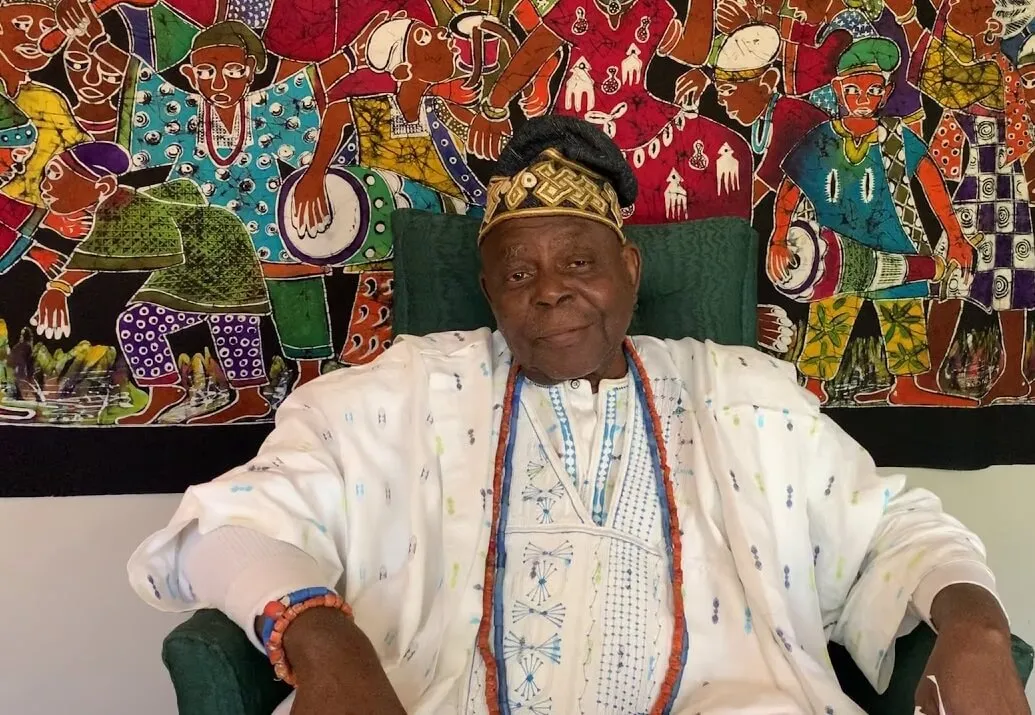








The Araba of Osogbo, Ifáyemí Elébuibón, has defended the tradition of selecting a young maiden as the Arugba of the Osun-Osogbo Festival, describing the role as a privilege rather than child abuse.
This is as a priestess and custodian of Osun Osogbo also defended the practice, saying the Arugba was selected through Ifa divination from the royal lineage.
Osun-Osogbo: Priestess
Elébuibón spoke in a video interview posted on Sunday by Yoruba cultural content creator, Wàá Ṣeré, amid discussions surrounding the age and responsibilities of the 10-year-old Arugba, Princess Alimot Osunbunmi.
Arugba is the young maiden chosen to carry the sacred calabash during the annual Osun-Osogbo Festival procession to the Osun Sacred Grove.
Alimot, a member of the royal family of the Ataoja of Osogbo, was selected through traditional Ifa divination in March 2025.
She carried the sacred calabash for the first time during this year’s procession to the Osun Sacred Grove on Friday, after she was unable to do so during the 2025 festival because of her young age.
10-year-old Arugba of the Osun-Osogbo Festival, Princess Alimot Osunbunmi carries the sacred calabash at Osun Osogbo festival…Photo Credit: Dewunmi Lagos
Explaining the role and its benefit, Elébuibón said the Arugba served as a spiritual intermediary between the Osun deity and the people.
He added that the responsibility was not determined by biological age.
“You see those people saying all that? They lack understanding. They don’t know. Whoever says the Arugba is too young—this one is ten years old, but some started at five!
“The role the Arugba plays is a role of spiritual maturity, not about physical age. What the Arugba does for the town and the community is what the white man calls a ‘medium’—an intermediary between the Orisa and the people,” he said.
Elébuibón said the young maiden could communicate the wishes of the deity to the people because of the spiritual significance attached to the position.
“As young as she is, provided she remains pure and undefiled by any man, she can wake up one morning and say, ‘Mother Osun said this and that, do this, do that, don’t do this.’”
He added that the Arugba’s spiritual development was not necessarily tied to her physical age.
“Very soon, she will mature spiritually far beyond her biological age because the Orisa themselves nourish and care for them. Her role is not about age; what she does is not about age.”
FILE: Ifayemi Elebuibon
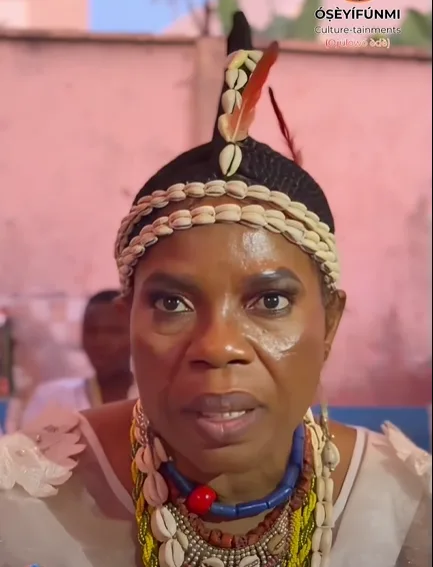
A female priestess and culture custodian, in another video posted by culture content creator Olamide Oseyifunmii, also defended the practice, saying the Arugba was selected through Ifa divination from the royal lineage.
According to her, the chosen maiden must be a virgin and is expected to observe certain taboos associated with the role.
“Whomever Ifa chooses becomes the Arugba. The Arugba must be a girl who remains untouched, pure, and a virgin. That is strictly what the Arugba must be,” she said.
She rejected the description of the practice as child abuse, saying the young girls selected for the role were traditionally protected and treated with care.
“Being selected as the Arugba carries taboos and honours; it is not what Westerners label as ‘child abuse’.”
The priestess said the Arugba was not expected to carry heavy loads apart from the sacred calabash during the annual procession.
She also explained the spiritual significance attached to the young maiden, saying devotees who bow before the Arugba were not worshipping the child but honouring the Osun deity believed to be represented through her.
“They were bowing to the divine spirit of Osun Ewuji inside her and upon her head,” she said.
The 2026 Osun-Osogbo Festival, which began on August 7, is being held at the Osun Sacred Grove in Osogbo, Osun State, and will run until August 19.
The annual festival, centred on the Osun deity, is one of Nigeria’s major traditional and cultural festivals and attracts worshippers, tourists and cultural enthusiasts from Nigeria and beyond.
Two persons have been confirmed d3ad following the collapse of a refuse dump at Ikot Effanga, along Old Odukpani Road in Calabar, Cross River State.
The spokesperson for the Cross River State Police Command, ASP Sunday Eitokpah, who disclosed this in a statement said the incident occurred in the early hours of Friday, August 28, 2026, when the collapsed refuse impacted a building reportedly constructed within a valley.
“The Cross River State Police Command is aware of a reported incident involving the collapse of a refuse dump at Ikot Effanga, along the Old Odukpani Road, Calabar, in the early hours of Friday, 28th August 2026, the statement read.
“Police personnel responded promptly to the scene, where it was discovered that the collapsed refuse had impacted a building reportedly constructed within a valley, resulting in the death of two occupants.”
The statement identified the victims as Nfon Imé, male, and an unidentified female, who were said to have been in the building at the time of the incident.
The bodies were recovered and deposited at the mortuary.
“The deceased, identified as Nfon Imé ‘m’, and a yet-to-be-identified female, believed to have been in the building at the time of the incident, have been recovered and deposited at the mortuary,” the statement said.
The police spokesperson said an assessment of the circumstances surrounding the incident was ongoing, while further investigation had commenced.
“The Command is currently conducting an assessment of the circumstances surrounding the incident, while further investigation is ongoing,” ASP Eitokpah said.
The command urged members of the public to remain calm and avoid speculation as efforts continued to establish the full facts surrounding the incident.
Togo, Benin and Niger owed Nigeria $11.16 million for electricity supplied by Nigerian power generation companies under bilateral arrangements in 2025, according to the Nigerian Electricity Regulatory Commission (NERC).
NERC disclosed this in its 2025 annual report, saying the Market Operator (MO) issued invoices totalling $73.91 million to the three international electricity customers during the year. However, only $62.75 million was paid, leaving an outstanding balance of $11.16 million and representing an 84.90 percent remittance performance.
The international customers identified by NERC are Société Nigérienne d’Électricité (NIGELEC) of Niger, Société Béninoise d’Énergie Électrique (SBEE) of Benin and Compagnie Énergie Électrique du Togo (CEET). “The international bilateral customers … received a total invoice of $73.91 million for ancillary services provided by the MO and made a total payment of $62.75 million, corresponding to a remittance performance of 84.90%,” NERC said.
The commission also reported that domestic bilateral customers paid N12.75 trillion out of N13.20 trillion invoiced by the Market Operator for services provided in 2025. According to NERC, the payments represented a 96.60 percent remittance performance. However, Ajaokuta Steel Company Limited and its host community, classified as a special customer, made no payments against invoices issued during the period.
NERC said the company had an outstanding N4.96 billion invoice from Nigerian Bulk Electricity Trading Plc (NBET) and another N500 million invoice from the Market Operator. “The Commission has escalated the issue of continual non-payment of electricity bills by Ajaokuta to the relevant federal ministries to find a lasting solution,” the report said.
NERC warned that continued failure to settle the obligations could put the Ajaokuta complex at risk of disconnection from its electricity service providers. “Failure to settle the obligations may put the Ajaokuta complex at risk of being disconnected from its service providers (NBET and MO) on the grounds of gross indebtedness,” it added.
NERC also said electricity distribution companies (DisCos) collectively took off 31,251.77 gigawatt-hours (GWh) of electricity in 2025, while 25,867.86GWh was billed to customers. This resulted in a market energy accounting efficiency (EAE) of 82.77 percent.
The commission explained that EAE measures how effectively DisCos account for electricity received at their trading points. It is calculated by comparing the energy billed to customers, including metered and unmetered consumers, with the total electricity supplied to an area over a given period.
Ibadan DisCo recorded the highest energy accounting efficiency at 88.84 percent, while Enugu DisCo recorded the lowest at 72.18 percent. “The disaggregated performance of the DisCos shows that Ibadan DisCo recorded the highest energy accounting efficiency of 88.84%, while Enugu DisCo recorded the lowest efficiency of 72.18%,” NERC said.
The commission said DisCos were responsible for developing strategies to improve their energy accounting performance. “DisCos have the responsibility of developing strategies to improve their energy accounting efficiencies,” NERC said.
It identified improved distribution infrastructure, reduced technical losses, better customer enumeration and customer service, increased metering and the deployment of technology to combat electricity theft as measures that could help improve the sector’s performance.