Connect with us

Business

Embraer grows profit 38% to $218.6m in Q2

Published

on

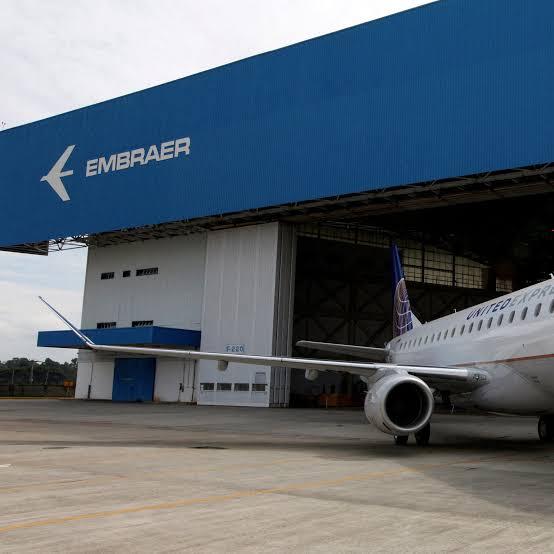
Brazilian aircraft manufacturer, Embraer, recorded a 38.4 per cent increase in adjusted net income in the second quarter of 2026, driven by higher revenue and improved operating performance.

The company disclosed this in its financial results released on Monday, 10 August 2026, as it raised its full-year guidance following a strong performance in the April-June period.

Embraer’s adjusted net income rose to $218.6m in Q2 2026 from $158m recorded in the corresponding period of 2025.

Revenue also increased 23 per cent year-on-year to $2.2bn, representing the company’s highest-ever revenue for the second quarter.

The aircraft manufacturer said adjusted free cash flow, excluding Eve, stood at $401m during the quarter.

It attributed the performance to “stronger operating performance, strong sales-related pre-downpayment inflows, and an extraordinary tax credit”.

The company said the tax credit, exemption from tariffs and improved business outlook prompted it to increase its financial guidance for 2026.

“Embraer now expects to close 2026 with an adjusted EBIT margin between 10 per cent and 10.6 per cent (up from between 8.7 per cent and 9.3 per cent) and adjusted free cash flow excluding Eve of US$400m or higher (up from US$200m or higher),” the company said in a statement.

Embraer also reported that its firm order backlog had risen to a record $34.5bn, representing a 16 per cent increase compared with the second quarter of 2025.

The company delivered 65 aircraft during the quarter, describing the performance as its “strongest second-quarter performance over the past 16 years.”

The deliveries represented a 17 per cent increase compared with the same period last year.

See also  Firm urges Nigerians to buy recycled products for waste control

Of the 65 aircraft delivered, 20 were commercial aircraft while 45 were executive jets. The company’s Defence and Security division recorded no aircraft deliveries during the period.

Embraer reaffirmed its 2026 delivery targets of between 80 and 85 commercial aircraft and between 160 and 170 executive jets.

The executive aviation business generated $725m in revenue during the quarter, representing a 32 per cent increase from Q2 2025.

The company said the growth was “benefiting from higher volumes and product mix.”

Meanwhile, its Defence & Security business recorded revenue of $304m, up 38 per cent year-on-year.

According to Embraer, the increase was “driven by stronger KC-390 Millennium revenue recognition related to customer mix and product stage.”


Source: punchng.com

FOLLOW US ON:

FACEBOOK

TWITTER

PINTEREST

TIKTOK

YOUTUBE

LINKEDIN

INSTAGRAM

Continue Reading
Click to comment

Leave a Reply

Your email address will not be published. Required fields are marked *

Business

FTSE re-entry triggers foreign demand for Nigerian equities

Published

on

Foreign and institutional investors have returned to Nigerian equities following the country’s official re-entry into FTSE Russell’s Frontier Market indexes, triggering a sharp uptick in trading activity across major banking tickers on Monday.

The reclassification comes after a challenging period for the nation’s capital market. In September 2023, FTSE Russell downgraded Nigeria to “Unclassified” status due to severe foreign-exchange illiquidity, trapped capital and multi-billion-dollar FX backlogs that prevented foreign portfolio managers from repatriating funds.

Following extensive structural reforms by the Central Bank of Nigeria to clear verified foreign-exchange backlogs, stabilise the naira and enhance market infrastructure, including the migration to a T+1 settlement cycle in June, FTSE Russell confirmed that Nigeria satisfied all five quality-of-markets criteria, paving the way for its official readmission.

Zenith Bank Plc, Guaranty Trust Holding Company Plc and FirstHoldCo Plc emerged as the primary targets of initial demand, reflecting selective portfolio rebalancing as index managers regained direct access to the Nigerian exchange after a three-year hiatus forced by foreign-exchange and capital-repatriation bottlenecks.

The market reclassification took effect at the opening of trading, following FTSE Russell’s confirmation that Nigeria satisfied all five quality-of-markets criteria. With large-cap, liquid financial institutions historically leading macroeconomic normalisation cycles, market analysts anticipate sustained portfolio tracking flows as international benchmark funds complete their portfolio adjustments.

Meanwhile, the relatively high yield on eligible Federal Government of Nigeria bonds, at around 17.10 per cent, provides an attractive carry opportunity for foreign investors and further strengthens the overall appeal of the domestic capital market.

See also  States’ capital spending plunges 58% as 2027 politics intensifies

This timing comes as FTSE Russell is also set to include Nigerian equities in its Frontier Index, giving Nigeria dual representation across both fixed-income and equity benchmarks.

An analyst at Meristem Securities Limited noted, “We expect the inclusion to increase foreign demand for naira-denominated government securities as benchmarked investors begin to allocate to Nigerian bonds. This should deepen the investor base, improve secondary-market liquidity and, if inflows are sustained, support lower bond yields.

“It could also improve FX liquidity through increased foreign inflows. However, greater foreign participation may increase the market’s sensitivity to global risk sentiment and exchange-rate movements, raising reversal risks during periods of stress.”

Research analysts at Coronation highlighted that “We expect the positive sentiment to persist in the near term, supported by potential passive fund inflows following Nigeria’s reclassification to frontier market status by FTSE Russell, which takes effect on September 21.

“The reclassification could drive additional demand from funds tracking relevant FTSE Russell indices and provide a near-term catalyst for market performance.”

Commenting on the development, the Group Managing Director and Chief Executive Officer, NGX Group, Temi Popoola, noted, “Nigeria’s restoration to FTSE Russell’s Frontier Market status is an important recognition of the progress made in our capital market and the strengthening of the infrastructure that supports it.

“Reclassification, however, is not the destination; it is a gateway. It opens the door to greater international attention on Nigeria and the chance to translate that visibility into meaningful, long-term investment.

“The timing is particularly significant. We are seeing renewed interest from major Nigerian businesses in the capital market as a route to mobilise capital and broaden ownership. Our responsibility is to ensure that the market has the efficiency, accessibility and depth investors need to participate with confidence.

See also  Fuel Scarcity Looms As PENGASSAN Declares Nationwide Strike

“At NGX Group, we remain focused on strengthening the connections between Nigerian enterprise and capital, at home, across Africa and around the world. The next chapter is about turning renewed global interest into greater capital formation, broader participation and a market that can play an even more significant role in financing Nigeria’s growth.”
Source: punchng.com

FOLLOW US ON:

FACEBOOK

TWITTER

PINTEREST

TIKTOK

YOUTUBE

LINKEDIN

INSTAGRAM

Continue Reading

Business

Dangote plans $10bn investment to tackle power crisis

Published

on

Africa’s richest man, Aliko Dangote, has said his conglomerate plans to invest over $10bn in the power sector to address the electricity crisis in Nigeria and drive industrialisation.

Dangote stated this during an interview with Al Jazeera, where he identified inconsistent government policies and inadequate electricity supply as major challenges discouraging Africans from investing in the continent.

He disclosed that the group is considering redirecting funds from certain businesses, including steel, towards electricity generation and other power-related investments.

“And I’m telling you in the next three to four years, there will be a major transformation in Africa, and that’s why we’re looking at power. We are going to invest in power. There are one or two businesses that we might cancel, like steel, and we will put the money in power. We want to invest over $10bn alone in power.”

He expressed concern that more than 600 million Africans continued to live without electricity, describing the situation as one that the continent must address, saying, “We Africans should not really allow over 600 million of our people to remain in darkness.”

The industrialist linked electricity supply to economic development and argued that governments that successfully deliver power to their citizens may not need to go for campaigns again during elections.

“You know, if some politicians work hard and have a plan, when you deliver power, you don’t need to go for a campaign when you’re going for an election. Power is key; we will never create growth without power. That’s why they say power is growth. When I say power, I mean electricity is growth.”

He said Africa would be unable to create jobs and achieve sustainable economic growth without industrialisation, stressing that the continent must reduce its dependence on imported goods.

On what some are saying about not investing in Africa, he said, “The problem really is, it takes two to tango. I think in the past, there’s been a lot of flip-flops in government policies. Government policies were changing every day, and then, the lack of electricity is also there.

See also  FG consultants begin workers’ verification Oct 16

“So, these two issues haven’t gone away. They are still there. But for some of us that really mean business, we are here, and we know that yes, without our intervention, Africa will never be able to create jobs. If there’s no industrialisation, how do you create jobs? You can’t,” he said.

Dangote warned that Africa could eventually lack the financial resources to continue importing the goods it consumes, making industrial development and local production necessary for the continent’s future.

“One day we will not have money to import what we are consuming. So how can we remain an import continent? It has to change. But that change can only happen when Africans believe in Africa, and they invest in Africa,” he stated.

According to the businessman, a growing number of investors are showing interest in supporting African businesses because of the opportunities available on the continent. He added that his investment approach was focused on spreading wealth, expanding participation in businesses and strengthening corporate governance.

“We want to make sure it’s about spreading the wealth. It’s about getting more people in the business. It’s also about corporate governance. So that’s the direction.”

Responding to accusations that his business activities were creating a monopoly, Dangote said he would remain focused on his objectives rather than be distracted by his critics.

He used football star Lionel Messi as an example, explaining that a player must concentrate on the ball rather than the audience while playing.

“Well, you know, if I’m going to listen to that, have you ever seen a footballer looking at the audience? He has to continue looking at the ball. If I’m Messi, for example, I’m kicking the ball, and I’m looking at the audience, do you think I won’t miss the ball? I will miss the ball,” he stated.

Dangote argued that people would not always be satisfied with the activities of businesses, adding that accusations of monopoly would not stop him from pursuing his investment plans.

See also  Nigeria, UK seal £746m deal to redevelop Tin Can, Apapa ports

“If I’m going to make my continent great and people want to call me a monopoly for no reason, so be it. I mean, it’s not going to reduce the colour of my face or whatever. You can call me whatever you want to call me; I didn’t stop anybody; it is an opportunity given to everybody, every one of us has that opportunity whether Africans, foreigners or whoever,” he stressed.

He said the government had not granted his businesses exclusive rights to operate in any sector, maintaining that opportunities were available to investors who were willing to participate.

“There’s nothing that the government gave us and say, ‘this is only for Dangote ’. The government will create a policy around a sector, and they will blow a whistle and say, ‘ Yes, this is it,” he noted.

Using a 100-metre race as an illustration, Dangote said investors who had chosen not to participate should not blame those who entered and won.

“If there’s a 100-metre race, some people were on the bench while I’m on the track, and I agreed to run that race, and I won that race alone, are you going to blame me or are you going to blame people who just sat on the bench?” he asked.

The businessman added that businesses and individuals needed to believe in Africa and invest in its development if they want to benefit from the continent’s economic opportunities.

“They’re not ready, they’re not prepared, they don’t even believe in Africa itself. If you don’t invest, you are not going to get fruit of that labour,” he replied to those accusing him of monopoly.

See also  Marketers fault Dangote’s 500,000-litre fuel delivery threshold

Addressing his critics, Dangote said opposition and distractions would continue but maintained that his businesses would remain committed to their objectives.

He said he considered the industrial development of Africa a responsibility that required determination, adding that he was willing to make personal sacrifices towards achieving the goal.

“The distraction will continue. But we have what you call a very thick skin. No matter what you do, even if you take bullets, you are hitting our body with it; we’re not going to stop. We have a target, and we’re getting to our target.

“And if we don’t do it, believe me honestly, Africa will be in trouble. And I would rather save my continent at the expense of even my life. This continent must get to the promised land,” he declared.

Dangote further called for increased processing of Africa’s raw materials within the continent, arguing that local value addition would help retain economic benefits and promote industrial development.

He added that African governments could eventually adopt measures to encourage local processing once the continent demonstrated the benefits of transforming raw materials before exporting them.

“Eventually they (foreigners) will stop taking our raw materials. They must produce on our own continent.

“You see, once we show people how to do all these, even the governments themselves will start saying, no, you can’t take our cocoa, process it here and add value, then you take it out,” he stated.

Source: punchng.com

FOLLOW US ON:

FACEBOOK

TWITTER

PINTEREST

TIKTOK

YOUTUBE

LINKEDIN

INSTAGRAM

Continue Reading

Business

US Treasury chief says meeting with China on trade, AI ‘very successful’

Published

on

US Treasury Secretary Scott Bessent touted a “very successful” meeting on trade and artificial intelligence with Chinese officials Sunday, adding that both sides discussed greater communication on AI threats.

“We just had a very successful engagement with the Chinese,” Bessent told reporters after the all-day meeting with Vice Premier He Lifeng.

The discussions, which also included top US trade official Jamieson Greer, lasted around eight hours and set the stage for possible agreements on trade, AI and other issues before a summit of the countries’ top leaders.

US President Donald Trump and his Chinese counterpart Xi Jinping are due to meet Thursday in Washington.

Bessent said the US proposed a notification mechanism between the two countries for incidents like security threats.

“What we discussed was setting up a mechanism. So it’s going to be called the US-China AI dialogue,” he said. “We’ve agreed to meet again.”

Bessent and Lifeng also spoke one-on-one during the gathering that took place at JPMorgan Chase’s headquarters in New York.

Chinese official Li Chenggang, who was elevated to a top-level international trade representative post shortly before the meetings, was present too.

Greer added that it is “imperative that we are able to work together.”

Both sides are looking to ease tensions on trade, technology and other strategic concerns.

These include the possible extension of a trade truce and guardrails for AI development.

US officials are also looking to ensure the continued flow of rare earth magnets and critical minerals that are vital for US manufacturers.

Working-level meetings could continue into Monday, a source familiar with discussions earlier told AFP.

See also  States’ capital spending plunges 58% as 2027 politics intensifies

Previous negotiations saw China pledge purchases of US agricultural goods, and their fulfilment of the terms could also be an issue under scrutiny.

AFP

Source: punchng.com

FOLLOW US ON:

FACEBOOK

TWITTER

PINTEREST

TIKTOK

YOUTUBE

LINKEDIN

INSTAGRAM

Continue Reading

Trending