Connect with us

Education

Faith divide widens: Students protest religious inequality at Gombe university

Published

on

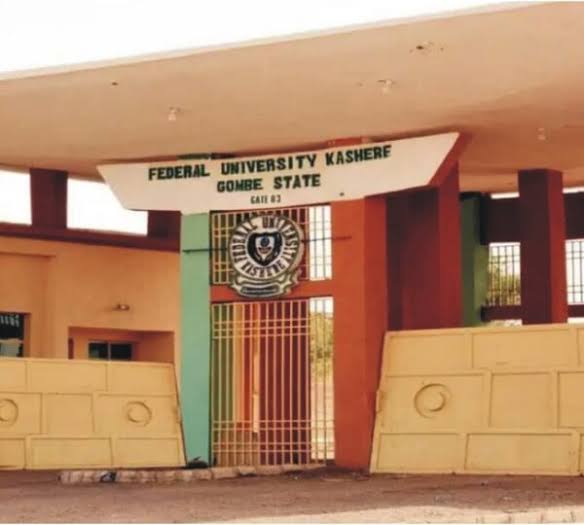
For 14 years, Christian students at the Federal University of Kashere, Gombe State, have worshipped in temporary and often disrupted spaces due to the absence of a chapel, even as multiple mosques operate across the campus. While the university insists it has provided land for the project, students and religious leaders argue that the lack of a functional worship centre reflects deeper concerns about fairness, planning, and inclusiveness in one of Nigeria’s federal institutions, writes CHIMA AZUBUIKE

When the Federal University of Kashere opened its doors in 2011 as one of Nigeria’s nine new federal universities, students, both Muslims and Christians, arrived with hopes of growing academically and spiritually in an environment designed to cater to all. However, for Christian students on campus, that hope has long been shadowed by a persistent challenge: access to a stable and suitable worship space.

Fourteen years after its establishment, the university still has no designated chapel for Christian worship, leading to intermittent disruptions, relocations, overcrowding, security concerns, and online agitation.

The Multipurpose Sports Complex, which Christian students had been using due to the limited capacity of their usual venue, was reportedly locked for alleged renovations. The incident triggered online outrage and drew renewed attention to a problem that students confirmed had persisted for more than a decade.

The Fellowship of Christian Students, which had been using the hall due to overcrowding at its former venue, FCLT 1, said the closure caused confusion and reignited longstanding concerns about marginalisation.

On Monday, photographs of the locked Multipurpose Hall, the venue Christian students had been using as a worship centre, circulated online, prompting a wave of reactions. Several users on X expressed concern over the development.

One user, @Zerubabel, wrote: “Christian students in Federal University Kashere in Gombe State have been suffering since the inception of the school. There’s no single chapel for Christian students and lecturers, but there are dozens of mosques on campus.”

Following the prompting, The PUNCH visited the campus. During the visit, our correspondent observed that the institution hosts no fewer than six mosques or designated prayer grounds distributed across strategic points on campus, with no Christian-designated worship centre in sight, raising questions about equity, planning, and the management of religious spaces in a federally funded institution.

When FUK was founded in 2011, the student community formed various religious associations, among them the Fellowship of Christian Students, whose leadership immediately began searching for a suitable place of worship. For several years, the fellowship relied on Lecture Theatre FCLT 1 for Sunday and weekday services.

See also  FG extends 2026 textbooks ranking deadline to August 7

However, as enrolment increased and Christian membership grew, the hall, originally designed for lectures, became unsafe. Students describe the space as “grossly inadequate,” with fears that an emergency could lead to injuries or a stampede. This prompted the fellowship to begin using the Multipurpose Sports Complex, a large, ventilated, open-style structure capable of accommodating their numbers.

For a while, the arrangement worked smoothly until this year, in the middle of preparations for Sunday service, the Multipurpose Hall was locked without prior notice to the fellowship.

In the morning, the hall was found locked, and FCS leaders sought clarification from campus authorities. They were informed that the venue was undergoing renovation and would not reopen until after a scheduled public lecture the following week. An operations officer reportedly explained that the closure was on instructions from the Director of Works.

According to the President of the Fellowship, Damter Isaac, the abrupt change caused confusion among worshippers. He said, “For those two days, we thought it would be resolved by Sunday, but when Sunday came, the Multipurpose Hall was still not open. We went to get access to the key, but they said it could not be opened until after the public lecture the following Thursday. That was when I met with Mr Imran, explained the situation, and he contacted the Director of Works. He assured us it was just a temporary movement and told us to call.”

Isaac further explained how the fellowship temporarily moved back to FCLT 1. “We were told we could use any venue of our choice. We chose FCLT 1, packed our equipment from the Multipurpose Hall, and moved back. The agreement was that we would show our setup at the renovated Multipurpose Hall to ensure proper management when we returned.”

Though the issue appeared to have been resolved administratively, the development reignited discussions among students and alumni about the absence of a chapel.

Multiple locations on campus were surveyed, confirming that the university hosts numerous prayer spaces for Muslim students and staff. These include a new mosque at the Chancellery, another at the former Vice Chancellor’s office, a mosque by Gate 3, a prayer location inside the library, another at the Postgraduate School, one near the medical centre, the Central Mosque near the Union Bank branch, and a worship area next to the boys’ hostel. There is also a prayer ground near the ICT centre.

See also  How A Class Of 24 Students Produced 2 Presidents, 4 Governors, 2 Ministers, 4 Emirs, 3 Justices, 4 Ambassadors and Other Influential Leaders

By contrast, Christian students have none. This uneven distribution lies at the heart of the agitation.

To facilitate the building of a chapel on the campus, the students opened a crowdfunding account, confirmed by FCS members, underscoring the desperation among Christian students, many of whom are tired of waiting for a permanent solution.

A X user, @Kunta_Kinte, replied to a post on the photographs of the locked Multipurpose Hall: “It’s true. One student shared this in case anyone wants to donate, but this shouldn’t be the norm for students to crowdfund projects like this. Chapel Project Account Details 0218987248, Account Name: FCS Chapel Project, FUK. Bank: Union Bank.”

As the online conversation grew, a peaceful protest reportedly organised by an individual student circulated on social media with the caption: “No chapel, no stable space, Christian students deserve better.” The fellowship’s executive council, however, quickly released a statement dissociating itself from the action.

The statement, signed by Public Relations Officer, Iliya Ezekiel, read: “The attention of the Fellowship has been drawn to a recent peaceful protest and the circulating caption: ‘No Chapel, No Stable Space, Christian Students Deserve Better.’ While the concerns raised are valid, the member involved did not follow proper due process, and the Fellowship Executive Council was not informed or consulted before the action was taken.”

The fellowship urged that protest-related posts be removed: “We therefore dissociate the Fellowship from this protest and kindly request that all related posts, uploads, and shares across social media be taken down immediately.”

The leadership assured members of its commitment to addressing the issue through dialogue: “The Fellowship remains committed to addressing these concerns through the appropriate channels, and we assure all members that due process will be followed to ensure necessary actions are taken. Thank you for your understanding and cooperation.”

Responding to allegations of discriminatory treatment, FUK’s Public Relations Officer, Janet Ezekiel, dismissed the claims. She stated that the administration of Vice Chancellor, Prof Umaru Pate, had fulfilled its responsibility regarding the provision of land for a chapel.

She said, “The responsibility of the management is to provide land, and they have done so. It is now up to the different religious groups to develop it. It’s not as if the FCS is not doing anything.

See also  83 bag first-class degrees as 1,043 graduate from JABU

The VC gave the land officially and even expanded it, because the problem initially was that the land was too small.”

Ezekiel added, “We now have a building committee for the Christian Staff Fellowship. So it’s not like nothing is being done.”

When contacted, the Dean of Student Affairs, Prof Shuaibu Umaru, dismissed claims of marginalisation, saying: “It’s not true. Is the university meant for Muslims alone?” He added, “The Multipurpose Hall is for everybody.”

Pastor Samuel Elebiyo of the Redeemed Christian Church of God, who previously served at Kashere, said the experiences of Christian students reflect a broader pattern across northern institutions. He said, “The community needs help. They have not enjoyed the goodwill that our Muslim colleagues have. When I inquired about building a chapel, I heard there was land near the gate by the main road, but it was revoked and moved near a mountain, far away, with no support to develop it.”

Elebiyo added, “This pattern is not unique to FUK. In the North, the Christian community needs assistance. Christian staff leaders have not done enough; they fold their arms as if it is not their concern, leaving students to suffer.”

Though the university says it has allocated an expanded land, Christian students argue that the problem goes beyond documents. For them, the real issue is access, fairness, and visibility.

For 14 years, the absence of a chapel has forced a cycle of temporary arrangements, lecture theatres, sports halls, borrowed spaces, none providing the stability expected in a federal university.

Meanwhile, the visible presence of multiple mosques across campus, many built with staff and community support, fuels perceptions of inequality.

The situation is worsened by communication gaps, sudden venue lockouts, and a lack of clarity about timelines for the chapel project.

Lecturers who requested anonymity said the controversy over Christian worship spaces is not simply a religious issue; it is a test of administrative fairness, campus inclusiveness, and institutional planning. While the university insists it has fulfilled its obligations by allocating land, Christian students’ lived experience tells a different story, one of years of waiting, makeshift arrangements, and repeated disruptions.

While sourcing funds through crowdfunding, the fellowship continues meeting in temporary venues, clinging to assurances that the long-awaited chapel project will eventually materialise.

punch.ng

FOLLOW US ON:

FACEBOOK

TWITTER

PINTEREST

TIKTOK

YOUTUBE

LINKEDIN

TUMBLR

INSTAGRAM

Continue Reading
Click to comment

Leave a Reply

Your email address will not be published. Required fields are marked *

Education

Nasarawa gov seeks global support for University of Public Relations and Leadership

Published

on

Nasarawa State Governor, Abdullahi Sule, on Tuesday called on international public relations practitioners to support the proposed University of Public Relations and Leadership in the state, urging them to maintain their relationship with the institution through professional engagements and training.

Sule said the university, being established in partnership with the Nigerian Institute of Public Relations, would provide an opportunity for practitioners across the world to contribute to leadership development and strengthen the public relations profession.

The governor made the appeal at the 25th Global Alliance Gala Dinner and World Public Relations Awards in Abuja, where he welcomed delegates and practitioners from different countries.

He said the international gathering had brought global attention to Abuja, expressing optimism that the delegates would extend their engagements to Nasarawa State.

Sule described public relations as inseparable from effective leadership, saying the proposed institution reflected his state’s commitment to promoting the profession and developing future leaders.

“I have always loved public relations because, to me, public relations is leadership, and leadership is public relations,” he said.

He urged the practitioners to visit the state regularly, either for professional gatherings or training at the proposed university.

“That is why the only university of public relations and leadership is in Nigeria, in my state. We strongly believe that we should continue to see you here, again and again. If we do not see you at a forum, we hope to see you coming for training at that university. That is the whole idea,” he said.

See also  ASUU protest rocks campuses ahead of FG talks

The University of Public Relations and Leadership is expected to be located in Gudi, Akwanga Local Government Area of Nasarawa State.

The project followed a Memorandum of Understanding signed in July 2025 between the NIPR and the Nasarawa State Government.

The institution, expected to be unveiled in November 2026 during the World Public Relations Forum in Nigeria, is designed to make public relations and leadership core components of tertiary education.

At the signing of the agreement, NIPR President, Dr Ike Neliaku, described the university as a global project supported by 126 countries through the Global Alliance for Public Relations and Communication.

Neliaku said the initiative was conceived to address leadership and governance challenges in Africa, which he identified as major impediments to the continent’s development.

Under the agreement, Nasarawa State is expected to receive at least 20 annual scholarship slots for qualified indigenes, with representation from each of the state’s 13 local government areas.

The arrangement also provides 50 concessionary admission slots annually for qualified candidates sponsored by the state government.

Sule had pledged that his administration would provide the necessary support to ensure the commencement of academic activities, describing the university as an opportunity to make Nasarawa a hub for manpower development and leadership training.

Source: punchng.com

FOLLOW US ON:

FACEBOOK

WHATSAPP CHANNEL

TWITTER

PINTEREST

TIKTOK

YOUTUBE

LINKEDIN

INSTAGRAM

Continue Reading

Education

FG orders recovery of excess payments to university workers, read details

Published

on

The Federal Government has directed federal universities, polytechnics and colleges of education to recover all overpayments arising from the implementation of the 2025/2026 remuneration agreements with tertiary education unions within three months.

The government also capped the payment of excess workload allowance for academic and non-academic staff in federal universities at a maximum of 52 hours per month.

The directives were contained in a November 11, 2026, circular issued by the National Salaries, Incomes and Wages Commission and signed by its Chairman and Chief Executive Officer, Maj. Gen. Junaid S. Bindawa.

The circular, with reference number SWC/S/04/S.149/T/187, was addressed to the Chief of Staff to the President, Secretary to the Government of the Federation, Head of the Civil Service of the Federation, ministers, federal permanent secretaries and heads of government agencies, among others.

The commission said the clarification became necessary following several requests from universities, colleges of education and polytechnics seeking guidance on the implementation of remuneration packages contained in the 2025/2026 agreements between the Federal Government and tertiary education-based unions.

It stated, “Following several requests from Universities, Colleges of Education and Polytechnics on the urgent need for clarification on the implementation of remuneration packages contained in the 2025/2026 Agreements between the Federal Government of Nigeria and the Tertiary Education Institutions Based-Unions, the Commission wishes to clarify as follows.”

On the Consolidated Academic Tools Allowance, the commission said the payment was restricted to academic staff on the Consolidated University Academic Salary Structure and the Consolidated Polytechnics and Colleges of Education Salary Structure.

It explained that vice-chancellors, rectors and provosts were not entitled to the allowance because they were not on the specified salary structures.

The circular stated that the allowance did not apply to the heads of the institutions because they were covered by the Certain Political, Public and Judicial Officer Salaries (Salaries, Allowance, etc.) (Amendment) Act 2008.

It further excluded staff on the Consolidated Medical Salary Structure and associated medical allowances, citing ongoing negotiations between the Federal Government and health-sector unions.

See also  JAMB releases 2026 UTME original result slips for printing

The commission said, “This does not apply to staff on Consolidated Medical Salary Structures and associated medical allowances, as collective bargaining is ongoing between the FGN and Health Sector-Based Associations and Unions on the review of CONMESS and associated medical allowances.”

Similarly, it restricted the Consolidated Non-Teaching Tools Allowance to non-academic staff on the Consolidated Tertiary Institutions Salary Structure and Consolidated Tertiary Education Institutions Salary Structure.

The commission also excluded workers on the Consolidated Health Salary Structure and associated medical allowances.

It said, “This does not apply to staff on the Consolidated Health Salary Structure and associated medical allowances, as collective bargaining is ongoing between the FGN and Health Sector-Based Associations and Unions on the review of CONHESS and associated medical allowances.”

On the Excess Workload Allowance, the commission specifically directed that payments to members of ASUU and NASU in federal universities must not exceed 52 hours monthly.

It stated, “A maximum of 52 hours per month applies to the payment of Excess Workload Allowance for the Academic Staff Union of Universities and the Non-Academic Union of Educational and Associated Institutions in Federal Universities.”

The circular also addressed the 10 per cent Earned Academic Allowance, explaining that the provision in the revised salary structure of university academic staff was designed for mainstreaming and budgeting, with five per cent allocated to employees funded by the Federal Government and the remaining five per cent to those funded by university councils through internally generated revenue.

According to the commission, the provision was captured on page 12 of the agreement between the Federal Government and ASUU.

It stated, “The provision of 10% academic earned allowance (EAA) in the table of revised total salary of universities’ academic staff as approved on page 12 of the agreement between FGN and ASUU was for mainstreaming and budgeting – 5% for those funded by FGN and 5% for those funded by Councils through Internally-Generated Revenue.”

However, the commission warned that the implementation must follow its earlier circular of December 30, 2025, which outlined the categories of beneficiaries funded by the Federal Government and university councils.

See also  Bandit attacks: Kebbi, Kwara reopen schools

It said, “However, the implementation of EAA should be in line with the Commission’s Circular No. SWC/S/04/149/IV/924 dated 30th December 2025, which clearly identified those funded by FGN and Councils, respectively.”

The commission subsequently directed all federal universities, polytechnics and colleges of education to comply with the clarifications and recover excess payments within the stipulated period.

It stated, “All Federal Universities, Colleges of Education and Polytechnics are to comply with these clarifications, and all overpayments should be recovered within three months.”

It added, “All enquiries relating to this circular should be directed to the Commission.”

The directive comes amid the Federal Government’s efforts to implement renegotiated remuneration agreements with academic and non-academic unions in the tertiary education sector after years of disputes over workers’ welfare, salaries, funding and conditions of service.

The Federal Government and ASUU signed their renegotiated 2025 agreement on December 23, 2025, following prolonged negotiations over the 2009 agreement. The deal introduced a 40 per cent upward review of university academic staff emoluments, effective January 1, 2026, alongside improved allowances and pension benefits.

In February 2026, the Minister of Education, Dr Tunji Alausa, announced the commencement of implementation of the 40 per cent increase in the Consolidated Academic Allowance, directing federal universities to reflect the approved adjustments in their payroll systems.

The Federal Government subsequently unveiled the 2026 agreements with academic and non-academic staff unions in October, announcing the payment of approved allowances to eligible personnel across universities, polytechnics and colleges of education, effective January 1, 2026.

The agreements cover unions including ASUU, the Academic Staff Union of Polytechnics, the Colleges of Education Academic Staff Union, the Senior Staff Association of Nigerian Universities and NASU. The government said the agreements were designed to improve staff welfare, strengthen industrial harmony and reduce disruptions to academic calendars.

See also  Tinubu renames Federal University of Medical Sciences Azare after Late Sheikh Dahiru Bauchi

Meanwhile, healthcare professionals in federal universities have threatened legal action against the National Salaries, Incomes and Wages Commission over the contents of the circular.

The affected medical doctors, nurses, pharmacists, medical laboratory scientists and allied health professionals, under the Coalition of Healthcare Professionals in Tertiary Education Institutions of Nigeria, described the circular as discriminatory and contrary to earlier government directives on the allowance.

The National Chairman and Coordinator of CHPTEIN, Musa Shehu, said in his reaction that the disputed circular, with reference number SWC/S/04/S.149/T/187, restricted CONTTA payments to employees on the Consolidated Tertiary Institutions Salary Structure, excluding those on the Consolidated Medical Salary Structure and Consolidated Health Salary Structure.

He noted that the original circulars, “referenced SWC/S/04/S.149/V/1067 for SSANU and SWC/S/04/S.149/IV/1071 for NASU, did not expressly exclude healthcare professionals earning salaries under CONMESS and CONHESS.”

He also maintained that the affected workers were non-teaching employees of federal universities and legitimate members of the two unions, with their check-off dues regularly deducted from their salaries.

“The Budget Office of the Federation calculated the financial implications of CONTTA based on the entire workforce of the Non-teaching staff on the payroll.”

CHPTEIN added that the ministry warned vice-chancellors in paragraph five of the circular that any deviation from the approved scope of funds released by the Federal Government would attract appropriate sanctions.

Questioning the basis for excluding healthcare professionals, the coalition asked why workers classified as non-teaching staff should be denied the allowance when the funds were reportedly calculated based on the entire non-teaching workforce.

Source: punchng.com

FOLLOW US ON:

FACEBOOK

WHATSAPP CHANNEL

TWITTER

PINTEREST

TIKTOK

YOUTUBE

LINKEDIN

INSTAGRAM

Continue Reading

Education

US court strikes down Trump’s four-year limit on foreign students, read details

Published

on

A federal judge in the United States has overturned a Trump administration regulation that sought to limit how long foreign students and exchange visitors could remain in the country, Bloomberg Law reports on Monday.

Judge F. Dennis Saylor of the US District Court for the District of Massachusetts ruled on Monday that the Department of Homeland Security regulation exceeded its statutory authority and failed to consider less restrictive ways of achieving its objectives.

The regulation sought to end the long-standing “duration of status” arrangement, which allows international students to remain in the US while making progress towards completing their academic programmes.

Under the proposed changes, holders of F-1 student visas and J-1 exchange visitor visas would have been limited to four years in the country. Those needing more time would have had to apply to the DHS for extensions.

The judge said the agency had not explained how imposing “an unreviewable, completely discretionary renewal system—after a foreign student has already been in the country for four years—meaningfully enhances the ability of DHS to root out cases of fraud, or how the benefits of such a system outweigh the immense costs of abandoning the existing system.”

Saylor said the department had not adequately explained how replacing the existing arrangement with a discretionary renewal system would help prevent immigration fraud or justify the additional burden on foreign students.

The judge also found that the government had failed to establish a rational link between the restrictions and the objectives it claimed they would achieve.

See also  JAMB releases 2026 UTME original result slips for printing

The case was brought by a coalition of higher education and labour organisations, including the United Auto Workers, which argued that the regulation would disrupt students’ education and make it more difficult for them to complete their degrees.

Saylor had earlier blocked the regulation from taking effect in September. Monday’s order set aside the rule.

The ruling means the proposed four-year limit and the requirement for students and exchange visitors to seek extensions under the new system cannot take effect.

In July, PUNCH Online reported that the Trump administration had introduced a four-year limit on the stay of foreign students and exchange visitors in the US, ending the long-standing “duration of status” arrangement that allowed them to remain in the country for as long as they continued making progress towards completing their academic programmes.

Under the proposed policy, F-1 and J-1 visa holders who needed more than four years would have been required to apply to the Department of Homeland Security for extensions.

Source: punchng.com

FOLLOW US ON:

FACEBOOK

WHATSAPP CHANNEL

TWITTER

PINTEREST

TIKTOK

YOUTUBE

LINKEDIN

INSTAGRAM

Continue Reading

Trending