

Connect with us

News

Malami Never Met Bail Conditions, Ignored Fresh Invitations – EFCC Fires Back

Published

on

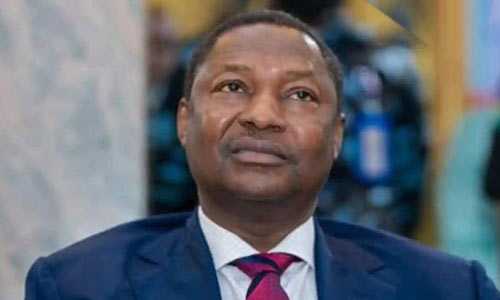
The Economic and Financial Crimes Commission (EFCC) has denied playing politics with the revocation of the administrative bail granted to a former Attorney-General and Minister of Justice, Abubakar Malami.

The EFCC, in a statement on Saturday, explained that the agency is apolitical in its operations.

The explanation follows the allegation that the anti-graft agency revoked the initial bail granted to Malami due to his involvement with opposition parties in the country, particularly the African Democratic Congress (ADC).

However, while denying such claims, the EFCC, in a statement made available to Naija News, said Malami was offered provisional bail after his brief interrogation on November 28, 2025, but did not meet any of the requirements nor show readiness to keep faith with them.

The EFCC added that Malami was invited on several other occasions to appear before investigators of the commission, but didn’t turn up, claiming ill health.

The EFCC also denied barring Malami from granting interviews and urged the former Minister to focus his energy on meeting his bail conditions rather than engage in false media wars.

The full statement reads: “The Economic and Financial Crimes Commission, EFCC, though not disposed to joining issues with respect to its operations in the media, is compelled to respond to the patently false claims of a former Attorney-General and Minister of Justice, Abubakar Malami, SAN about a purported revocation of “his bail over attendance at a political gathering in Kebbi.”

“Administrative bail is a discretionary temporary reprieve that allows a suspect to be released on stated conditions pending conclusion of investigation and arraignment in court. To this effect, after his brief interrogation on November 28, 2025, Malami was offered provisional bail hinged on five requirements. He has neither met any of the requirements nor shown readiness to keep faith with them.

See also  Nigeria's domestic debt service hits N1.7trn Q2 2025

“He was due back for further interrogation on December 1, 2025 , but in a curious twist, the former Minister pleaded with his investigators through a letter written to the Commission on December 4, 2025, to allow him to attend to his “ill-health”. The Commission compassionately granted his plea even while his bail conditions had not been met.

“He was initially required to commence reporting for further investigations on December 1, 2025 but this had to be deferred to December 4, 2025 largely owing to his “ Request for an Adjournment on Grounds of Ill- Health.” He neither provided a medical report nor credible proof of ill-health to the Commission

“The EFCC cannot allow the latitude granted the former Minister on his health stand in the way of investigations. On this score, he was invited again on December 8, 2025, for further interrogation and detained until the pending bail conditions are met.

“Evidently, the former minister’s claims of revocation of bail by the EFCC are untenable. It is equally ridiculous to insinuate that the Commission barred him “ from granting media interviews and from participating in political activities in Kebbi State”. Such bogus claims from a former chief law officer of the nation are strange, as the EFCC has no interest in the political affiliation of its suspects. It bears reiterating that the Commission is apolitical. A former governor and ranking member of the ruling party was recently arraigned for alleged contract fraud.

“The Commission wishes to advise Malami to expend his energy on meeting the five bail conditions he acknowledged and signed on November 28, 2025.

See also  Passenger crushed to de@th during fight over motorpark in Lagos

“It would also serve his interest to cooperate with his team of interrogators rather than dissipate energy in whipping up sentiments through false claims in the media.”

FOLLOW US ON:

FACEBOOK

TWITTER

PINTEREST

TIKTOK

YOUTUBE

LINKEDIN

TUMBLR

INSTAGRAM

Continue Reading
Click to comment

Leave a Reply

Your email address will not be published. Required fields are marked *

News

Makinde signs executive order regulating vigilante, security groups

Published

on

Oyo State Governor, Seyi Makinde, on Wednesday, signed into law the Executive Order 001 of 2026 on the Regulation of Associations, Groups and Organisations offering Security and Allied Services in the state.

He said the move was necessary to ensure that all groups and associations involved in security-related activities, such as vigilante and other community-based security groups, operate within a clear legal and operational framework that supports peace, order and rule of law in the state.

At the signing ceremony on Wednesday in Ibadan, the state capital, Makinde stressed that the executive order became necessary in view of the growing security challenges confronting communities and the increasing number of groups engaging in security-related activities without proper coordination.

While noting that security remains a collective responsibility of both the government and citizens, he explained that the order was designed to ensure that all organisations involved in security and allied services are properly registered, documented and monitored by the state government.

The governor equally stressed that the people must avoid any action that could lead to ethnic tension, while cautioning socio-cultural groups to desist from narratives that could result in ethnic profiling, discrimination or confrontation as the state government would not tolerate any form of criminality under the guise of security operations.

Makinde also used the occasion to address the recent abduction of students and teachers in Oriire Local Government Area of the state, assuring residents that the government, in collaboration with security agencies and relevant stakeholders, are working to ensure the safe return of the victims.

See also  Passenger crushed to de@th during fight over motorpark in Lagos

He also lauded the security agencies and residents for their patience and restraint during the difficult period, reaffirming his administration’s commitment to strengthening security coordination across the state.

The governor urged citizens to report suspicious activities to security agencies rather than resorting to self-help or unlawful reprisals.

Earlier, the state Attorney-General and Commissioner for Justice, Abiodun Aikomo, explained that all associations, groups and organisations offering security-related services with a membership strength above five persons must notify and register with the government through the Office of the Special Adviser on Security.

He added that existing groups must notify the office within 72 hours of signing the Executive Order and comply with the directive for documentation and certification.

Aikomo further stated that the regulation would enable the government to identify and monitor individuals or groups carrying weapons or operating in security uniforms across the state.

He warned that failure to comply with the executive order constitutes a violation of the law and would attract punishment accordingly.

He added that the Office of the Special Adviser on Security, the Commissioner of Police and the Nigeria Security and Civil Defence Corps have been directed to enforce full compliance with the order, which became effective immediately after it was signed by the governor.

punch.ng

FOLLOW US ON:

FACEBOOK

TWITTER

PINTEREST

TIKTOK

YOUTUBE

LINKEDIN

INSTAGRAM

Continue Reading

News

Coup trial: Accused colonel rejects military court

Published

on

The second accused person in the charges brought against 36 persons accused of alleged mutiny and plot to overthrow the government of President Bola Tinubu, Col Mohammed Ma’aji, has challenged the jurisdiction of the Defence Headquarters Garrison General Court Martial sitting in Asokoro, Abuja, to hear the case.

Ma’aji, in a preliminary objection filed before the court martial in charge No: DHQ/GAR/ABJ/49/ADM, between the Armed Forces of Nigeria and Brig Gen M.A. Sadiq, Col Ma’aji, alongside 35 others, urged the court martial to strike out the charges instituted against him, arguing that the military tribunal lacked the jurisdiction to entertain the case.

Ma’aji, in the objection, contended that the charges were fundamentally defective and incompetent in law.

The objection, brought pursuant to Rules 36(1) and 37(1) of the Rules of Procedure Army 1972, urged the tribunal to make an order striking out and/or dismissing the charges against the 2nd Accused.

“Take notice that the 2nd accused hereby objects to the jurisdiction of the General Court Martial to entertain Counts One to Nine of the charges preferred against the 2nd Accused in Charge No: DHQ/GAR/ABJ/49/ADM, namely ARMED FORCES OF NIGERIA V. BRIG. GEN. M. A. SADIQ (N/10321) & 35 ORS and hereby prays the General Court Martial for the following reliefs:

“An Order striking out and/or dismissing the charges against the 2nd Accused in Charge No: DHQ/GAR/ABJ/49/ADM for lack of jurisdiction. An order declining jurisdiction to entertain the charge as constituted.

“And for such further order(s) as the Honourable General Court Martial may deem fit to make in the circumstances.”

The second accused in the charge also argued that the complainant, listed as the Armed Forces of Nigeria, lacked the legal capacity to institute criminal proceedings.

According to Ma’aji, “The complainant (Armed Force of Nigeria) is not a juristic person and thereby lacks the requisite competence to initiate and prosecute the criminal proceedings in Charge No: DHQ/GAR/ABJ/49/ADM.”

See also  Trump threats: Tinubu rallies foreign allies as North rejects Sharia ban

Ma’aji further maintained that because the complainant allegedly lacked legal personality, the General Court Martial was equally deprived of jurisdiction to hear the matter.

Citing several Supreme Court and Court of Appeal authorities, including Green v. Green, Fawehinmi v NBA, and Mothercat Nig Ltd v Reg. Trustees of the Full Gospel Assembly Nig, the defence argued that only natural persons or entities expressly recognised by law could sue or be sued.

The written address submitted in support of the objection stated, “The name ‘Armed Forces of Nigeria’ described as ‘complainant’ in Charge No: DHQ/GAR/ABJ/49/ADM is unknown to law and destitute of any legal capacity to exercise Prosecutorial powers in respect of the charges preferred against the 2nd Accused.”

The second accused also challenged the competence of counts one to nine of the charge, which allegedly accused him of inciting other officers to join a plot to overthrow President Tinubu.

Ma’aji insisted that the allegations contained in the particulars of the charges did not fall within the offence of mutiny as contemplated under Section 52(1)(b) of the Armed Forces Act, 2004.

He argued that the particulars of the charge “disclose offences against the Sovereign State otherwise known as the Federal Republic of Nigeria and constitutional order rather than offences relating to military or service discipline or command structure.”

He maintained that the phrase “plot to overthrow the government of the Federal Republic of Nigeria” contained in the charge could not be equated with “lawful authority in the Federation” as envisaged under Section 52(3) of the Armed Forces Act.

“It is submitted that the Federal Republic of Nigeria does not fall within the phrase ‘a lawful authority in the Federation’ as used in Section 52(3) of the Armed Forces Act, Laws of Federation, 2004,” Ma’aji contended.

Relying on constitutional provisions and judicial precedents, he argued that the court-martial, being a tribunal of limited jurisdiction, could not extend its powers beyond what was expressly granted by statute.

See also  Kano Assembly moves to impeach deputy governor, see reasons

Ma’aji also cited the Supreme Court’s warning against judicial expansion of statutory provisions, insisting that any ambiguity in penal legislation must be resolved in favour of the accused persons.

Quoting the Supreme Court decision in Nigerian Navy v. Lambert, the second accused submitted: “It is settled law that penal statutes are to be construed strictly to the benefit of the accused person and that where there is a reasonable construction that avoids the penalty in any particular case, the court must adopt that construction.”

The preliminary objection further contended that for a charge of mutiny or incitement to mutiny to stand, there must be allegations of concerted insubordination, defiance of military authority or refusal of lawful command or organised military rebellion against superior military command.

According to the defence, the particulars supplied by the prosecution failed to disclose those essential ingredients.

On this ground, he urged the General Court Martial to uphold his preliminary objection and dismiss the charges against him for want of jurisdiction.

Meanwhile, a witness in the ongoing trial of six alleged coup plotters before the Federal High Court in Abuja, on Wednesday, told investigators that Ma’aji allegedly threatened to force his way into the Presidential Villa, even if insiders refused to cooperate.

The fourth defendant, Zekeri Umoru, made the allegation in a video previewed in court during proceedings in the trial-within-trial over the admissibility of the defendants’ extrajudicial statements.

Umoru and five others in April were arraigned before Justice Joyce Abdulmalik on 13 counts of criminal charges over alleged complicity in an alleged coup plot to overthrow Tinubu’s government.

The six defendants: Maj Gen Mohammed Ibrahim Gana (retd), Capt Erasmus Victor (retd), Insp Ahmed Ibrahim, Zekeri Umoru, Bukar Kashim Goni and Abdulkadir Sani, however, pleaded not guilty to all the counts after the charge was read to them.

See also  Nigeria's domestic debt service hits N1.7trn Q2 2025

At the resumed sitting, Umoru, who worked with Julius Berger on the Presidential Villa clinic project, alleged that Ma’aji, through the third defendant, Insp Ibrahim, asked him to recruit between 18 and 19 persons working inside the Villa, including soldiers, Department of State Service personnel and Julius Berger staff.

According to the video evidence played in court, Umoru alleged that plans were discussed to switch off electricity within the Presidential Villa to aid the operation, but he warned that such an action would immediately trigger investigations and lead to the detention of workers on duty.

He further claimed that Insp Ibrahim later demanded N100m from Ma’aji to facilitate access into the Villa through an ambulance route, but Ma’aji allegedly rejected the amount as excessive, insisting he could still gain entry by force, although “there would be bloodshed.”

The witness also told investigators that he became uncomfortable with the alleged plan and repeatedly attempted to return the money given to him, insisting that the Presidential Villa “was not child’s play.”

He denied having access to the Villa’s solar power plant, despite allegations that he intended to sabotage the electricity supply within the complex.

The court further heard that Umoru did not immediately report the alleged plot to authorities because Insp Ibrahim allegedly advised him to delete messages and avoid contacting Ma’aji due to an ongoing audit in their office.

Following the screening of the video evidence, Justice Abdulmalik adjourned the matter until May 21 for continuation of the trial-within-trial.

punch.ng

FOLLOW US ON:

FACEBOOK

TWITTER

PINTEREST

TIKTOK

YOUTUBE

LINKEDIN

INSTAGRAM

Continue Reading

News

Nigerians have constitutional right to self-defence from insecurity — Bwala

Published

on

The Special Adviser to President Bola Tinubu on Policy Communication, Daniel Bwala, says Nigerians are constitutionally empowered to self-defence themselves against attackers, including in situations involving lethal threats, while maintaining that the government is working to address insecurity across the country.

Bwala stated this during an interview on Arise Television on Wednesday.

He was reacting to recent violent incidents in the country, including the killings in Esiele community in Orire Local Government Area of Oyo State and the abduction of teachers and pupils of LA Primary School.

The presidential aide said the Nigerian Constitution guarantees citizens the right to self-defence.

“The constitution has guaranteed to every citizen of Nigeria the right to self-defence; you have the right to defend yourself,” he said.

“When your right, my right, and that of my neighbour is put together, it becomes collective rights to defend ourselves and Nigerians have the right to defend themselves.

“If you come to my house to try to kill me, any lethal weapon I use to defend myself is guaranteed by the Constitution,” he added.

Bwala, however, noted that firearm possession remains regulated by law.

He said, “Nigerians don’t have the right to bear certain arms unless those arms are permitted but the collective people can come together to apply to the government for the right to coordinate themselves.”

Explaining the government’s position on insecurity, Bwala said criminality is a global challenge but insisted that collective action is necessary to address it.

“Solution is what we all look to; evil men operate anywhere in the world, no matter how tight you are as a government.

See also  '𝗜 𝗹𝗲𝗱 600 𝗯𝗮𝗻𝗱𝗶𝘁𝘀 𝘁𝗼 𝘀𝘂𝗿𝗿𝗲𝗻𝗱𝗲𝗿', 𝗚𝘂𝗺𝗶 𝗱𝗲𝗳𝗲𝗻𝗱𝘀 𝗻𝗲𝗴𝗼𝘁𝗶𝗮𝘁𝗶𝗼𝗻 𝗿𝗼𝗹𝗲

“You do your best and expect that with the help of God and collective participation of the people through collective intelligence, we will be able to put an end to it,” he said.

On public reactions to recurring attacks, he said citizens will continue to express frustration.

“I know the Nigerian people will continue to complain. For example, no matter how we say that we are sorry and the incident happens again, people will complain, cry and mourn because it’s the lives of the Nigerian people that are taken away by the evil element. We will put an end to this as a people,” he said.

Bwala also linked rising insecurity to election cycles and societal pressures.

“Every eve of elections in Nigeria from 2014, 2018, 2022, and now 2026, you will see that crisis increases because of the idea of a crisis economy. A lot of people take advantage of that but the will and spirit of the collective people is what will put an end to this situation,” he said.

He further noted the role of local vigilance groups and security collaboration.

“As a people, we have vigilantes, and in Borno State, we have paramilitary organisations that provide intelligence to law enforcement,” he said.

punch.ng

FOLLOW US ON:

FACEBOOK

TWITTER

PINTEREST

TIKTOK

YOUTUBE

LINKEDIN

INSTAGRAM

Continue Reading

Trending