Connect with us

Education

Era of corruption, impunity in tertiary institutions over – FG

Published

on

The Federal Government has declared an end to corruption and impunity in Nigeria’s tertiary institutions, warning that transparency, accountability and ethical leadership will now be strictly enforced across the sector.

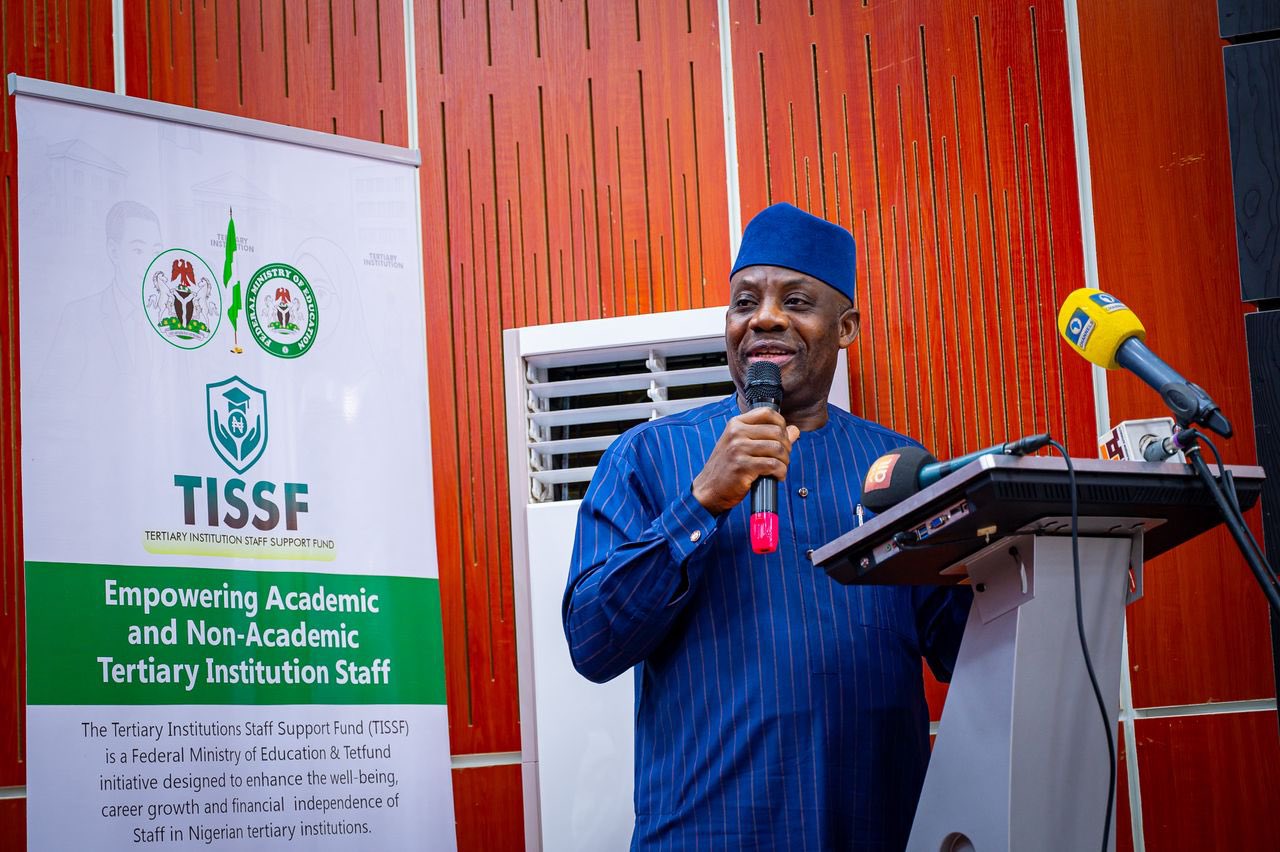
The Minister of Education, Dr Maruf Alausa, made this known on Wednesday in Abuja while delivering an address at a retreat organised by the Conference of Heads of Polytechnics, Colleges of Education and similar institutions for council chairmen, commissioners of education, rectors, registrars and bursars.

Speaking on the theme, “Transforming Polytechnic Education in Nigeria: Innovation, Good Governance and Sustainability for National Development,” Alausa said the government would no longer tolerate financial recklessness, abuse of office or unethical practices in tertiary institutions.

“The era of impunity in our institutions is over. We demand fiscal discipline, timely audits and zero tolerance for corruption in order to build public trust and attract investment,” the minister said.

He charged governing councils and management teams to uphold transparency, accountability and ethical leadership, urging them to avoid conflicts of interest, ensure prudent management of resources and prioritise merit in appointments and promotions.

Beyond governance reforms, the minister called for a comprehensive transformation of polytechnic education, stressing innovation and sustainability as key drivers of national development.

“Polytechnics are not mere institutions; they are the crucibles where innovation meets practicality, where skills forge economic resilience, and where sustainable development becomes a lived reality for our nation,” he said.

Alausa said the Federal Ministry of Education was revitalising technical and vocational education and training to ensure that graduates were equipped with practical, industry-ready skills.

See also  Kebbi school abduction happened despite intelligence report  – Tinubu

“We have adopted a policy that ensures our polytechnic graduates are industry-ready, innovative problem-solvers capable of driving national development,” he stated.

He urged polytechnic leaders to make innovation central to their institutions by promoting entrepreneurship, research and industry partnerships.

“Innovation must be the heartbeat of our polytechnics. I urge you to foster entrepreneurship centres, research hubs and industry partnerships that turn ideas into prototypes and inventions into enterprises that will graduate into job creators,” he said.

The minister identified priority sectors such as renewable energy, agricultural technology, digital manufacturing and climate-resilient solutions as areas where polytechnics should focus their research and training efforts.

He also emphasised the need for sustainable funding models, encouraging institutions to boost Internally Generated Revenue and reduce dependence on imports.

While acknowledging persistent challenges including funding gaps, obsolete facilities and societal bias favouring university education over technical skills, Alausa expressed confidence in sustained government support.

“Under President Bola Tinubu’s Renewed Hope Agenda, we are committed to supporting you with policy reforms, infrastructure upgrades and partnerships,” he said.

The minister further announced a special TETFund intervention to upgrade polytechnic engineering schools with modern, state-of-the-art equipment, following similar interventions in medical colleges last year.

He urged participants to return to their institutions and implement the principles discussed at the retreat.

In his remarks, the Chairman of the Conference of Heads of Polytechnics, Colleges of Education and similar institutions, Dr Sani Tunga, described the retreat as timely, given the critical role of polytechnic education in Nigeria’s development.

Tunga said the theme reflected the realities facing polytechnics and colleges of technology, which he described as vital for producing skilled and entrepreneurial manpower needed to diversify the economy, reduce unemployment and achieve the Sustainable Development Goals.

See also  Abia varsity chancellor tasks new veterinary doctors on food safety, public health

“Our polytechnics and colleges of technology stand at the forefront of producing skilled, innovative and entrepreneurial manpower,” he said, while noting challenges such as inadequate funding, outdated infrastructure, changing industry demands, governance gaps and sustainability concerns.

He also highlighted recurring conflicts within the system, particularly between governing councils and management, as well as between management and staff unions such as ASUP, SSANIP and NASU.

According to him, such disputes, often linked to policy interpretation, resource allocation and welfare issues, undermine institutional harmony and slow progress.

Tunga stressed the need for continuous dialogue among council chairmen, commissioners, rectors, registrars and bursars to address these issues constructively.

He said the retreat was designed to explore innovative approaches to curriculum development, strengthen research and industry partnerships, improve governance and accountability, enhance financial sustainability and address the root causes of conflicts in the system.

Linking the success of the polytechnic sector to national development, Tunga said, “The transformation we seek is not merely institutional; it is national. A vibrant polytechnic sector will empower our youths, boost local content, foster self-reliance and contribute meaningfully to Nigeria’s emergence as a technological and economic powerhouse.”

In his opening remarks, the Executive Secretary of the National Board for Technical Education, Prof Idris Bugaje, described ongoing reforms as a turning point for technical and polytechnic education after decades of neglect.

Bugaje noted that technical and polytechnic education predated university education in Nigeria but suffered marginalisation after independence, particularly following the civil war, as universities received greater priority.

He highlighted the imbalance in the education system, saying, “We have only 153 technical colleges compared to over 15,000 senior secondary schools in Nigeria today. We were really struggling to survive in this very unfriendly system.”

See also  Honorary awards: TASUED dismisses claims of snubbing Gbenga Daniel

According to him, the situation has begun to improve in the last two years due to reforms initiated by the current Minister of Education.

“Until the last two years, we have started seeing light at the end of the tunnel. NBTE is being reinvented, re-engineered and re-created, courtesy of the efforts of Dr Maruf Alausa,” he said.

The retreat brought together leaders across Nigeria’s polytechnic and technical education sector to chart a path toward skills-driven national development, amid renewed efforts to restore relevance to a system long constrained by underfunding, outdated curricula, weak industry linkages and declining public confidence.

punch.ng

FOLLOW US ON:

FACEBOOK

TWITTER

PINTEREST

TIKTOK

YOUTUBE

LINKEDIN

TUMBLR

INSTAGRAM

Continue Reading
Click to comment

Leave a Reply

Your email address will not be published. Required fields are marked *

Education

OAU has fulfilled founding fathers’ vision, says TETFund boss

Published

on

The executive secretary, Tertiary Education Trust Fund, Sonny Echono, has said the Obafemi Awolowo University (OAU), Ile-Ife, Osun State, has lived to the ideals of its founding fathers, breeding experts in various fields of human endeavors.

Echono, while delivering a lecture to mark the 65th anniversary of Obafemi Awolowo University, Ile-Ife, Osun State, also said investment in research and innovation systems will generate practical solutions suited to local realities.

The TETFUND boss, in the copy of the paper obtained in Osogbo on Friday, paid glowing tributes to the pioneer and successive Vice Chancellors of the university for sustaining the legacies of the university’s founding fathers.

“The Great Ife has remained a symbol of commitment and purposeful leadership. Expectedly, the university has lived to the ideals of its founding fathers as the breeding ground for erudite scholars, legal luminaries, successful businessmen, diplomats, accomplished technocrats and administrators, including its legion of Nigerian National Merit Award Winners, who are contributing to national development, and have continued to uphold the reputation of the university,” he said.

Speaking on the concept of research and innovation, Echono noted that research and innovation remain key drivers of national development, saying nations that have achieved sustained economic growth and technological advancement have done so through deliberate investment in knowledge generation, scientific inquiry, and practical innovation.

He added that in present day global economy, development does not depend on natural resources, but on the capacity to create, apply, and commercialize knowledge.

“Research and innovation remain key drivers of national development. Nations that have achieved sustained economic growth and technological advancement have done so through deliberate investment in knowledge generation, scientific inquiry, and practical innovation.

See also  Abia varsity chancellor tasks new veterinary doctors on food safety, public health

“In today’s global economy, development does not depend on natural resources but on the capacity to create, apply, and commercialize knowledge. Nigeria’s developmental challenges, though significant, also present opportunities for innovation-driven transformation.

“Addressing issues such as unemployment, insecurity, hunger, healthcare limitations, industrial underdevelopment, and technological dependence requires sustained investment in research and innovation systems that generate practical solutions suited to local realities,” Echono said.

Commending President Bola Tinubu for focusing on research and innovation that can provide solutions to challenges peculiar to the country and her people, Echono also stressed that building a fully functional and innovation-driven economy requires deliberate efforts to address issues of funding constraints, insufficient infrastructure, inadequate motivation, limited academia-industry collaboration, and challenges in commercialising research outputs.

He emphasised that the role of TETFund in enhancing the capacity of tertiary institutions in the country for research and development through its interventions activities has become increasingly strategic for strengthening Nigeria’s research and innovation ecosystem.

He further said that by supporting research funding, academic capacity development, innovation hubs, commercialisation initiatives, and entrepreneurship programmes, TETFund has been repositioning institutions in the country as active contributors to national development.

He declared that Nigeria’s “Sustainable development largely depends on how effective we are at leveraging knowledge, innovation, and technology to grow national economy, expand opportunities, create jobs and wealth, develop new products and services and improve the well-being of its people. This is essential for national growth, competitiveness, and long-term stability.”

Earlier, the Vice Chancellor of the university, Prof Simeon Bamire, said the institution has been recording steady growth since it’s establishment about 65 years ago and commanded the sacrifices and commitment of staff members and students towards sustaining legacies of excellence OAU is reputed for.

See also  Honorary awards: TASUED dismisses claims of snubbing Gbenga Daniel

The PUNCH reports that Bamire announced plans to unveil the N10bn President Bola Ahmed Tinubu Centre of Excellence in Intercultural Dialogue and Youth Empowerment on June 8 as part of activities marking the institution’s 65th anniversary.

Bamire said the centre was designed to serve as a platform for research, dialogue, leadership development, innovation and youth empowerment.

punch.ng

FOLLOW US ON:

FACEBOOK

TWITTER

PINTEREST

TIKTOK

YOUTUBE

LINKEDIN

INSTAGRAM

Continue Reading

Education

UNIPORT names ex-Rivers health commissioner new vice-chancellor

Published

on

The University of Port Harcourt has approved the appointment of Professor Princewill Chike as the 10th Vice Chancellor of the institution.

Chike was the Rivers State Commissioner for Health during the administration of Governor Nyesom Wike.

He will succeed the outgoing Vice Chancellor, Prof. Owunari Georgewill, whose tenure will elapse on July 13.

Georgewill, who is the 9th VC of UNIPORT, will preside over his last convocation ceremony scheduled for Friday, June 5 and Saturday, June 6, 2026.

The university, in a statement issued in Port Harcourt on Thursday, said Chike’s appointment was approved by the institution’s governing council following a selection process.

The statement titled ‘University of Port Harcourt Appoints Professor Princewill R. Chike as 10th Vice-Chancellor was signed by the Public Relations Officer of UNIPORT,  Dr  Sam Kpenu.

The statement reads, “The Governing Council of the University of Port Harcourt has approved the appointment of Professor Princewill R. Chike as the 10th Vice-Chancellor of the University.

“The appointment was made by the 17th Governing Council following the successful conclusion of the selection process.

“The process was conducted in strict compliance with the provisions of the Universities (Miscellaneous Provisions) Act and the University of Port Harcourt Act.

“It involved the constitution of a Search Team and a Joint Council-Senate Selection Board, which carried out their responsibilities in accordance with the extant laws and regulations governing the appointment of Vice-Chancellors in Nigerian universities.

“The Pro-Chancellor and Chairman of the Governing Council, Senator Mao Ohuabunwa, congratulated Professor Chike on his appointment and expressed confidence in his ability to provide visionary leadership for the continued growth and development of the university.

See also  Banditry: Kwara closes schools in four LGs, demands military base

“Professor Princewill R. Chike is expected to formally assume office as the 10th Vice-Chancellor of the University of Port Harcourt on 13 July 2026.”

Continue Reading

Education

ASUP gives 21-day ultimatum to poly over poor welfare

Published

on

The Academic Staff Union of Polytechnics (ASUP), Federal Polytechnic Ngodo-Isuochi chapter, Abia State, has issued a 21-day ultimatum to the institution’s management over alleged non-implementation of staff welfare demands and breach of statutory obligations.

The ultimatum was contained in a letter addressed to the Rector Dr. Pdi Ndubuisi, dated May 26, 2026, which was jointly signed by the ASUP chairman in the institution, Mr Ador Osundu; and secretary, Mr Onyeneke Arrhenius.

In the letter sighted on Monday, the union’s executive stated that repeated efforts through dialogue, congresses, and official correspondence to draw the attention of the institution’s management had failed to yield action, creating “industrial tension, eroding trust, and threatening the stability of the institution”.

ASUP warned that failure to resolve the issues within 21 days would compel it to activate “all lawful trade union mechanisms, including industrial action”.

The body added that the ultimatum, adopted at the union’s congress on May 22, 2026, takes effect from the date of receipt of the letter (May 26).

ASUP listed six unresolved issues, citing violations of Nigerian labour, health, and anti-corruption laws.

The union accused management of failing to invite the National Housing Fund (NHF) officials for staff sensitisation and enrolment in violation of the National Housing Fund Act, which mandates employer cooperation in deductions and remittances.

Management was also faulted for not facilitating the National Health Insurance (NHIA) enrolment for staff, denying access to affordable healthcare guaranteed under the National Health Insurance Authority Act 2022 and the National Health Act 2014.

ASUP equally raised concerns over alleged diversion of funds approved for a borehole project into a personal account.

See also  Avoid unlawful groups, embrace discipline, FUMSA VC urges new students

“We call for an independent audit of the project fund, failure to do that will force us to petition the Independent Corrupt Practice Commission and the Economic and Financial Crimes Commission,” the lecturers stated.

The union decried what it called a chronic shortage of essential drugs and medical supplies at the health centre, describing it as a failure of the institution’s duty of care. It demanded immediate restocking and engagement of competent medical personnel.

The union expressed dissatisfaction over management’s failure to remit deducted check-off dues from February 2026 till date, calling it a violation of the Trade Unions Act and Section 40 of the 1999 Constitution.

“The union remains open to negotiation until the ultimatum expires, should management invite its leadership for talks.

“As we await management’s action, ASUP reaffirms its commitment to industrial peace, staff welfare, and institutional progress,” the letter stated.

When contacted the Public Relations Officer of the Polytechnic Dr Mrs Anukaenyi Blessing, said she cannot comment on the petition because she is not a member of the management board of Institutions.

punch.ng

FOLLOW US ON:

FACEBOOK

TWITTER

PINTEREST

TIKTOK

YOUTUBE

LINKEDIN

INSTAGRAM

Continue Reading

Trending