Connect with us

Education

Era of corruption, impunity in tertiary institutions over – FG

Published

on

The Federal Government has declared an end to corruption and impunity in Nigeria’s tertiary institutions, warning that transparency, accountability and ethical leadership will now be strictly enforced across the sector.

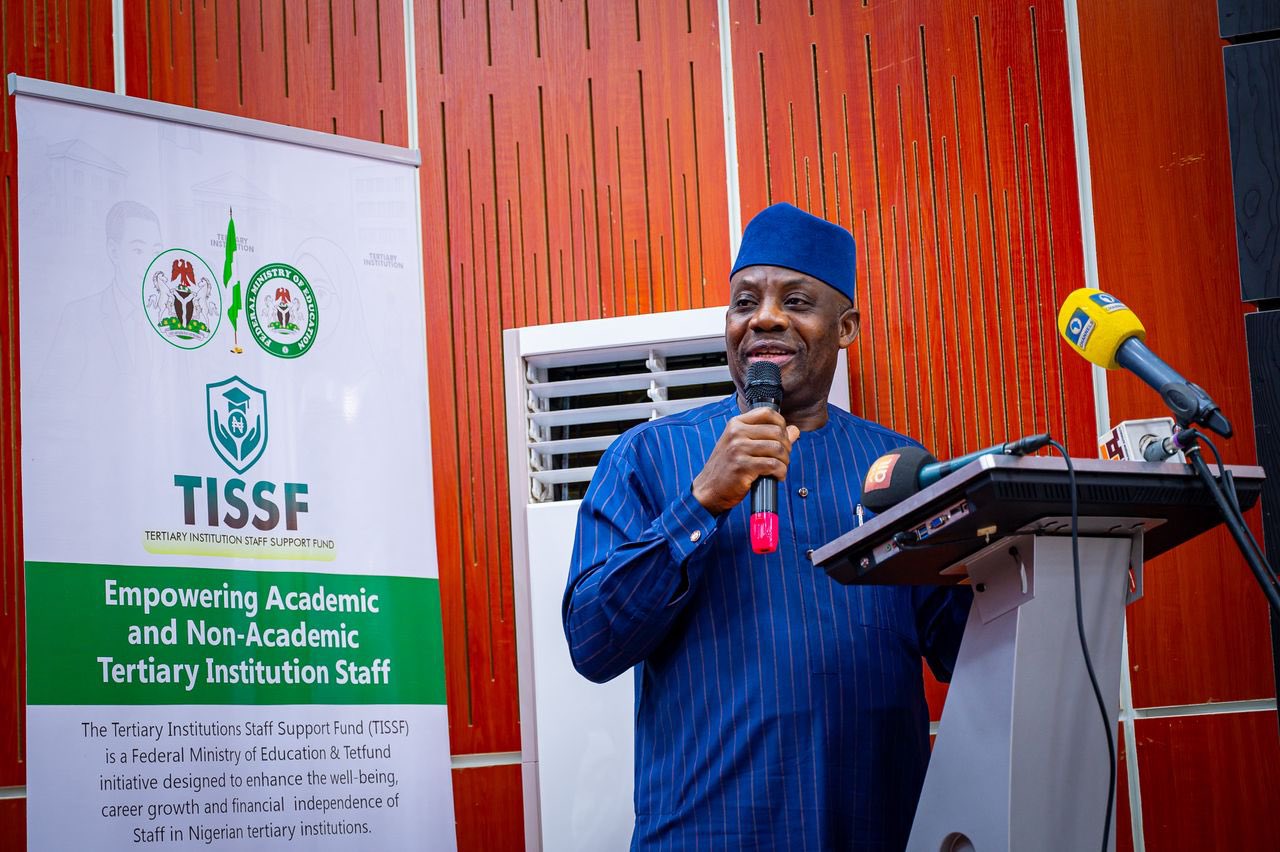
The Minister of Education, Dr Maruf Alausa, made this known on Wednesday in Abuja while delivering an address at a retreat organised by the Conference of Heads of Polytechnics, Colleges of Education and similar institutions for council chairmen, commissioners of education, rectors, registrars and bursars.

Speaking on the theme, “Transforming Polytechnic Education in Nigeria: Innovation, Good Governance and Sustainability for National Development,” Alausa said the government would no longer tolerate financial recklessness, abuse of office or unethical practices in tertiary institutions.

“The era of impunity in our institutions is over. We demand fiscal discipline, timely audits and zero tolerance for corruption in order to build public trust and attract investment,” the minister said.

He charged governing councils and management teams to uphold transparency, accountability and ethical leadership, urging them to avoid conflicts of interest, ensure prudent management of resources and prioritise merit in appointments and promotions.

Beyond governance reforms, the minister called for a comprehensive transformation of polytechnic education, stressing innovation and sustainability as key drivers of national development.

“Polytechnics are not mere institutions; they are the crucibles where innovation meets practicality, where skills forge economic resilience, and where sustainable development becomes a lived reality for our nation,” he said.

Alausa said the Federal Ministry of Education was revitalising technical and vocational education and training to ensure that graduates were equipped with practical, industry-ready skills.

See also  School closures threaten national stability, FG warns

“We have adopted a policy that ensures our polytechnic graduates are industry-ready, innovative problem-solvers capable of driving national development,” he stated.

He urged polytechnic leaders to make innovation central to their institutions by promoting entrepreneurship, research and industry partnerships.

“Innovation must be the heartbeat of our polytechnics. I urge you to foster entrepreneurship centres, research hubs and industry partnerships that turn ideas into prototypes and inventions into enterprises that will graduate into job creators,” he said.

The minister identified priority sectors such as renewable energy, agricultural technology, digital manufacturing and climate-resilient solutions as areas where polytechnics should focus their research and training efforts.

He also emphasised the need for sustainable funding models, encouraging institutions to boost Internally Generated Revenue and reduce dependence on imports.

While acknowledging persistent challenges including funding gaps, obsolete facilities and societal bias favouring university education over technical skills, Alausa expressed confidence in sustained government support.

“Under President Bola Tinubu’s Renewed Hope Agenda, we are committed to supporting you with policy reforms, infrastructure upgrades and partnerships,” he said.

The minister further announced a special TETFund intervention to upgrade polytechnic engineering schools with modern, state-of-the-art equipment, following similar interventions in medical colleges last year.

He urged participants to return to their institutions and implement the principles discussed at the retreat.

In his remarks, the Chairman of the Conference of Heads of Polytechnics, Colleges of Education and similar institutions, Dr Sani Tunga, described the retreat as timely, given the critical role of polytechnic education in Nigeria’s development.

Tunga said the theme reflected the realities facing polytechnics and colleges of technology, which he described as vital for producing skilled and entrepreneurial manpower needed to diversify the economy, reduce unemployment and achieve the Sustainable Development Goals.

See also  At least five girls k!lled after missile strikes Iranian primary school

“Our polytechnics and colleges of technology stand at the forefront of producing skilled, innovative and entrepreneurial manpower,” he said, while noting challenges such as inadequate funding, outdated infrastructure, changing industry demands, governance gaps and sustainability concerns.

He also highlighted recurring conflicts within the system, particularly between governing councils and management, as well as between management and staff unions such as ASUP, SSANIP and NASU.

According to him, such disputes, often linked to policy interpretation, resource allocation and welfare issues, undermine institutional harmony and slow progress.

Tunga stressed the need for continuous dialogue among council chairmen, commissioners, rectors, registrars and bursars to address these issues constructively.

He said the retreat was designed to explore innovative approaches to curriculum development, strengthen research and industry partnerships, improve governance and accountability, enhance financial sustainability and address the root causes of conflicts in the system.

Linking the success of the polytechnic sector to national development, Tunga said, “The transformation we seek is not merely institutional; it is national. A vibrant polytechnic sector will empower our youths, boost local content, foster self-reliance and contribute meaningfully to Nigeria’s emergence as a technological and economic powerhouse.”

In his opening remarks, the Executive Secretary of the National Board for Technical Education, Prof Idris Bugaje, described ongoing reforms as a turning point for technical and polytechnic education after decades of neglect.

Bugaje noted that technical and polytechnic education predated university education in Nigeria but suffered marginalisation after independence, particularly following the civil war, as universities received greater priority.

He highlighted the imbalance in the education system, saying, “We have only 153 technical colleges compared to over 15,000 senior secondary schools in Nigeria today. We were really struggling to survive in this very unfriendly system.”

See also  WAEC mandates 250 computers, CCTV for schools participating in CBT

According to him, the situation has begun to improve in the last two years due to reforms initiated by the current Minister of Education.

“Until the last two years, we have started seeing light at the end of the tunnel. NBTE is being reinvented, re-engineered and re-created, courtesy of the efforts of Dr Maruf Alausa,” he said.

The retreat brought together leaders across Nigeria’s polytechnic and technical education sector to chart a path toward skills-driven national development, amid renewed efforts to restore relevance to a system long constrained by underfunding, outdated curricula, weak industry linkages and declining public confidence.

punch.ng

FOLLOW US ON:

FACEBOOK

TWITTER

PINTEREST

TIKTOK

YOUTUBE

LINKEDIN

TUMBLR

INSTAGRAM

Continue Reading
Click to comment

Leave a Reply

Your email address will not be published. Required fields are marked *

Education

Ondo sets up committee on safe school programme due to Insecurity

Published

on

The Ondo State Government has set up a steering committee for safe schools programme in the state.

This was said to be a part of the efforts to protect school children from kidnapping and other forms of criminalities in the state.

The Safe Schools Initiative is a Federal Government programme, designed to protect students, teachers, and educational infrastructure from violence, kidnappings, and others forms of attacks.

At the inauguration of the committee in Akure on Tuesday, the state Commissioner for Education, Science and Technology, Igbekele Ajibefun, explained that the committee was specifically created to carry out critical responsibilities, provide strategic direction, and enhance coordination among stakeholders.

According to him, members of the steering committee include , representatives from the Nigerian Army, the Nigeria Police Force, the Nigeria Security and Civil Defence Corps, the Amotekun Corps, religious and traditional leaders, and Parents-Teachers Association.

Charging the committee members, the commissioner who is the chairman of the committee said , “You are to support the implementation of the Safe Schools Programme and strengthen mechanisms to prevent security threats in the educational institutions of the state.”

As the chairman of the committee, Ajibefun emphasised that the success of the initiative largely rests on the active participation of all stakeholders.

Explaining that security is a shared responsibility requiring vigilance, preparedness, resilience and collective action, Ajibefun admonished the members to discharge their duties with diligence, commitment, integrity, and a strong sense of purpose.

Earlier in his welcome address, the Permanent Secretary of the ministry—who also serves as the secretary of the committee, Akindele Ige, stated that the establishment of the committee was s a direct response to the growing security threats targeting schools.

See also  NLC to convene meeting on ASUU strike as ultimatum ends today

Ige noted that recent attacks have reinforced the need for deliberate, coordinated, and sustained efforts to protect students, educators, and school infrastructure across the state.

He affirmed that “No meaningful teaching can take place where there is fear, and no effective learning can occur where there is insecurity.”

Continue Reading

Education

Teacher’s detention sparks uproar among Lagos colleagues

Published

on

Colleagues of a Lagos teacher, Peter Shodipe of Ijaiye Ojokoro Junior College, have appealed to authorities to thoroughly review the circumstances surrounding a drama presentation that allegedly triggered panic among students in the school.

Shodipe was arrested after a co-curricular programme organised by the National Value Education Department of the school caused confusion when some students mistook a drama presentation on banditry for a real-life attack.

The incident, which occurred during a Wednesday co-curricular activity, later drew the attention of the police after frightened students shouted that bandits had invaded the school.

Speaking with our correspondent on Saturday, sources within the school maintained that Shodipe was merely carrying out an approved educational assignment.

A teacher in the school, who requested anonymity for fear of victimisation, said the programme had been planned as part of activities marking National Awareness Day and was intended to educate students about insecurity, particularly banditry and kidnapping.

According to the source, the National Value Education Department, comprising teachers of Social Studies, Civic Education, Security Education and History, had agreed to organise a pep talk, quiz competition and drama presentation focusing on the causes, effects and prevention of insecurity.

Shodipe, who was assigned to coordinate the drama, reportedly selected students from JSS3 for the presentation and supervised rehearsals a day before the event.

The source said, “The drama was not a standalone activity. It was part of a broader educational programme. We prepared quiz questions, assigned teachers to different responsibilities and planned awareness talks.

“The drama was intended to help students understand the realities of insecurity and the importance of vigilance. It was never conceived as entertainment or content for social media.”

The source explained that preparations for the programme began within the school compound on the morning of the event.

See also  School closures threaten national stability, FG warns

The teacher specifically noted that the preparations were observed by officials of the Lagos State Neighbourhood Safety Corps stationed at the school.

“Students changed into costumes near the school gate while officials of the Lagos State Neighbourhood Safety Corps stationed at the school observed the preparations.

A staff member volunteered a bus to serve as a prop for the drama, and the vehicle remained on the school premises throughout the preparations.

“Some parents dropping off their children also saw students changing into costumes and understood that a drama presentation was about to take place,” the source added.

However, confusion reportedly erupted when the bus moved into position for the performance.

Some students who had not been briefed on the exercise allegedly began shouting, “Bandits! Bandits!” causing panic among other students and staff members.

The situation escalated as frightened students fled into neighbouring schools within the educational complex before some eventually ran onto nearby roads.

This also prompted concerned residents to alert security agencies.

Another teacher in the school, who also preferred not to be named due to the sensitive nature of the incident, said police officers later arrived and arrested Shodipe.

“When the officers arrived, they first went to the principal’s office. The principal later took them into the staffroom, where Mr Shodipe was identified.

“Education officials and school administrators subsequently made efforts to intervene, but by then the matter had already been escalated beyond the divisional level before the teacher was transferred to the state command headquarters,” the source said.

The detention of the teacher has generated concern among colleagues, particularly following comments made by the Lagos State Commissioner of Police, Tijani Fatai, who described the incident as content creation.

See also  NLC to convene meeting on ASUU strike as ultimatum ends today

Speaking during a strategic meeting with police officers on Friday, the police commissioner said, “I can recall a teacher tried to create content around banditry and some other students who were not there got to know of this, and this caused a lot of pandemonium within the school.”

He further warned content creators against raising false alarms, stating that anyone found creating unnecessary content around sensitive security issues would face the law.

However, the colleagues strongly disputed that characterisation, insisting that describing the activity as content creation misrepresented the context in which it occurred.

The teacher further said, “We were surprised to hear it described that way because this was not a skit designed for social media and nobody was creating content.

“Mr Shodipe is a classroom teacher. He was assigned by the department to coordinate one aspect of an officially approved school programme, just as other teachers were assigned to handle the quiz and awareness sessions. Everything happened within the framework of teaching and learning.”

The source said the existence of departmental plans, rehearsals and other programme components demonstrated that the exercise was educational in nature.

“If this had been a personal project, people might understand the allegation. But this was a departmental activity involving multiple teachers and students. There were meetings, preparations and assigned responsibilities. The unfortunate panic that followed does not change the original purpose of the programme.

“The programme involved several teachers and formed part of activities approved by the department. What happened was an unintended consequence of a role-play exercise, not an attempt to create online content or spread a false alarm,” the source added.

See also  At least five girls k!lled after missile strikes Iranian primary school

The teacher acknowledged that communication gaps may have contributed to the misunderstanding but argued that any shortcomings should be treated as administrative issues rather than criminal conduct.

“We are not saying everything was perfect. Looking back, perhaps more people should have been informed because of the sensitive nature of the topic. But there is a difference between a mistake in planning and a criminal act. Nobody intended to cause panic, and nobody gained anything from what happened,” the source added.

The sources further appealed to the authorities to consider testimonies from parents, security personnel, students and staff members who witnessed the preparations before reaching any conclusions.

“What we are asking for is fairness. Let investigators speak with the teachers who planned the programme, the security personnel who witnessed the preparations and the parents who saw the students getting ready for the drama.

“We believe Mr Shodipe deserves a fair hearing and should not be punished for what appears to have been an unintended misunderstanding.”

It was gathered that efforts by Shodipe’s family to gain access to the detained teacher have so far been unsuccessful.

When contacted for a reaction, the Secretary of the National Union of Teachers in Lagos State, Gbenga Ayetobo, said the union had no information on the incident.

“No information for now, please,” he said.

The state Police Public Relations Officer, Abimbola Adebisi, could not be reached for comment as calls and text messages sent to her phone number were not responded to as of the time of filing this report.

punch.ng

FOLLOW US ON:

FACEBOOK

TWITTER

PINTEREST

TIKTOK

YOUTUBE

LINKEDIN

INSTAGRAM

Continue Reading

Education

OAU has fulfilled founding fathers’ vision, says TETFund boss

Published

on

The executive secretary, Tertiary Education Trust Fund, Sonny Echono, has said the Obafemi Awolowo University (OAU), Ile-Ife, Osun State, has lived to the ideals of its founding fathers, breeding experts in various fields of human endeavors.

Echono, while delivering a lecture to mark the 65th anniversary of Obafemi Awolowo University, Ile-Ife, Osun State, also said investment in research and innovation systems will generate practical solutions suited to local realities.

The TETFUND boss, in the copy of the paper obtained in Osogbo on Friday, paid glowing tributes to the pioneer and successive Vice Chancellors of the university for sustaining the legacies of the university’s founding fathers.

“The Great Ife has remained a symbol of commitment and purposeful leadership. Expectedly, the university has lived to the ideals of its founding fathers as the breeding ground for erudite scholars, legal luminaries, successful businessmen, diplomats, accomplished technocrats and administrators, including its legion of Nigerian National Merit Award Winners, who are contributing to national development, and have continued to uphold the reputation of the university,” he said.

Speaking on the concept of research and innovation, Echono noted that research and innovation remain key drivers of national development, saying nations that have achieved sustained economic growth and technological advancement have done so through deliberate investment in knowledge generation, scientific inquiry, and practical innovation.

He added that in present day global economy, development does not depend on natural resources, but on the capacity to create, apply, and commercialize knowledge.

“Research and innovation remain key drivers of national development. Nations that have achieved sustained economic growth and technological advancement have done so through deliberate investment in knowledge generation, scientific inquiry, and practical innovation.

See also  School closures threaten national stability, FG warns

“In today’s global economy, development does not depend on natural resources but on the capacity to create, apply, and commercialize knowledge. Nigeria’s developmental challenges, though significant, also present opportunities for innovation-driven transformation.

“Addressing issues such as unemployment, insecurity, hunger, healthcare limitations, industrial underdevelopment, and technological dependence requires sustained investment in research and innovation systems that generate practical solutions suited to local realities,” Echono said.

Commending President Bola Tinubu for focusing on research and innovation that can provide solutions to challenges peculiar to the country and her people, Echono also stressed that building a fully functional and innovation-driven economy requires deliberate efforts to address issues of funding constraints, insufficient infrastructure, inadequate motivation, limited academia-industry collaboration, and challenges in commercialising research outputs.

He emphasised that the role of TETFund in enhancing the capacity of tertiary institutions in the country for research and development through its interventions activities has become increasingly strategic for strengthening Nigeria’s research and innovation ecosystem.

He further said that by supporting research funding, academic capacity development, innovation hubs, commercialisation initiatives, and entrepreneurship programmes, TETFund has been repositioning institutions in the country as active contributors to national development.

He declared that Nigeria’s “Sustainable development largely depends on how effective we are at leveraging knowledge, innovation, and technology to grow national economy, expand opportunities, create jobs and wealth, develop new products and services and improve the well-being of its people. This is essential for national growth, competitiveness, and long-term stability.”

Earlier, the Vice Chancellor of the university, Prof Simeon Bamire, said the institution has been recording steady growth since it’s establishment about 65 years ago and commanded the sacrifices and commitment of staff members and students towards sustaining legacies of excellence OAU is reputed for.

See also  Bandit attacks: Kebbi, Kwara reopen schools

The PUNCH reports that Bamire announced plans to unveil the N10bn President Bola Ahmed Tinubu Centre of Excellence in Intercultural Dialogue and Youth Empowerment on June 8 as part of activities marking the institution’s 65th anniversary.

Bamire said the centre was designed to serve as a platform for research, dialogue, leadership development, innovation and youth empowerment.

punch.ng

FOLLOW US ON:

FACEBOOK

TWITTER

PINTEREST

TIKTOK

YOUTUBE

LINKEDIN

INSTAGRAM

Continue Reading

Trending