Connect with us

News

Presidency reveals why Egbetokun resigned as IG

Published

on

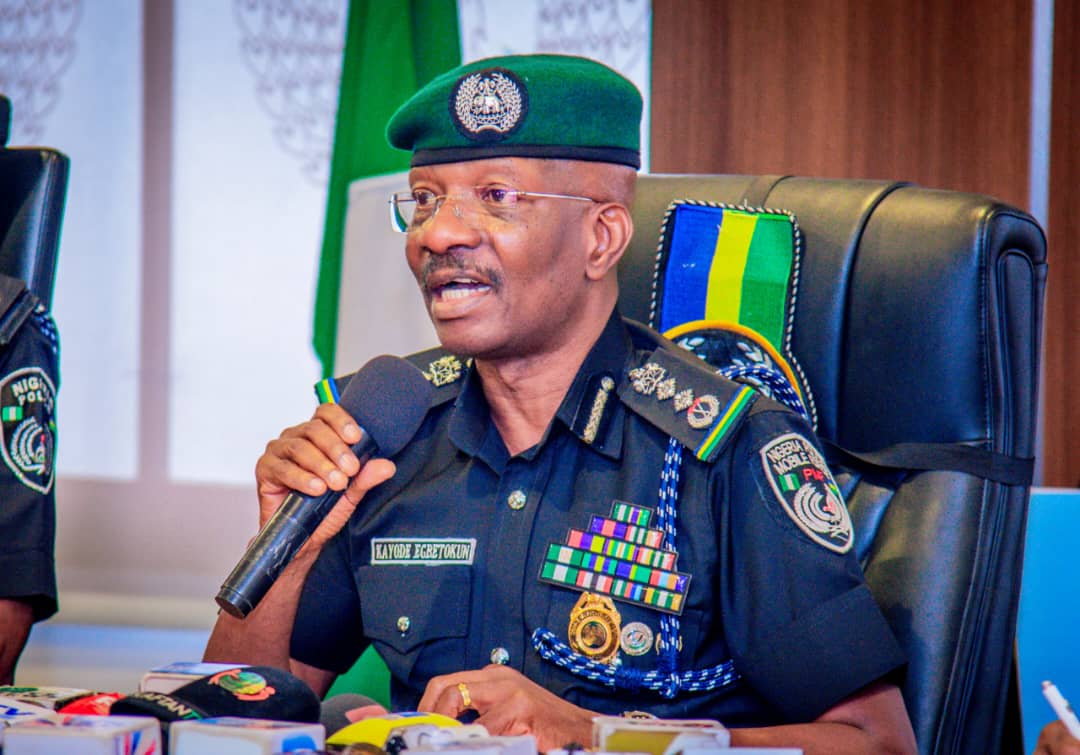
The Presidency has confirmed the resignation of Kayode Egbetokun as the Inspector-General of Police.

It said the former police boss resigned from office, citing family issues that require his undivided attention.

The Special Adviser to the President on Information and Strategy, Bayo Onanuga, disclosed this in a response to an inquiry by PUNCH Online, saying, “The IGP resigned in a letter today, citing family issues which require his undivided attention.”

However, multiple Presidency sources told our correspondent that Egbetokun was asked to step down during a meeting with President Bola Tinubu at the Presidential Villa, Abuja, on Monday evening.

“It was in that meeting he was asked to go,” a highly placed official in the Presidency stated on condition of anonymity due to the sensitivity of the matter.

Our correspondent observed the IGP’s official vehicle, a Toyota Land Cruiser with number plate NPF-01, parking at the forecourt of the Presidential Villa around 6:40 pm on Monday.

Egbetokun, dressed in his black uniform without his cap, alighted from the vehicle and turned back to ask for his notepad from an aide who briskly reached into the vehicle and handed it to him.

The IGP arrived at approximately the same time governors were arriving for an interfaith breaking of fast with the President, raising initial uncertainty about the purpose of his visit.

However, another source at the Villa confirmed that Egbetokun was specifically summoned that evening by the President.

“He was called in. It wasn’t a routine visit,” the source stated.

Security officials who confided in our correspondent said the IGP returned to the State House at about 8:00 pm as his vehicle was subjected to search by DSS operatives at the Villa.

See also  Remain apolitical, neutral in professional duties, NAF warns personnel

Egbetokun, who was appointed IGP on June 19, 2023, has faced mounting criticism over the nation’s deteriorating security situation, particularly the wave of kidnappings, banditry, and terrorist attacks across multiple states.

Recent high-profile incidents include the abduction of nearly 300 schoolchildren from St. Mary’s boarding school in Niger State in November 2025, mass killings in Kwara State communities in February 2026, and persistent kidnappings along major highways.

The President, during Monday’s Iftar with governors, had pledged that the establishment of state police to combat insecurity would not be postponed, declaring that “security is the foundation of prosperity.”

“Without it, farms cannot flourish, businesses cannot grow, and families cannot sleep in peace. We will establish state police to curb insecurity,” Tinubu had stated at the event.

Before his appointment as IGP, Egbetokun served as Deputy Inspector-General of Police in charge of the Force Criminal Investigations Department.

He succeeded Usman Alkali Baba, whose tenure expired in September 2023 after an extension granted by former President Muhammadu Buhari.

The IGP resigned in a letter today, citing family issues which require his undivided attention

punch.ng

FOLLOW US ON:

FACEBOOK

TWITTER

PINTEREST

TIKTOK

YOUTUBE

LINKEDIN

TUMBLR

INSTAGRAM

Continue Reading
Click to comment

Leave a Reply

Your email address will not be published. Required fields are marked *

News

US blockade: Iran closes Strait of Hormuz again with ships mid-transit

Published

on

Iran’s military declared the Strait of Hormuz closed again on Saturday, its military command said, hours after reopening it and with more than a dozen commercial ships passing through the vital waterway.

The toing and froing over the Strait cast doubt on US President Donald Trump’s optimism the day before, that a peace deal to end the US-Israeli war with Iran was “very close”.

Tehran had on Friday declared the strait, which usually carries a fifth of the world’s oil and liquefied natural gas, open after a ceasefire was agreed in Lebanon to halt Israel’s war with Hezbollah.

This prompted elation in global markets and sent oil prices plunging, but with Trump insisting that a US naval blockade of Iranian ports would continue until a deal was concluded, Tehran threatened to shut the strait once more.

Then, late on Saturday morning, citing a statement from military central command, Iranian state TV reported that “control of the Strait of Hormuz has returned to its previous status” and “is under strict management and control of the armed forces”, calling the decision a response to a continued US blockade.

The announcement came as maritime tracking sites showed several ships making a dash through the narrow waterway, hugging close to Iranian territorial waters as instructed by Tehran and, for some, broadcasting their identity as Indian or Chinese in an apparent attempt to show their neutrality.

By 1030 GMT on Saturday, no fewer than eight oil and gas tankers had crossed the strait, but at least as many ships appeared to have turned back, having begun to exit the Gulf.

See also  Alaafin Crowns Kwara Monarch Oloro Of Oro

We’re going to get it’

There are just four days remaining before the end of the two-week ceasefire in the US-Israeli war with Iran, launched by Washington and its ally on February 28.

Nevertheless, President Trump appeared convinced that a deal could be finished shortly.

He declared Friday “GREAT AND BRILLIANT,” and made a series of social media posts praising the talks mediator, Pakistan.

Islamabad’s powerful military chief, Field Marshal Asim Munir, on Saturday finished a three-day visit to Iran aimed at securing the peace deal, during which he met Iran’s top leadership.

While Munir was in Iran, Pakistani Prime Minister Shehbaz Sharif visited Saudi Arabia, Qatar and Turkey to push the peace process.

Egypt, which has also been involved in diplomatic efforts, also appeared upbeat on Saturday, with Foreign Minister Badr Abdelatty saying Cairo and Islamabad hoped to secure a final agreement “in the coming days”.

Islamabad has emerged as the lead mediator during the conflict, hosting a marathon round of direct peace talks last weekend attended by US Vice President JD Vance.

A second round of talks is expected in the Pakistani capital this coming week, with envoys hoping to end the war that was started by the US and Israel on February 28.

The allies launched a massive wave of surprise attacks on Iran, despite Washington and Tehran being engaged in diplomatic talks, which killed Iranian supreme leader Ali Khamenei and numerous senior leaders.

The war rapidly spread across the region, with Iran targeting US interests in the Gulf and Hezbollah dragging Lebanon into the conflict by launching rockets at Israel.

See also  PHOTOS: Nigerian man who s£xually ass@ulted a teenage girl in the UK is spared jail due to his 'troubled background'

In a sign that the two-week ceasefire remained stable, Iran’s civil aviation agency declared its airspace was open again, with international flights able to transit Iran via the east of the country.

Nevertheless, two major sticking points in the peace talks — Iran’s stockpile of near-weapons-grade enriched uranium and the future of the Strait of Hormuz appeared to be up in the air.

Speaking by phone with AFP on Friday, Trump said “we’re very close to having a deal,” adding that there were “no sticking points at all” left with Tehran.

Later the same day, at an event in Arizona, the president declared that Iran had agreed to hand over its 440 or so kilogrammes of uranium enriched to 60 per cent, close to that needed for a bomb.

“We’re going to get it by going in with Iran, with lots of excavators,” he said.

But hours before, Iran’s foreign ministry had said its stockpile, thought to be buried deep under rubble by US bombing in last June’s 12-day war, was not going anywhere.

“Iran’s enriched uranium is not going to be transferred anywhere,” Iranian foreign ministry spokesman Esmaeil Baqaei told state TV.

“Transfer of Iran’s enriched uranium to the US has never been raised in negotiations.”

Ordinary Iranians, meanwhile, remained cut off from the international internet, with monitor Netblocks announcing on Saturday that the blackout implemented at the start of the war had reached its 50th day.

AFP

punch.ng

FOLLOW US ON:

FACEBOOK

TWITTER

PINTEREST

TIKTOK

YOUTUBE

LINKEDIN

Continue Reading

News

Abia inaugurates tasks force against human trafficking

Published

on

Abia State Government and the National Agency for the Prohibition of Trafficking in Persons, NAPTIP, have inaugurated the Abia State task force against human trafficking, aimed at protecting vulnerable citizens from the growing menace.

The task force has the Attorney-General and Commissioner for Justice, Abia State, Mr. Ikechukwu Uwanna, SAN, as the Chairman.

Inaugurating the task force in Umuahia, Abia State Governor, Alex Otti described the action as a decisive step to eliminate human trafficking and uphold human dignity in the State.

“This moment is not merely ceremonial; it is strategic, purposeful and urgent.

“The establishment of this Task Force marks a decisive step in strengthening our collective resolve to prevent, combat, and ultimately eradicate the scourge of human trafficking within our dear State,” he stated.

Otti, who was represented by his deputy, Ikechukwu Emetu, said that trafficking networks are often linked to organized crime, including drug trafficking and transnational criminal syndicates.

He lamented that families and communities have been affected by the menace but called for enforcement, rehabilitation and reintegration approaches

In her speech, the Director-General of NAPTIP, Mrs. Binta Adamu Bello, noted that the inauguration makes Abia the 25th state in Nigeria to establish a NAPTIP-supported task force against the growing global menace.

In his remarks, Uwanna, SAN, expressed optimism that the initiative would prevent the State from becoming a haven for human traffickers.

FOLLOW US ON:

FACEBOOK

TWITTER

PINTEREST

TIKTOK

YOUTUBE

LINKEDIN

See also  Ex-AGF Malami, son, wife granted N1.5bn bail
Continue Reading

News

Abia Govt cautions doctors against rejecting emergency patients over money

Published

on

Doctors, nurses and other medical personnel in Abia hospitals have been told to first save the life of a patient brought into their facilities under emergency condition, before demanding for payment.

The caution was given during the ongoing training program organized by the Abia State government for doctors, nurses, pharmacists, laboratory technicians and other Abia medical staff in Umuahia.

The programme, which is being used to prepare Patients Liaison Officers, PLOs, for hospitals, also cautioned medical staff in the State against using harsh words against patients and their family members but soft word and close care.

Speaking during the training session in Umuahia, the Chief Executive Officer of Quantus Medical Foundation, Dr. Nnenna Ihekoromadu decried the poor patient-personnel relationship in Nigeria.

She said sick persons in the hospital needed respect, soft words and close care to fasten the healing capacity of drugs, pointing out that doctors, nurses, pharmacists, Lab technicians or other staff on duty should be held accountable for good or bad service rendered to their patients.

She noted that it was wrong to abandon a patient under emergency to fate because no money was deposited by the patient’s family.
“So if a patient cannot afford care and they’ve come into an emergency situation, they will have to be treated.

“Stabilize them, treat them before you start asking about payments,” Ihekoromadu said.

She also urged the Nigerian government to ensure that medical staff in the country get good welfare package to be able to function optimally.

See also  Bandits attacked Kwara community for 10 hours before soldiers arrived – Village head

FOLLOW US ON:

FACEBOOK

TWITTER

PINTEREST

TIKTOK

YOUTUBE

LINKEDIN

Continue Reading

Trending