Connect with us

News

Presidency reveals why Egbetokun resigned as IG

Published

on

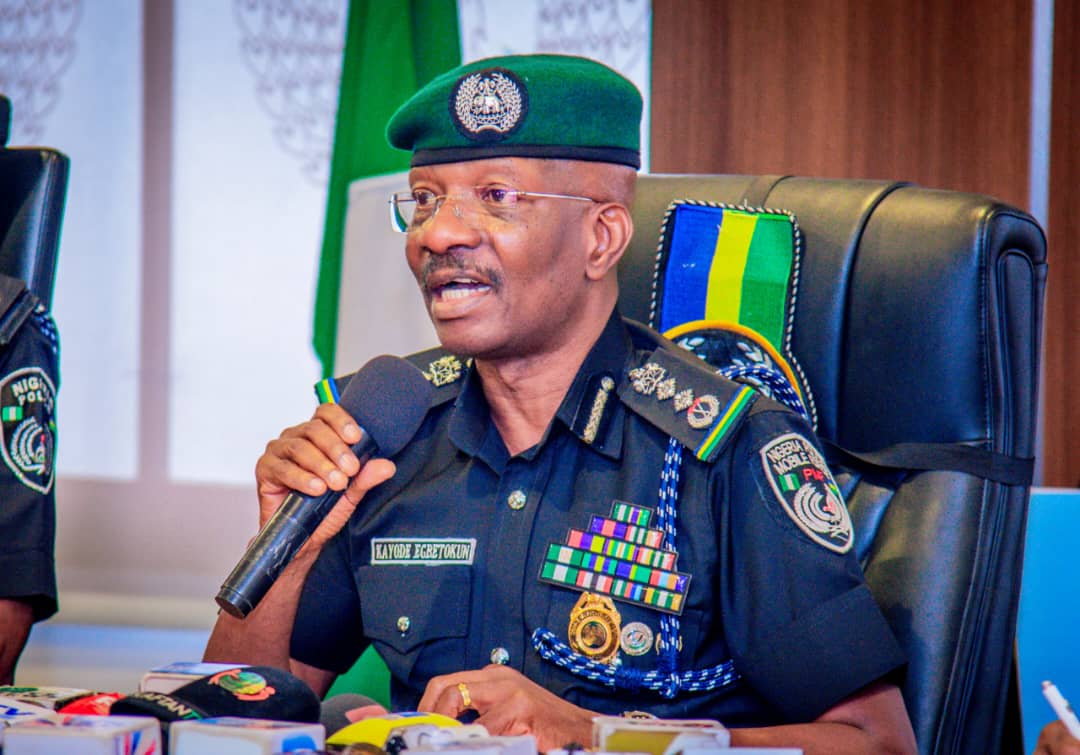
The Presidency has confirmed the resignation of Kayode Egbetokun as the Inspector-General of Police.

It said the former police boss resigned from office, citing family issues that require his undivided attention.

The Special Adviser to the President on Information and Strategy, Bayo Onanuga, disclosed this in a response to an inquiry by PUNCH Online, saying, “The IGP resigned in a letter today, citing family issues which require his undivided attention.”

However, multiple Presidency sources told our correspondent that Egbetokun was asked to step down during a meeting with President Bola Tinubu at the Presidential Villa, Abuja, on Monday evening.

“It was in that meeting he was asked to go,” a highly placed official in the Presidency stated on condition of anonymity due to the sensitivity of the matter.

Our correspondent observed the IGP’s official vehicle, a Toyota Land Cruiser with number plate NPF-01, parking at the forecourt of the Presidential Villa around 6:40 pm on Monday.

Egbetokun, dressed in his black uniform without his cap, alighted from the vehicle and turned back to ask for his notepad from an aide who briskly reached into the vehicle and handed it to him.

The IGP arrived at approximately the same time governors were arriving for an interfaith breaking of fast with the President, raising initial uncertainty about the purpose of his visit.

However, another source at the Villa confirmed that Egbetokun was specifically summoned that evening by the President.

“He was called in. It wasn’t a routine visit,” the source stated.

Security officials who confided in our correspondent said the IGP returned to the State House at about 8:00 pm as his vehicle was subjected to search by DSS operatives at the Villa.

See also  See what made Imisi win Big Brother Naija

Egbetokun, who was appointed IGP on June 19, 2023, has faced mounting criticism over the nation’s deteriorating security situation, particularly the wave of kidnappings, banditry, and terrorist attacks across multiple states.

Recent high-profile incidents include the abduction of nearly 300 schoolchildren from St. Mary’s boarding school in Niger State in November 2025, mass killings in Kwara State communities in February 2026, and persistent kidnappings along major highways.

The President, during Monday’s Iftar with governors, had pledged that the establishment of state police to combat insecurity would not be postponed, declaring that “security is the foundation of prosperity.”

“Without it, farms cannot flourish, businesses cannot grow, and families cannot sleep in peace. We will establish state police to curb insecurity,” Tinubu had stated at the event.

Before his appointment as IGP, Egbetokun served as Deputy Inspector-General of Police in charge of the Force Criminal Investigations Department.

He succeeded Usman Alkali Baba, whose tenure expired in September 2023 after an extension granted by former President Muhammadu Buhari.

The IGP resigned in a letter today, citing family issues which require his undivided attention

punch.ng

FOLLOW US ON:

FACEBOOK

TWITTER

PINTEREST

TIKTOK

YOUTUBE

LINKEDIN

TUMBLR

INSTAGRAM

Continue Reading
Click to comment

Leave a Reply

Your email address will not be published. Required fields are marked *

News

Fire-ravaged Lagos airport old terminal to be demolished – Keyamo

Published

on

The Minister of Aviation and Aerospace Development, Festus Keyamo, has inspected the level of destruction caused by Monday’s ravaging fire.

The minister said the fire was contained and no life was lost.

While speaking with journalists at the incident scene, Keyamo said victims who were hospitalised are now responding to treatment at a health facility in Lagos.

Lagos airport
The fire incident scene. Credit: Olasunkanmi Akinlotan

He said the terminal, which was slated for refurbishment, will be pulled down anyway, adding that a temporary terminal from where the few airlines operating from the facility will now operate has reached an advanced stage.

It will be recalled that a ravaging fire disrupted operations at the old terminal of the Murtala Muhammed International Airport, Lagos, on Monday, triggering diversions, compounding travel delays and operational uncertainty across airlines.

The fire incident scene. Credit: Olasunkanmi Akinlotan

It was also gathered that at least six persons were hospitalised after the fire outbreak engulfed Terminal 1 of the Murtala Muhammed International Airport, forcing the diversion of international flights, damaging airport equipment, and triggering a massive multi-agency emergency response.

The fire incident, which began around 3:00 p.m., was still being battled by firefighters as of 7:00 p.m., with thick smoke billowing from sections of the terminal.

More to come…

punch.ng

FOLLOW US ON:

FACEBOOK

TWITTER

PINTEREST

TIKTOK

YOUTUBE

LINKEDIN

TUMBLR

INSTAGRAM

See also  Oyo Declares Public Holiday For Isese Festival
Continue Reading

News

FULL LIST: US Congress urges Nigeria to ditch Russian arms, block beef exports

Published

on

The House Committees on Appropriations and Foreign Affairs of the United States Congress have recommended a series of measures aimed at addressing what they described as the “persecution of Christians” in Nigeria.

The recommendations followed the formal submission of a report to the White House outlining the committee’s findings and proposals.

The submission came after President Donald Trump redesignated Nigeria as a Country of Particular Concern (CPC).

In the report released on Monday by committee chairman Riley Moore, lawmakers proposed several steps to address the alleged crisis and improve security and religious freedom.

One key recommendation calls on Nigeria to distance itself from Russia in the security sphere, including divesting from Russian military hardware and instead procuring U.S. defence equipment through sales and financing arrangements.

The committees also proposed a sweeping bilateral agreement between Washington and Abuja aimed at protecting vulnerable Christian communities, eliminating jihadist terror networks, and countering Chinese and Russian influence in Nigeria.

The report further suggested blocking beef and other cattle-related exports to certain countries as a measure to compel Fulani herdsmen to disarm amid reports of attacks on Christian communities.

It also recommended the continuation of visa restrictions on individuals involved in violence against Christians and violations of religious freedom.

Full Recommendations:

  • Strike a bilateral agreement between the United States and the Government of Nigeria to protect vulnerable Christian communities from violent persecution, eliminate jihadist terror activity in the region, further economic cooperation, and counter adversaries in the region, including the Chinese Communist Party and Russian Federation. Such an agreement should include:

    • Commitments by the Government of Nigeria to:

      • Co-fund donor-supported humanitarian assistance — including through faith-based organizations — and prioritize underserved communities of Internally Displaced Persons (IDPs) and their host communities, especially in the predominantly Christian Middle Belt region.

      • Support and respond to early-warning mechanisms to prevent attacks and kidnappings, including by deploying sufficient and capable security forces to the Middle Belt to enable rapid and effective response, and hold those who ignore warnings accountable.

      • Remove Fulani militias from confiscated, productive farmland and enable the voluntary return of displaced communities to their homes, including by ensuring security and infrastructure, thereby reducing the need for humanitarian aid and generating economic development through increased agricultural productivity.

      • Continue and expand security cooperation with the United States, including divestment of Russian military equipment for American military equipment through sales and financing.

    • Technical support to the Government of Nigeria to reduce and then eliminate violence from armed Fulani militias, including:

      • Developing a demobilization, disarmament, and reintegration program to address illicit weapons and support safer communities while allowing farmers to engage in legitimate self-defense.

      • Supporting the new Ministry of Livestock, ranching plans, and meaningful land reform efforts.

      • Enhancing the recruitment, technical capabilities, and willingness of security forces and military to prevent and respond to violent attacks.

    • Comprehensive counter-terrorism cooperation to rid the region of Foreign Terrorist Organizations that pose a direct threat to the U.S., including through the provision of excess defense equipment and use of relevant drawdown authorities.

    • Counteract hostile foreign exploitation of Chinese illegal mining operations and their destabilizing practice of paying protection money to Fulani militias.

  • Implement the National Security, Department of State, and Related Programs Appropriations Act, 2026, to support the preceding recommendations and the following priorities:

    • Increased accountability by requiring proof of progress before obligating additional funds.

    • Programs to address religious freedom, atrocity response, legal reforms, expand and improve policing, strengthen the criminal justice sector, improve anti-money laundering methods, and enhance capabilities to disrupt terrorist financing networks as well as capture illicit monies from Fulani militia members.

    • Treasury Department programs and activities to strengthen the integrity of Nigeria’s financial system to safeguard U.S. national security and enhance the favorable balance of trade for the United States.

    • U.S. Development Finance Corporation investments in Nigeria, especially in the Middle Belt.

    • GAO audit report on the effectiveness of aid to Nigeria and recommendations for strengthened oversight.

  • Invoke and publicly announce the CPC Presidential Directives to name and shame perpetrators of violence.

  • Implement sanctions on groups and individuals who participate in, or tolerate, violence against Christians.

  • Continue visa restrictions for perpetrators involved in Christian violence and violations of religious freedom.

  • Demand the repeal of sharia codes and criminal anti-blasphemy laws.

  • Review and use points of leverage to compel Fulani herdsmen to disarm, including by blocking export of beef and other cattle-related products to countries such as Ivory Coast, Ghana, South Africa, and Senegal.

  • Ensure adequate staffing of diplomatic posts in Nigeria.

  • Improve the Foreign Military Sales process to expedite the procurement and delivery of defense articles and services necessary to support shared security priorities.

  • Require a National Intelligence Estimate (NIE) on Nigeria’s sectarian and communal violence, and review classifying Fulani militia groups with links to terror groups, as well as other groups conducting organized campaigns of violence that threaten the United States, as a Foreign Terrorist Organization.

  • Enlist the support of international partners, including France, Hungary, and the United Kingdom.

    punch.ng

    FOLLOW US ON:

    FACEBOOK

    TWITTER

    PINTEREST

    TIKTOK

    YOUTUBE

    LINKEDIN

    TUMBLR

    INSTAGRAM

See also  Ghana accepts Nigerians, other West Africans deported from US
Continue Reading

News

El‑Rufai files motion to dismiss DSS case, demands N2 bn compensation

Published

on

A former Kaduna State Governor, Nasir El-Rufai, has filed an application asking the court to quash charges instituted against him by the Department of State Services, describing the case as incompetent and a gross abuse of court process.

The application was filed in response to Charge No. FHC/ABJ/CR/99/2026 is pending before the Federal High Court. The matter is scheduled for hearing on February 25, 2026, before Justice Joyce Abdulmalik.

In the motion, El-Rufai is seeking an order quashing or striking out the charge dated February 16, 2026, on the grounds that it discloses no offence known to law and constitutes an abuse of the judicial process.

He is also asking the court to discharge him on the basis that the charge fails to establish a prima facie case.

Additionally, the former governor is seeking N2 billion in costs against the DSS, alleging what he described as the “abuse and misuse of the court process” and the unconstitutional use of the criminal justice system to harass and embarrass him.

According to the court documents, the motion, which lists 17 grounds for dismissal, challenges the constitutional validity of the charges, arguing that they cite offences not known to law and fail to meet statutory requirements. Other grounds include alleged duplicity, absence of evidence, lack of prosecutorial competence, and claims of bad faith and political persecution.

The application further contends that the prosecution violates several constitutional provisions that breached El-Rufai’s fundamental rights, including Section 36(5) of the 1999 Constitution, which guarantees the presumption of innocence; Section 36(11), which provides for the right against self-incrimination; Section 36(12), which requires that offences be defined in written law; as well as Sections 39 and 40, which guarantee the rights to freedom of expression and freedom of association, respectively.

See also  FG pushes for N17.89tn new loans to finance 2026 budget

El-Rufai’s legal team said it notified the Director-General of the DSS of the application through a letter dated February 18, formally communicating the filing and the details of his counsel.

PUNCH Online had reported that the DSS had fixed February 25 to arraign El-Rufai over alleged cybercrime and breach of national security.

The DSS had filed a three-count criminal charge against the former governor, accusing him of unlawfully intercepting the telephone conversation of the National Security Adviser, Nuhu Ribadu.

The secret police alleged that El-Rufai’s actions contravened provisions of the Cybercrimes (Prohibition, Prevention, etc.) Amendment Act, 2024, and the Nigerian Communications Act, 2003.

In the first count, the DSS alleged that the former governor, on February 13, 2026, while appearing as a guest on Arise TV’s Prime Time Programme in Abuja, admitted during the interview that he and others unlawfully intercepted the phone communications of the NSA, an offence said to be contrary to, and punishable under Section 12(1) of the Cybercrimes (Prohibition, Prevention, etc.) Amendment Act, 2024.

In count two, El-Rufai was accused of stating during the same television interview that he knew and related with an individual who unlawfully intercepted the NSA’s phone communications without reporting the person to relevant security agencies.

The DSS said the alleged offence is punishable under Section 27(b) of the Cybercrimes (Prohibition, Prevention, etc.) Amendment Act, 2024.

El-Rufai had, during the live Arise TV interview, claimed that he overheard Ribadu directing security operatives to detain him, linking the alleged directive to what he described as an attempted arrest at the Nnamdi Azikiwe International Airport on February 12 upon his return from Cairo, Egypt.

See also  Oyo Declares Public Holiday For Isese Festival

punch.ng

FOLLOW US ON:

FACEBOOK

TWITTER

PINTEREST

TIKTOK

YOUTUBE

LINKEDIN

TUMBLR

INSTAGRAM

Continue Reading

Trending