Connect with us

Business

Senate rejects new fintech body, hands full oversight to CBN

Published

on

The Senate on Wednesday called for a stronger regulatory framework that would place the Central Bank of Nigeria at the centre of supervising the country’s fast-growing financial technology sector.

The upper chamber also demanded tougher measures to curb the rising wave of Ponzi schemes across the country.

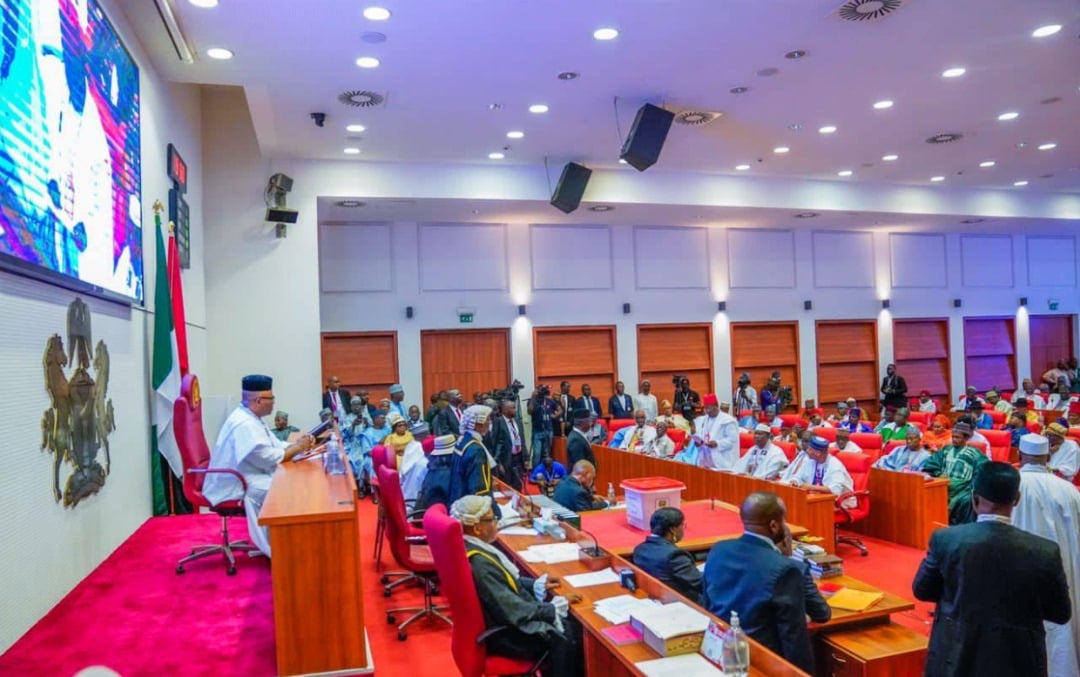
Chairman of the Senate Committee on Banking, Insurance and Other Financial Institutions, Senator Mukhail Adetokunbo Abiru (Lagos East), disclosed this during a one-day public hearing at the National Assembly, Abuja.

The hearing focused on the Banks and Other Financial Institutions Act (Amendment) Bill, 2025 (SB. 959) and an investigative session into the operations of Ponzi schemes in Nigeria, with particular reference to the recent Crypto Bullion Exchange incident.

The session was jointly organised by the Senate Committees on Banking, ICT and Cyber Security, Capital Market, and Anti-Corruption and Financial Crimes.

Abiru said the proposed amendment seeks to strengthen the existing legal framework under the Banks and Other Financial Institutions Act, 2020 and provide a clear statutory basis for the designation, registration and supervision of Systemically Important Institutions, particularly technology-driven financial service providers.

According to him, the bill will amend BOFIA 2020 to reflect the realities of Nigeria’s evolving financial ecosystem, where fintech companies now process huge transaction volumes and hold sensitive financial data belonging to millions of Nigerians.

Over the past decade, fintech firms — including mobile money operators, payment platforms, digital lenders and settlement companies — have expanded rapidly, deepening financial inclusion.

However, concerns have grown that the regulatory framework has not kept pace with their scale and systemic importance.

See also  Dangote refinery slashes petrol gantry price by N75/litre; read details

Although the Central Bank of Nigeria currently designates Systemically Important Financial Institutions, the framework largely focuses on banks and does not fully address large, non-bank digital platforms, thereby creating regulatory gaps.

Abiru said the amendment would empower the CBN to designate qualifying fintechs and digital financial institutions as Systemically Important Institutions, establish a national registry to enhance transparency and beneficial ownership disclosure, strengthen risk-based supervision tailored to technology-driven services, and promote data sovereignty and systemic stability.

“The question has arisen as to whether the creation of a new standalone regulatory agency would be a preferable pathway for supervising fintechs.

“However, after careful consideration, it is evident that establishing an entirely new agency would duplicate functions, create bureaucratic overlap, increase administrative costs, and fragment regulatory authority in a sector where coordination and coherence are essential”. Abiru said.

He added that fintech regulation is closely tied to monetary policy, payments oversight, prudential supervision, Know-Your-Customer and Anti-Money Laundering enforcement, as well as systemic risk monitoring — functions that already reside within the Central Bank.

“It is far more effective to strengthen the BOFIA framework, modernise CBN supervisory powers, and mandate robust coordination with agencies such as the Securities and Exchange Commission, Nigerian Communications Commission, National Information Technology Development Agency, Corporate Affairs Commission, Federal Competition and Consumer Protection Commission, Office of the National Security Adviser and the Federal Ministry of Finance,” he said.

The senator noted that incorporating fintech regulation into BOFIA would prevent regulatory silos and ensure digital financial services remain integrated with the broader banking system.

See also  Nigeria’s oil output hits 74-month high, beats OPEC quota

Beyond fintech regulation, the Senate also intensified its scrutiny of Ponzi schemes and fraudulent digital investment platforms.

Abiru described the growing prevalence of such schemes as a serious threat to financial stability and public confidence.

He cited the recent CBEX incident, which reportedly led to significant losses for many Nigerians, including young professionals, retirees, traders, small business owners and students.

He warned that Ponzi schemes not only cause personal hardship but also undermine trust in legitimate financial institutions, distort capital allocation, damage Nigeria’s financial reputation and increase the risk of money laundering and illicit financial flows.

Following its investigation into regulatory gaps, institutional coordination and the adequacy of existing laws, the Senate proposed stricter measures to curb fraudulent investment platforms.

Stakeholders who made submissions at the hearing included representatives of the Central Bank of Nigeria, Nigerian Deposit Insurance Corporation, Economic and Financial Crimes Commission, Nigerian Communications Commission, Federal Competition and Consumer Protection Commission, Ministry of Finance Incorporated and the Chartered Institute of Bankers of Nigeria, among others.

The Senate said it would consider the memoranda submitted before making its final recommendations on the proposed amendment and related regulatory reforms.

punch.ng

FOLLOW US ON:

FACEBOOK

TWITTER

PINTEREST

TIKTOK

YOUTUBE

LINKEDIN

TUMBLR

INSTAGRAM

Continue Reading
Click to comment

Leave a Reply

Your email address will not be published. Required fields are marked *

Business

Agricultural quarantine service postpones release of recruitment shortlist

Published

on

The Nigeria Agricultural Quarantine Service has postponed the publication of shortlisted candidates for its ongoing recruitment exercise, which was initially scheduled for Thursday, August 13.

NAQS said the decision was made to ensure a thorough, transparent and accurate recruitment process.

The agency announced the postponement in a public notice signed by the Director of Human Resources, ACG Issaka Ahmed, and posted on its X handle on Friday.

“In order to ensure a thorough, transparent and accurate process, we are unable to release the list of shortlisted candidates as scheduled,” the notice stated.

The agency apologised for the delay and urged applicants and members of the public to remain patient while awaiting a new date.

“We sincerely regret any inconvenience or uncertainty this delay may have caused and appreciate the patience, understanding and continued interest of all applicants.

“All applicants and the general public are hereby notified that a new date will be communicated in due course through our official communication channels,” it said.

The agency advised applicants to rely only on information released through its official channels.

The recruitment exercise, which opened on July 28 and closed on August 10, attracted 606,928 attempted applications, while 407,659 were successfully submitted, according to statistics released by NAQS on Wednesday.

The agency said 199,269 applications were incomplete at the close of the application period.

The Assistant Superintendent of Quarantine II cadre, requiring HND or bachelor’s degree, recorded the highest number of applications with 290,076, followed by Quarantine Assistant II with 117,177 applications.

Other cadres included the NCE category with 79,685 applications, OND with 70,170, and the Superintendent cadre requiring a master’s degree with 13,183 applications.

See also  FG plans 500 CNG stations to cut petrol use

PUNCH Online reports that NAQS said it will conduct a computer-based test and interviews on August 15, after shortlisted candidates are released on August 13.

However, candidates will now await new dates.

The recruitment exercise covers the Superintendent, Inspectorate and Assistant cadres.

Source: punchng.com

FOLLOW US ON:

FACEBOOK

TWITTER

PINTEREST

TIKTOK

YOUTUBE

LINKEDIN

INSTAGRAM

Continue Reading

Business

Customs dismiss smuggling, revenue leakage allegations

Published

on

The Nigeria Customs Service has dismissed allegations of increased smuggling, revenue leakage, recruitment impropriety and manipulation of succession within the service, describing them as a misrepresentation of its operations and administrative processes.

The service’s National Public Relations Officer, Deputy Comptroller Abdullahi Maiwada, stated this in a response released on Thursday to an investigative report published by a media outlet (not PUNCH) on August 7, 2026.

The report had alleged intensified smuggling along the Seme, Idiroko, Ilaro, Ipokia and Igbeti-Kishi corridors, as well as manipulation of the 846 valuation code at the Apapa, Tin Can Island and PTML Area Commands.

Maiwada said the claim of a surge in smuggling was inconsistent with the service’s enforcement activities, pointing to regular seizures recorded along the affected corridors.

“Our responsibility is to reduce smuggling to the barest minimum, not to claim that it can be completely eradicated,” he said.

On the 846 valuation code, the NCS explained that it was a digital tool designed for vehicles with non-standard or non-compliant Vehicle Identification Numbers, including specialised heavy equipment, classic vehicles and customised models.

“The 846 code is an established digital valuation code within the Customs portal, specifically designated for vehicles with non-standard or non-compliant Vehicle Identification Numbers,” Maiwada said.

He added that standard vehicles were assessed automatically through manufacturer-linked databases, while 846 applications were subjected to secondary approval by valuation officers and Area Controllers.

Maiwada said discrepancies discovered through post-clearance audits could lead to Demand Notices for the recovery of short-collected duties and sanctions against offending operators, adding that revenue collections at major ports had reached historic levels under the digital framework.

On the recruitment of Assistant Superintendents of Customs II, the Service said the exercise was conducted under the authorisation of the Nigeria Customs Service Board and in line with the NCS Act 2023 and Federal Character Commission guidelines.

See also  I Wonder How Lagos Economy Would Be Without Igbo Traders – Illbliss

It said successful candidates were issued provisional offers subject to medical verification, background checks and formal acceptance.

The Service also rejected allegations of succession manipulation and favouritism among officers, saying promotions were determined by seniority, merit, promotion examinations and available vacancies in accordance with established regulations.

“Succession and promotion within the Service are governed by established rules and career progression structures, not personal preference,” the Service said.

Maiwada said leadership training for Deputy Comptrollers was part of the Service’s human capital development strategy, aimed at strengthening trade operations, intelligence management and executive leadership.

He explained that approved training programmes and international exposures were funded through budgetary allocations or formal technical assistance arrangements with partner institutions.

Responding to calls for independent investigations, the NCS said it remained subject to oversight by the Federal Ministry of Finance, National Assembly, Office of the Auditor-General for the Federation and anti-corruption agencies.

“The management maintains a firm, intolerant posture toward corruption, revenue leakage or administrative misconduct,” the Service stated.

It added that any officer or stakeholder found culpable would face disciplinary action and prosecution in accordance with the law, while assuring Nigerians that the Service would cooperate with any legitimate investigation by statutory authorities.

Source: punchng.com

FOLLOW US ON:

FACEBOOK

TWITTER

PINTEREST

TIKTOK

YOUTUBE

LINKEDIN

INSTAGRAM

Continue Reading

Business

Patience Jonathan revealed she mentored Azikel refinery boss Eruani from ‘small boy’ to big businessman

Published

on

Ex-President Goodluck Jonathan’s wife, Patience, has described the Group President of Azikel Group, Dr Azibapu Eruani, as a “small boy” she raised and mentored into the league of Nigeria’s biggest businessmen.

She said her guidance was behind his bold entry into big business at a relatively young age.

The former First Lady spoke on Tuesday in a video which went viral on Thursday during an inspection tour of the Azikel Refinery in Obunagha, Bayelsa State, alongside other dignitaries.

She said she personally introduced Eruani to billionaire businessmen, Aliko Dangote and Aminu Dantata, and pushed him to aspire to their level despite being the youngest among them.

“He’s a boy that I brought up. We are always together. Although he’s the little one among us when we are friends — Dangote, Seyi, Dantata, Eruani — among us, he’s the smallest. But I made sure he followed the Dangotes, he followed Dantata.

“Because I’m a woman in their midst, I made sure I told this small boy, ‘Go and follow them, and stop the grammar.’ But when he told me that one day he would be like Dangote, I said, ‘You’re thinking too high.’ I prayed to God to grant him his heart’s desire,” she said.

Group President of Azikel Group, Dr Azibapu Eruani

The former First Lady also recalled how the immediate past APC administration under Muhammadu Buhari initially failed to grant Eruani a refinery licence before eventually approving three.

“During the Buhari administration, he and others came to me and told me they were going to apply for a refinery. I told him, ‘Eruani, your brother, the President, did not give you a refinery.

See also  FG plans 500 CNG stations to cut petrol use

“Is it the APC government that will give you one?’ I prayed it would happen. But later, they came back and told me they had been given three refineries,” she said.

The inspection coincided with the arrival of the refinery’s Crude Distillation Unit, a major milestone in the development of the $1bn facility.

The 25,000 barrels-per-day plant is a private hydro-skimming refinery designed to process condensate into petrol, diesel, aviation fuel, kerosene and other products.

It is set to become Nigeria’s second-largest full-slate refinery and the first major privately owned refinery in the Niger Delta.

The Managing Director/Chief Executive Officer of the Niger Delta Development Commission, Samuel Ogbuku, who joined the inspection tour, commended Eruani for his perseverance, noting that he had attended the project’s groundbreaking ceremony eight years ago.

Ogbuku described the refinery as an inspiration and a potential catalyst for investment, job creation and economic growth in Bayelsa State, and urged residents, particularly youths, to key into the opportunities it would create.


He also praised the Bayelsa State Government for improving road infrastructure leading to the refinery site and called for continued support for the project.

Governor Douye Diri, who was represented at the inspection by his deputy, Peter Akpe, has consistently backed the project, which is expected to employ hundreds of workers and drive industrialisation in the state.

Other dignitaries at the event included the Chairman of the Bayelsa State Council of Traditional Rulers, King Bubaraye Dakolo; Vice President of Azikel Group, Presley Asemota; and Isaac Yalah, among others.

See also  Lagos doctors declare three-day warning strike

Source: punchng.com

FOLLOW US ON:

FACEBOOK

TWITTER

PINTEREST

TIKTOK

YOUTUBE

LINKEDIN

INSTAGRAM

Continue Reading

Trending