Connect with us

Politics

Ministers gauge support, popularity ahead of resignation deadline

Published

on

Serving ministers and appointees angling for gubernatorial tickets in 2027 are in a dilemma as the resignation deadline draws near.

The government officials, following the President’s March 31, 2026, resignation directive, have begun weighing their options, chances in their various states, ahead of the major cabinet-exit decision. Their choices are not any lighter by the competing interests and feisty internal politics across states.

Already, no fewer than nine ministers in the Tinubu administration are expected to step down over renewed political ambitions across their respective states.

While some of the ministers may have already been preparing to exit, the stark reality is that they will have to return to their home states and reconnect with grassroots politics to determine their political fate ahead of 2027.

Among those likely to make the move is the Minister of Power, Adebayo Adelabu, who is expected to rejoin the race for the Oyo State governorship. Similarly, the Minister of Health and Social Welfare, Muhammad Ali Pate, is being linked with the governorship contest in Bauchi State, where the Minister of Foreign Affairs, Yusuf Maitama Tuggar, is also believed to be nursing similar ambitions.

In the South-East, Nkeiruka Onyejeocha, Minister of State for Labour, may either return to the National Assembly or seek the governorship seat of Abia State. For Borno State, the Minister of Agriculture, Abubakar Kyari, is widely speculated to be preparing for a governorship bid, while Saidu Ahmed Alkali is linked to the race in Gombe State.

Also on the radar is the Minister of Communications and Digital Economy, Bosun Tijani, who may test his popularity in Ogun State. In Plateau State, the Minister of Humanitarian Affairs, Bernard Doro, is reportedly eyeing a senatorial seat, while Ekperikpe Ekpo is projected to join the governorship race in Akwa Ibom State.

Most of these ministers are expected to step down before the commencement of party primaries, scheduled between April 22 and May 20, 2026, in compliance with electoral guidelines and party requirements.

Also linked to the 2027 governorship ambition in Kwara State are the Director General of the National Orientation Agency (NOA), Issa Onilu; the Director General of the National Institute for Legislative and Democratic Studies (NILDS), Abubakar Olanrewaju Suleiman; and the Pro-Chancellor of the Federal University of Health Sciences, Ila Orangun, Wale Sulaiman.

The possible obstacles and advantages
For Adelabu, his ambition would immediately confront a combination of political, structural and perception challenges capable of defining the trajectory of his campaign long before the general election.

At the centre of these hurdles is the dominance of Governor Seyi Makinde and the entrenched structure of the Peoples Democratic Party (PDP) in the state. Although Makinde will complete his tenure before the election, his influence over party succession and grassroots mobilisation remains formidable. Any PDP candidate emerging with his backing would inherit an already functional political machinery, placing Adelabu at a structural disadvantage from the outset.

Equally significant are internal divisions within the All Progressives Congress (APC) in Oyo State. Years of factional disputes have weakened party cohesion, and Adelabu’s shifting political alignments, from APC to Accord Party and back, may fuel resistance among party stakeholders.

Securing the APC ticket could therefore become his first major battlefield, especially against strong aspirants with established grassroots networks and longstanding party loyalty.

The most defining challenge lies in the public perception of his performance as Minister of Power. Nigeria’s electricity sector remains one of the most sensitive governance issues, directly affecting households and businesses.

Zoning politics also complicates his path. While Adelabu is from Ibadan, the state’s dominant political bloc, growing agitation from Oke-Ogun, Ogbomoso and Oyo zones for power rotation could reshape party calculations and weaken consensus around another Ibadan candidate.

See also  Trump, CNN clash over Iran ‘victory’ report

Beyond party primaries, Adelabu must also rebuild trust among voters following previous electoral defeats and political realignments, while countering any anti-federal sentiment that may arise from economic pressures linked to the ruling party.

Ultimately, Adelabu’s challenge extends beyond contesting an election; it involves reconciling party factions, defending his ministerial record and constructing a persuasive narrative capable of overcoming the PDP’s entrenched dominance in Oyo politics.

He will also contend with names such as Adebo Akande, Adegboyega Adegoke, Nureni Adeniran and Niyi Aborisade, all seen as figures capable of inheriting Makinde’s political base if backed by the governor.

For Adelabu within the APC, contenders such as former governorship candidate Teslim Folarin, House of Representatives member Remi Oseni, former deputy governor Rauf Olaniyan and erstwhile Minister of Communications Adebayo Shittu are also strong aspirants. Other hopefuls, including Azeez Adeduntan, Akeem Agbaje and Saheed Oladele, are mobilising support, while Senator Sharafadeen Alli is frequently mentioned in ongoing consultations.

If Pate resigns to pursue the 2027 governorship in Bauchi State, he will face steep political headwinds despite his strong technocratic profile.

Top among these is the zoning reality that has historically favoured Bauchi South, leaving contenders from Bauchi Central, like Pate, at a structural disadvantage in the state’s power calculus. This long-standing arrangement could limit his ability to galvanise broad-based support across key voting blocs.

Equally significant is his limited grassroots political machinery. Unlike entrenched politicians, Pate is not deeply rooted in ward-level mobilisation and patronage networks that often determine electoral outcomes in Bauchi.

Within the APC, he must also contend with intense primary battles from established figures who command loyalty among delegates and local power brokers, further complicating his path to securing the party’s ticket.

On the opposition front, the influence of incumbent governor Bala Mohammed remains formidable. His political structure, whether retained within the PDP or realigned, will significantly shape the contest.

Compounding this is the elite perception challenge, with Pate often viewed as a policy expert rather than a grassroots politician, which could hinder acceptance among local stakeholders. Together, these hurdles underscore the complexity of his potential bid.

For Tuggar, several structural and political factors will shape both his viability and the challenges ahead.

He would require a cohesive and united party structure in Bauchi. However, internal factionalism within the APC in the state, often driven by legacy disputes and competing interests, could weaken his chances if not resolved before the primaries.

Another key factor is grassroots acceptability. While Tuggar possesses strong diplomatic credentials and national visibility, governorship contests in Bauchi are heavily influenced by local networks, traditional institutions and ward-level mobilisation.

Zoning and regional balance may also come into play. Bauchi politics is sensitive to senatorial distribution of power, and any perceived imbalance could trigger resistance from key blocs.

Tuggar’s ambition would therefore hinge on his ability to consolidate APC structures, neutralise PDP influence and translate his national profile into local political capital.

For Onilu, Suleiman and others, the disposition of the outgoing governor of Kwara State, AbdulRahman AbdulRazaq, will largely determine how far their ambitions can go, alongside the determination of opposition parties such as the PDP, whose candidates will also seek to unseat the ruling APC.

Minister of Communications and Digital Economy, Bosun Tijani, faces a different calculation. His achievements in broadband expansion and digital innovation have strengthened his technocratic credentials, but analysts say translating federal technology reforms into grassroots political support in Ogun State may prove challenging without a visible local economic impact.

Similarly, the Minister of Agriculture and Food Security, Abubakar Kyari, confronts perhaps the toughest political test, as rising food prices may shape public judgment of his performance should he pursue governorship ambitions in Borno State.

See also  Peter Obi Insists He Won 2023 Presidential Election

In contrast, the Minister of Interior, Olubunmi Tunji-Ojo, faces less immediate electoral pressure. With the Ondo State governorship election scheduled for 2028, analysts believe his ongoing reforms in passport administration and immigration services are aimed at building long-term political capital rather than preparing for an imminent resignation.

Wike option in PDP’s revised game plan
BARRING any contrary signal from the Presidency, the Minister of Federal Capital Territory, Nyesom Ezenwo Wike, may announce his resignation from the Federal Cabinet in what insiders say would be the first step towards actualising his revised game plan for the 2027 general election.

The Guardian learned that the Caretaker National Working Committee, led by Abdulrahman Mohammed, which is loyal to the FCT Minister, sees the recent Appeal Court ruling on the lingering leadership dispute within the Peoples Democratic Party (PDP) as a tacit endorsement of their leadership.

On March 9, 2026, the Court of Appeal, while dismissing the appeal filed by the Kabiru Tanimu Turaki-led NWC, discovered that the party’s failure to abide by the statutory regulations and improper notification of the Independent National Electoral Commission (INEC) violated the steps towards a proper convention.

However, while upholding the restraining order placed on INEC against recognising the outcomes of the Ibadan Convention, the court encouraged the party to seek an alternative dispute resolution approach to settle their family differences.

However, it was gathered that shortly after the ruling, the FCT Minister, who hailed the judgment of the Appellate court as a victory for due process, started oiling his political machinery towards a possible contest for the PDP presidential ticket.

An insider confided in The Guardian that the initial plan was for the former PDP National Secretary, Senator Sam Anyanwu, to fly the PDP presidential flag and later announce his withdrawal for President Tinubu.

“But, from the look of things, our leader thinks that flying the PDP flag will enhance his capacity to mobilise support for the President, especially in Rivers, Imo and Enugu States. His experiment in the FCT election was found to be very effective. So, he wants to repeat them in the states he has an interest in,” the source stated.

The source said that the Minister was planning to see President Tinubu in Lagos to finalise arrangements towards adopting the strategy, stressing that the Minister’s move was instrumental to recent calls for the zoning of the PDP tickets.

Shock directive, performance record
The Guardian gathered that despite the clear deadline, some expected aspirants are not in a hurry to step down, as sources disclosed that remaining in office provides strategic advantages they are reluctant to relinquish.

Leaving too early may mean losing these benefits without any guarantee of electoral success.

There is also uncertainty within political parties, as many aspirants continue to wait for clear signals, endorsements or zoning decisions before taking the final step.

Stakeholders’ views on the ministers
However, stakeholders across the political spectrum believe that the hesitation shown by aspiring appointees could stem from their assessment of their platform’s popularity or from fears about the impact of the direct primary method on their chances of clinching party tickets.

A member of the opposition coalition, Dr Umar Ardo, said that as politicians, some aspirants may be buying time or seeking the approval of their principal before quitting to avoid negative interpretations or possible vendetta, as their actions could be viewed as sabotage.

Also, the Executive Director of the Human Rights Writers Association (HURIWA), Emmanuel Onwubiko, stated that contrary to speculations that appointees are reluctant to resign, they will eventually do so.

He noted that while some aspirants may still be negotiating presidential endorsement, others may wait until the final moments before stepping down.

See also  Tinubu clears 959 for national honours

In an interview with The Guardian yesterday, public affairs analyst Tony Ogbebor downplayed the potential impact of ministers resigning to run for elective office, insisting that governance would continue uninterrupted.

He stated: “The exit of such cabinet members would merely trigger a routine administrative process, where permanent secretaries assume acting roles pending fresh appointments by President Bola Tinubu.

“None of the appointees is indispensable. Their absence, particularly in the power sector, would hardly be felt given the observed underwhelming performance.”

Ogbebor accused the Power Minister of presiding over persistent challenges, including repeated national grid collapses, even as he questioned the minister’s readiness to seek elective office.

“His track record at the federal level raises doubts about his capacity to govern effectively at the state level. If he could not fix power with all the support at his disposal, what exactly is he going to campaign with?” he asked, adding that he would not support such a candidate if allowed to vote.

While offering a more measured assessment of Tuggar, whom he rated as “barely average,” and a slightly above-average rating for the Minister of Health, Ogbebor maintained that technocratic credentials alone do not guarantee effective leadership.

He warned that Nigeria has witnessed instances in which technocrats in government performed worse than career politicians, while expressing support for enforcing provisions of the Electoral Act requiring political appointees to resign before contesting elections.

“This is a step toward ensuring fairness. Those seeking elective positions should step down and face the electorate on equal terms. The political space should reward competence and accountability,” he asserted.

In his intervention, the Initiator of the Creative Change Centre, Omole Ibukun, said Nigeria’s public institutions are unlikely to experience meaningful structural shifts despite the expected exits, as they are largely driven by political leadership rather than strong bureaucratic systems.

According to him, the absence of ministers and agency heads will expose institutional weaknesses and create temporary governance gaps.

“These MDAs are not driven by institutional continuity because they are run by political appointees sitting atop weak bureaucracies,” he said. “What you will see is acting leadership, permanent secretaries or senior directors, stepping in, but decision-making will slow down, especially on politically sensitive issues. Some programmes may enter a holding pattern, while internal jockeying will intensify as different power blocs position themselves ahead of new appointments.”

Ibukun further noted that the potential exits of key cabinet members reflect deeper governance challenges across critical sectors. He pointed to the Coordinating Minister of Health and Social Welfare, Muhammad Ali Pate, noting that his departure would come at a time when the country’s health system remains “broken, underfunded, unequal and crisis prone.”

He also criticised the performance of the Minister of Foreign Affairs, Yusuf Tuggar, arguing that Nigeria’s foreign policy has yet to achieve a significant economic impact. “Nigeria’s foreign policy still lacks economic depth, with trade, diaspora leverage and regional influence largely under-optimised,” he stated.

On the National Orientation Agency (NOA), Ibukun was even more scathing, accusing its Director General, Issa Onilu, of failing to make the agency relevant. “You cannot ‘orient’ citizens in a state that materially disorients them. Under his leadership, NOA became largely irrelevant,” he said.

Ibukun suggested that the anticipated resignations underscore a recurring pattern in Nigerian governance, where public office is often treated as a stepping stone to higher political ambition rather than an opportunity for reform. “What this situation shows is that many of them came to prepare for the next office, not to transform the current one,” he told The Guardian.

The Guardian

FOLLOW US ON:

FACEBOOK

TWITTER

PINTEREST

TIKTOK

YOUTUBE

LINKEDIN

Continue Reading
Click to comment

Leave a Reply

Your email address will not be published. Required fields are marked *

Politics

Supporters back Bauchi senator amid APC exit report after primaries fallout

Published

on

The senator representing Bauchi South Senatorial District, Shehu Buba, has reportedly defected from the All Progressives Congress to the Peoples Redemption Party following his withdrawal from the APC governorship race in Bauchi State.

The development comes days after the senator announced his withdrawal from the APC governorship contest, citing alleged irregularities and constitutional breaches in the conduct of the party’s primaries in the state.

In a statement issued by his Special Adviser on Media and Communications, Sabo Muhammad, the senator accused some party officials of manipulating the primaries process by allegedly announcing predetermined results without conducting actual voting exercises.

“The party officials have practically been hijacked by persons who do not mean well for the party, having allowed themselves to be caged at undisclosed hotels in Bauchi State without appearing at the elections’ venues but releasing predetermined results,” the statement read.

Following his withdrawal, photographs emerged on Sunday from Mujaddadi TV (Buba’s Social Media Team) showing the senator holding a registration certification of the PRP, fuelling reports of his defection from the ruling party.

Meanwhile, supporters of the lawmaker on Saturday reaffirmed their loyalty to him, declaring their readiness to follow him to any political platform ahead of the 2027 general elections.

The supporters said they had resolved to urge Buba to leave the APC and join the PRP to actualise his governorship ambition in Bauchi State.

Speaking during a solidarity rally organised in support of the senator at Pali Suite in Bauchi on Saturday, Chairman of the Mujaddadi Kafar Kafarmu Group, Haruna Modibbo, described Buba as the most competent aspirant among those seeking the governorship seat in the state.

See also  APC, opposition list expectations for next INEC chair ahead of 2027

Modibbo recalled that the senator withdrew from the APC governorship race over alleged plans to impose a candidate instead of conducting what he described as a free, fair and transparent primaries.

According to him, since Buba’s withdrawal, many supporters have accused some APC stakeholders in Bauchi State of working against the senator’s governorship ambition ahead of the 2027 elections.

He maintained that Buba remained the most credible candidate to govern Bauchi, citing his record in youth empowerment, women support programmes, job creation, education and healthcare since becoming senator representing Bauchi South.

Modibbo added that the state stood to benefit significantly if the senator eventually emerged as governor in 2027.

The group also pledged to mobilise support for Buba across the state to ensure his electoral success, while urging women and youths to sensitise the public to the need to elect a capable and people-oriented leader.

Leader of the women’s wing of the Mujaddadi Kafar Kafarmu Group, Ummi Aliyu, said members were prepared to intensify grassroots mobilisation in support of the senator.

She stressed that the people should look beyond party affiliations and support candidates based on competence, credibility and leadership qualities.

punch.ng

FOLLOW US ON:

FACEBOOK

TWITTER

PINTEREST

TIKTOK

YOUTUBE

LINKEDIN

INSTAGRAM

Continue Reading

Politics

Tinubu polls 10.9m votes to clinch presidential ticket at the APC presidential primaries

Published

on

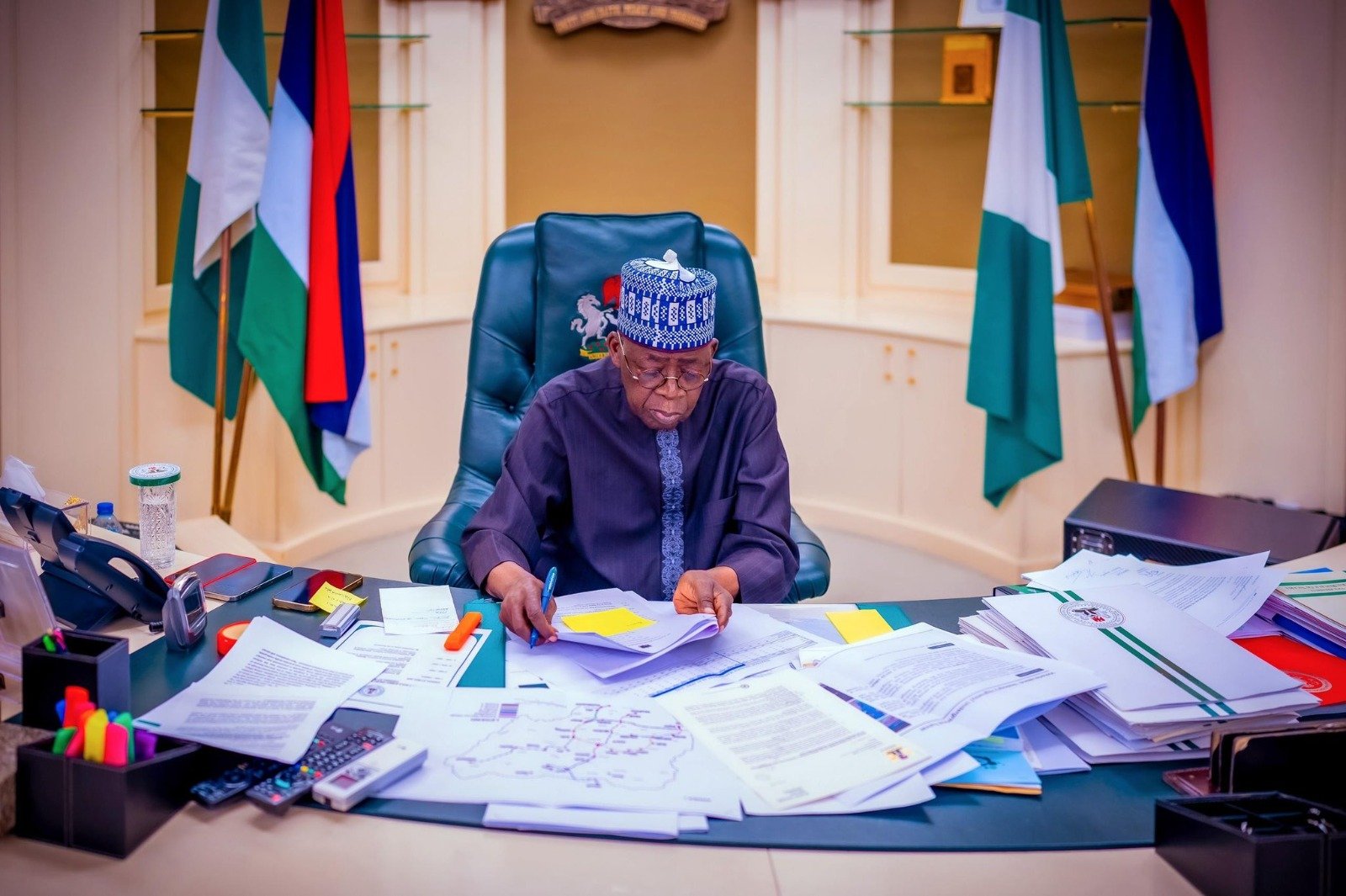
President Bola Tinubu on Sunday clinched the All Progressives Congress presidential ticket for the 2027 general election, polling 10,999,162 votes against his sole challenger, Stanley Osifo, who scored 16,503 in the nationwide direct primaries conducted across all 8,809 wards on Saturday, May 23.

The Returning Officer and Chairman of the Presidential Primary Elections Committee, Pius Anyim, announced the final figures and made the declaration after the nationwide collation of results at the Bola Ahmed Tinubu International Conference Centre, Abuja.

The exercise ended the scheduled primaries of the APC, ahead of the 2027 elections.

The APC kicked off its 2027 primary elections with the House of Representatives exercise, followed by the Senate primaries on Monday, May 18, state Houses of Assembly primaries on Wednesday, May 20, governorship primaries on Thursday, May 21, and the presidential primary on Saturday, May 23.

Speaking at the presidential primary declaration on Sunday, Anyim stated that total registered voters stood at 12,643,30 11,069,756 were accredited, while 11,015,665 votes were cast.

“It is, therefore, my duty as returning officer for this primary election to declare President Bola Tinubu, having satisfied the guidelines, as the winner of the APC presidential primary election and hereby declare the presidential candidate of the APC,” Anyim said.

Tinubu, thereafter, received the party’s certificate of return and flag from the party chairman, Prof Nentawe Yilwatda, in a ceremony attended by APC governors, members of the National Executive Committee, the National Working Committee, lawmakers and party stalwarts.

In his acceptance speech, the President thanked the party leadership and members who voted in the nationwide exercise, acknowledging the trust they reposed in him to be the flag bearer in the 2027 polls.

He said, “I accept with profound humility and gratitude the nomination of our great party, the APC, to stand again as your presidential candidate in the 2027 election.”

The President said he had watched the primary exercise unfold on television after casting his own vote at his Ward L2 polling unit in Ikoyi-Obalende, Lagos, on Saturday morning, describing what he saw across the country as a personal source of inspiration.

“I was glued to the television after voting. I saw the mammoth crowd in Kano and Kaduna, the city boy walking the streets of Calabar.

“It was a good feeling to see that there was no bloodshed, no rancour. This is politics in earnest. This is where we want Nigeria, facing one focus,” he noted.

Tinubu extended a hand of partnership to political opponents, critics of his administration and to his sole contender, Osifo.

He said, “To those who despise our philosophy, we offer dialogue and engagement, not anger, confident that the sincerity of our purpose and the result of our work will speak for themselves.

“Democracy is sustained not by uniformity but by diversity, by a shared belief in the nation, and the blending of ideas. I owe you no grudge, including Osifo, who spent his money.”

See also  Kano Gov Meets Tinubu In France After Secret Meeting With Kwankwaso

Tinubu also pledged to work with every section of the polity and Nigerians from all walks of life.

“I pledge to build an even more inclusive government, one that listens, learns, and leads with the best interests of all Nigerians at heart,” he said, adding that the next election must be “a reaffirmation of Nigeria’s democratic maturity” rather than merely a contest of parties.

Reflecting on the past three years he has spent in office, Tinubu acknowledged that the economic reforms his administration has pursued since May 2023 have been painful not only for citizens but for him personally.

He revealed, “I know what it takes to reform this nation we met in tatters. If you lost sleep, I’ve lost some too. If you’ve lost weight, I’ve lost some too.

“But I’ve always remembered one thing: in 2022, I asked for this job. You all supported me, and I got it. So I must do it…Since that night, a lot has changed. The political landscape has evolved. Thank you, all of you.”

He argued that his efforts have yielded results, citing deliverables such as the Nigerian Education Loan Fund with, he said, has disbursed over N282bn across 1.5 million beneficiaries.

He also cited the Presidential Metering Initiative, which he said has supplied 2.5 million meters nationwide; a N4tn bond programme to settle legacy debts owed to power-generating and gas companies; and a peak power generation of 6,000 megawatts, which he argued was 50 per cent above what the administration inherited.

On security, Tinubu said his government is intensifying its partnership with local communities and also reviewing its security blueprint to tackle evolving threats.

“I acknowledge the security challenges still confronting parts of our beloved nation. I assure you that I take seriously the responsibility to safeguard the lives and property of every Nigerian.

“Our government has intensified efforts to strengthen our security architecture, support our brave armed forces and the police, and forge stronger partnerships with local communities,” he stated.

The President said his administration had invested in intelligence, surveillance and modern equipment, and was addressing the root causes of insecurity.

He also called on the National Assembly to act.

According to him, “We also expect the National Assembly to amend the Constitution to allow the creation of state police as a matter of national emergency.

“We will not rest until we restore peace and stability to every corner of our country. Our resolve is unwavering, and our goal is clear: a Nigeria where every citizen can live, work, and aspire without fear.”

Meanwhile, Tinubu’s main contender, Osifo, has pledged to work with the party to ensure victory at the presidential polls next January.

Osifo, who spoke to our correspondent shortly after the conclusion of the exercise, said, “I’m okay with the outcome of the results. And I’m working with the party, I’m working with the candidate of the party as well. I have no problem with it.”

He, however, debunked notions that framed his candidacy as a challenge to the President.

See also  Kefas postpones defection to APC over Kebbi kidnap

“We are one party, we are members of the All Progressives Congress, we are one family.

“So we are not challenging ourselves. What we did was to have within ourselves who would become the candidate of the party.

“So where we are now, we have that already today,” he explained.

On Tinubu’s public declaration that he holds no grudge against the sole contender, Osifo said he shares the same sentiment as the President.

He argued, “That is why we are working together. We are one party, so we must work together. Nobody is an island.

“Even if I had become the candidate today, I cannot work alone. Offering an olive branch is something that everybody would want to support the President for.”

He thanked his nationwide organisational network for the effort, noting that coordinators had been deployed in all 36 states and the FCT, across every local government and ward in the country.

“It’s not been an easy task. They have done marvellously well.

“I am a very young man. I have a lot of years ahead of me, so it’s possible for things to happen. But I think God knows better, and God knows tomorrow.

“So let’s just put our hope in God and work as we move forward,” he stated.

Osifo had recorded zero votes in the Federal Capital Territory,  Delta, Kogi, Ebonyi, Jigawa, Borno, Kwara, Enugu, Kebbi, Ondo, Edo and Kaduna states, among others, but secured over 5,248 votes in Niger State.

The direct primaries were the first contested presidential primary in APC’s history and a product of the Electoral Act 2026, signed by Tinubu in February, which eliminated indirect primaries and mandated that parties adopt either consensus or direct primaries.

APC stronger – Yilwatda

The APC national chairman, Prof Yilwatda, said the ruling party remains the strongest political force ahead of the 2027 general elections.

He insisted that no opposition party could match the APC’s growing membership strength, nationwide structure, and massive participation in its ongoing internal processes.

Speaking at the party’s presidential primary election national collation centre, Yilwatda said the massive participation in the party’s 2027 primaries reflected how the APC is increasingly becoming the preferred platform for Nigerians seeking electoral victory.

Responding to questions from journalists, the national chairman disclosed that the reconciliation committee headed by Yobe State Governor, Mai Mala Buni, is working tirelessly to address grievances and resolve issues arising during and after the primaries.

“The APC is becoming the rallying point for all political parties. Everybody wants to be in the APC. The competition to be in the APC is quite high, and we see thousands of people buying our forms.

See also  Igbos in Edo vow five million votes for Obi after alleged threat

“It shows how our party is accepted by Nigerians and by the people. If you saw the mass turnout yesterday in all the congresses held to nominate the President, the numbers were in their thousands, and this is just a mock demonstration of what the general election will look like.

“It shows clearly that no other party would win the election because the numbers turning out are in the thousands.

“Believe me, no political party can showcase one-tenth of what we presented in their own congresses. It shows that we are on the path, and the winning path,” he said.

Speaking on grievances which trailed the exercises, Yilwatda said, “You should know that when it comes to power, it is a game of power, and everybody wants to be the one elected. Everyone wants to find reasons why he should be elected. But we, as a party, have internal mechanisms for conflict resolution.

“We have the presidential conflict resolution team and the party reconciliation team. So we activate them to go down to the state level and the national level to ensure quicker reconciliation, a fast healing process, and merge it with campaigns to ensure that we win the 2027 election.”

The APC national chairman acknowledged that complaints are inevitable in a contest of this magnitude, but dismissed claims that videos showing miscounted voters originated from the party’s primaries.

“There is no way you can have a political contest anywhere in the world of this nature, and nobody complains. In fact, if you see any political party where nobody complains about congresses or internal elections, that party is actually weak.

“Strong parties have strong opposition from within, all vying for positions.

“It is just like a football league—imagine a league where nobody is complaining; it means the league is not competitive. The competition here is quite high, and every Nigerian looks up to the APC as a vehicle that will bring them to power in 2027.

“Sometimes you see videos online. I even received a video that was sent to me, which I later found out was from an event that happened three or four years ago.

“These are unverified videos and were not even meant for our party activities. They were from activities somewhere else, even union or leadership elections in different settings, but are being circulated as if they are APC activities.

“If you check all our activities, we have our flags, our banners, and people raising their membership cards. In those videos, you cannot see any APC banner anywhere. So it shows clearly that those were not APC activities,” he stated.

punch.ng

FOLLOW US ON:

FACEBOOK

TWITTER

PINTEREST

TIKTOK

YOUTUBE

LINKEDIN

INSTAGRAM

Continue Reading

Politics

PDP gov primaries: Adebutu, Lamido, Aondoakaa emerge flag bearers, read details

Published

on

The Peoples Democratic Party on Sunday conducted its governorship primaries to elect flagbearers across several states ahead of the 2027 general elections.

Chief among those who emerged were former federal lawmaker representing Remo Federal Constituency and its candidate in the 2023 election, Oladipupo Adebutu, as the candidate for Ogun State.

Similarly, in Katsina State, the PDP declared Senator Yakubu Lado as its governorship candidate after he secured 77,013 votes in a peaceful primary, while in Jigawa State, Mustapha Sule Lamido, son of the former governor, Sule Lamido, was affirmed unopposed as the party’s flagbearer at a delegates’ congress in Dutse.

In Adamawa State, Maurice Vunobolki emerged as the PDP governorship candidate, while in Lagos State, former party chairman, Adedeji Doherty, was affirmed as the consensus candidate.

In Benue State, the party’s candidate and former Attorney General of the Federation, Michael Aondoakaa (SAN), unveiled Dr Oyije Ogbenjuwa as his running mate, pledging to prioritise security and youth inclusion if elected.

Meanwhile, in Gombe State, tension trailed the PDP primaries as governorship aspirants rejected an alleged attempt to include former APC aspirant, Prof Isa Pantami, in the party’s ongoing selection process, warning against actions capable of triggering legal disputes.

Adebutu’s emergence at the venue of the primaries in Abeokuta came through voice affirmation by the party members who came from the 20 local government areas and 236 wards.

The event was witnessed by officials from the Independent National Electoral Commission.

The Chairman of the PDP governorship primaries for the state, Afolabi Ariyo, led the party members in a voice vote affirming Adebutu as the consensus governorship candidate for the 2027 election.

With his emergence, he will face the candidate of the All Progressives Congress, Solomon Adeola, popularly called Yayi, in the election in 2027.

In his acceptance speech, Adebutu hailed party members for the large turnout and support, urging them to remain unwavering as the party remained determined to send the APC packing from the state in 2027.

He explained that though he was denied governorship in 2023 through what he called manipulation, he had the assurance that the people’s vote would be allowed to count in 2027.

Speaking earlier, the state chairman of the party, Abayomi Tella, said the large turnout of party members for the exercise further confirmed that the opposition party was not dead in the state.

See also  PHOTOS: Tanzania charges over 200 with treason following Election protests

Tella urged the party members to remain united and work for the victory of the party ahead of the 2027 election.

Also speaking at the event, former governor of Ekiti State, Ayodele Fayose, described Adebutu as a political leader who has all it takes to take the state to greater heights.

He called on party members to stay united and work together for  the victory of the party in 2027.

In Katsina State, Lado was declared the winner of the governorship primaries.

Chairman of the PDP governorship primary election committee, Nuradeen Sani, announced the result on Sunday, saying the process was conducted in line with the provisions of the Electoral Act.

Declaring the outcome, Sani said the exercise was peaceful and transparent.

“Being the chairman of the governorship primary election of the Peoples Democratic Party (PDP), together with my committee members, and having followed the Electoral Act in conducting the primary election of the PDP for Katsina State, I hereby announce the result.

“The total number of 78,085 was accredited, while a total of 77,013 votes were cast in favour of Senator Yakubu Lado, as 72 delegates came in behind and could not vote.

“Lado, having scored the majority of votes cast, is hereby declared the winner of the consensus primary election today, Sunday, 24th May, 2026,” he declared.

With his emergence, Lado will face the incumbent governor and candidate of the APC in the election, Dikko Radda.

In Jigawa, thousands of PDP members affirmed Mustapha Sule Lamido as the party’s governorship candidate.

The exercise drew members and supporters from the state’s 287 wards to the state capital.

In his acceptance speech delivered shortly after the affirmation, Lamido, who also flew the PDP flag in 2023, said: “I stand before you today with a heart full of gratitude and a deep sense of responsibility.”

He said he humbly accepted the mandate as the flagbearer of the PDP for the 2027 elections.

Lamido recalled that in 2023, the people entrusted him with the same responsibility, and they ran a campaign rooted in unity, hope, reform, and the promise of a better Jigawa.

“Though we did not secure victory then, we earned the confidence of hundreds of thousands of our people and laid a strong foundation,” he stated.

See also  No Nigerian is a Street Urchin, Obi Decries Class Slurs Against Supporters on X

He said the party was back in the race because the problems bedevilling the state were still present, including unprecedented hardship, bad governance, and insensitive leadership.

“We are here to rebuild Jigawa into a state that works for all, where leadership is accountable, resources are managed responsibly, and opportunities are accessible to every citizen,” he said.

He, however, stressed that he accepted the candidacy not as a personal ambition but as a collective mission to rescue, rebuild, and reposition the state for sustainable progress.

Lamido will face the governor, Umar Namadi, in the February 6, 2027, election.

In Adamawa State, the party affirmed Maurice Vunobolki as the candidate, while ex-PDP chairman in Lagos State, Adedeji Doherty, emerged the Lagos PDP governorship consensus candidate.

Doherty will contest the 2027 election with the incumbent Deputy Governor, Obafemi Hamzat, flying the flag of the APC, alongside the candidates of the African Democratic Congress and the Nigeria Democratic Congress.

Doherty’s emergence followed his adoption by delegates and stakeholders during the party’s primaries held in Ikeja.

Doherty, who currently serves as the South-West Zonal Chairman of a faction of the PDP aligned with the Minister of the Federal Capital Territory, Nyesom Wike, was unanimously endorsed by party delegates drawn from the 20 local government areas of Lagos State.

Announcing the outcome of the exercise, the Chairman of the PDP governorship primary electoral committee in Lagos State, Mr Olalekan Rotimi, said the party adopted the consensus option in line with the provisions of the Electoral Act 2026.

Rotimi said the process reflected the collective decision of party leaders and stakeholders across the state.

“In accordance with the provisions of the Electoral Act 2026, which grants political parties the option of selecting candidates either through direct election or consensus, the Lagos State PDP family has today unanimously adopted and endorsed Mr Adedeji Doherty as the sole governorship candidate of our party for the 2027 Lagos State governorship election,” he said.

In his acceptance speech, Doherty pledged to pursue inclusive governance and promised to build what he described as a prosperous Lagos that works for all residents, irrespective of political, ethnic or social background.

Also on Sunday, a former deputy governor of Oyo State, Hazeem Gbolarumi, emerged as the PDP governorship candidate.

He polled 3,615 votes to defeat his main challenger in the election, Beulah Adeoye, who polled 22.

See also  ADC picks Tinubu’s challenger for the 2027 race today

Adeoye had dumped the Governor Seyi Makinde camp of the PDP for the Wike camp after the governor joined the Allied People’s Movement for his presidential declaration, alongside other loyalists.

In Benue State, Aondoakaa (SAN) picked a 38-year-old Dr Ogbenjuwa as his running mate.

Unveiling his choice of running mate at the party’s congress held in Makurdi on Sunday, Aondoakaa said the nomination was to show that the party is youth-friendly, while he promised that his immediate priority if given the mandate in 2027 is to stop all attacks and bloodshed in Benue communities.

He called on every member of the party to close ranks and work together as one united family.

Aspirants of the party in Gombe State, however, rejected attempts to “smuggle” Pantami into the primaries.

In a communiqué issued on Sunday, the aspirants said Pantami, who participated in the APC governorship primaries held on May 21, 2026, could not lawfully defect to the PDP and seek to participate in another governorship primary for the same election cycle.

The communiqué was jointly signed by Alhaji Abdulkadir-Hamma Saleh, Khamisu-Ahmed Mailantarki, Usman-Aliyu Garry, and Monica Kaltho.

Recall that Pantam withdrew from the APC governorship primaries, having alleged irregularities as the basis for his decision.

The aspirants, in their release on Sunday, said in the interest of party unity and cohesion, they had unanimously agreed to allow the leadership of the PDP in Gombe State to pick from among them to be the party’s flagbearer.

According to them, the agreement was reached “in respect and deference to the leadership of our great party,” particularly the leader of the PDP in the state, Ibrahim Dankwambo, alongside the state executive committee, the 11 local government chairmen, and the elders committee.

The communiqué stated that the aspirants had already signed a written undertaking committing themselves to abide by the decision of the party leadership.

“We, therefore, condemn in the strongest terms the alleged attempt to smuggle into the PDP primaries an aspirant who, by law and established democratic principles, is ineligible to participate, having already contested in the APC governorship primaries held on 21st May, 2026,” the statement read.

punch.ng

FOLLOW US ON:

FACEBOOK

TWITTER

PINTEREST

TIKTOK

YOUTUBE

LINKEDIN

INSTAGRAM

Continue Reading

Trending