Connect with us

Politics

Fresh blow for ADC as state congresses stall

Published

on

The leadership crisis rocking the African Democratic Congress shows no sign of abating as internal wrangling and legal hurdles have stalled the state congresses scheduled for Saturday, April 11, 2026.

The crisis, which has since fragmented the party into three camps led by former Senate President David Mark, Nafiu Gombe and a bloc spearheaded by some state ADC chairmen, led to the recent de-recognition of the Mark-led National Working Committee by the Independent National Electoral Commission.

While some states have announced the suspension of their congresses, a few states have vowed to proceed with the election ahead of the party’s convention.

On Thursday, a faction led by Gombe stormed the INEC headquarters in Abuja, demanding formal recognition.

Gombe, accompanied by a Rep member from Kogi State, Leke Abejide, and hundreds of supporters, accused the David Mark-led leadership of attempting to hijack the party’s leadership in defiance of its constitution and internal processes.

Addressing officials of the electoral body during the protest, Gombe insisted that due process must be followed in resolving the leadership dispute.

He said, “We are here to urge INEC to follow due process. You cannot come to the ADC through the window and expect to overturn the owners of the ADC. As democrats, we don’t want any moneybags to come and destroy democracy. The ADC is for all Nigerians from wards, states, to the national level.”

Also speaking, Abejide called on the commission to resist what he described as an attempted takeover of the party, stressing that the ADC constitution clearly outlines eligibility requirements for leadership positions.

“We are here to urge INEC to do the right thing and rescue democracy from the hands of usurpers. How do you come to a party and attempt to hijack the leadership on the same day? Which political platform is that done?

“The party constitution is clear about this. You have to spend at least two years in the ADC as an active member before you can aspire for any position. The commission has not erred. These people are hijackers, and INEC must follow through on reverting to status quo ante bellum by recognising Nafiu Bala Gombe as the national chairman of the party,” he said.

Similarly, the ADC Director of Youths and Mobilisation, Mohammed Sahad, commended INEC for complying with a court order, but urged the commission to go further by affirming Gombe’s leadership.

“INEC has not erred in any way. In fact, we commend the commission for obeying the court order. But they need to recognise Nafiu Bala Gombe as the authentic national chairman of the ADC. INEC needs to do the right thing and do it now. That is why we are here,” he said.

Responding on behalf of the commission, INEC National Commissioner, Abdullahi Abdu Zuru, assured the protesters that their concerns would be reviewed.

“I am here on behalf of the chairman, and I believe INEC, as a commission, will look at your letter and give you feedback. Thank you for being orderly with your protest,” he said.

The protest comes barely 24 hours after a rival faction of the party, led by former Senate President David Mark, staged a large demonstration in Abuja under the banner of #OccupyINEC, accusing the electoral body of actions they claimed undermined democracy and the party’s internal leadership structure.

The back-to-back protests underscore the deepening rift within the ADC, raising concerns over the party’s stability ahead of future electoral contests.

Congresses halted in states

The protracted crisis rocking the Adamawa state chapter of the ADC has taken another dimension, as a Yola High Court has stopped the party from going ahead with its planned congresses.

Justice Ahmed Isa, who presided over the case, ordered the suspension of the congresses slated for Thursday until the determination of the case. The court subsequently adjourned the case to April 15, 2026, for continuation of the hearing.

The embattled ADC chairman in the State, Shehu Yohanna, had approached the court, seeking to stop the congresses due to alleged exclusion from the process.

Yohanna filed the suit against Sadiq Dasin, the state chairman of the transition committee. When The PUNCH contacted the North East Vice Chairman of the party and former Secretary to the Government of the Federation, Mr Babachir Lawal, he denied knowledge of the court ruling.

“I’m in Abuja, so I don’t know about the case. Go and ask those who were in court today. I don’t know anything about the court case, “ he said.

In Anambra, the state congresses would also not be held. The party chairman, Patrick Obianyo, disclosed that the party has suspended the proposed congresses until further notice.

Obianyo said the party’s decision underscores its unwavering commitment to the rule of law, due process, and respect for judicial authority.

He, therefore, called on all party members and stakeholders to remain calm, law-abiding, and peaceful throughout this period.

He also informed the INEC not to recognise anything done by those parading themselves as ADC leaders in the state.

“The African Democratic Congress, the Anambra State chapter, has announced the immediate suspension of all planned and proposed congresses across the state, until further notice.

“For the avoidance of doubt, the tenure of the current ADC Executive Committee in Anambra State, as well as in other states, remains constitutionally valid and duly recognised by INEC.

“Consequently, the general public is strongly advised to disregard any directives, announcements, or actions from unauthorised individuals falsely parading themselves as party leaders.

“The party will duly communicate new dates for congresses and conventions following the conclusion of ongoing national consultations and meetings.’’

See also  Emergency plenary: N’Assembly moves to shift presidential poll to Feb 13

Similarly, the Ondo ADC has announced the suspension of its earlier scheduled Congresses following the re-recognition of the national leadership of the party.

The party had earlier scheduled to hold its ward, local government and state congresses this month, but disclosed that the exercises had been suspended.

This was contained in a statement made available to our correspondent by the state chairman of the party, Mr Wole Ademoyegun.

It said the suspension was in line with the directive of the INEC, which asked the party to maintain the status quo ante bellum.

“We reaffirm our unwavering respect for INEC as the constitutionally constituted regulatory authority for political parties and our firm commitment to due process and institutional order.

“Accordingly, all members and stakeholders of the party are hereby enjoined to remain calm, maintain unity, and exercise the highest level of discipline during this period.

“The party strongly advises against any form of activity that may contravene the directive of INEC or disrupt the peace and order within the party.”

Also, the Zamfara ADC said that it might not continue with the congresses as earlier planned.

The state chairman of the party, Alhaji Kabiru Garba, said the party has yet to make any preparations with regard to the congresses.

In a telephone interview with The PUNCH, Garba said, “Being the state chairman of ADC in Zamfara, I am telling you that I don’t know anything about the forthcoming congresses. Nobody has briefed me on the level of preparedness regarding the congresses. As such, I have no idea whether the exercises will hold or not.”

Relatedly, the ADC in Niger State has suspended its planned congresses across all 25 local government areas until further notice.

State chairman Musa Hassan said the decision, conveyed in a Wednesday statement, was to uphold the rule of law, due process, and judicial authority.

He warned that the INEC would not recognise any congress conducted by unauthorised committees and urged the public to disregard directives from individuals posing as party leaders. A new date will be announced after ongoing consultations.

Meanwhile, the crisis rocking the Kaduna State chapter of the party escalated on Wednesday as rival groups issued conflicting positions on the conduct of the party’s ward, local government and state congresses.

While one faction announced the postponement of the exercise to May, another dismissed the decision as unauthorised, insisting that any such move lacked constitutional backing and would not be recognised.

In a statement dated April 6, 2026, a group led by the State Organising Secretary, Adamu Bello, said the congresses earlier scheduled to begin on April 7 had been postponed following a surge in defections into the party.

The statement, co-signed by the Publicity Secretary, Idris Musa, explained that the postponement was to accommodate new entrants and ensure inclusivity.

“This decision follows a significant influx of defectors from various parties, including the PDP, APC, NNPP and Labour Party,” the statement read.

“The party leadership believes conducting the congress at this time would be premature and may not reflect the true representation of the party’s growing strength.”

It added that the congresses had been rescheduled to the first week of May, noting that the national leadership had been informed.

However, another faction rejected the announcement, describing it as misleading and lacking official authorisation.

In a disclaimer issued by the factional State Organising Secretary, Ibrahim Musa, the group denied claims that the INEC had stopped the congresses.

“The attention of the ADC has been drawn to a purported publication claiming that INEC has stopped the party from conducting its leadership elections. This claim is false and misleading,” the statement read.

It added that those behind the publication were not recognised spokespersons of the party and did not represent its official position.

“This appears to be a deliberate attempt to misinform party members and create confusion,” the statement added, warning that action could be taken against those involved.

Weighing in on the development, the factional chairman of the party in the state, Ahmed Tijjani Mustapha, insisted that only the state executive committee had the authority to organise congresses.

“They are stakeholders of the party, but the conduct of congresses is clearly stipulated in our constitution,” he said.

“It is the mandate of the state executive committee to decide when and how congresses will be held.”

In Osun, the ADC State Chairman, Charles Omidiji, has said its members will not participate in the forthcoming state congress of the party. He, however, said a faction within the party in the state called the Omoluabi Progressives planned to hold the congress.

“I have the directive of the national body not to participate in the congress. But a faction in Osun ADC called Omoluabi Progressives is planning to hold the congress. But as Osun State chairman of the party, I am telling you that we are not participating.”

However, the Director of Media of Osun ADC, Seun Abosede, said Omidiji was no longer the chairman of the party in Osun and thus incompetent to speak for the party.

“He can’t speak for Osun ADC. He has joined the Nigeria Democratic Congress. He has been listed on the website of the party as Osun’s protem chairman. Omidiji is no longer in Osun ADC.

“We are proceeding with the congress. On Saturday, we will have our state congress, and thereafter, we will proceed to the national convention. You can check the website of the NDC, Omidiji is listed on its website as Osun protem chairman,” Abosede said.

But the situation is different in Plateau, where the party insisted it is set to proceed with its state congresses scheduled for Saturday.

See also  Protest rocks PDP national secretariat as Wike-led faction takes over

In an interview with The PUNCH in Jos on Wednesday, the state ADC Chairman, Hannatu Gagara, confirmed that the party will go ahead with the congress, saying, “We have done the screening of delegates at the ward and local Government levels. So, we are proceeding with the state congress on Saturday by the Grace of God.”

Gagara dismissed concerns over the INEC de-recognition, stating, “The electoral body did not say we should stop our congresses. And besides, we contacted INEC this morning about it, and I can tell you they have no problem with what we are doing.”

The National Chief Whip of the ADC, Sabiu Musa, who is also from Plateau state, echoed Gagara’s sentiments, saying, “The party has held its ward and local government congresses in Plateau state, and from the report I got, it was a success. So, the remaining one, which is the state congress, is going to be an affirmation of the current chairman, led by Amb Hannatu Gagara. So, ADC is good to go in Plateau state.”

In the same vein, the  Jigawa State chapter has vowed to proceed with its scheduled ward, local government, and state congresses.

A chieftain and coordinator of the party coalition in the state, Mahmud Gumel, confirmed to our correspondent on Wednesday that the congresses will hold as planned, saying the party is not intimidated by INEC’s actions.

“We will go ahead with our congresses and convention. We have complied with the law by giving INEC the required notice. Whether they attend or not, our processes will continue,” Gumel said.

He expressed concern over what he described as attempts to undermine political pluralism ahead of the 2027 general elections, warning that such actions could weaken Nigeria’s democratic framework and limit the choices available to voters.

In Edo, the party on Thursday held its ward and local government area Congresses across the 192 wards and 18 local government areas to elect new leaders. The party said it was ready for the state Congress fixed for Saturday.

However, the state chairman, Ken Odion, described the congress as null and void, noting that the state chapter will comply with the decision of the INEC.

Odion said going ahead would amount to a futile exercise, which would result in wanton waste of capital and human resources.

He said, “Some people said that they are going ahead, but as a state chairman, I am not going ahead with those activities because when you go ahead, you finish it, and you need to submit it to the body that said you should not go ahead. Where do you want to submit the report?’’

The Kogi ADC has asked party members to disregard the purported suspension of congresses in the state.

This was contained in a statement issued on Wednesday by the publicity secretary of the party, Abdumalik Suleiman.

“The African Democratic Congress, Kogi State chapter, wishes to inform party members, stakeholders, and the general public to disregard the purported suspension of congresses in Kogi State contained in a letter issued by the state’s outgoing Chairman, Mr Kingsley Ogga.”

Suleiman said that “Ogga lacks the constitutional authority to suspend congresses in the state.”

“In issuing that directive, he usurped the powers of the National Working Committee NWC, the only organ of the party vested with the authority to commence or halt electoral processes within the party.”

Uncertainty in Oyo

When asked if the congresses would be held in Oyo, the state publicity secretary, Bimbo Adelowo, said, “In the light of the de-recognition of David Mark-led interim committee of  ADC, a lot of situations have arisen that make the party a political party technically without clear-cut leadership.

“First, I would like to say this: INEC might be wrong in its decision to derecognise the interim NWC of ADC, but the fact that INEC, as a regulatory body, is empowered under law to set rules, whether the rules are just or not, is another case entirely.

“Since INEC has made a pronouncement, definitely everyone should abide by it until otherwise is pronounced by a court of competent jurisdiction.’’

“Our congresses, in view of the above, have been shelved in order not to run foul of the law. But that doesn’t preclude our party from holding our meetings, only that INEC will not monitor any of the meetings,” he explained.

Division in Abia

In a related development, a faction of the party in Abia State has distanced the party from the actions of Don Obinna, saying he lacks the authority to act or speak as the party’s chairman in the state.

The decision was reached in Umuahia on Thursday, where party leaders, including Austine Akobundu, senator representing Abia Central; Uko Nkole and Okey Igwe, among other stakeholders, reviewed the situation in the party and reaffirmed their commitment to due process.

Reading the communiqué on behalf of the caucus, Nkole drew attention to a subsisting order of the Abia State High Court which, through an interim injunction dated December 3, 2025, restrained Obinna from parading himself or acting in any capacity as chairman of the party in the state pending the determination of the case.

The caucus also referenced the findings of the ADC South-East Zonal Disciplinary Committee contained in a report dated September 25, 2025, which clarified the party’s position on Obinna’s conduct and status.

According to the caucus, Obinna’s continued claim to the leadership of the party in Abia State is unlawful and misleading, describing it as a violation of party discipline and contempt of a valid court order. It therefore declared that any meetings, directives, or public engagements conducted by him in the name of the party are null and void.

See also  BREAKING: Humanitarian minister, Nentawe, emerges APC national chairman

The caucus reaffirmed Kanu Kanu as the Acting State Chairman of the ADC pending the conduct of the party’s state congresses.

Meanwhile,  Obinna has said the current tenure of the Abia State ward, LGA, and state executives remains in effect.

In a statement on Thursday, Obinna, who still claims to be the substantive state chairman of the party, advised party members, leaders, and stakeholders to “remain calm, stay positive, and promote the constructive message of ADC while refraining from acts that could disturb peace in their areas.”

Mark-led NWC seeks court order against INEC

The David Mark-led NWC, which was sacked by INEC, has approached the Federal High Court in Abuja, seeking orders to compel the electoral body to reverse its decision to delete the party’s top officials from its records.

The suit, marked FHC/ABJ/CS/1819/2025, follows the removal of the names of Mark, listed as National Chairman, and Rauf Aregbesola, National Secretary, from INEC’s official portal on April 1.

In a motion on notice dated April 7, the embattled chairman, through his counsel, Sulaiman Usman (SAN), prayed the court to issue a mandatory injunction directing the electoral body to immediately restore the names of the party’s National Working Committee members as they existed prior to the dispute.

The application, brought pursuant to Order 26 Rules 1 to 4 of the Federal High Court (Civil Procedure) Rules, 2019, as well as under the court’s inherent and equitable jurisdiction, seeks three principal reliefs.

The applicant also sought “an order of mandatory injunction, directing INEC to forthwith restore and maintain records of the names of Senator David Mark as National Chairman and Ogbeni Rauf Aregbesola as National Secretary, as well as all members of the National Executive Committee.”

In addition, the motion is seeking “an order restraining INEC from tampering with, or otherwise interfering with, the said leadership records of the 1st defendant, recognising or giving effect to any contrary or competing claims, pending the final determination of this suit.”

The application is a direct response to the March 12 judgment of the Court of Appeal in a dispute initiated by a former deputy national chairman of the party, Nafiu Bala Gombe, before Justice James Omotosho Nwite of the Federal High Court.

In a seven-point argument supporting the motion, Usman contended that the appellate court had expressly ordered all parties to maintain the status quo ante bellum, a legal principle referring to the last uncontested state of affairs before litigation commenced.

He argued, “As of Sept. 2, 2025, when this action was instituted, the 2nd defendant (Senator David Mark) was the recognised national chairman of the 1st defendant.

“The said leadership structure had already been constituted. The plaintiff had already resigned his prior office and had no subsisting role within the party.”

The senior advocate further submitted that INEC acted under a misinterpretation of the appellate court’s directive by removing the names of the party’s leadership, thereby creating what he described as a vacuum within the party’s structure.

According to him, the electoral umpire’s decision amounts to a position of non-recognition that is inconsistent with the true intent of the Court of Appeal’s order and capable of undermining the substance of the pending suit.

Usman added, “The law is settled that a mandatory injunction may be granted at an interlocutory stage to restore a party to the position wrongfully altered.

“This is a proper case for the exercise of the equitable jurisdiction of this honourable court.”

In a related application also filed on April 7 but dated April 2, the applicant is seeking an accelerated hearing of the case, citing the urgency and far-reaching implications of the dispute on the party’s operations.

The motion urges the court to abridge the time within which parties are to file and exchange processes and to order a day-to-day hearing until the matter is finally determined.

Justifying the request, the lawyer argued that the suit raises fundamental issues affecting the leadership structure of a registered political party and has broader implications for democratic governance and political participation.

He stated that the Court of Appeal had already directed that the matter be heard expeditiously, warning that the lingering uncertainty over the party’s leadership is hampering its internal administration and political activities.

Usman further noted that the situation could encourage the emergence of parallel structures and conflicting claims within the party if not urgently resolved.

“The continued pendency of the suit is capable of rendering the subject matter nugatory,” he said.

Court records show that the dispute dates back to September 2025, when the trial judge declined an ex parte application filed by Gombe seeking to halt the activities of the Mark-led leadership pending the determination of the suit.

The court, instead, ordered the plaintiff to put all defendants on notice to show cause why the application should not be granted.

Following the development, the Mark-led leadership challenged the jurisdiction of the trial court at the Court of Appeal, which subsequently directed parties to return to the lower court and maintain the status quo ante bellum.

In the substantive suit, Gombe listed the ADC, Mark, Aregbesola, INEC and Ralph Nwosu as the 1st to 5th defendants.

Nwosu, a former national chairman of the party, had earlier stepped down, paving the way for Mark’s emergence as the leader of the party.

Despite the developments, the party’s National Publicity Secretary, Bolaji Abdullahi, said on Channel Television recently that the ADC would contest the 2027 general election despite the challenges facing it.

punch.ng

FOLLOW US ON:

FACEBOOK

TWITTER

PINTEREST

TIKTOK

YOUTUBE

LINKEDIN

Continue Reading
Click to comment

Leave a Reply

Your email address will not be published. Required fields are marked *

Politics

Presidential battle: Promises, power struggle as campaigns gather pace, read details

Published

on

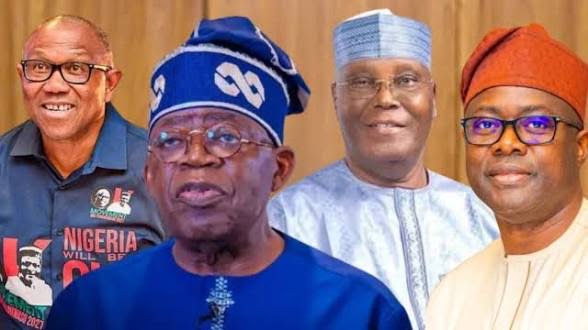
The January 17, 2027 presidential race gathered momentum on Wednesday as President Bola Tinubu and opposition candidates Atiku Abubakar, Seyi Makinde and Peter Obi intensified their campaigns, unveiling competing promises on security, economic recovery, national unity and improved living conditions.

While Tinubu sought another four-year mandate on the strength of his administration’s policies and promised continuity, the opposition candidates criticised the state of the country and offered alternative plans to tackle mounting economic and security challenges.

The African Democratic Congress presidential candidate, former Vice-President Atiku and that of the Allied People’s Movement, Oyo State Governor Makinde stepped up their campaigns against President Tinubu, with both opposition figures outlining their plans to address the country’s challenges.

Atiku, who took his presidential campaign to Sokoto, pledged to tackle insecurity and restore fuel subsidy if elected in 2027.

Similarly, Makinde unveiled his Reset Nigeria manifesto in Abuja, promising to ease the economic burden on Nigerians and improve their living conditions if elected president.

The presidential candidate of the Nigeria Democratic Congress, Peter Obi, also pledged to promote national unity, tackle insecurity and fight corruption if elected in the 2027 general election.

He condemned political violence ahead of the elections following an attack on his campaign convoy by suspected thugs in Calabar, Cross River State, on Wednesday.

While Tinubu is seeking re-election for a second term, Atiku, Makinde and Obi, who are contesting on the platforms of the ADC, APM and NDC, respectively, are among the major opposition figures challenging his bid.

Tinubu has urged voters in Nasarawa State’s 13 local government areas to support candidates of the All Progressives Congress in the 2027 general elections.

He made the appeal on Wednesday through Vice-President Kashim Shettima at the APC presidential campaign rally in Lafia, the state capital.

Tinubu said voting for APC candidates at all levels would guarantee the continuation of his administration’s Renewed Hope Agenda.

He also cited road construction and rehabilitation, alongside improvements in healthcare facilities and schools, as some of the achievements recorded in Nasarawa State under his administration.

He urged residents to renew his mandate for another four years in 2027, promising to deliver more dividends of democracy if re-elected.

Tinubu stated, “We want to assure you that, if God wills and we win the upcoming elections, we will ensure that we support you for maximum safety. We call on you to vote for all our party’s candidates. The biggest message from the leader of the country is: APC from top to bottom, APC from bottom to top.

“We do not want a situation where they say, vote for the President and not the governor, or vote for the governor and not the President, or the senator, or the House of Assembly.

“We want APC straight! APC straight! APC from top to bottom and bottom to top. May God give us peace and understanding. May God grant us peace of mind. We thank you very much.”

He also commended Nasarawa State Governor, Abdullahi Sule, for executing projects aimed at improving residents’ living conditions.

Similarly, the Chairman of the Progressive Governors Forum and Imo State Governor, Hope Uzodimma, highlighted the benefits of Tinubu’s economic policies and urged Nigerians to re-elect the President for another four-year term to enable him to deliver more dividends of democracy.

He said, “It is our decision to continue the deliberate trajectory of Nigeria through the architect of modern Nigeria, President Bola Ahmed Tinubu.

“We have come to Nasarawa State, and we have seen the developments. We have seen that, through the Renewed Hope Agenda, the hope of Nasarawa State has been renewed.

“And we are here to affirm once more that Nigeria is in good hands. All of you should vote for President Bola Ahmed Tinubu.

“We have worked so hard. We have 31 governors. The party is a family. We plead for peace and harmony, and we pray for a peaceful Nigeria. Support our President, support our governorship candidate, and support Nigeria. May God bless all of us as we support the All Progressives Congress,” he said.

The APC National Chairman, Professor Nentawe Yilwatda; Speaker of the House of Representatives, Tajudeen Abbas; and Director-General of the party’s Presidential Campaign Council, Senator Abdulaziz Yari, expressed confidence that Nasarawa State would deliver massive support for the APC in the 2027 elections.

Earlier, Governor Sule, who expressed delight at the large turnout of APC supporters from Nasarawa and neighbouring North-Central states, assured Tinubu that the presidential and state campaign councils were committed to securing victory for all the party’s candidates.

Meanwhile, the APC Presidential Campaign Council has said the education reforms introduced by Tinubu’s administration have led to the disbursement of N372.62bn in student loans and the training of 156,446 beneficiaries under the Technical and Vocational Education and Training programme.

The council, in a statement by its spokesperson and Minister of Solid Minerals, Dele Alake, on Wednesday, said the reforms had also expanded access to basic education, improved teachers’ welfare and stabilised the academic calendar in tertiary institutions across the country.

However, the administration’s education policies and reported achievements have faced criticism from opposition parties as the January 16, 2027 presidential election approaches.

While some opposition figures have faulted the reforms, others have questioned their impact on Nigerians.

In response, the APC PCC said the administration had introduced free technical education covering tuition, boarding, textbooks and uniforms to strengthen vocational skills and expand employment opportunities.

The statement read, “President Bola Tinubu’s reforms in the education sector since assuming office have expanded access to learning, improved teachers’ welfare and stabilised the academic calendar across higher institutions in the country.

“According to the Federal Ministry of Education’s 2026 report on the Nigerian Education Sector Renewal Initiative, the government’s interventions cover basic and secondary education, technical and vocational training, and tertiary education.

“The reforms focus on six priority areas: technical and vocational education, science and medical sciences, out-of-school children, girl-child education, digitalisation and education quality assurance.

“According to the NESRI report, the Federal Government allocated a record N3.52tn to education in the 2026 budget and secured $552m for the HOPE-EDU programme, which targets 29 million children, over 500,000 teachers and 65,000 public schools.”

The APC PCC stated that the BESDA programme had returned more than one million out-of-school children to classrooms, trained 1,400 Tsangaya teachers and established 200 bilingual centres in 17 northern states.

It added that the AGILE programme had reached 7.19 million girls, including 3.7 million enrolled in secondary schools, while more than 10,000 schools had received facility upgrades.

See also  2027: Jonathan keeps mum as northern opposition intensifies pressure

Alake said the Tinubu administration had introduced a revised national curriculum to reintroduce Nigerian History and strengthen Civic and Heritage Studies. He added that the National Learning Assessment had also been restored to monitor pupils’ performance and identify learning gaps.

The statement further read, “Under EduRevamp, 53,553 teachers have registered, while 51,794 joined the first cohort of the Accelerated Teacher Professionalisation Pathway (ATPP), a six-month programme offering professional qualifications, certification and licensing.

“Backed by N2bn, the programme targets 250,000 teachers by 2027. Also, the Inspire Live initiative provides online lessons from Primary One to Senior Secondary School Three, supported by certified teachers and AI-assisted learning.

“Under President Tinubu’s administration, the TVET scheme has attracted over 2.8 million applications, with 156,446 verified trainees receiving free training, monthly stipends and start-up support.

“More than N65.7bn has already been disbursed to trainees, while another N30.2bn has gone to training centres. The government has also rehabilitated 38 technical colleges and introduced free technical education covering tuition, boarding, textbooks and uniforms.”

The APC PCC spokesperson also disclosed that the Federal Government was investing N110bn in the rehabilitation of 18 federal medical schools across the six geopolitical zones.

He added that nursing enrolment rose from 81,480 in 2023 to 114,300 in 2025, while 20 STEM-focused tertiary institutions had been approved and 12 engineering and technology faculties earmarked for rehabilitation.

On student financing, the APC PCC said, “NELFUND, a flagship programme of the Tinubu administration in the education sector, has processed 1,659,853 student loan applications and disbursed N372.62bn, comprising N192.89bn for tuition and N179.73bn for upkeep allowances across 319 tertiary institutions.

“The administration has resolved the age-long dispute between the Academic Staff Union of Universities (ASUU) and implemented the agreement providing for a 40 per cent increase in academic staff remuneration and improved welfare benefits.

“Additionally, the Tertiary Institutions Staff Support Fund has disbursed N28bn to 15,000 workers across 153 public institutions, offering eligible staff loans of up to N10m for housing, healthcare, transportation and education.

“Equally, the Federal Government has provided N365m annually for research and innovation through the National Laureate Prize, while the Student Venture Capital Grant has disbursed over N2.5bn to 45 student entrepreneurs. Each beneficiary can access up to N50m in equity-free funding.”

The campaign council also disclosed that entrepreneurship certification was ongoing in 14 federal universities, while the Diaspora BRIDGE initiative had registered 1,141 Nigerian professionals abroad and reached 16,675 students in 107 tertiary institutions.

Meanwhile, Atiku made his campaign promises while formally launching his presidential bid in Sokoto, where thousands of supporters reportedly turned out despite alleged attempts to frustrate the rally.

He said his administration, if elected, would prioritise tackling insecurity, reviving the economy and expanding regional trade, particularly in Northern Nigeria, where many communities depend on cross-border commerce.

“I will open all the land borders for our people to do legitimate business with our brothers across the border. We will restore subsidy back into our fuel and do everything humanly possible to bring an end to insecurity so as to ensure our people can go back to their farms,” he said.

The former Vice-President urged Nigerians to participate massively in the 2027 elections, vote for the ADC and protect their votes against manipulation.

He also vowed that the party would resist any attempt to repeat what he described as electoral irregularities in previous elections.

“We should all come out, vote massively, protect our votes and make sure our votes are counted and announced. We will not allow what happened in the last elections to happen anymore,” Atiku said.

Atiku highlighted Sokoto’s historical and political significance, describing it as a major centre of influence in Northern Nigeria and West Africa because it is the seat of the Sokoto Caliphate.

He commended the state chapter of the party for organising the campaign flag-off but alleged that the ruling party in Sokoto had attempted to frustrate the event.

Earlier, ADC National Chairman, Senator David Mark, said the large turnout at the rally showed that residents of the state were eager for political change.

He cited the delegation’s journey from the airport to the rally venue, which reportedly lasted more than three hours despite covering less than 10 kilometres, as evidence of the party’s growing support in the state.

Mark described the Atiku-Amaechi ticket as the leadership combination needed to address Nigeria’s security and economic challenges.

Atiku unveils plan

According to the ADC, Atiku’s motorcade took three and a half hours to travel from Sultan Muhammad III International Airport to the party’s state secretariat, with thousands of residents lining the route to welcome the former Vice-President.

The party said the crowd comprised men, women, youths and elderly residents, many of whom abandoned their daily activities to join the procession.

In a statement on Wednesday, the Director of Strategic Communication of the ADC Presidential Campaign Council, Phrank Shaibu, said the reception reflected Nigerians’ frustration with rising food, transportation and fuel costs.

“This was not a crowd assembled by inducement. It was a spontaneous turnout by Nigerians who are struggling with the cost of food, transport, fuel and other basic necessities,” Shaibu said.

The party also accused the Sokoto State Government of denying it access to public facilities requested for the campaign flag-off, alleging that the authorities had placed obstacles in the way of its activities.

It said the restrictions failed to discourage supporters, insisting that the turnout demonstrated residents’ determination to freely express their political choices.

“Denying people a venue cannot suppress their political choices. In Sokoto, those efforts backfired: the people came out in even greater numbers and made their voices heard,” the statement said.

At the rally, Atiku reiterated his commitment to addressing the cost-of-living crisis, while the ADC highlighted a proposed targeted, production-based subsidy for qualifying petroleum products refined locally as a key component of his economic agenda.

The party said the proposed policy would tie government support to domestic refining, with the aim of lowering fuel prices and reducing transportation and energy costs for households and businesses.

“By tying support to domestic production, the policy will help bring down the cost of fuel and ease the pressure that high transport and energy costs place on food prices and family budgets,” the statement said.

The ADC said its economic agenda centred on affordability, local production and a government responsive to the daily challenges facing Nigerians.

“When you have a message that connects with the people, you do not need to rent a crowd. The people show up on their own,” Shaibu added.

Meanwhile, Makinde unveiled his Reset Agenda manifesto, promising reforms in the economy, education, security and the socio-political system to improve Nigerians’ living conditions.

See also  You impoverished Nigerians, Obasanjo attacks Tinubu’s reforms

Speaking on Wednesday at Transcorp Hilton, Abuja, during the presentation of the manifesto to Nigerians from different walks of life, Makinde said his presidential ambition was driven by the need to address the country’s challenges and restore the vision of its founding fathers.

The APM presidential candidate is among the opposition figures seeking to challenge Tinubu in the 2027 general election.

Makinde is the second presidential hopeful, after the Social Democratic Party candidate, to unveil his manifesto ahead of the election.

He said the government must move beyond making promises to delivering measurable results, stressing that every commitment should be backed by responsible institutions, clear implementation plans and verifiable targets.

He stated, “My simple proposition is that government must make life easier for the people. We must develop people’s abilities and expand their access to opportunities. We must also have institutions that work.

“Concrete promises alone are not enough. Every promise must be linked to a responsible institution, a delivery plan and measurable results that citizens can verify. It is not enough to say we have this or that and then engage in arguments. What matters is that citizens can verify the results. That is the standard behind our Reset Agenda.

“There are four major concerns that have shaped my decision to seek the presidency. And they form the basis of the Reset Agenda. The first concern is the emphasis on macroeconomic reforms to the detriment of broad-based economic growth.

“For us, macroeconomic reforms must translate into improvements in people’s lives. What does macroeconomic stability mean if it does not improve the living conditions of ordinary Nigerians? Macroeconomic stability must have a direct impact on the people through job creation, improved incomes and a lower cost of living. These are issues we cannot shy away from.”

Makinde said his administration would prioritise accountability and ensure that the government took responsibility for its performance. He lamented that despite Nigeria’s abundant human and natural resources, poor leadership ideas had hindered the country’s development.

He also pledged to strengthen national institutions to promote unity and ensure that political affiliations and personal connections did not undermine national development or efforts to improve citizens’ welfare.

The APM candidate continued, “Yes, there has been a lot of political debate about petroleum subsidy, but under our Reset Agenda, we have a clear pathway to deliver value to Nigerians.

“Today, Nigerians do not have a clear understanding of the projects being implemented and the actual performance of the budget. If you examine the budget, you will see the benchmark price at which it was prepared. Most times, the benchmark is around $50 per barrel.

“So, what happens when crude oil rises to $100 per barrel? Must Nigerians continue to pay through their noses, or should we have a system in which the government establishes a benchmark and returns the additional value to the Nigerian people? We will create a system that ensures that Nigerians benefit from increased oil revenues.

“Our administration will be measurable, and within three years, beginning with the first 100 days, we will establish clear targets against which our performance will be assessed. All of us must be held accountable.”

Makinde urged Nigerians to hold the Federal Government accountable for its promises, particularly its commitment to providing reliable electricity. He recalled the government’s pledge that Nigerians should not re-elect it if it failed to fix the power sector.

He criticised the government for shifting responsibility to state governments under the electricity autonomy law, insisting that it must remain accountable for challenges in national power generation and distribution.

On the country’s political system, the Oyo State governor said successive administrations had experimented with different arrangements in an attempt to address Nigeria’s challenges.

He stated, “On the social and political front, I can tell you that successive administrations have attempted to address the challenges confronting our political system.

“We started with the parliamentary system, which was developed along the Westminster model. Then we moved to the presidential system. We later experimented with a modified presidential system during General Ibrahim Babangida’s regime. At that time, we had a two-party system. Subsequently, we moved through different political arrangements before eventually adopting the multi-party system.

“My personal opinion, which is something we will have a conversation about, is that our diversity should become a source of strength and unity for Nigeria rather than a source of division. Ideally, the presidential system works best with a two-party structure. However, we currently operate a multi-party system, and people may want the opportunity to pursue their political ambitions independently.”

Makinde said his proposed transitional government of national unity under the Reset Agenda would not be designed to serve his personal interests. He declared that he would not seek any position under whatever constitutional and political arrangements might emerge.

He continued, “Therefore, I am not going to interfere with the multi-party arrangement we currently have. However, I believe that anyone aspiring to become President of Nigeria should not emerge with less than 33 per cent (like the current President) of the votes in a system where the remaining voters may have voted against them.

“When someone emerges under such circumstances, they may enter government and begin compromising the political system itself. They may start asking other political actors to bring the mandates they received from their supporters into the government. Where those political actors resist, they may be subjected to pressure. They did that to Governor Bala and me. Rather, we insist on standing on the side of the Nigerian people.

“What we are proposing is that, to become President of Nigeria, a candidate must secure at least 51 per cent vote. That way, candidates and political parties will have to engage in discussions across party lines and other divisions to secure the support needed to form a government that commands the respect of the majority of Nigerians.”

Meanwhile, his running mate, Lawal Musa Daura, condemned the alleged suppression of opposition parties, warning that denying political opponents a level playing field posed a threat to democracy.

He stated, “Through resilience, commitment and sustained efforts, Nigerians have continued to work towards ensuring that democracy not only survives but also takes the country closer to its desired destination.

“Unfortunately, a situation in which governments suppress opposition is something that should concern everyone. Everybody knows that suppression is wrong. But how does a government suppress itself? It does so by refusing to allow a level playing field, failing to respect the rules and denying people the opportunity to participate and exercise their democratic rights.

“When this happens, the entire population is threatened. The first victim is the nation itself, followed by those at the helm of affairs and, ultimately, the rest of the citizens.

See also  Atiku, Obi, Makinde resist step-down pressure ahead of 2027 polls

“I would like to say that whenever people attempt to use their privileged positions to muzzle the opposition, they are doing themselves a disservice. The quality of opposition determines the extent to which the political temperature of society can be reduced.”

Daura said a vibrant opposition was essential to democracy, arguing that it complemented the government rather than serving as its enemy and helped reduce political tensions.

He added that their proposed transitional government would convene a national conference involving all segments of society to discuss the country’s challenges and agree on a common direction.

The APM vice-presidential candidate identified education, the economy, security and the socio-political system as the four pillars of the Reset Agenda, promising to place national interests above personal gains.

Also speaking, the National Chairman of the Social Democratic Party, Professor Sadiq Gombe, described Makinde as the opposition’s shining star and confirmed that discussions were ongoing among political parties to build a common platform.

He expressed optimism about the efforts to unite opposition parties, highlighting Makinde’s role in the emerging political discussions.

He stated, “Today, Governor Seyi Makinde is a shining light of the opposition. He contested the election under the PDP and won despite all odds, under a Federal Government controlled by the APC, while all the other states in the region were also controlled by the APC.

“Yet, Governor Seyi Makinde broke through to emerge as the governor of Oyo State, the headquarters of the South-West. I think that is a great political achievement. Secondly, you cannot overlook the fact that Today, Governor Seyi Makinde and my dear brother, Governor Bala Mohammed of Bauchi State, have truly rekindled the aspirations and light of our democracy.

“When other governors had left the room in the past, these gentlemen remained steadfast and continued to do whatever they could to sustain what we call democracy in Nigeria Today. Governor Makinde hosted the first initiative through which opposition political parties in Nigeria came together, and that initiative is still ongoing.

“Today, opposition political parties are reaching out to one another. Presidential candidates are meeting one another, and we are sharing love and building relationships together. We are discussing ways to unite ourselves.”

Obi promises action

In another development, the presidential candidate of the NDC, Peter Obi, said his administration would prioritise national unity, security, education, healthcare and citizens’ welfare.

Speaking at a town hall meeting with party stakeholders and supporters in Calabar on Wednesday, Obi said national unity was necessary to tackle insecurity and other challenges confronting the country.

He stated, “Nigeria is currently divided. We will work to unite this country because uniting the nation would provide the strength needed to confront insecurity and other national challenges.

“Our commitment is to unite Nigeria. Nigeria Today is not united. If we unite Nigeria today, we will have the strength to fight insecurity.”

The former Anambra State governor vowed that his administration would not tolerate kidnapping and attacks on schoolchildren, promising to pursue abductors to their hideouts.

“Anybody who kidnaps schoolchildren and goes into the bush, we will be in that bush with him, wherever it is. We are not scared of him,” he said.

On corruption, Obi pledged to tackle the menace decisively, insisting that public funds must be used for the benefit and welfare of Nigerians.

“We will fight corruption head-on. We want people to stop stealing public money. Public money must be used for the public good and the welfare of the people,” he said.

He also promised to increase investment in education and healthcare, describing both sectors as critical to national development.

Obi said his political partnership represented a new approach to governance, anchored on shared responsibility and a commitment to transforming the country.

“We represent a new Nigeria that is possible. We represent a governance that people have not seen in Nigeria before,” he said.

Obi’s convoy attacked in Calabar

Meanwhile, a viral 30-second video of the attack on Obi’s convoy showed some of the assailants, many of them dressed in black shirts, fez caps and face coverings, using machetes to damage vehicles.

The incident reportedly caused panic as passersby and roadside traders fled the scene.

One of Obi’s media aides, Esther Umoh, had raised the alarm in a post on her official X handle.

“Thugs are trying to attack our convoy,” she wrote.

Shortly afterwards, Umoh shared another five-second video showing a victim with a gunshot injury to the leg being evacuated from the scene. She attributed the injury to a stray bullet.

Recounting the incident at the town hall meeting, Obi said he witnessed the attack but was advised by his security team to take another route after the assailants allegedly armed themselves with machetes and other weapons.

He said, “They were throwing stones, and I saw people running back. And my security people said we should find another way because they have machetes and other things.

“I asked, ‘In Nigeria? I am coming down to go and meet them.’ By the time they saw what was happening, they left. All these things happened because Nigerians allow it. We are not going to allow it in 2027.”

The former Anambra State governor arrived in Calabar alongside his wife, Margaret, and his running mate, Rabiu Kwankwaso, for the town hall meeting.

Efforts to reach the spokesperson for the NDC Presidential Campaign Council, Constance Ikokwu, and Obi’s spokesman, Idris Zekeri, for further comments were unsuccessful.

The Calabar incident is the latest reported security challenge involving Obi’s campaign, coming about two months after his convoy was blocked and confronted by youths in Benue State.

During the visit, Obi’s convoy was blocked by angry youths along the Makurdi-Gboko Federal Highway as he travelled to the state for political engagements ahead of the 2027 presidential election and to commiserate with victims of the June 2025 attacks in Yelewata.

Trouble reportedly started a few metres from the airport when the convoy encountered a roadblock mounted by the youths, who prevented motorists from using the two-lane highway.

The blockade caused traffic congestion, while the police were criticised for failing to disperse the youths promptly.

The Benue State Commissioner of Police, Cletus Nwadiogbu, subsequently disclosed that at least 46 suspects had been arrested in connection with the incident.

He said investigations were ongoing and security operatives were tracking key leaders of the youths.

Source: punchng.com

FOLLOW US ON:

FACEBOOK

WHATSAPP CHANNEL

TWITTER

PINTEREST

TIKTOK

YOUTUBE

LINKEDIN

INSTAGRAM

Continue Reading

Politics

Four Nigerian-Americans win US midterms, Georgia result pending

Published

on

Four Nigerian-Americans have won elective positions in the November 3 midterm elections in the United States, while the result of another candidate, Segun Adeyina, remained uncalled as votes were being counted.

The winners are Will Jawando, Junior Ezeonu, Oye Owolewa and Carol Kazeem, who secured positions in local government and state legislatures across Maryland, Texas, Washington, DC and Pennsylvania.

Jawando, the Democratic Party Candidate, won the race for Montgomery County executive in Maryland, defeating Republican candidate Esther Wells.

Jawando. Photo: Wusa9

Results published by NBC Washington on Wednesday showed Jawando with 237,383 votes, representing 78.15 per cent, against Wells’s 66,383 votes, or 21.85 per cent, with 72 per cent of the expected vote counted.

Jawando, a member of the Montgomery County Council before the election, is the son of a Nigerian father and an American mother.

The Baltimore Banner and The Washington Post have previously reported on his Nigerian heritage and political career.

In Texas, 27-year-old Ezeonu, also a Democrat, secured a seat in the state’s House of Representatives for District 101 after defeating incumbent Chris Turner in the Democratic primary.

Ezeonu was the only candidate on the November general-election ballot after no Republican opponent entered the race.

Ezeonu. Photo: Run For Something

His campaign biography says he was born in Onitsha, Anambra State, and moved to Texas at the age of two.

He was elected to the Grand Prairie City Council in 2021 and later became the city’s youngest mayor pro tempore.

In Washington, DC, Owolewa, the Democratic candidate, won an at-large seat on the District of Columbia Council.

The 51st, a local news publication, reported that Owolewa secured 69 per cent of the vote, against independent candidate Elissa Silverman’s 21 per cent.

See also  Atiku, Obi absent as opposition begins single-candidate talks ahead of 2027
Oye Owolewa. Photo: Instagram (@repoyedc)

Owolewa, a pharmacist and the son of Nigerian immigrants from Kwara and Osun states, previously served as the District’s elected shadow representative, a position that advocates for statehood but does not carry voting rights in the US Congress.

Meanwhile, Kazeem, also a Democrat, retained her seat in the Pennsylvania House of Representatives, representing District 159.

She contested on the Democratic Party platform against Republican Michael Bannon. Election results published by MultiState Elections listed Kazeem as the winner of the race.

Carol Kazeem. Photo: Kazeem on Facebook

Kazeem was among eight Nigerian-Americans who won legislative seats in the 2022 US midterm elections.

Adeyina, a Nigerian-born Democratic incumbent, was seeking re-election to the Georgia House of Representatives for District 110, where he faced Republican Charles Lollar.

The Atlanta Journal-Constitution’s election tracker initially showed Adeyina leading Lollar with 1,353 votes against 689, but only eight per cent of the estimated votes had been counted at the time of that update.

Segun Adeyina. Photo: Nigerian Centre

Adeyina was first elected to the Georgia House in 2022 and represents parts of Gwinnett County. His official legislative biography says he is the executive director of the Nigerian American Public Advisory Committee, an organisation involved in voter education and registration among immigrant communities.

The US midterm elections are held halfway through a president’s four-year term and determine the composition of Congress, with all 435 seats in the House of Representatives and 35 of the Senate’s 100 seats contested in the 2026 elections.

Governorships and state and local government positions are also decided during the polls.

See also  Coalition: ‘Nigerians Are Aware That Their Politicians Are Fraudsters’ – Farotimi

The elections are widely seen as a test of the sitting president’s performance and influence.

Source: punchng.com

FOLLOW US ON:

FACEBOOK

WHATSAPP CHANNEL

TWITTER

PINTEREST

TIKTOK

YOUTUBE

LINKEDIN

INSTAGRAM

Continue Reading

Politics

DSS denies Atiku’s ADC rally disruption claim, orders probe

Published

on

The Department of State Services has ordered an investigation into an allegation by former Vice-President and African Democratic Congress presidential candidate, Atiku Abubakar, that the agency is planning to organise protests in Sokoto State.

The secret police said the investigation was ordered by its Director-General, Oluwatosin Ajayi, despite describing the allegation as inconsistent with its operations to protect political actors across party lines.

Multiple reports had noted on Tuesday that Atiku while fielding questions from journalists in Abuja accused the leadership of the DSS, of recruiting protesters to create disorder in Sokoto and provide a pretext for imposing a curfew to stop the party’s campaign rally.

However, in a statement issued on Tuesday by the Deputy Director, Public Relations and Strategic Communications, Favour Dozie, the DSS said its “operatives rescued the ADC governorship candidate in Sokoto State, Mannir Daniya, during an attack on October 31, 2026.”

dss logo
Department of State Services logo: Photo: DSS

According to the Service, its operatives “deployed to protect Daniya evacuated him to safety during the incident, while two DSS personnel were assaulted and were still receiving treatment in hospital as of Tuesday.”

The agency added that “Daniya personally contacted the State Director of the DSS in Sokoto to express appreciation and requested additional security reinforcement.”

PUNCH Online had earlier reported that the All Progressives Congress and the ADC in Sokoto State on Saturday traded accusations over an alleged attack on the convoy of the ADC governorship candidate Dan’iya.

The DSS also cited its arrest and prosecution of a man, Monday Udeme Steven, in Rivers State on March 2, 2026, over an alleged threat to attack the presidential candidate of the New Democratic Congress, Peter Obi.

It said “Steven was prosecuted at a Federal High Court in Rivers State and sentenced to two years’ imprisonment.”

See also  Atiku, Obi absent as opposition begins single-candidate talks ahead of 2027

The Service said the operations demonstrated its commitment to protecting political actors irrespective of their party affiliations, but acknowledged that Atiku’s allegation had prompted the DG to order an investigation.

“Though these operations to protect all Political Parties is at variance with the elder statesman’s allegation and tend to demoralize our gallant operatives who are risking their lives in the line of duty, the DGDSS has still ordered an investigation into the allegation in deference to the elder statesman,” the statement read.

The DSS also referred to a similar allegation by the African Action Congress presidential candidate, Omoyele Sowore, who accused the agency of involvement in an attack on him in Ekiti State.

It said it welcomed the police investigation into the incident, which, according to the DSS, produced a preliminary report identifying an “altercation” as the cause and led to the arrest of 11 suspects.

The Service said it was awaiting the outcome of the police investigation and would not expend further energy on the matter.

“The Service will continue to remain accountable under the present DG,” the statement added.

Source: punchng.com

FOLLOW US ON:

FACEBOOK

WHATSAPP CHANNEL

TWITTER

PINTEREST

TIKTOK

YOUTUBE

LINKEDIN

INSTAGRAM

Continue Reading

Trending