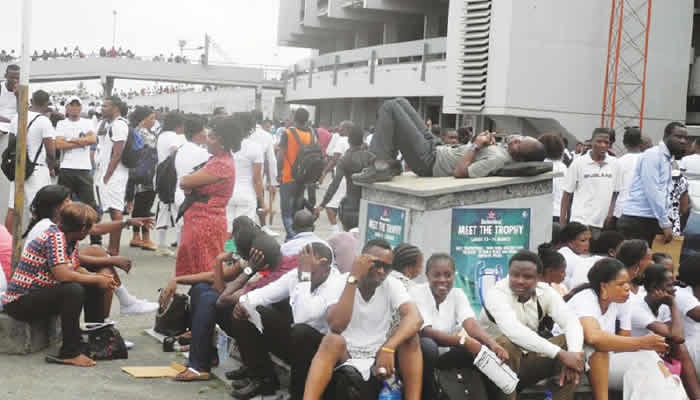
Following the conclusion of its nationwide protests on Tuesday, members of the Academic Staff Union of Universities are set to hold congresses to decide their next line of action.
This comes as the Federal Government meets today to address long-standing agitations over the implementation of the renegotiated 2009 FGN-ASUU agreement, which triggered nationwide protests across universities on Tuesday.
Earlier this year, the President Bola Tinubu administration released N50bn to settle earned academic allowances owed to university lecturers and staff.
However, ASUU has consistently demanded clear commitments on improved salaries, conditions of service, university funding, autonomy, and a review of laws governing the National Universities Commission and the Joint Admissions and Matriculation Board.
The meeting, expected to be attended by the Minister of Education, Dr. Tunji Alausa; the Minister of Labour and Employment, Muhammadu Maigari Dingyadi; and representatives of the National Salaries, Incomes and Wages Commission, is expected to produce a timetable for signing and the phased implementation of the renegotiated agreement, along with related reports.
Government sources in the Education and Labour ministries said that today’s discussions would focus on reconciling the Yayale Ahmed committee draft concluded in December 2024 with the original 2009 agreement and subsequent recommendations, including the Nimi Briggs report.
Also on the table is how to phase the fiscal commitments into the national budget and produce a legally binding instrument for signature.
Speaking with our correspondent on Wednesday, ASUU president, Prof. Chris Piwuna, said the union expected commitment from the government.
“I truly hope they will come up with something tangible. Our members are tired of words and no action.”
Piwuna, however, clarified that ASUU was not invited for today’s meeting.
Piwuna affirmed that the union was done with nationwide protests and was poised to hold congresses to decide on its next line of action.
“We don’t have any meeting with the Federal Government tomorrow (today). It’s their meeting, we’re not involved. We have not received any invitation yet for a meeting with the Federal Government.
“However, we’ll let Nigerians know our next line of action after the protests. We operate from the bottom up. The protests are over, so we’ll go back to our members and ask them what is next, and we’ll do exactly what they want us to do as elected representatives,” Piwuna said.
Ahead of Tuesday’s protests, ASUU branches had warned that their patience was exhausted after the renegotiation concluded in December 2024 and was formally submitted to the government in February.
At a press conference in Abuja, ASUU’s Abuja zonal coordinator, Prof. Al-Amin Abdullahi, said the union had fulfilled its part of the bargain and expected the government to adopt the report without delay.
He noted that earlier reports never advanced beyond “filing cabinets” and stressed that failure to act could trigger another shutdown of public universities.
ASUU had also rejected the government’s offer of loan-style “support funds” in place of cash entitlements.
Today’s meeting comes as ASUU members had consistently lamented poor pay, worsening state of academics, with professors earning about N500,000 monthly, sleeping in officers ‘ quarters, and reportedly struggling to join buses meant for students.
Documents obtained show that under the Consolidated University Academic Salary structure, Graduate Assistants earn between N125,000 and N138,020 monthly, while professors earn between N525,010 and N633,333.
Assistant Lecturers earn between N150,000 and N171,487; Lecturer II (N186,543–N209,693); Lecturer I (N239,292–N281,956); Senior Lecturer (N386,101–N480,780); and Readers (N436,392–N522,212).
A former Vice Chancellor of the University of Lagos, Prof. Oluwatoyin Ogundipe, lamented the erosion of morale among lecturers.
Ogundipe said, “The lecturers are tired, the morale is low, and lecturers are poorly paid. Academic staff members are on the edge, itching to leave. The standard of teaching is going down. As Vice Chancellor, I earned N900,000 as salary. My present salary as a professor, still in the system, is N700,000. My son saw my pay slip and described it as a joke. Do you know that some lecturers sleep in the office?”
ASUU president Piwuna said many lecturers earned just over N400,000 and accused the government of neglecting academics while prioritising pay raises for politicians.
He described as unsurprising the FG neglects the lecturers while the Revenue Mobilisation Allocation and Fiscal Commission was proposing an upward review of the salaries of public office holders.
He added that stagnant salaries had crippled universities’ ability to attract quality lecturers, worsened morale, and affected output.
Piwuna said, “Well, from experience, Nigerian elites or the political class always look after themselves. So, we’re not surprised that the arms of government that Nigerians are most dissatisfied with are the ones that are getting the pay rise, while those who work day and night to ensure that the country keeps moving, who are making tangible contributions to the growth of this country, are being neglected.
“Our salaries have remained stagnant, and that has affected the quality of lecturers that we can attract into the universities. That has also affected our morale, and because our morale is low, certainly the output would also be affected. And so our salaries have been a major area of concern for our members.
“Our salaries, our condition of service have always been a product of collective bargaining. And the last time this was done was in 2009. Talking about increases, for instance, this government has made an increase through the minimum wage, but all that was added to our salaries, and it’s for every public service, is N40,000.
“So, professors that were earning a little over N400,000 have still not been able to get to the N500,000 mark that you’re talking about, except for professors that have had annual increases for maybe 10, 20 years.”
In the same vein, a Senior Lecturer, Department of Economics, University of Lagos, Prof. Tunde Adeoye, urged the Federal Government to urgently review salaries of lecturers to avert another industrial strike.
According to him, the Federal Government needs to be sensitive to the plight of lecturers and engage them in renegotiating the 2009 agreement, adding that the major issue is improving the salary structure of academics.
Adeoye stressed the need for the Federal Government to increase the salaries of university lecturers to reflect the current economic realities in the country.
He added that the salary of a professor in a Nigerian university was about N500,000 without any deductions, adding that after deductions, it comes to about N300,000.
He noted that in some African countries like Kenya and Zimbabwe, lecturers were paid better than in Nigeria, and urged the federal government to make concerted efforts toward improving the living standards of lecturers and their condition of service to prevent brain drain.
Adeoye said, “The ASUU members equally have families and aged parents to cater for. As it is now, many of our members cannot pay their house rents.
“Many of our members who were sick have died, while some with hypertension cannot even afford to buy their routine drugs.”
In the same vein, Secretary of the Committee of Vice Chancellors, Prof. Andrew Haruna, faulted successive Nigerian governments for neglecting the education sector and reducing the value of academics to mere salary figures, stressing that what lecturers truly need is an enabling environment to teach, research, and contribute meaningfully to national development.
Speaking with The PUNCH, Haruna, who has taught in over 10 European universities, lamented that academics in Nigeria were undervalued compared to their peers abroad.
Haruna said, “I have taught in many countries in Europe. If you go through my CV, you will see that I taught in more than 10 different universities in Europe, and I was trained in Europe, and I came back to Nigeria to help. Now, if I were trained in Europe, I would know what I am worth.
“So, if you get just a meagre salary in Nigeria, just because I have decided to come and contribute, it simply shows the kind of leadership we have. Do they really respect the Nigerian citizens? If they respect the Nigerian citizens, do they really respect the Nigerian academia?”
He argued that the problem was not just low pay, but the lack of infrastructure and conducive conditions for intellectual work.
On the international value of academics, he stressed that professors remained globally mobile, unlike many other professions.
He added, “If I earn $4,000 a month and I decide to come to Nigeria and you pay me N400,000, you simply show the kind of value you put on me. Professors, academics, are highly mobile. We are the only category of workers who have a professor in Nigeria, a professor in America, and a professor in Germany. Just like the degree we get in a Nigerian university, the Nigerian student will go to America and do a master’s degree, and go to Japan and do a PhD. So, this is the only job that is international.”
FOLLOW US ON:
FACEBOOK
TWITTER
PINTEREST
TIKTOK
YOUTUBE
LINKEDIN
TUMBLR
INSTAGRAM