Connect with us

Lifestyle

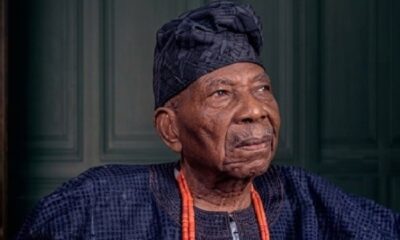
My father fought well to stay alive – Onigbinde’s son

Published

on

Mr Oyekunle Onigbinde, the last child of the late national coach Festus Onigbinde, has said that although his father was sick, he fought well to stay alive.

Oyekunle made the remarks in an interview with the News Agency of Nigeria in Ibadan on Tuesday.

Describing his father as a generous man who cared for everyone, Oyekunle said his death on Monday came as a huge shock.

“He fought well to stay alive.

“He was sick, but due to old age, his body couldn’t fight the recovery.

“My father was very accommodating; he pulled everyone together.

“He didn’t care who you were; he just wanted everyone happy and united.

“He was the string that knitted many together,” he said.

Meanwhile, renowned sports analyst Tayo Balogun told NAN that his 40-minute phone conversation with Onigbinde in 2025 would forever linger in his memory.

“We went down memory lane, and I thanked him for being who he was: painstaking, foresighted, forthright, forthcoming, and incredibly hardworking.

“I told him I appreciated him and that I was calling to let him know that his contributions to Nigerian football will always be footnoted in history.

“During the call, I noticed his voice had lost some of its vibration. He attributed this to old age, claiming he was as fit as a fiddle.

“He asked after my TV Gang of Feyi Ogunduyile and Modele Sarafa-Yusuf (then known as Oshiinaike),” he said.

Balogun said he praised Onigbinde for his contributions to Shooting Stars Sports Club (3SC).

“He actually changed the name from IICC Shooting Stars.

“I asked him if he remembered that I asked him why he was practising penalty kicks after 3SC had comprehensively beaten Tonnere Kalara Club of Yaounde at the Liberty Stadium, just before the second-leg match.

See also  Comedian Broda Shaggy hospitalised after alleged shooting

“He told me Remi Asuni, the then Oyo State FA Chairman, asked him the same question and that he answered, ‘If we can beat them 4-0 in Ibadan, they may pay us back in Yaounde,’” he said.

The 73-year-old analyst said he also praised Onigbinde for his bravery in selecting players for the 2002 World Cup.

“I told him I understood why he included Mutiu Adepoju, but did not understand why he didn’t play him in any of the matches.

“He said that was the only mistake he made, but that if I noticed, we were quite close in all the matches we played, and if he brought in Mutiu and we lost, it would be blamed on Adepoju,” he said.

Balogun described Onigbinde as the most thorough Nigerian coach he knew.

“Each year, he would draw up a list of requirements for his team.

“With Shooting Stars, he would get 20 per cent, and with the Eagles, he didn’t even get 10 per cent.

“All the same, he got spectacular results with both teams.

“He was the first coach to take a group of rookies like Chibuzor Ehilegbu, Paul Okoku, Femi Olukanmi, and others to Ghana and beat the then-dreaded Black Stars in their country.

“Onigbinde’s memory will remain indelible.

“He was a gentleman, humble, and highly intelligent.

“I am glad I got to know you, sir,” he said.

(NAN)

punch.ng

FOLLOW US ON:

FACEBOOK

TWITTER

PINTEREST

TIKTOK

YOUTUBE

LINKEDIN

TUMBLR

INSTAGRAM

Continue Reading
Click to comment

Leave a Reply

Your email address will not be published. Required fields are marked *

Lifestyle

North Korean leader’s daughter believed to have younger sibling – Seoul

Published

on

North Korean leader Kim Jong Un’s daughter and apparent successor is believed to have a younger sibling, South Korea’s spy agency said on Thursday, offering a more detailed view of the ruling family’s structure.

Seoul’s spy agency has previously said Kim is believed to have three children, but there has been uncertainty about their order of birth.

Kim’s daughter, Kim Ju Ae, was first introduced to the public in 2022 when she accompanied her father to the launch of an intercontinental ballistic missile.

The Kim family has ruled North Korea with an iron grip for decades, and a cult of personality surrounding their “Paektu bloodline” dominates daily life in the diplomatically isolated country.

“The National Intelligence Service currently assesses that Kim Ju Ae is being groomed as the successor and understands she has a younger sibling of unknown gender,” the agency said in a statement.

The NIS added that it was continuing to verify whether Kim Ju Ae has an older brother, but believes that “even if he exists, he is not in a position to become the successor”.

Since 2022, Kim Ju Ae has appeared at a number of major political events with the North Korean leader, including a high-profile visit to Beijing.

North Korean state media have also referred to her as “the beloved child” and a “great person of guidance” — “hyangdo” in Korean — a term typically reserved for top leaders and their successors.

AFP

Source: punchng.com

FOLLOW US ON:

FACEBOOK

TWITTER

PINTEREST

TIKTOK

YOUTUBE

LINKEDIN

INSTAGRAM

See also  God Didn’t Give Me That Grace – Olu Of Warri Speaks On Having More Than One Wife
Continue Reading

Lifestyle

“All Women Are the Same” — Why Do Some Men Say This?

Published

on

The statement “All women are the same” is one that often appears during heated conversations about relationships, heartbreak, cheating and trust. But what makes some men reach the point where they believe an entire gender behaves the same way?

For some men, the statement may come from painful personal experiences. A man who has experienced betrayal, repeated heartbreak, dishonesty or disappointment in relationships may begin to believe that what happened to him is simply how women behave.

But is that really the case?

Is It Experience or Generalisation?

When someone has been hurt several times, it is understandable that their experiences can influence how they view future relationships. However, there is a major difference between saying “I have had bad experiences with several women” and saying “all women are the same.”

The first statement describes personal experience.

The second makes a judgment about millions of individuals based on the actions of some.

Women, like men, have different personalities, values, priorities and behaviours. Some people are faithful, some are unfaithful. Some are generous, while others may be selfish. Some are honest, while others may lie.

These characteristics are not exclusive to one gender.

Why Does the Statement Become So Popular After Heartbreak?

Heartbreak can change the way people think.

A man who trusted someone deeply and was betrayed may become suspicious of future partners. Instead of judging each new person based on their own character, he may unconsciously compare them with the person who hurt him.

This can create a dangerous cycle:

See also  Three nights Nigeria will not forget

One person hurts you → you lose trust → you expect the same behaviour from others → every new relationship is viewed through the lens of the past.

Sometimes, the real issue isn’t that “all women are the same.”

It may be that one painful experience has changed the way a person sees relationships.

But What About “All Men Are the Same”?

Interestingly, women sometimes make a similar statement: “All men are the same.”

It can come from similar experiences—being cheated on, lied to, mistreated or disappointed by previous partners.

But if we reject the idea that all men are identical, we should apply the same standard when discussing women.

One person’s behaviour should not automatically become the definition of an entire gender.

Could Someone Be Choosing the Same Type of Partner?

Another uncomfortable question is whether repeated relationship problems can sometimes be connected to patterns in the people someone chooses.

If a person repeatedly enters relationships with partners who display similar negative behaviours, it may be worth asking:

“Am I choosing the same type of person again and again?”

This doesn’t mean victims are responsible for being mistreated. It simply means that understanding relationship patterns can sometimes help people make better choices in the future.

The Bigger Question

Perhaps the more important question isn’t:

“Are all women the same?”

Instead, we should ask:

“Why do some people allow the actions of one or a few individuals to determine how they view an entire gender?”

Relationships require people to judge each other as individuals rather than as representatives of a particular gender.

See also  Destiny Boy’s father raises the alarm over son’s missing SUV

There are good women and bad women.

There are good men and bad men.

There are faithful people and unfaithful people.

There are people who genuinely want healthy relationships, and there are people who do not.

The challenge is learning how to recognise character without allowing past experiences to completely control our judgment.

What Do You Think?

When a man says “All women are the same,” is he telling the truth about his experiences, expressing anger from a broken relationship, or making an unfair generalisation?

And when a woman says “All men are the same,” should we apply the same reasoning?

Share your opinion in the comments. Do you believe repeated bad experiences can justify saying “all women are the same,” or should every person be judged individually?

FOLLOW US ON:

FACEBOOK

TWITTER

PINTEREST

TIKTOK

YOUTUBE

LINKEDIN

INSTAGRAM

Continue Reading

Lifestyle

“All Men Are the Same” — Why Do Some Women Say This?

Published

on

The statement “All men are the same” is one of those phrases that can quickly ignite a heated debate between men and women.

For some women, the words may come from painful personal experiences—betrayal, cheating, dishonesty, broken promises, neglect, or relationships that ended badly. After experiencing similar disappointments more than once, it can become easy to believe that the problem is not just one person, but an entire gender.

But is it fair to say that all men are the same?

One bad experience can change the way people see relationships

Relationships can have a powerful effect on how people view love and trust.

A woman who has been repeatedly disappointed by men may become cautious about trusting another man. What begins as one person’s behaviour can eventually become a pattern in her mind.

She may begin to think:

“They all eventually cheat.”
“They all lie.”
“They all make promises they cannot keep.”
“Men only behave well when they want something.”

For someone who has experienced repeated disappointment, these beliefs may feel completely justified.

However, personal experience does not necessarily represent everyone.

Men are not all the same

Just as women have different personalities, values and behaviours, men are also individuals.

Some men are faithful while others are unfaithful. Some are responsible fathers and partners, while others fail to take responsibility. Some communicate openly, while others struggle to express their feelings.

Therefore, judging every man based on the behaviour of a few may create another problem: good men can end up paying for the actions of bad men.

See also  Akinwumi Ogundiran: Scholar of the Yoruba World and Atlantic Africa

The same principle applies in reverse. A man who has been hurt by one or more women should not automatically conclude that every woman will treat him the same way.

Is “all men are the same” really about men?

Perhaps, in some cases, the statement is less about every man and more about trust and emotional scars.

When someone has repeatedly experienced similar problems, they may begin to expect the same outcome from future relationships.

That does not necessarily make the generalisation accurate, but it can help explain why some people make it.

The challenge is learning how to separate past experiences from new people.

What about the men who feel unfairly judged?

There are men who strongly object to the statement because they believe it dismisses their efforts to be good partners, husbands and fathers.

A man who has remained faithful, supported his family and treated his partner with respect may understandably feel frustrated when he is told that he is “just like every other man.”

This raises an important question:

Should an individual be judged by the actions of other people simply because they belong to the same gender?

The same standard should apply to everyone

If it is unfair to judge every woman because of the behaviour of some women, then it should also be unfair to judge every man because of the behaviour of some men.

People should ideally be judged by their character, choices and actions—not simply by their gender.

At the same time, people who have been hurt should not be mocked for their experiences. Their feelings are real, even when the conclusion they draw from those experiences may be too broad.

See also  PHOTOS: General Conrad Dibia Nwawo

Perhaps the healthier approach is not to say “all men are the same” or “all women are the same,” but rather:

“Not everyone will treat me the way someone in my past treated me.”

That mindset leaves room for caution without completely closing the door on trust.

What do you think?

Do some women say “all men are the same” because they have genuinely experienced similar behaviour from different men?

Or is the statement an unfair generalisation that punishes good men for the actions of bad ones?

And men, how do you feel when you hear a woman say, “All men are the same”?

Share your opinion in the comments. We want to hear both sides of the conversation.

FOLLOW US ON:

FACEBOOK

TWITTER

PINTEREST

TIKTOK

YOUTUBE

LINKEDIN

INSTAGRAM

Continue Reading

Trending