
Connect with us

Business

Marketers fault Dangote’s 500,000-litre fuel delivery threshold

Published

on

The Dangote Petroleum Refinery has introduced a minimum purchase requirement of 500,000 litres of petrol for oil marketers wishing to benefit from its free delivery scheme, sparking debates across Nigeria’s downstream petroleum sector.

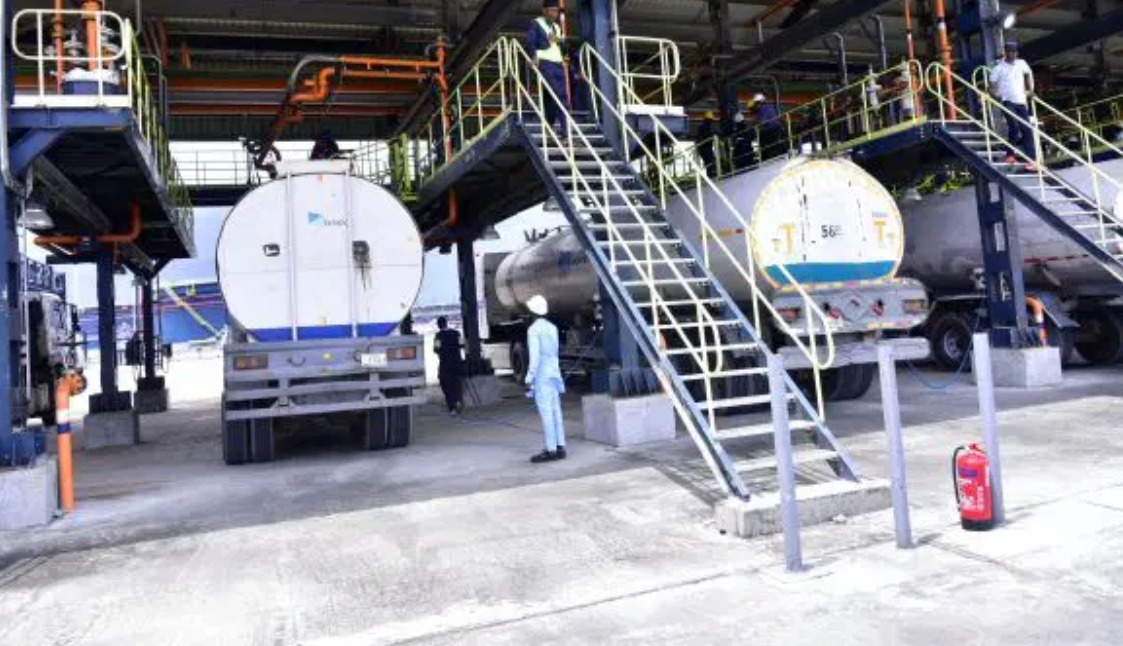
The refinery confirmed the new condition this week, stating that only marketers who buy half a million litres or more qualify for no-cost transportation of products. At the refinery’s gantry price of N820 per litre, this translates to a minimum outlay of about N410 million, equivalent to at least 11 trucks of 45,000 litres each.

A senior refinery official, who asked not to be named, explained, “Yes, the Minimum Order Quantity for the free delivery is 500,000 litres.”

The requirement has raised concerns among independent petroleum marketers, who argue that the benchmark is too high for most operators to meet. The National Publicity Secretary of the Independent Petroleum Marketers Association of Nigeria, Chinedu Ukadike, confirmed that members were struggling with the threshold.

“Yes, it is true. We have to buy a minimum of 500,000 litres. That requirement has not been easy to follow,” he said. Ukadike explained that the association was compiling a list of members who could pool resources to meet the refinery’s benchmark.

According to him, without such collaboration, the free delivery scheme could be hijacked by middlemen, leading to profiteering and bureaucracy in the fuel supply chain.

“The current situation would bring back middlemen. We usually just buy one truck before, but now we have to buy 11 trucks. That is why we are encouraging members to group themselves to access products directly from Dangote,” Ukadike stressed.

See also  FG scraps revenue collection deductions, pledges fiscal transparency

Energy analyst Olatide Jeremiah, Chief Executive Officer of Petroleumprice.ng, criticised the requirement, describing it as unrealistic for the majority of retail station owners. “At ₦820 per litre, marketers must raise over ₦400m to qualify. How many operators can afford that? Many will have no choice but to rely on wholesalers,” Jeremiah said.

He argued that the policy could inadvertently strengthen middlemen, undermining the refinery’s goal of reducing costs and providing direct delivery to retailers. “The only way to eliminate middlemen is to allow marketers to load and pay per truck. Requiring 11 trucks per order risks keeping depot operators and wholesalers in business, which is exactly what Dangote wants to avoid,” he warned.

Earlier this month, the Dangote Refinery unveiled a free delivery initiative, backed by 1,000 compressed natural gas-powered trucks, aimed at cutting supply chain costs and ensuring cheaper pump prices for Nigerians.

The refinery, which boasts a capacity of 650,000 barrels per day, is Africa’s largest and began commercial operations last year. Its entry into the market has been hailed as a potential game-changer for Nigeria’s energy landscape, with expectations of improved domestic fuel supply and reduced dependence on imports.

Several major marketers, including Conoil Plc, Eterna Plc, Golden Super, Nepal Energies, Kifayat Global Energy, and Riquest & Gas, have already partnered with the refinery to benefit from the free logistics scheme.

However, the scheme has triggered strong opposition from tanker owners and fuel distributors. The President of the National Association of Road Transport Owners, Yusuf Othman, criticised the initiative, arguing that it undermines existing agreements between his members and fuel buyers.

See also  Tinubu’s Executive Order: FG, states, LGs allocation may increase by N15tn

“NARTO members own over 30,000 trucks, and we cannot do fuel distribution free of charge. Many of our members took bank facilities to buy trucks based on signed contracts. If Dangote delivers fuel directly for free, those agreements collapse,” Othman lamented.

He also cited provisions of the Petroleum Industry Act (PIA), arguing that the refinery’s direct free delivery violates regulatory guidelines.

Stakeholders now fear that instead of reducing costs, the new threshold could distort the market, leaving small operators sidelined while wholesalers reassert control.

Analysts warn that depot operators and middlemen, who typically thrive on bulk purchases, may continue to dominate distribution. Smaller filling station owners, lacking the resources to buy 11 trucks at once, may find themselves dependent on intermediaries once again.

Jeremiah reinforced this concern, noting that middlemen could easily resell products with additional margins, undermining the refinery’s effort to lower pump prices.

“If nothing changes, the refinery is only encouraging middleman activities, and depot operations will remain viable. That would defeat the original purpose of the free delivery programme,” he said.

While the Dangote Refinery’s initiative was designed to cut costs and reduce pump prices, the implementation has exposed structural weaknesses in Nigeria’s downstream sector.

IPMAN is pushing for collective purchasing to help smaller operators participate, while experts recommend revising the policy to allow per-truck loading. Industry watchers argue that without adjustments, the refinery risks alienating the very marketers it needs to ensure broad distribution nationwide.

For now, the free delivery programme remains under scrutiny, with stakeholders awaiting possible revisions. The debate highlights the delicate balance between economies of scale for the refinery and inclusivity for independent marketers in Nigeria’s evolving fuel supply chain.

See also  Asian stocks hit by fresh tech fears as gold retreats from peak

punch.ng

FOLLOW US ON:

FACEBOOK

TWITTER

PINTEREST

TIKTOK

YOUTUBE

LINKEDIN

TUMBLR

INSTAGRAM

Continue Reading
Click to comment

Leave a Reply

Your email address will not be published. Required fields are marked *

Business

Lagos enforces 5% tax on gaming winnings

Published

on

The Lagos State Government has begun enforcing a five per cent withholding tax on gaming winnings from licensed gaming platforms operating within the state.

The Chief Executive Officer of the Lagos State Lotteries and Gaming Authority, Are Bashir, made this known in a public notice issued on Friday.

He stated that the policy, which takes immediate effect, applies to players’ net winnings and is to be deducted at the point of payout.

Bashir directed all licensed gaming operators in the state to comply immediately with the new tax framework in line with existing Nigerian tax laws and regulatory directives governing the gaming industry.

According to the notice, the five per cent deduction will be automatically withheld before winnings are paid to players and remitted to the Lagos State Internal Revenue Service as the statutory tax authority.

Bashir said the initiative is part of the state’s wider efforts to improve tax compliance, transparency and accountability in the fast-growing gaming sector.

“The measure forms part of Lagos’ broader drive to strengthen tax compliance, transparency, and accountability in the rapidly expanding gaming sector,” the notice read.

He said under the new arrangement, players are required to provide their National Identification Number (NIN) in line with Know Your Customer (KYC) regulations.

Bashir clarified that all deductions and remittances will be handled strictly by licensed gaming operators in accordance with regulatory requirements, adding that players will receive their winnings net of the statutory deduction, with proper records maintained to ensure transparency.

See also  FG scraps revenue collection deductions, pledges fiscal transparency

He further noted that the withholding tax deducted will serve as a tax credit to the player.

“All licensed gaming operators in Lagos State have now been formally directed to commence the deductions with immediate effect,” the notice said.

Bashir reiterated that the policy is aimed at ensuring effective regulation of the gaming industry while aligning both operators and players with existing tax obligations in the state.

Continue Reading

Business

Customs hand over seized N40.7m petrol to NMDPRA

Published

on

The Comptroller-General of Customs, Adewale Adeniyi, on Friday handed over 1,650 jerrycans of Premium Motor Spirit, worth N40.7 million, to the Nigerian Midstream and Downstream Petroleum Regulatory Authority for further investigation.

Addressing journalists at the handover ceremony held at the Customs Training College in Ikeja, Adeniyi said the seized fuel was intercepted at various locations, including Badagry, Owode, Seme, and other axes within Lagos State.

Represented by the National Coordinator of Operation Whirlwind, Deputy Comptroller-General Abubakar Aliyu, Adeniyi said the contraband was intercepted over the past nine weeks.

“In the space of nine weeks, our operatives intensified surveillance and enforcement across critical border communities. A total of 1,650 jerrycans of 25 litres each were seized along notorious smuggling routes, including Adodo, Seme, Owode Apa, Ajilete, Idjaun, Ilaro, Badagry, Idiroko, and Imeko. The total duty-paid value of the PMS is N40.7 million,” Adeniyi said.

He added that three tankers used to transport the fuel were carrying 60,000, 45,000, and 49,000 litres respectively, totalling 154,000 litres of PMS.

According to Adeniyi, the interception was the result of intelligence-driven operations and the vigilance of Operation Whirlwind in safeguarding Nigeria’s economy and energy security.

He explained that the transportation and movement of petroleum products are governed by regulatory frameworks and standard operating procedures designed to prevent diversion, smuggling, hoarding, and economic sabotage.

“These items contravened the established Standard Operating Procedures of Operation Whirlwind,” Adeniyi said, emphasising that such violations undermine government policy, distort market stability, and deprive the nation of critical revenue.

See also  FG scraps revenue collection deductions, pledges fiscal transparency

He warned that border corridors such as Owode, Seme, and Badagry remain sensitive economic arteries. “These routes have historically been exploited for illegal cross-border petroleum movement. Under our watch, there will be no safe haven for economic sabotage,” he said.

Adeniyi said the handover to NMDPRA reflects inter-agency collaboration. “While Customs enforces border control and anti-smuggling mandates, NMDPRA regulates distribution and ensures compliance with downstream laws. This collaboration ensures due process, transparency, and regulatory integrity,” he said.

Representing NMDPRA, Mrs. Grace Dauda said the agency ensures that petroleum products produced in Nigeria are consumed domestically. “It is unfortunate that some businessmen attempt to smuggle the product out of the country. The public must work together to stop economic sabotage,” she said.

Operation Whirlwind is a special tactical enforcement operation launched by the Nigeria Customs Service in 2024 to combat cross-border smuggling of petroleum products, particularly PMS, and other contraband that threaten Nigeria’s economic security. It was established in response to a surge in illegal fuel diversion across the country.

punch.ng

FOLLOW US ON:

FACEBOOK

TWITTER

PINTEREST

TIKTOK

YOUTUBE

LINKEDIN

TUMBLR

INSTAGRAM

Continue Reading

Business

Stocks drop, oil rises after Trump Iran threat

Published

on

Most Asia equities fell and oil prices rose on Friday after Donald Trump ratcheted up Middle East tensions by hinting at possible military strikes on Iran if it did not make a “meaningful deal” in nuclear talks.

The remarks fanned geopolitical concerns and cast a pall over a tentative rebound in markets following an AI-fuelled sell-off this month.

Traders are also looking ahead to the release of US data later in the day that will provide a fresh snapshot of the world’s top economy.

A slew of forecast-beating figures over the past few days have lifted optimism about the outlook but tempered expectations for more interest rate cuts.

The US president told the inaugural meeting of the “Board of Peace”, his initiative to secure stability in Gaza, that Tehran should make a deal.

“It’s proven to be over the years not easy to make a meaningful deal with Iran. We have to make a meaningful deal otherwise bad things happen,” he said, as he deployed warships, fighter jets and other military hardware to the region.

He warned that Washington “may have to take it a step further” without any agreement, adding: “You’re going to be finding out over the next probably 10 days.”

Israeli Prime Minister Benjamin Netanyahu earlier warned: “If the ayatollahs make a mistake and attack us, they will receive a response they cannot even imagine.”

The threats come days after the United States and Iran held a second round of Omani-mediated talks in Geneva as Washington looks to prevent the country from getting a nuclear bomb, which Tehran says it is not pursuing.

See also  CBN, NCC propose instant refunds for failed airtime, data

The prospect of a conflict in the crude-rich Middle East has sent oil prices surging this week, and they extended the gains Friday to sit at their highest levels since June.

Equity traders were also spooked.

Hong Kong fell as it reopened from a three-day break, while Tokyo, Sydney, Wellington and Bangkok were also down. However, Seoul continued to rally to a fresh record thanks to more tech buying, with Singapore, Manila and Mumbai also up.

City Index market analyst Matt Simpson said a strike was not certain.

“At its core, this looks like pressure and leverage rather than a prelude to invasion,” he wrote.

“The US is pairing military readiness with stalled nuclear negotiations, signalling it has credible strike options if talks fail. That doesn’t automatically translate into boots on the ground or a regime-change campaign.

“While military assets dominate headlines, diplomacy is still in motion. The fact talks are continuing at all suggests both sides are still probing for a diplomatic off-ramp before tensions harden further.”

Shares in Jakarta slipped even after Trump and Indonesian President Prabowo Subianto reached a trade deal after months of wrangling.

The accord sets a 19 percent tariff on Indonesian goods entering the United States. The Southeast Asian country had been threatened with a potential 32 percent levy before the pact.

Jakarta also agreed to $33 billion in purchases of US energy commodities, agricultural products and aviation-related goods, including Boeing aircraft.

– Key figures at around 0700 GMT –

Tokyo – Nikkei 225: DOWN 1.1 percent at 56,825.70 (close)

Hong Kong – Hang Seng Index: DOWN 0.7 percent at 26,508.98

See also  FG scraps revenue collection deductions, pledges fiscal transparency

Shanghai – Composite: Closed for holiday

West Texas Intermediate: UP 0.9 percent at $67.05 per barrel

Brent North Sea Crude: UP 0.9 percent at $72.27 per barrel

Euro/dollar: DOWN at $1.1756 from $1.1767 on Thursday

Pound/dollar: DOWN at $1.3448 from $1.3458

Euro/pound: DOWN at 87.42 pence from 87.43 pence

Dollar/yen: UP at 155.17 yen from 155.07 yen

New York – Dow: DOWN 0.5 percent at 49,395.16 (close)

London – FTSE 100: DOWN 0.6 percent at 10,627.04 (close)

AFP

punch.ng

FOLLOW US ON:
FACEBOOK

TWITTER

PINTEREST

TIKTOK

YOUTUBE

LINKEDIN

TUMBLR

INSTAGRAM

Continue Reading

Trending