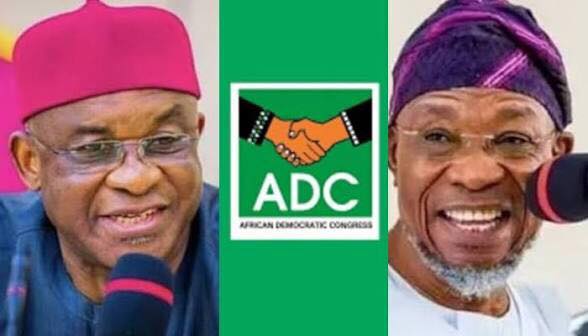
The African Democratic Congress, the Peoples Democratic Party, and former Anambra State Governor Peter Obi have protested the decision of the Independent National Electoral Commission (INEC) to de-recognise the ADC National Chairman, David Mark, National Secretary, Rauf Aregbesola, and others.
INEC, through its National Commissioner and Chairman of the Information and Voter Education Committee, Mohammed Haruna, announced the decision in a statement on Wednesday.
It hinged its decision on a court order which directed the commission to maintain the status quo pending the determination of a suit challenging the legality of David Mark’s leadership of the opposition party.
Reacting, the ADC spokesman, Bolaji Abdullahi and his Peoples Democratic Party counterpart, Ini Ememobong, insisted that the development was a calculated attempt to undermine democratic structures, alleging the involvement of the APC government and urging supporters to mobilise in defence of democratic principles.
Also, the National Coordinator of the Obidient Movement, Obi’s support group, Yunusa Tanko, warned that INEC’s decision is a recipe for crisis, adding that there might be a catastrophic consequence if the commission chooses to be partisan.
On Wednesday, the electoral commission removed the names of Mark and Aregbesola from its portal, delisting them as the national chairman and national secretary of the ADC, respectively.
The commission also stated that it would not recognise Nafiu Bala Gombe, who approached the court seeking to be declared the national chairman.
Haruna explained that the commission had been inundated with conflicting legal demands from opposing camps, each laying claims to the party’s leadership and seeking official recognition.
INEC disclosed that it received a letter from Suleiman Usman SAN & Co., cautioning it against recognising Gombe as acting national chairman due to a pending court case, specifically referring to ongoing litigation, and a counter-letter from Summit Law Chambers demanding enforcement of the appellate court’s judgment, which they argue affirms Gombe’s position.
The electoral body explained that, “the letter from Suleiman Usman SAN & Co urged the commission not to recognise Mr Nafiu Bala Gombe as acting National Chairman of the African Democratic Congress on account of the pending Suit No. FHC/ABJ/CS/1819/2025, while the letter from Summit Law Chambers, on the other hand, attached the certified True Copy of the Judgment of the Court of Appeal in Suit No. CA/ABJ/145/2026: Senator David Mark v Hon. Nafiu Bala Gombe & Ors and requested the commission to enforce the judgement of the Court of Appeal, including: Ceasing recognition of Senator David Mark and Ogbeni Rauf Aregbesola as National Chairman and National Secretary respectively of ADC; Removing their names from the Commission’s portal; and refraining from dealing with or recognising any actions taken by them in respect of the party in line with the preservation orders made by the Court of Appeal.”
INEC said Summit Law Chambers accused it of disregarding court orders by engaging with David Mark’s faction, alleging that the commission invited the group to a meeting and monitored its activities.
The chambers also called for several actions, including invalidating the group’s NEC meeting, removing its name from INEC’s portal, and allowing Gombe to take control of the party pending the court’s final decision.
However, INEC maintained that its actions were strictly based on the Court of Appeal ruling delivered on March 12, 2026, which dismissed Mark’s interlocutory appeal and issued preservative orders.
Quoting the appellate court, the commission stated, “Finally, it is necessary to make preservatory orders to ensure that the subject matter of the dispute pending before the trial court is not prejudiced, as courts have inherent powers to control and regulate proceedings to ensure justice.
“That suit no. FHC/ABJ/CS/1819/2025, be and is hereby granted an accelerated hearing in view of the Electoral Time Table released by the 4th Respondent.”
The court in its decision had also ordered, “That the parties are hereby directed to maintain the status quo ante bellum and shall refrain from taking any step or doing any act capable of foisting a fait accompli on the court or otherwise rendering nugatory the proceedings before the trial court.”
INEC, in its observations, traced the dispute to the emergence of a new National Working Committee led by David Mark following a National Executive Council meeting in July 2025, after the resignation of the previous executive.
The commission explained that Gombe, who was then Vice-National Chairman, rejected the process and insisted that he should automatically assume leadership, which led him to file Suit No. FHC/ABJ/CS/1819/2025 at the Federal High Court.
INEC noted that “ Nafiu Bala Gombe, who was the Vice-National Chairman, denied he ever resigned from the party and claimed that following the resignation of the chairman of the party, Mr Ralph Okey Nwosu, Hon. Nafiu Bala Gombe, automatically ought to take over as the chairman of the party.”
The commission added that Gombe sought multiple court orders, including “An order restraining INEC from recognising, dealing with or continuing to deal with the 2nd and 3rd Defendants as the national chairman and secretary” and “an order directing INEC to recognise the Plaintiff as the acting national chairman.”
After reviewing all legal processes and the appellate court’s judgment, INEC said it reached a decisive resolution at its meeting on March 31, 2026.
The commission declared, “To maintain the status quo ante bellum as directed by the Court of Appeal based on the facts and position of the parties existing before 2nd September 2026, when the case was filed by the plaintiff.
“That the commission would refrain from taking any step or doing any act capable of foisting a fait accompli on the court or otherwise rendering nugatory the proceedings before the trial court.”
Rejecting Gombe’s request to assume interim control, INEC stated, “The commission refused to accede to the request of the Plaintiff’s Solicitors to allow Hon. Nafiu Bala Gombe to take over the affairs of ADC pending the determination of the case.”
INEC also announced a complete suspension of engagement with all factions of the ADC.
“The commission shall not receive any further communication or deal with any of the parties or groups pertaining to the affairs of the party and will not monitor any meeting, congress or convention convened on behalf of the African Democratic Congress by any group until the matter is decided by the Federal High Court, Abuja.”
Additionally, the electoral body ordered the removal of the current leadership names from its official portal, stating, “Since the names of the current National Working Committee members led by Senator David Mark were uploaded on 9th September, 2025, the names would be removed from the INEC portal pursuant to the order of the Court of Appeal to maintain the status quo ante bellum.”
Reacting on behalf of the ADC, Abdullahi dismissed INEC’s reliance on the Court of Appeal’s stance, noting that its directive merely calls for maintaining the status quo as an interim measure.
He argued that the appropriate position is to revert to the status quo as it existed before Gombe’s legal action, particularly, prior to proceedings at the court.
Abdullahi maintained that at the time in question, Mark was in charge, and that remains the position the party recognises.
He warned that any attempt to alter this arrangement now suggests a fresh plot by enemies of democracy, stressing that such moves would be resisted.
The ADC spokesman warned, “It is definitely a violation of the Court of Appeal position because what the Court of Appeal will rule is that we should maintain the status quo. And that means we should go back to maintain the status quo before all legal interpretation.
“This indicates only one thing. We should maintain the status quo before the Nafiiu Gombe went to court. And the status quo at the time was that David Mark was the leader. And that’s why INEC recognised it.
“So if they are doing otherwise now, it means they are yielding to pressure from the enemies of democracy that this APC government represents, and we are going to resist it by all legal means possible.”
Earlier, in a statement on Wednesday, Abdullahi accused the ruling All Progressives Congress of attempting to hijack its leadership, while vowing to resist any such move through lawful and democratic means.
Abdullahi further claimed that the APC plans to sponsor a crowd posing as disgruntled party members to take to the streets and demand the removal of David Mark from his position.
The statement read in part, “Yesterday, we disclosed a sinister plot by agents of the ruling APC government to pressure INEC into taking illegal action to destabilise our party, following the milestone movement of H.E. Rabiu Kwankwaso to the ADC.
“After meeting a brick wall with INEC, they have now changed tactics, but the objectives remain the same. Information reaching us this morning is that a public protest is being planned for tomorrow, Thursday, 2nd April, in Abuja, sponsored by a particularly notorious minister. Their expectation is that a protest will give oxygen to a case already suffocating in the courts under the weight of its own illegality.
“The plan is simple: a paid crowd, posturing as aggrieved party members, will take to the streets demanding David Mark Must Go. This, they hope, will create public pressure on the INEC Chairman to magically upgrade and recognise an individual who resigned his position and was subsequently expelled from the ADC, to the position of National Chairman of a party he no longer belongs to.
“The plan by the ruling APC government to hijack the leadership of the ADC, the only viable opposition party left in the country, is real. If anything, it has assumed a new level of desperation in the past few days.
“They are not just afraid of our momentum. They are afraid of what happens when the Nigerian people start paying attention and begin to believe that change is possible.”
When contacted, the former National Chairman of the ADC, Ralph Nwosu, dismissed as false reports INEC’s de-recognition of ADC leadership.
Nwosu, who spoke in a phone interview with The PUNCH, described the circulating claims as unfounded amid growing controversy over the internal wrangling within the ADC. “That is fake news. I can’t say more than that,” Nwosu said.
An ally of Obi, Yunusa also condemned the decision, describing it as absurd and unacceptable, and questioning why a pending court matter would be used as a basis for INEC’s actions.
Yunusa also alleged that the move is politically motivated, suggesting government involvement and warning that the development could have serious consequences for Nigeria, while insisting that the action would be resisted.
The Obidient National Coordinator stated, “This is completely absurd. A court case that is still pending. When did they adjudicate on the issue of the court case and make it a basis to say they are not recognising anybody? This is terrible. This is unacceptable. They should be careful with the way they are going. We will reject this, honestly.’’
“Anyway, as far as we are concerned, this is a matter that will be discussed in the public domain for the Nigerian people. Nigeria ceases to be a nation if this happens. Nigeria will face catastrophic effects if INEC continues to use this as a pretext in making decisions that concern the people. This is totally unacceptable in any ramification whatsoever, and the people reject it.
“The APC government is behind it. Of course, because they have seen the level of mobilisation of the African Democratic Congress in Kano, Kaduna and some other parts of the country. And they do not really care if this is set ablaze. This is a catastrophic position that they should not take,” he noted.
The APC spokesman, Felix Morka and his deputy, Duro Meseko, did not respond to a request for reaction. Calls to their phones rang out and they have yet to respond to a message seeking their reaction to the ADC allegations as of the time of filing this report.
Commenting on the development, the PDP National Publicity Secretary alleged that the government is responsible for the challenges facing ADC and other opposition parties, accusing it of undermining credible political processes and influencing opposition parties’ affairs.
He described the situation as a national tragedy and a threat to democracy, noting that the parties will pursue legal options but warned against continued interference, while expressing confidence that Nigerians will overcome the situation.
He stated, “We have said in the statement that it is the APC government that is responsible for the internal crisis in opposition political parties, and they will do everything possible to ensure there is no credible opposition.
“The APC government is afraid of the quit notice Nigerians are giving them. They started with the Labour Party, then they moved to the PDP, and now they are in the ADC. They even went to Accord. Any platform that looks credible and formidable, the APC people enter and destroy it. This is why we are saying that we must all come together and reason. If we need to boycott this election, then we will do so.’’
He added, “I can say for a fact that there is no opposition political party whose APC leadership and the president have not interfered with to the extent that they can use it to do what they want. These are the reasons why the problems in these parties are intractable. There is absolutely no doubt.
“It is a national tragedy and a challenge to democracy that should not be allowed to happen. It is sad that Nigerians are being denied what they are supposed to have, but we can assure that in the end, Nigerians will progress.”
Meanwhile, the faction led by Gombe commended INEC for what it described as a neutral and lawful handling of the party’s deepening leadership crisis.
The commendation was conveyed by Gombe’s Chief of Staff, Bala Sani, in a phone interview with The PUNCH on Wednesday.
The faction said INEC’s recent actions were in line with the ruling of the Court of Appeal and reflected a commitment to due process amid the ongoing dispute over the party’s leadership.
He said, “Our position is very clear. All we want is for INEC to comply with the judgment of the Court of Appeal. So, at our own ends, as the leadership of ADC under the Nafiu Bala leadership, we try to commend INEC’s commitment to neutrality and impartiality by maintaining the status quo ante bellum, which does exactly what the Court of Appeal ruling gave.
“We are telling the world that they came to hijack the party from us. We are the legacy parties and members of the party. We built this party for more than 20 years before these people came in. And when they came in, they wanted to pursue us all. But we stood our ground and said, “ No. That’s not how it works.
‘So, the decision is a testament to INEC’s dedication to upholding the constitution and ensuring that the electoral process in this country is not compromised. We thank the civil societies because they all went to the INEC this morning to protest, which drew the attention of INEC to do the needful.”