Connect with us

Lifestyle

Ned Never Slept Outside Because I Held Him Well In The Other Room – Regina Daniels

Published

on

Nollywood actress, Regina Daniels, has opened up about her marriage to her estranged husband, Senator Ned Nwoko.

It was reports that the embattled wife revealed why their seven-year relationship remained faithful despite his polygamous lifestyle.

In a reply to a comment on her Instagram page, Daniels said that during their years together, Nwoko never slept with other women outside their home because she held him well in the other room.

She wrote: “Yes i think he loved me but a toxic one! Because tell me why a polygamous man forgot what it meant to be in polygamy, except for the media.

“Just because it boosted his ego of being seen with multiple women which is easy by me because anyone that sees a man as an odogwu sees the wife as what? He basically had to beg that he share days at ours and other days with his other wives because they begged for his attention.

“Y’all should pls forget this yeye social media comparison because my ex man never slept outside one day in our 7 years of marriage. You know why? Because as a delta babe, I hold am well for the other room ladies use your skills that’s all men want actually!”

FOLLOW US ON:

FACEBOOK

TWITTER

PINTEREST

TIKTOK

YOUTUBE

LINKEDIN

TUMBLR

INSTAGRAM

See also  Mohbad’s father releases special song ahead of his second year de@th anniversary
Continue Reading
Click to comment

Leave a Reply

Your email address will not be published. Required fields are marked *

Lifestyle

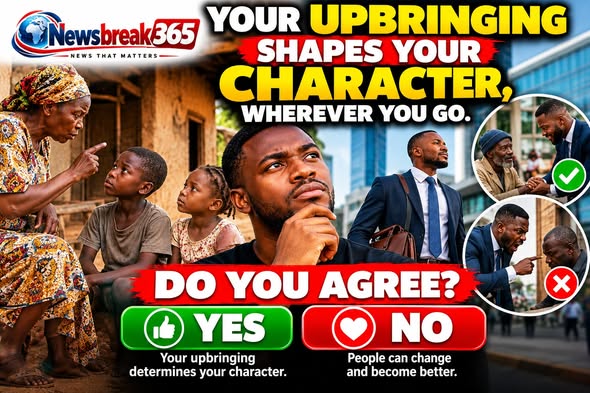
YOUR UPBRINGING SHAPES YOUR CHARACTER, WHEREVER YOU GO

Published

on

You can leave your village, move to another country, become wealthy, and associate with powerful people — but if you refuse to work on yourself, your bad habits may follow you wherever you go.**

Your upbringing plays an important role in shaping your character. The values you learn as a child can influence how you treat people, handle challenges, and make decisions as an adult.

A child raised to respect others may grow into an adult who treats people with dignity, regardless of their financial status. A child taught honesty may learn the importance of integrity, even when telling the truth is difficult.

But here is something worth thinking about: **not everyone who grows up in a good home becomes a good person, and not everyone who experiences a difficult upbringing becomes a bad person.**

Some people come from humble backgrounds and become compassionate, respectful, and successful. Others acquire wealth, power, and influence but still struggle to show kindness to those who cannot benefit them.

Why? Because upbringing is only part of the story. Personal choices, life experiences, education, and the willingness to change also shape who we become.

You cannot always choose the environment in which you grow up, but as an adult, you can choose the values you carry forward.

Never allow your background to become an excuse for bad behaviour. Let your experiences teach you, let your mistakes correct you, and let your character speak louder than your possessions.**

Remember: money can change your lifestyle, education can expand your knowledge, and power can elevate your position. But how you treat other human beings reveals a great deal about the person you are.

See also  Ash Wednesday: CAN urges national unity, policy implementation

🔥 **THE BIG QUESTION:**

Do you believe your upbringing determines your character for life, or can people completely change and become better human beings regardless of how they were raised?

👇 **COMMENT: UPBRINGING or PERSONAL CHOICE?**

Share your opinion. Your perspective may make someone think differently today.

Follow **Newsbreak365 — News That Matters** for more thought-provoking discussions about society, human behaviour, culture, and everyday life.

#Newsbreak365 #CharacterMatters #Upbringing #LifeLessons #HumanBehaviour #SocialCommentary

FOLLOW US ON:

FACEBOOK

TWITTER

PINTEREST

TIKTOK

YOUTUBE

LINKEDIN

INSTAGRAM

Continue Reading

Lifestyle

IF YOU’RE NOT FEEDING SOMEONE, WHY BULLY THEM? THE CRUELTY OF HUMILIATING THE LESS PRIVILEGED

Published

on

**Newsbreak365 | Social Awareness**

In a world where millions of people struggle to survive, one question deserves to be asked: **If you’re not feeding someone, helping them, or contributing to their survival, why bully them for being less privileged?**

Poverty is already painful enough. Nobody should have to endure insults, public humiliation, or discrimination simply because they cannot afford the lifestyle that others enjoy.

## When Wealth Becomes a Weapon

Some people use their money, expensive clothes, luxurious cars, professional positions, or social status to make others feel inferior. They laugh at those who are struggling, mock people who beg for assistance, and treat the less privileged as though they are worth less.

But having money does not make you a better human being. Wearing expensive clothes does not give you the right to humiliate someone who cannot afford them.

**Your financial status is not a measure of your humanity.**

Behind every struggling person is a story the world may never know. Someone who is homeless today may once have had a stable home. Someone asking for help may have spent years helping others. Someone who appears helpless may be fighting battles that would challenge even the strongest person.

We should never judge an entire human life by the circumstances we see today.

## Poverty Is Not a Crime

Nobody chooses every difficulty that life brings. Job loss, economic hardship, family responsibilities, illness, and unexpected circumstances can affect people’s lives in different ways.

Even when people make mistakes that contribute to their struggles, they still deserve basic human dignity.

See also  Sanitary Inspectors in Nigeria: The Era of the Wole-wole (PHOTOS)

You are not obligated to feed everyone. You are not required to pay another person’s bills or solve every problem you encounter.

However, **if you cannot help someone, at least do not deliberately make their suffering worse.**

A kind word can restore hope. A little respect can protect someone’s dignity. And sometimes, simply refusing to participate in public humiliation is an important act of humanity.

## Remember That Life Can Change

The person you laugh at today may become successful tomorrow. The person you consider insignificant may one day achieve things you never imagined.

Equally, someone who enjoys wealth and comfort today may experience hardship in the future.

Life is unpredictable. That is why humility matters.

Treat people with respect, not because you expect them to become rich or useful to you, but because their humanity deserves respect regardless of their financial circumstances.

True greatness is not demonstrated by how many people fear you, how loudly you can insult others, or how much wealth you display.

It is demonstrated by how you treat people who have less power, fewer resources, and no obvious advantage to offer you.

## The Question Everyone Should Answer

If you are not feeding someone, why bully them?

If you are not paying their bills, why mock their poverty?

If you are not helping them overcome their difficulties, why become another source of pain in their lives?

And if you believe that every human being deserves dignity, why should someone’s financial situation change the way you treat them?

See also  First remembrance prayers for Buhari hold Monday

**The world does not need more people who use their advantages to humiliate others. It needs more people who understand that success without compassion is an empty achievement.**

At Newsbreak365, we believe that conversations about poverty, bullying, inequality, and human dignity deserve attention. A society becomes stronger when people learn to disagree without humiliation and treat others with respect regardless of their social or economic status.

### JOIN THE CONVERSATION

Do you believe people who are financially successful sometimes use their wealth to intimidate or humiliate the less privileged?

Should society do more to challenge bullying based on poverty and social status?

Share your thoughts in the comments. Let us have an honest and respectful conversation.

**Newsbreak365 — Real News. Bigger Impact.**

#Newsbreak365 #StopBullying #PovertyIsNotACrime #HumanityFirst #SocialAwareness #RespectHumanDignity #KindnessMatters

FOLLOW US ON:

FACEBOOK

TWITTER

PINTEREST

TIKTOK

YOUTUBE

LINKEDIN

INSTAGRAM

Continue Reading

Lifestyle

Rumour Peddlers: When Gossip Becomes a Weapon That Destroys Lives

Published

on

Some people do not need weapons to hurt others. A few words, a false story, and a willing audience can be enough to destroy a person’s reputation, damage relationships, and turn friends into enemies.**

In a world where information spreads within seconds, rumours and gossip have become powerful forces capable of causing serious personal and social damage. Sometimes, the most painful attacks do not come from strangers but from people we know, people we trust, and people who smile with us in public while discussing our lives behind closed doors.

## When Words Become Weapons

Rumour peddlers are people who spread unverified stories, exaggerate information, or repeat allegations without considering the consequences. Some do it for attention. Others do it out of jealousy, resentment, or a desire to feel important. In other cases, people simply repeat what they hear without taking the time to establish whether it is true.

Whatever the motivation, the consequences can be devastating.

A rumour can destroy years of friendship. An unverified allegation can damage someone’s professional reputation. Gossip can create suspicion between husbands and wives, divide families, weaken communities, and turn colleagues against one another.

The person spreading the story may move on with their day, but the person being discussed may spend months or even years trying to repair the damage.

## The Dangerous Excuse: “I Only Heard It From Someone Else”

One of the most common excuses people give after spreading a rumour is that they did not originate the story.

“I only heard it from someone else.”

See also  Sanitary Inspectors in Nigeria: The Era of the Wole-wole (PHOTOS)

But does repeating a story remove your responsibility for spreading it?

If you do not know whether a claim is true, why pass it on as though it were a fact? If you have no reliable evidence, why contribute to the destruction of another person’s reputation?

Every person who repeats an unverified allegation can help it reach a wider audience. A story that begins as a whisper can eventually become something an entire community believes, even when the original claim has never been established.

**The fact that many people repeat a story does not automatically make it true.**

## Why Do People Spread Rumours?

There is no single explanation for gossip. Some people use it to gain social attention, some repeat information carelessly, and others may use false or misleading stories to damage someone they dislike.

Social media has made the problem even more complicated. A screenshot, voice note, edited video, or sensational caption can spread rapidly before anyone checks its accuracy.

In the pursuit of likes, comments, shares, and online popularity, some people forget that real human beings may suffer the consequences of what they publish.

Freedom of expression does not make every allegation responsible, and popularity does not turn misinformation into truth.

## The Damage Nobody Sees

The effects of malicious gossip are not always visible.

A person whose reputation has been attacked may lose friendships, face difficulties at work, experience family conflict, or struggle with the emotional burden of being judged for something that may not even be true.

Even after a rumour is corrected, some people may continue to remember the accusation rather than the facts.

See also  SIBLING RIVALRY

That is why responsible communication matters. An apology can be important, but it cannot always restore the trust that has been lost.

Before sharing a damaging story about someone, ask yourself: Is it verified? Is it fair to repeat? Could sharing it cause unnecessary harm?

These questions can prevent careless words from becoming lasting wounds.

## How Can We Stop the Spread of Harmful Rumours?

Everyone has a role to play in creating a more responsible society.

– **Verify before sharing:** Do not treat hearsay as established fact.
– **Refuse to participate in malicious gossip:** You do not have to repeat every story you hear.
– **Challenge misinformation responsibly:** Correct false claims with credible information rather than insults or further speculation.
– **Protect people’s dignity:** Discuss genuine concerns through appropriate channels instead of spreading allegations publicly.
– **Use social media responsibly:** Remember that sharing, reposting, or commenting on a claim can amplify it.

These steps will not eliminate every rumour, but they can reduce the damage caused by careless and malicious communication.

## Final Thoughts: Think Before You Speak

Nobody is perfect, and people will always talk. However, there is a difference between discussing a verified matter responsibly and spreading unconfirmed stories that can ruin another person’s life.

The real test of character is not how much information you know about other people, but how responsibly you handle the information you receive.

**Do not become the bridge through which a rumour travels. Do not allow gossip to turn you into a weapon against another human being.**

Before you speak, post, forward, or share, remember that behind every name is a human being whose dignity and reputation deserve fairness.

See also  First remembrance prayers for Buhari hold Monday

### Newsbreak365 Asks

**Who bears greater responsibility when a harmful rumour spreads: the person who starts it, the person who repeats it without checking the facts, or the people who believe and spread it further?**

Share your opinion in the comments. Let us have a thoughtful discussion about the power of words and the responsibility that comes with using them.

*Newsbreak365 — News | People | Perspective*

**Editorial note:** This article discusses the general social consequences of gossip and unverified allegations. Specific accusations about individuals should be assessed using reliable evidence and appropriate context.

FOLLOW US ON:

FACEBOOK

TWITTER

PINTEREST

TIKTOK

YOUTUBE

LINKEDIN

INSTAGRAM

Continue Reading

Trending