Connect with us

Lifestyle

Don’t handle your family feud like I did, Phyna advises Imisi

Published

on

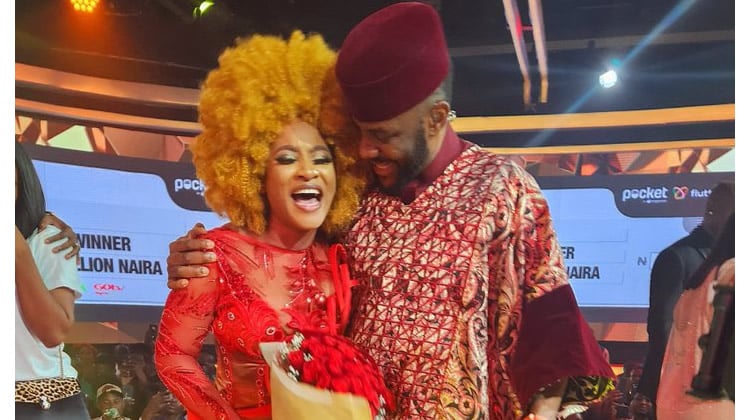
Reality TV star Phyna has offered words of encouragement to fellow Big Brother Naija winner Imisi amid a family feud between the latter and her mother.

In an X post on Monday, Phyna wrote,”To Imisi, @imisiofficial and to anyone walking through the same fire… I’m praying for your strength.

“My own experience broke me, but I’m slowly rising.

“And I’m rooting for you with everything in me, don’t handle it like I did, build strong and focus on you baby girl.”

The post comes against the backdrop of a family dispute in which Imisi’s mother accused her daughter of hatred and revealed the poor condition of the home where she currently lives, despite Imisi winning N150 million after her Big Brother victory.

Imisi replied in Yoruba,”This is why Aunty Debola said you should not show your face to the world. I can’t be saying all that now, you are in the midst of people. Just overlook everything and leave social media.

“Don’t worry, I will send you money to rent a new house. I am tired of all this drama. I am still recovering from the stress of Big Brother.

“Should I be facing another stress now? Please forgive me, I am your daughter.”

Recall Imisi’s mother has publicly expressed frustration on social media, saying she does not need her daughter’s money after being sidelined following the win.

She also blamed Imisi for recounting her childhood experiences, which she claims involve untrue allegations of parental neglect and sexual assault.

In a video, she showed the old house she currently resides in, saying she is content with her situation, a revelation that sparked online controversy.

See also  Failed Maths exam led me to music – Zlatan

In 2023, after Phyna’s BBNaija win, her father, Felix Otabor, revealed in an interview that he was distressed by his daughter’s actions following her BBNaija win.

Otabor said Phyna had asked him to stop working as a hearse driver and requested that he sell his cars, promising to improve the family’s life.

He said he later struggled financially after selling the vehicles, losing his business momentum and community position, and has not seen his daughter since her victory.

He described feeling sidelined while she enjoyed her wealth.

punch.ng

FOLLOW US ON:

FACEBOOK

TWITTER

PINTEREST

TIKTOK

YOUTUBE

LINKEDIN

TUMBLR

INSTAGRAM

Continue Reading
Click to comment

Leave a Reply

Your email address will not be published. Required fields are marked *

Lifestyle

10 most developed African countries in 2025

Published

on

Development in Africa doesn’t move in leaps; it is a back-and-forth progress; it inches forward, sometimes slips back, then steadies again. Yet in 2025, several countries stand out for doing more things right than wrong with better healthcare access, stronger education outcomes, functional infrastructure, and relatively higher living standards.

Contents
1. Seychelles
2. Mauritius
3. Algeria
4. Tunisia
5. Egypt
6. South Africa
7. Gabon
8. Botswana
9. Libya
10. Morocco

Based on Business Insider Africa’s 2025 report, which draws heavily from the UN Human Development Index (HDI), Tribune Online takes a look at the most developed African countries this year:

1. Seychelles
Seychelles does not just lead Africa; it dominates the development conversation.

With the continent’s highest Human Development Index (HDI), the island nation benefits from long life expectancy, universal healthcare access, and strong public institutions. Tourism fuels the economy, but smart governance keeps services running smoothly.

For a country with fewer than 100,000 people, its development model punches well above its weight.

2. Mauritius
Mauritius is proof that stability compounds over time. Ensuring strong institutions, diversified income streams, and a reliable education system that keep it near the top year after year. The country balances tourism, finance, manufacturing, and ICT with relative ease. In 2025, it remains one of Africa’s clearest development success stories.

3. Algeria
Algeria’s ranking reflects scale, resources, and long-term public investment. Its oil and gas revenues continue to support education, healthcare, and infrastructure. While youth unemployment and reform pressures persist, Algeria’s HDI still places it firmly among Africa’s development leaders.

See also  Maryam Abacha From Royal Roots to National Influence

4. Tunisia
Tunisia’s development strength lies in its people, maintaining high literacy rates, strong healthcare access, and urban infrastructure, which keep it competitive despite recent economic stress. Even through political uncertainty, past investments in human capital continue to pay dividends in 2025, and the country remains steadfast.

5. Egypt
Egypt’s presence on this list is driven by momentum and magnitude. The country has large-scale infrastructure projects, expanded healthcare coverage, and education reforms that have gradually lifted development indicators. As one of Africa’s biggest populations, even modest improvements translate into massive social impact.

6. South Africa
South Africa remains Africa’s most industrialised economy, and it shows in headlines. The country’s advanced financial markets, transport networks, and manufacturing capacity anchor its development ranking. That said, inequality and unemployment still blunt progress. In 2025, South Africa will be developed, but unevenly so.

7. Gabon
Gabon often flies under the radar, yet its numbers tell a different story: controlling high urbanisation, relatively strong healthcare access, and oil revenues support living standards above much of the continent. The challenge ahead is diversification, but in terms of development metrics, Gabon holds its ground.

8. Botswana
Botswana’s story is one of discipline and patience in Africa. With decades of political stability, prudent economic management, and steady investment in education, the country has created a solid development foundation. It is not flashy, but it works, and 2025 proves that consistency still counts.

9. Libya
Libya’s inclusion reflects recovery, not perfection. After years of conflict, rebuilding efforts in health, education, and basic services have improved its development indicators. Also, oil wealth helps, but progress remains fragile. Still, by HDI standards, Libya makes the top ten.

See also  Why pregnant women with previous CS shouldn’t use PHCs for antenatal care

10. Morocco
Fortunately, Morocco rounds out the list through long-term planning. With heavy investment in transport infrastructure, renewable energy, and industrial zones, living standards in the country have gradually improved. Education and healthcare access continue to improve, placing Morocco among Africa’s development frontrunners in 2025.

Meanwhile, the most developed African countries were not ranked by chance. Each followed a different path, some through resource management, and others through institutional stability or human-capital investment.

FOLLOW US ON:

FACEBOOK

TWITTER

PINTEREST

TIKTOK

YOUTUBE

LINKEDIN

TUMBLR

INSTAGRAM
Continue Reading

Lifestyle

Soyinka decries Seyi Tinubu’s ‘excessive’ security escort

Published

on

Professor Wole Soyinka says President Bola Tinubu must be cautious about his approach to regional security, domestic governance, and the use of state protection for privileged individuals.

The nobel laureate said this at the 20th Wole Soyinka Centre for Investigative Journalism Awards in Lagos on Tuesday.

All these were captured in a now viral four-minute, 25-second video shared on Tuesday night by #Nigeriastories on X.

Soyinka had recounted an encounter which he described as recent in his hotel room in Ikoyi, Lagos State, that left him shocked at what he considered an extravagant display of state security.

He described seeing “an excessively large security battalion assigned to a young individual close to the Presidency,” an entourage he said was “sufficient to take over a small country.”

Soyinka revealed that the young man turned out to be Seyi Tinubu, the President’s son.

Soyinka on Tinubu’s son

He said the discovery concerned him enough to contact National Security Adviser Nuhu Ribadu.

“I was so astonished that I started looking for the national security adviser. I said track him down for me. I think they got him somewhere in Paris. But he was with the president; he was in a meeting.

“Then, I said I’ve just seen something I can’t believe I don’t understand and I described the scene to him I said do you mean that a child of the head of state goes around with an army for his protection or whatever.

“I couldn’t believe it. Later on, I did some investigative journalism, and I found that apparently this is how this young man goes around with his battalion, his heavy armed soldiers,” he said.

See also  A Royal Ride Through Nigeria: The Prince of Wales' 1925 Visit (PHOTOS)

“I was astonished,” Soyinka said, adding that “children must understand their place. They are not elected leaders, and they must not inherit the architecture of state power simply by proximity.”

In a separate remark captured at the same event in honour of veteran poet Odia Ofeimum and many others, Soyinka urged Tinubu to reconsider the scale of security personnel attached to Seyi, stressing that such resources are urgently needed elsewhere.

He humorously observed that if a major insurgency were to break out, perhaps the President should ask Seyi to “go and handle it,” given the size of his escort — but added that “beyond the humour lies a serious matter of priority and fairness.”

He warned that concentrating a battalion of operatives around one individual is inconsistent with a nation battling kidnappings, rural attacks, insurgency and criminal violence, insisting that security deployments must reflect national realities, not privilege.

Turning to the media, Soyinka praised journalists for resilience but urged stronger editorial discipline in an era of escalating misinformation.

He cautioned that “the next great conflict may well be triggered by the misuse of social platforms,” calling for renewed commitment to truth and verification, and describing credible journalism as one of Nigeria’s strongest defences against chaos.

PUNCH Online reports that the video shared at about 22.18pm on Tuesday night had garnered over 27,000 views, 466 reposts and 81 quotes.

Benin coup, Lagos demolitions

Also in the viral footage, Soyinka warned that Nigeria’s involvement in the recently halted coup attempt in the Republic of Benin carries significant risks.

See also  Lieutenant-General Taoreed Abiodun Lagbaja: Life, Family, Education and Legacy

Soyinka described the intervention as “another unnecessary military entanglement next door,” arguing that Nigeria should focus on reinforcing democratic institutions rather than resorting to reflex military deployment.

He cautioned that instability in neighbouring countries inevitably spills into Nigeria.

He noted, “What happens in Benin inevitably affects us. Instability anywhere in the region echoes across our own sense of security.”

Beyond regional matters, Soyinka turned to domestic issues, criticising the ongoing wave of demolitions across Lagos.

He said he had personally received photos and testimonies of displaced families and stressed that even necessary urban reforms must prioritise dignity.

“Let us not strip away the humanity of the people affected,” he said, calling for evacuation procedures that protect the vulnerable.

PUNCH Online reports that the trending video continues to circulate widely on X, drawing public comment and discussion on governance, accountability in the country.

Late November, Tinubu ordered the withdrawal of police officers attached to Very Important Persons across the country, directing that they be redeployed to core policing duties.

While, there are no official communication or light response yet from the Presidency as of Tuesday night, PUNCH Online reports that no video confirmation or acceptance that the individual Soyinka raised the alarm about is indeed Seyi Tinubu.

Continue Reading

Lifestyle

Declare Your Lineage – Royal Family Tells Musician KWAM 1 Over His Interest In Becoming Next Awujale Of Ijebuland

Published

on

KWAM 1, in a letter dated December 3, 2025, addressed to the chairman of the Fusengbuwa Ruling House in Agunsebi Quarters, Ijebu-Ode, announced his interest in the stool, describing himself as a “bonafide son” of the ruling house.

The Fusengbuwa ruling house of Ijebu-Ode, next in line to produce the new Awujale of Ijebuland, Ogun State, has instructed Fuji musician Wasiu Ayinde, popularly known as KWAM 1, to confirm his family’s royal lineage to validate his membership in the ruling house.

KWAM 1, in a letter dated December 3, 2025, addressed to the chairman of the Fusengbuwa Ruling House in Agunsebi Quarters, Ijebu-Ode, announced his interest in the stool, describing himself as a “bonafide son” of the ruling house.

KWAM 1 also stated that his candidacy aligns with Ijebu customary law and the Ogun State Chieftaincy Laws.

In an interview with Punch, the Chairman of the ruling house and former National President of the Institute of Chartered Accountants of Nigeria, Abdulateef Owoyemi, said only bonafide members of the family would be allowed to participate in the selection process.

Owoyemi explained that KWAM 1, Olori Omooba of Ijebu land and others interested in the stool have been directed to complete the Fusengbuwa ruling house royal lineage data form.

According to him, the form, which requires contenders to trace their genealogy back seven generations, ensures that only genuine princes from the family can participate, thereby blocking “strangers” from claiming the throne.

He said, “The first step for anyone interested in contesting for the Awujale throne is to declare their lineage by filling the standard Fusengbuwa ruling house royal lineage data form. Once confirmed as a legitimate member of the ruling house, they can then apply for the expression of interest form.

See also  PHOTOS: Jacob Zuma Statue in Imo State, Nigeria — Diplomacy, Symbolism and Public Backlash

“We have told him, just like everyone else interested in the Awujale throne, that the first step is to declare his lineage. He will do this by completing the royal lineage data form, showing his full name, which parent and grandparent he descends from, and continuing up to seven generations.

“The completed form will be signed and submitted to the head of the ruling house unit of the Fusengbuwa ruling house, who will affirm that he is a genuine member. Only then will the process move forward.”

Owoyemi emphasised that although the application window for the throne officially closed on December 5, KWAM 1 had been given a five-day extension, which would lapse on December 10.

He noted, “We won’t shut anybody out of picking the next Awujale, but we must ensure that you are a legitimate member of Fusengbuwa. Every right comes with responsibilities. For a royal family, everyone must prove their legitimacy by completing the royal lineage data form.

“When we receive the form, we will review it meticulously. If clarification is needed, we will contact the applicant. We welcome men of influence who will use their influence to enhance the throne, not to claim it, ensuring that what truly belongs to our family is preserved.”

Owoyemi explained that the local government has given them 14 days to select candidates, and the ruling house hopes to have a new Awujale by the second or third week of January 2026.

He added, “The local government has given us 14 days to select candidates, which expires on December 18. After that, the kingmakers have seven days to deliberate and choose one candidate, whose name will be forwarded to the governor.

See also  Lieutenant-General Taoreed Abiodun Lagbaja: Life, Family, Education and Legacy

“Legally, the government then has 21 days to conduct background checks and security clearance, allowing for objections or protests. After this period, the State Executive Council will ratify the nominee, and the governor will announce the next Awujale, after which coronation rites will commence.

“So, combining the candidate selection, kingmakers’ deliberation, and legal objection period, we are looking at around 42 days. Therefore, we expect the next Awujale to emerge between the second and third week of January.”

FOLLOW US ON:

FACEBOOK

TWITTER

PINTEREST

TIKTOK

YOUTUBE

LINKEDIN

TUMBLR

INSTAGRAM

Continue Reading

Trending