Connect with us

Business

PENGASSAN-Dangote rift widens over salary suspension

Published

on

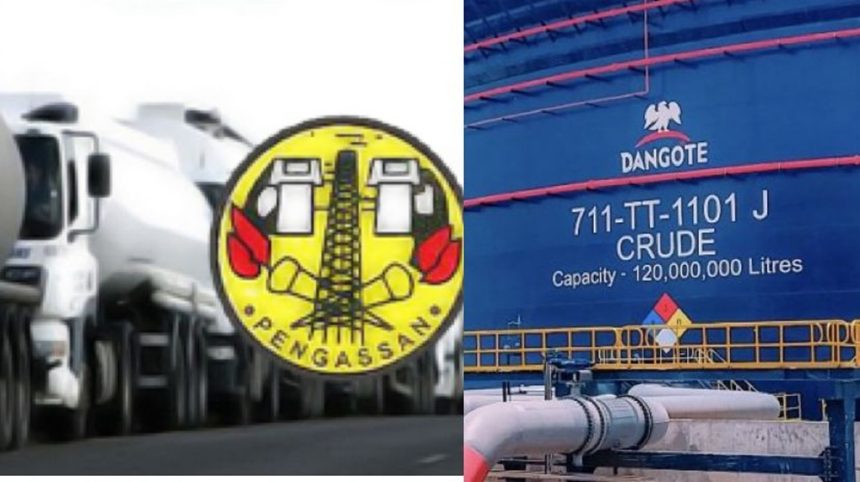
The Dangote Petroleum Refinery has stopped the monthly salaries of the engineers sacked in September during its face-off with the Petroleum and Natural Gas Senior Staff Association of Nigeria.

In a bid to address this, PENGASSAN said it is engaging the Dangote Group to resolve the matter amicably instead of resorting to another industrial action.

Findings by The PUNCH revealed that the salaries were halted following the refusal of many of the engineers to accept their redeployment to Zamfara, Borno, Benue, and Sokoto states, among others.

Some of the workers, who spoke on condition of anonymity because of the sensitivity of the issue, had earlier said individuals were sent to a coal mine in Benue, concrete road construction sites in Borno and Ebonyi states, as well as rice plants in Kebbi, Niger, Sokoto, and Zamfara.

While a few workers were said to have accepted the redeployment, many rejected it, relying on assurances from PENGASSAN that the crisis would be resolved through dialogue.

It was learnt that the Dangote Group issued a warning signal in October by slashing the wages of the affected workers before withholding their November salaries completely.

A senior official of the Dangote Group confirmed to our correspondent that the company would no longer continue paying those who rejected the redeployment offers.

While the affected workers described the non-payment of their salaries as “victimisation”, the official, who did not want his name in print due to the lack of authorisation to speak on the matter, wondered why the company should keep paying individuals who had refused the alternative placements offered.

“Those whose services were terminated were given an opportunity to work in our other projects, such as rice mills, concrete road construction, and coal mines.

See also  FG eyes N796bn annually from 5% petrol surcharge

All those who accepted have started working.

“If a newspaper terminates the services of an employee, and if it even goes out of its way to provide alternative employment, but the employee is not interested in availing the alternative employment, will it keep paying his/her salary?” the official said.

Recall that PENGASSAN had shut down oil and gas facilities in September over allegations that 800 refinery workers were fired for volunteering to be members of the union. However, the Dangote refinery said it only sacked a few workers who were sabotaging the facility, describing the exercise as a reorganisation.

The shutdown caused nationwide losses in oil and gas production and contributed to a drop in power generation until the Federal Government intervened and directed the redeployment of the affected workers.

In October, the sacked engineers were invited to pick up their letters at the Ikeja office of the Dangote Group. One of the letters sighted by our correspondent was titled ’Offer of Trainee Engagement’ and carried the letterhead of Dangote Projects Limited.

It reads partly: “Based on your performance at the assessment and subsequent interviews held with you, we are pleased to engage you as Engineer Trainee (Mechanical Engineering) for the coal project we are executing at Okpokwu, Benue State. This engagement shall be subject to the following conditions: You will report to your work location within 14 days upon receipt of this letter.

“You will undergo classroom training and hands-on training in the construction, commissioning, and operation of our Coal Project at Okpokwu, Benue State. Your training will be for a period of two years, and it will be reviewed periodically. You will be required to submit reports on your learning and progress. The objective of the training is to impart to you skills and to enable you to take up a position of responsibility in the organisation.”

See also  Minority investors vital for capital market growth – Sola Oni

Many of the engineers expressed concerns about the posting, especially to places perceived to be security hot spots. “The issue with the re-employment is that, firstly, there’s no address to report to on that letter. No office to report to in the states we were posted to. Secondly, those are security hot zones.

“Thirdly, in the letter, it is stated that if you don’t report within 14 days, your employment will be terminated, but no office location was given, and they don’t exist when we checked on Google Maps. So, if we accept the letters, we are basically terminating our employment by ourselves because there’s no office in those states to report to. PENGASSAN has basically told us not to accept the letters. We should let them continue with their talks,” they told The PUNCH.

Speaking during a briefing last week, the PENGASSAN President, Festus Osifo, said the union was still engaging the Dangote refinery to have the issues resolved.

Osifo said, “Since our last national industrial action, we have been engaging them in a lot of conversations, but the issues are not fully resolved. There are still a lot of pending issues. The NEC decided that, yes, let us still continue that process by pushing those issues by engaging in a dialogue to resolve the issues, and by also engaging all our social partners and stakeholders to get the issues resolved. And we hope and pray that these issues will be resolved at the table.

“These issues should be resolved in mere jaw-jaw so that we will not go back to Egypt. But as PENGASSAN, you know, we don’t shy away from doing what is right. But our preference is to get the subject resolved over the negotiation table.”

See also  FULL LIST: Nigeria, 66 other countries hit with Trump tariffs

A senior management officer told our correspondent on Sunday that PENGASSAN had the right to make its requests, but the company also had the liberty to make decisions that suited its business.

“They (PENGASSAN) have their privilege to ask. We can’t deny the opportunity to anyone to ask anything they wish. But we, too, have the privilege to state what we want,” the official said.

Some of the engineers lamented the turn of events. They disclosed that there was “an agreement that they would send us to oil and gas companies owned by Dangote.”

According to them, it was initially agreed that their salaries would be paid until the issue was resolved.

“But we noticed a reduction in our October salaries. We were not paid for November when others have been paid. That’s clear victimisation. It was agreed that Dangote would keep paying us until the matter is resolved, but it seems they have breached the agreement already,” they said.

As the stalemate lingers, the affected engineers said they are now caught between losing their livelihoods and accepting deployments they consider unsafe and irregular, while PENGASSAN continues to push for a negotiated settlement to prevent another nationwide shutdown.

With both sides holding firmly to their positions, the resolution of the dispute now hangs on the outcome of ongoing engagements between the union and the Dangote Group.


Continue Reading
Click to comment

Leave a Reply

Your email address will not be published. Required fields are marked *

Business

NNPC sets 36-year oil production record at 355,000bpd

Published

on

The Nigerian National Petroleum Company’s upstream subsidiary, NNPC Exploration and Production Limited, has recorded its highest daily crude oil production in more than three decades, hitting 355,000 barrels per day on December 1, 2025.

The milestone, confirmed in a statement issued on Tuesday by NNPC Limited’s Chief Corporate Communications Officer, Andy Odeh, marks the company’s biggest output since 1989 and signals renewed momentum in Nigeria’s upstream recovery efforts.

According to the statement, NNPC E&P Limited’s average daily output has surged by 52 per cent in just two years, rising from 203,000 barrels per day in 2023 to 312,000 barrels per day in 2025, a performance the company attributed to strengthened operational systems, disciplined asset management and structured field development.

“On December 1st, 2025, NNPC E&P Limited, the flagship upstream subsidiary of NNPC Limited, achieved a record production level of 355,000 barrels of oil per day, its highest daily output since 1989. The milestone marks a significant step forward for Nigeria’s upstream sector and reflects the company’s ongoing transformation anchored on efficiency and discipline.

“The figures show genuine transformation: average daily production surged 52 per cent, rising from 203,000 barrels per day in 2023 to 312,000 in 2025.

“This record growth is no coincidence; it stems from a clear strategy anchored on operational excellence, strong asset management, and structured field development,” the statement said, stressing that the achievement reflects a “genuine transformation” underway within the company.

Commenting on the achievement, the Group Chief Executive Officer of NNPC Limited, Bayo Ojulari, described the accomplishment as fresh evidence that Nigeria’s energy revival “is not a dream but already happening.”

See also  FULL LIST: Nigeria, 66 other countries hit with Trump tariffs

Ojulari noted that by exceeding its own production benchmarks, NNPC E&P has demonstrated that the essential building blocks needed to scale national output are being firmly established.

“By showing its ability to exceed its own production benchmarks, NEPL confirms that the essential building blocks for scaling national output are being firmly established. The achievement signals that the machinery of production, equipment, processes, capabilities, and partnerships can be driven with commercial discipline to produce real and positive outcomes.

“The achievement converts national ambition into measurable momentum. The presidential targets of two million barrels per day by 2027 and three million by 2030 have often appeared aspirational. NEPLs’ delivery brings them closer to reality,” he added.

Ojulari said the accomplishment boosts investor confidence and reassures global partners that Nigeria remains committed to reclaiming its place as a stable, dependable crude supplier.

The Executive Vice President, Upstream, Udy Ntia, said the milestone represents more than a production figure, stressing that NEPL’s growth is anchored on responsible and sustainable operations.

“In a sector where shortcuts can yield short-term wins but long-term damage, NEPL is making a different point: sustainable progress must rest on responsible operations. This ensures that scaling production does not compromise worker safety, community wellbeing, or environmental protection. It reinforces a shift away from extraction at any cost towards sustainable value creation, a core requirement for any modern energy company seeking global relevance,” Ntia said.

According to him, the company’s approach ensures that scaling output does not undermine worker safety, environmental protection or community wellbeing.

Similarly, the Managing Director of NNPC E&P Limited, Nicolas Foucart, said the new production record reflects the broader transformation sweeping through NNPC Limited.

See also  NNPC / Heirs Energies ends gas flaring at OML 17, seals deals with offtakers

“This is a story shaped by leadership that charts a clear course; by partnerships built on alignment and accountability; and by a workforce whose hard work is turning goals into measurable progress. Our people, our processes, and principles are the real engines behind this success. We are building for tomorrow, not just celebrating today,” Foucart noted.

He added that the gains translate into increased national revenue, stronger energy security and a more resilient economic foundation.

“For Nigerians, this accomplishment means far more than increased barrels; it translates into greater national revenue, stronger energy security, and a more resilient economic foundation. NEPL has not only produced more hydrocarbons; it has reignited belief in what Nigeria’s energy sector can achieve with the right systems, culture, and dedication.”

Nigeria’s crude oil sector has struggled over the past decade, with output frequently dropping below OPEC quotas due to pipeline vandalism, crude theft, underinvestment, deferred maintenance and declining performance of mature fields.

At several points between 2021 and 2023, the country’s production fell to multi-decade lows, raising concerns about revenue losses and the long-term viability of the industry.

Reforms under the Petroleum Industry Act, the unbundling of NNPC into a commercial entity and renewed upstream interventions have aimed to reverse the decline.

President Bola Tinubu’s administration has set ambitious production targets of two million barrels per day by 2027 and three million barrels per day by 2030, goals industry players previously considered optimistic.

NNPC E&P Limited, a wholly-owned subsidiary responsible for several joint venture and production-sharing assets, has been positioned as a critical driver of this revival. The company has implemented field optimisation strategies, renewed contractor alignment, strengthened governance structures and ramped up previously underperforming assets.

See also  FG eyes N796bn annually from 5% petrol surcharge

The latest 355,000 bpd performance, the company’s highest since 1989, is a significant step toward stabilising national output and rebuilding investor confidence in Nigeria’s oil industry.

punch.ng

FOLLOW US ON:

FACEBOOK

TWITTER

PINTEREST

TIKTOK

YOUTUBE

LINKEDIN

TUMBLR

INSTAGRAM

Continue Reading

Business

NNPC / Heirs Energies ends gas flaring at OML 17, seals deals with offtakers

Published

on

The NNPC / Heirs Energies OML 17 Joint Venture on Tuesday signed Gas Flare Commercialisation Agreements under the Nigerian Gas Flare Commercialisation Programme and approved Non-NGFCP frameworks.

At the ceremony held in Lagos, the JV said the event marked a significant transition from regulatory approvals to structured commercial execution, enabling flare gas volumes across OML 17 to be captured and deployed for productive use, including power generation, industrial applications, cooking gas and compressed natural gas, in alignment with Nigeria’s gas development priorities and energy-transition objectives.

The agreements brought together Heirs Energies, as operator of the OML 17 Joint Venture, and approved flare gas offtakers under frameworks designed to eliminate routine flaring while converting previously wasted resources into economic value.

The offtakers are AUT Gas, Twems Energies, Gas & Power Infrastructure Development Limited (PCCD) and Africa Gas & Transport Company Limited.

Speaking at the ceremony, the Chief Upstream Investment Officer of NNPC Upstream Investment Management Services, Seyi Omotowa, representing NNPC Limited, described the milestone as a practical demonstration of Nigeria’s commitment to gas-based development.

“For us at NNPC Limited and NUIMS, flare gas commercialisation is not a compliance exercise; it is a strategic pathway to improving energy availability, deepening gas-based industrialisation and strengthening Nigeria’s position as a responsible energy producer. OML 17 has become a practical model of this vision, moving decisively from approval to delivery.”

He commended Heirs Energies for disciplined execution and investment, noting that the JV continues to set benchmarks for operational delivery and gas development within Nigeria’s upstream sector.

See also  Wema Bank is the longest surviving indigenous bank in Nigeria.

The Nigerian Upstream Petroleum Regulatory Commission Chief Executive, Gbenga Komolafe, who was represented at the ceremony by the Senior Manager, NUPRC, Mr Ojo Olalekan, reaffirmed the commission’s commitment to supporting the implementation of flare gas commercialisation projects and ensuring that operators and offtakers are enabled to deliver bankable, environmentally responsible gas-to-market solutions in line with the Petroleum Industry Act 2021.

“This ceremony demonstrates Heirs Energies’ commitment to eliminating routine gas flaring across OML 17 and aligns fully with the commission’s Gas Flare Commercialisation Programme and national energy and emission-reduction objectives,” he said.

Heirs Energies’ Chief Executive Officer, Osa Igiehon, noted that the agreements reflect the company’s broader gas-led strategy and brownfield excellence approach, focused on creating long-term value for Nigeria.

“Gas sits at the heart of Nigeria’s development journey. Through disciplined investment, partnership with regulators and credible offtakers, and a clear execution focus, we are converting waste into value, strengthening domestic energy supply and supporting responsible operations across OML 17,” he noted.

Igiehon added that the NGFCP and Non-NGFCP flare gas projects build on recent operational progress by the OML 17 Joint Venture, including a significant increase in gas delivery to the domestic market through brownfield interventions and infrastructure optimisation.

“The JV has also continued to deepen its host-community partnerships through targeted healthcare interventions, education support and skills-development programmes across its areas of operation.

“With the symbolic signing completed, the flare gas offtakers are expected to progress into full project implementation, working closely with the JV, regulators and communities to deliver commercial, environmental and social outcomes.

See also  ‘Pilots, Biologists’ — UK Removes Over 100 Occupations From Skilled Worker Visa List (See Full List)

“The OML 17 NGFCP initiative reinforces Nigeria’s position as a gas-led economy, supporting domestic power generation, industrial growth and responsible resource development while advancing the country’s energy-transition objectives,” he stated.

punch.ng

FOLLOW US ON:

FACEBOOK

TWITTER

PINTEREST

TIKTOK

YOUTUBE

LINKEDIN

TUMBLR

INSTAGRAM

Continue Reading

Business

NNPC E&P hits 355,000bpd, records highest output in 36 years

Published

on

The Nigerian National Petroleum Company’s upstream subsidiary, NNPC Exploration and Production Limited, has recorded its highest daily crude oil production in more than three decades, hitting 355,000 barrels per day on December 1, 2025.

The milestone, confirmed in a statement issued on Tuesday by NNPC Limited’s Chief Corporate Communications Officer, Andy Odeh, marks the company’s biggest output since 1989 and signals renewed momentum in Nigeria’s upstream recovery efforts.

According to the statement, NNPC E&P Limited’s average daily output has increased by 52 per cent in two years, rising from 203,000 barrels per day in 2023 to 312,000 barrels per day in 2025—a performance the company attributed to strengthened operational systems, disciplined asset management and structured field development.

“On December 1, 2025, NNPC E&P Limited, the flagship upstream subsidiary of NNPC Limited, achieved a record production level of 355,000 barrels of oil per day, its highest daily output since 1989.

“The milestone marks a significant step forward for Nigeria’s upstream sector and reflects the company’s ongoing transformation anchored on efficiency and discipline.

“The figures show genuine transformation: average daily production surged 52 per cent, rising from 203,000 barrels per day in 2023 to 312,000 in 2025.

“This record growth is no coincidence; it stems from a clear strategy anchored on operational excellence, strong asset management and structured field development,” the statement said.

Commenting on the achievement, the Group Chief Executive Officer of NNPC Limited, Bayo Ojulari, described the accomplishment as evidence that Nigeria’s energy revival “is not a dream but already happening.”

See also  Wema Bank is the longest surviving indigenous bank in Nigeria.

Ojulari said that by exceeding its own production benchmarks, NNPC E&P has shown that the essential building blocks needed to scale national output are being established.

“By showing its ability to exceed its own production benchmarks, NEPL confirms that the essential building blocks for scaling national output are being firmly established.

“The achievement signals that the machinery of production, equipment, processes, capabilities and partnerships can be driven with commercial discipline to produce real and positive outcomes.

“The achievement converts national ambition into measurable momentum. The presidential targets of two million barrels per day by 2027 and three million by 2030 have often appeared aspirational. NEPL’s delivery brings them closer to reality,” he added.

He said the accomplishment boosts investor confidence and reassures global partners that Nigeria remains committed to reclaiming its place as a stable and dependable crude supplier.

The Executive Vice President, Upstream, Udy Ntia, said the milestone represents more than a production figure, noting that NEPL’s growth is anchored on responsible and sustainable operations.

“In a sector where shortcuts can yield short-term wins but long-term damage, NEPL is making a different point: sustainable progress must rest on responsible operations.

“This ensures that scaling production does not compromise worker safety, community wellbeing or environmental protection,” Ntia said.

According to him, the company’s approach ensures that higher output does not undermine worker safety, environmental protections or community relations.

Nigeria’s crude oil sector has struggled over the past decade, with output frequently dropping below OPEC quotas due to pipeline vandalism, crude theft, underinvestment, deferred maintenance and declining performance of mature fields.

See also  Nigeria Secures $2Bn Shell Gas Investment in New Offshore Gas Project

At several points between 2021 and 2023, the country’s production fell to multi-decade lows, raising concerns about revenue losses and the long-term viability of the industry.

Reforms under the Petroleum Industry Act, the unbundling of NNPC into a commercial entity and renewed upstream interventions have aimed to reverse the decline.

President Bola Tinubu’s administration has set ambitious production targets of two million barrels per day by 2027 and three million barrels per day by 2030, targets that industry players previously considered optimistic.

NNPC E&P Limited, a wholly owned subsidiary responsible for several joint venture and production-sharing assets, has been positioned as a key driver of the revival.

The company has implemented field optimisation strategies, renewed contractor alignment, strengthened governance structures and ramped up previously underperforming assets.

The latest 355,000bpd performance—its highest since 1989—represents a significant step toward stabilising national output and rebuilding investor confidence in Nigeria’s oil industry.

punch.ng

FOLLOW US ON:

FACEBOOK

TWITTER

PINTEREST

TIKTOK

YOUTUBE

LINKEDIN

TUMBLR

INSTAGRAM

Continue Reading

Trending