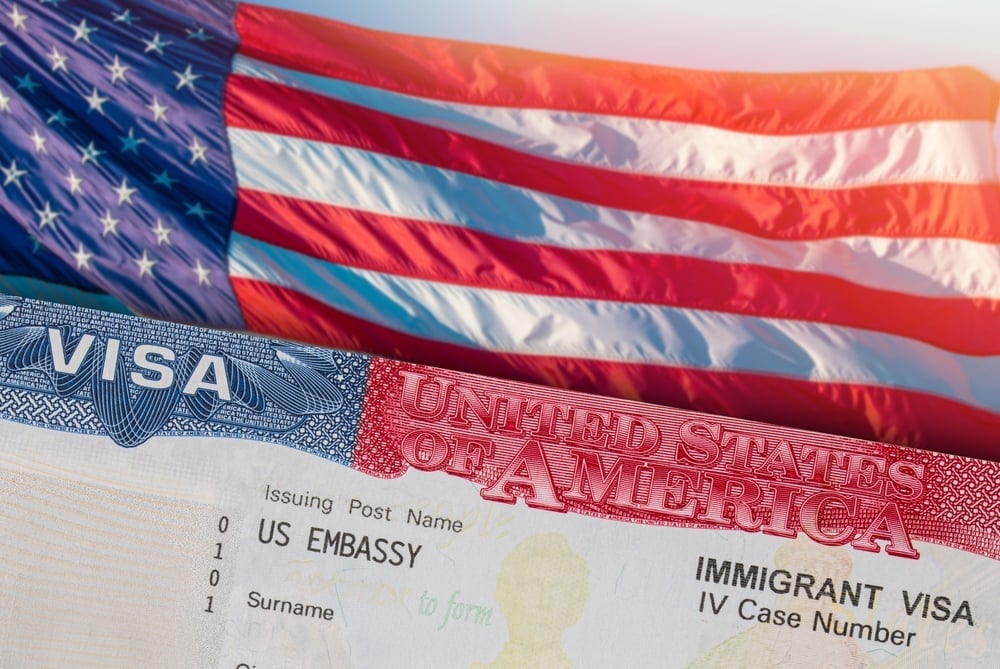
No fewer than 5,000 intending Nigerian immigrants to the United States may be delayed following the new visa restrictions imposed on Nigeria and 74 other countries by President Donald Trump on Wednesday.
Data from the US consulate in Lagos show that 5,626 immigrant visas were issued in 2023, up from 4,219 in 2022—an increase of 1,407 visas within a year.
An analysis by The PUNCH indicates that at least 5,000 immigrant visas granted to Nigerians annually could be affected by the latest measure, which seeks to restrict the entry of foreigners intending to live in the United States.
Additionally, a total of 70,621 Nigerians were issued U.S. immigrant and non-immigrant visas in 2024.
A breakdown reveals that 63,313 non-immigrant visas were issued to Nigerians, with Abuja accounting for 30,222, while 33,091 were issued in Lagos. Also, 7,308 persons obtained US immigrant visas during the period.
Confirming the development, a State Department spokesperson said, “The State Department is pausing immigrant visa processing for 75 countries.”
The pause will begin on January 21 and will continue indefinitely until the review is complete.
The policy forms part of a wider entry suspension affecting countries regarded by Washington as posing screening and vetting difficulties or producing migrants who rely excessively on public benefits.
The latest development comes barely a week after the Trump administration imposed a visa bond requirement of up to $15,000 on nationals from 38 countries, including Nigeria, effective January 21, 2026.
The policy targets countries with high visa overstay rates and security concerns.
The State Department in a post on X on Wednesday announced the pause of immigrant visa processing from 75 countries, which it claimed the migrants take welfare from the American people at unacceptable rates.
The post read, “The State Department will pause immigrant visa processing from 75 countries whose migrants take welfare from the American people at unacceptable rates. The freeze will remain active until the U.S. can ensure that new immigrants will not extract wealth from the American people.
‘’The pause impacts dozens of countries – including Somalia, Haiti, Iran, and Eritrea – whose immigrants often become public charges on the United States upon arrival. We are working to ensure the generosity of the American people will no longer be abused. The Trump Administration will always put America First.”
The affected countries include 27 African countries, 22 Asian countries, 8 European countries, 13 North American and Caribbean countries, three South American countries and one Oceania.
They are Algeria, Cameroon, Cape Verde, Cote d’Ivoire, Democratic Republic of the Congo, Egypt, Eritrea, Ethiopia, Gambia, Ghana, Guinea, Liberia, Libya, Morocco, Nigeria, Republic of Congo, Rwanda, Senegal, Sierra Leone, Somalia, South Sudan, Sudan, Tanzania, Togo, Tunisia, Uganda and Yemen.
Others are Afghanistan, Armenia, Azerbaijan, Bangladesh, Bhutan, Burma, Cambodia, Georgia, Iran, Iraq, Jordan, Kazakhstan, Kuwait, Kyrgyzstan, Laos, Lebanon, Mongolia, Nepal, Pakistan, Syria, Thailand and Uzbekistan.
Also on the list are Albania, Belarus, Bosnia, Kosovo, Macedonia, Moldova, Montenegro, Russia, Antigua and Barbuda, Bahamas, Barbados, Belize, Cuba, Dominica, Grenada, Guatemala, Haiti, Jamaica, Nicaragua, Saint Kitts and Nevis, Saint Lucia, Saint Vincent, Grenadines, Brazil, Colombia, Uruguay and Fiji.
State Department data show that global immigrant visa issuance climbed to 612,258 in 2024, up from 562,976 in 2023. Non-immigrant visa issuance also rose from 10,438,327 in 2023 to 10,969,936 in 2024.
The report further puts the global migrant visa issuance at 240,526 for the year 2020; 285,069 in 2021; 493,448 in 2022; 562,976 in 2023, and 612,258 in 2024.
Non-immigrant categories for 2020 were recorded as 4,013,210; 2, 792,083 for 2021; 6,815,120 in 2022; 10,438,327 in 2023, while 10,969,936 were recorded in 2024.
Meanwhile, in December, the US previously announced a partial visa ban on Nigeria alongside other countries.
In relation to Nigeria, the US policy cited persistent security challenges and overstays on temporary visas.
Referencing radical extremist activity in parts of the country, the proclamation stated that such conditions “create substantial screening and vetting difficulties.”
It also referenced overstay rates contained in US government reports.
Consequently, the proclamation ordered that “the entry into the United States of nationals of Nigeria as immigrants, and as non-immigrants on B-1, B-2, B-1/B-2, F, M, and J visas, is hereby suspended.”
It further directed consular officers to reduce the validity period for any other non-immigrant visas issued to Nigerian nationals.
The State Department stressed that visas already issued before the effective date of the proclamation would not be revoked under the new policy.
However, Nigerians outside the United States without valid visas at the time of implementation would be directly affected by the entry suspension.
Reacting to the restriction, former Nigerian Ambassador to Mexico, Ogbole Amedu-Ode, described the sweeping ban as a contradiction of America’s long-standing advocacy for the free movement of people and ideas.
“It is unfortunate that the apostle of globalisation is the one now engaging what I’ll call a reverse gear as far as the globalisation phenomenon is concerned. Even as he views this as being in America’s interest to keep some countries or citizens of certain countries out of his national territory.”
He criticised the scale of the measure, stating that it is unbecoming to ban 75 countries’ citizens from travelling to the United States.
According to him, “Migration and immigration are as old as the human race, and for the US under Donald Trump to begin to rev up the anti-migration, anti-immigration policies which we are witnessing now is not helping to solve matters as far as human-to-human contacts are concerned.”
Amedu-Ode added that travel is a natural human activity, stressing, “In view of the fact that travelling between countries is natural to the human person, especially in this age now of ease of travel by air, by road, by ship, it’s unfortunate.”
Ex-Ambassador Godknows Igali acknowledged Washington’s sovereign right to set its immigration policies, but urged the US to weigh the implications for bilateral relations.
“Well, it’s America’s right, America has the right. These are issues of the right of countries. They are determining the conditions of their visas, but again, you have to consider your relationship with other countries. Between Nigeria and the US, we have a very robust relationship that has gone on for many, many decades,” he said.
He emphasised Nigerians’ positive contributions to US society, noting, “Nigerians have given a good account of themselves in the US, very disciplined, very hardworking. Almost all Nigerians are doing very well in the US. So, they are not a liability to the system.”
He added, “Most Nigerians who go to the US are skilled; we don’t go there as a liability. We are hardworking, we are creative, we are industrious, we are enterprising.’’
He urged sustained diplomacy, saying, “We advise the Nigerian Ministry of Foreign Affairs to sustain discussion with them so that Nigeria can be removed from that list.”
Foreign affairs analyst Charles Onunaiju said the latest restriction reflects a deeper shift in US domestic politics and global posture.
“If you look at the United States and see what’s going on there with the so-called ICE picking up people in the streets, you could see chaos in US cities with these issues about immigration. So, it is not a surprise the extent to which the United States could go,” he said.
Onunaiju warned that the present period “is not a normal time” in US foreign relations, observing that even close allies have been affected.
“Recently, the United States imposed a visa ban on key European officials. So, I think the worst has not happened yet. There could be more tightening. People should anticipate that. Mr Trump campaigned and won on the basis of extremist anti-immigration posturing, and he is leveraging that.”
He added that Nigerians should “prepare for the worst”, stressing that the US President had recently stated that he did not recognise international law and was guided only by his “private morality.”
“We have to acknowledge that this is not a normal time and anything is possible between the United States and the rest of the world.”
Ex-ambassador Rasheed Akinkoulie observed that the sweeping ban did not apply to Nigerians applying for visas, arguing that the conditions are simply more stringent, citing the $15,000 visa bond.
‘’Government officials and diplomats who have to travel to the USA are still granted visas without any problem.”
punch.ng
FOLLOW US ON: