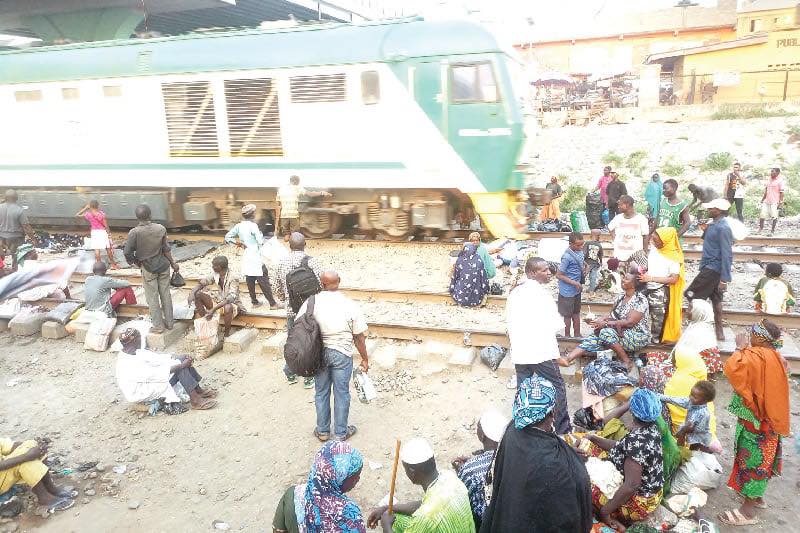
Daily, vulnerable citizens, children, the elderly, and people living with disabilities line the railway tracks across Lagos, defiantly confronting constant, life-threatening hazards, despite repeated efforts by authorities to keep them away from potential deadly harm. For them, every naira earned is a hard-fought lifeline, and the rail corridor is more than a mere path; it is a battleground where survival and resilience are tested with every step, writes IBRAHIM ADAM
As the day unfolds in Lagos State, bridges spanning rail tracks and adjoining roads transform into temporary shelters for beggars, who rely on the benevolence of sympathetic passers-by to quietly carry them through another day.
Even as the shrill blast of a train horn cuts through the air, reverberating along the steel veins that slice through the heart of the city, these vulnerable individuals remain undaunted.
One of the many bridges across Lagos, known as a hub for beggars, is the Agege Pen Cinema Flyover.
During multiple visits to the place, our correspondent observed that women, both young and old, far outnumbered men among those seeking alms beneath the structure.
While many clutched worn bags with their calloused hands roughened by years of hardship, some cradled small children, rocking them gently as they waited for whatever the day might bring.
Tension is never far away. As a train thundered past one afternoon, some fled for safety without hesitation, while a daring handful merely took a few steps back, their faces inches from the fast-moving steel, silently calculating danger with chilling precision.
Among them was an amputee, balanced on a single crutch, who stood perilously close to the speeding train, leaning forward as it roared past, his fragile stance underscoring the thin line between survival and death.
The moment the train thundered through the tracks, he quickly hopped away, avoiding the angry stares of concerned passers-by.
Access to this perilous corridor is through two staircases. One, wooden and splintered, sways uncertainly beneath the weight of those who climb it; the other, built of concrete blocks, appears sturdier, yet offers little protection from the dangers that define daily movement in the area.
At the far end, stones have been heaped into a makeshift pathway, enabling passage over the busy lanes where traders go about their daily commerce.
Whenever donations, whether money or gifts, are offered, a group of miscreants takes charge of the distribution, making sure others receive their share.
Our correspondent also visited some of their homes, located a short distance from the railway tracks. The makeshift shanties, which are cramped and closely packed along a narrow gutter, are constructed from discarded corrugated iron sheets and scraps of wood.
Some have no doors, while others are shielded with torn pieces of fabric. Men could be seen taking turns relieving themselves at the edge of the gutter, as others lie asleep inside the dark, stifling interiors.
Portrait of hardship
At 65, Nafiu Magaji’s weathered face tells a silent story of hardship and a life spent navigating society’s neglect.
A native of Ngwa Zango Community in Bichi Local Government Area of Kano State, Nafiu Magaji is married with five children, all of whom depend entirely on the paltry sum he makes daily for survival.
“The reason I started begging is due to prolonged neglect and abandonment,” he said. “For many years, people in my condition have been forgotten by those responsible for our welfare. When a person is left helpless and without hope, they are often forced to do whatever they can simply to survive.”
Magaji identified the lack of access to education, food and clothing as the primary factors that pushed him into begging.
Harassment, he added, has further compounded their hardship as they are routinely chased from one location to another by government officials and security agencies.
“Instead of assistance, we are constantly displaced. This has been our reality for as long as I can remember,” he lamented.
Pursuit of safer ground
In search of relative safety, Magaji said he joined his colleagues along the railway corridor. Begging on major roads, he explained, exposed them to the constant threat of traffic accidents, but the rail tracks, which appeared calmer and more accessible, embody greater risk.
“The reality is that the railway environment is extremely dangerous. We remain there not by choice, but because we have no alternative,” he said.
Magaji recalled witnessing several fatal accidents involving fast-moving trains, particularly among beggars who were blind or deaf and unable to react in time.
“Trains move at great speed. Even when someone tries to respond, it is often too late. Some survive by chance; others die instantly. I have seen lives lost before my eyes,” he said.
Mogaji said that due to the risks, railway officials regularly chase them away, only for them to return later in desperation.
“I make about N3,000 daily from begging. I return to the railway every day because I must pay rent and feed my family. There is no other option,” he said.
The ban on street begging
In August 2021, the Lagos State Government imposed a ban on street begging, launching a statewide operation to clear beggars and street urchins from public spaces.
At a joint press conference in Alausa, the then Commissioner for Youth and Social Development, Olusegun Dawodu, alongside officials from the Information Ministry and the Police, vowed to eradicate street begging.
He described the practice as a social vice that constituted a nuisance to law-abiding citizens.
“As a responsible government, we will not allow Lagos to become a haven for beggars. Street begging, if unchecked, will undermine all our development plans,” Dawodu said.
Investigations, he added, revealed that organised syndicates transport children and adults from other parts of the country to Lagos to engage in alms begging and hawking, turning it into a lucrative enterprise.
In July 2024, the Speaker of the Lagos State House of Assembly, Mudashiru Obasa, said lawmakers were considering legislation to regulate alms solicitation across the state. The proposed law would empower the government and registered foundations to oversee aid distribution and sanction those found begging or exploiting children.
In December 2025, the Lagos State Government announced the arrest of 95 individuals for street begging across different parts of the state.
The Commissioner for Environment and Water Resources, Tokunbo Wahab, said the arrests were part of sustained efforts to eliminate what he described as “environmental nuisance.”
A mother’s fight for survival
At 57, Balikis Adamu bears the weight of a life shaped by loss and hardship. A native of Gujungu Community in Taura Local Government Area of Jigawa State, she is a mother of six, five girls and one boy.
Her life took a devastating turn more than 14 years ago when her husband died, leaving her to raise the children alone. With no means of sustenance, Balikis said she was forced into begging—not by choice, but out of desperation to provide for her children’s basic needs.
She moved to Lagos with her children, earning about N2,000 daily to cater for them. Over time, the struggle became unbearable, and Balikis said she eventually sent her children back to Jigawa so she could continue alone.
“At night, I sleep by the roadside. I wait for nearby shops to close before finding a place to lie down. This has become my daily routine. Over time, I grew used to it and accepted it as my destiny,” she said quietly.
That fragile existence suffered another blow when she was involved in an accident that left her permanently injured.
“I was trying to cross the road when a tricycle hit me,” she recalled. “I received treatment in Lagos and later returned to Jigawa for further care, but it did not work. My hand became permanently deformed. I have accepted it as my fate, which is why I returned to Lagos to continue begging.”
Despite the daily hardships, Balikis still holds on to hope that support could help her rebuild her life. She said she would willingly abandon begging if given assistance.
Hausa council calls for decisive action
The Chieftaincy Council of the Hausa Community in Agege, Lagos, has called on the government to take decisive steps to permanently remove beggars from public spaces, particularly railway corridors.
Speaking to Saturday PUNCH, the council said repeated sensitisation and orientation programmes had failed to yield lasting results, as many beggars continued to return to the streets despite sustained engagement.
“It saddens us deeply that these people are still on the streets and along the rail tracks begging,” the council said, noting that previous bans and arrests had not addressed the problem.
The council disclosed that it had engaged Northern governors in efforts to find a permanent solution. While many beggars were returned to their home states and supported, the initiative proved short-lived, as several later returned to Lagos.
“At this point, only firm and coordinated government action can offer a lasting solution,” the council stated, attributing the return of many beggars to the relatively high income generated from begging in Lagos.
The council revealed that earnings from begging often surpass the income of many salaried workers, which makes it difficult for most of them to quit.
While acknowledging the generosity of Lagos residents, the council warned that continued almsgiving sustains the practice and draws beggars to hazardous locations such as railway corridors.
“These beggars are organised. They have leaders and even tax one another because of the large sums involved. For many, begging has become a business,” the council added.
‘Train accidents have claimed many lives’
A chieftain of the Hausa community, Khalid Ahmed, warned beggars against occupying railway tracks, citing frequent train accidents that have claimed numerous lives.
He highlighted the danger faced by vulnerable individuals, including amputees and those with hearing or speech impairments, who may be unable to respond swiftly to oncoming trains.
“Accidents happen there all the time,” Ahmed said. “Some people are crushed before they can move. Others, sometimes drunk, fall asleep on the tracks. When the train comes at full speed, it kills instantly. We have lost count of how many lives have been lost.”
He noted that leaders within the begging community often issue safety warnings, but these are frequently ignored.
Ahmed called for government intervention, stressing that most beggars are driven by desperation rather than choice.
‘I tasted death three times’
A reformed beggar, Sani Bashir, recounted surviving three train accidents within nine months. His body still bears the scars of multiple fractures, a grim reminder that compelled him to abandon begging.
“It was horrible. I tasted death three times, not once, but three times,” he told Saturday PUNCH. “Each incident happened about three months apart. I never imagined it would happen, but Alhamdulillah, I am alive.”
NRC to remove unauthorised occupants
To safeguard lives and protect the rail tracks, the Nigerian Railway Corporation said it came up with plans to remove unauthorised occupants from the Lagos rail corridor.
An NRC official, who spoke on condition of anonymity, said the exercise would be carried out in collaboration with the Lagos State Government and security agencies.
“During previous operations, the state government supported us with the Police and Civil Defence Corps. Illegal structures and encroachments were removed,” the official said.
He added that the NRC was fully aware of the presence of beggars along the tracks.
“We are doing everything possible to ensure they leave. Their safety also matters, we do not want them to become victims of train accidents,” he said.
‘Government should provide safe locations for us’
The chairman of beggars in Agege, Kabir Usman, and his deputy, Mohammed Nasir, appealed to the government to provide safe, designated locations where vulnerable people could live and sustain themselves.
He said such an arrangement would improve safety, guarantee access to basic needs, and promote more orderly livelihoods. “Agege has a higher concentration of beggars than many other parts of Lagos. If dedicated areas are provided, people can survive without constant harassment, displacement, or discrimination, while contributing to a more organised and peaceful environment,” he said.
They alleged being exploited by the state government during elections, only to be later neglected.
Psychological toll of repeated trauma
A psychotherapist and emotional intelligence expert, Jacob Micheal, said repeated exposure to life-threatening situations can leave vulnerable people emotionally numb, which is known as desensitisation or traumatic adaptation.
According to Michael, many affected individuals develop a fatalistic mindset, adding, “When a person no longer places value on their own life, it becomes extremely difficult for them to make choices that protect their well-being,” he said.
The psychotherapist noted that many beggars are disconnected from family and society.
“Structured support helps reconnect them to skills, purpose, and community. Guided storytelling sessions, where individuals narrate their experiences, give meaning to trauma. Once trauma is given meaning, the brain no longer holds it emotionally.
“When someone begins to see themselves as useful, even in a small way, their outlook on life changes. With structured psychotherapy and social support, even severely traumatised individuals can recover,” he said.