Connect with us

Business

UAE targets Nigeria for multi-billion-dollar investments

Published

on

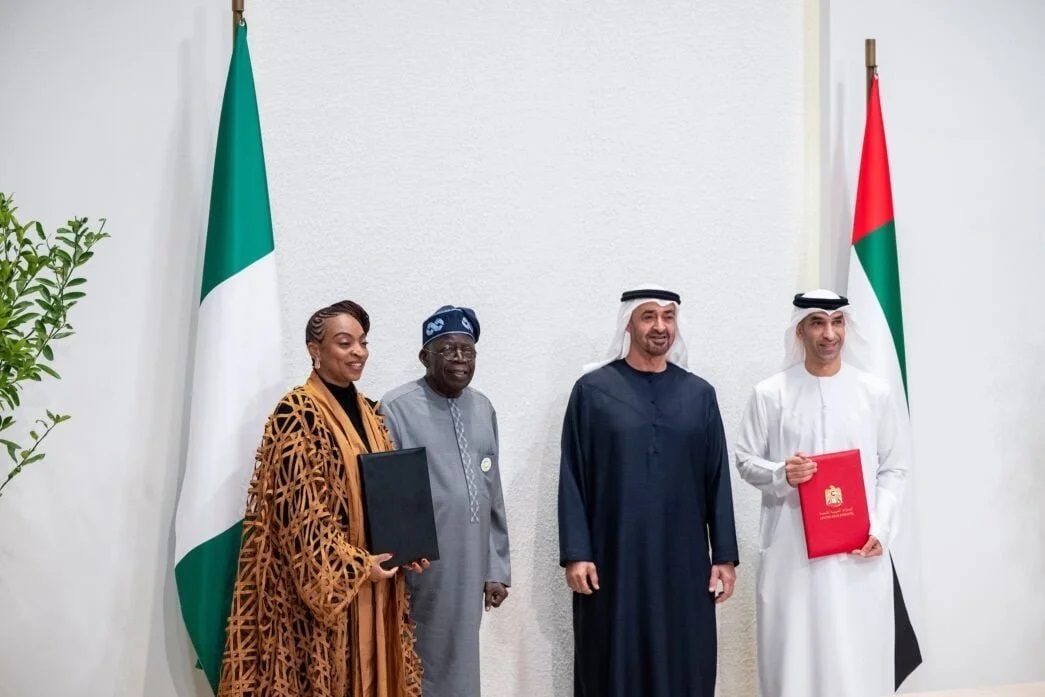
The United Arab Emirates has positioned Nigeria as a major destination for multi-billion-dollar investments spanning agriculture, technology, infrastructure, mining and trade, with the country’s Minister of Investment, Mohamed Alsuwaidi, admitting that Gulf capital is currently underexposed to Africa’s largest economy.

Alsuwaidi said this at the first Investopia Africa event held in Lagos on Monday, where discussions surrounded a wide range of opportunities that could translate into investments running from hundreds of millions to several billions of dollars, depending on sector readiness, regulatory clarity and the availability of credible local partners.

The PUNCH reports that as of 2025, trade relations between the UAE and Nigeria reached $4.3bn for non-oil commodities.

Speaking during a fireside chat with Nigeria’s Minister of Industry, Trade and Investment, Dr Jumoke Oduwole, the UAE minister said, “Opportunities around agriculture. The UAE has big interests in companies like Louis-Dreyfus and Unigroup. So, investment in agricultural land is for the export of products. You know, that’s a couple of hundred million, maybe. I think investment around infrastructure, whether it’s in public transport, utilities, power, water or wastewater recycling, is crucial.

Again, it depends on legislation and opportunities. It could be in the tens of millions if I look at it from that perspective. I think in terms of connectivity and trade facilitation, whether it’s through capital or whether it’s through infrastructure like warehousing or others. A few billion there. I’m throwing out the billions here, just quantifying numbers in my head.

“I think the technology space is huge. We talked about smart metering, fibre-optic laying, small data centres, and cloud solutions. Again, in the billions. You can’t build a data centre for less than $100m today. Then mining. Again, huge opportunity. Requires a lot of infrastructure. I see a lot of opportunity.”

However, he cautioned that the pace at which investment commitments materialise would depend largely on information flow, market familiarity and the ability to identify reliable partners.

“Now, translating that is getting information, being able to find either a private sector or a government to be a partner with a government or private sector on my side,” he said. “Making sure that they have all the information to make the right decision.”

Alsuwaidi trashed the notion that trust was the primary barrier to deeper UAE–Nigeria investment ties, arguing instead that market understanding and partner identification were the real challenges.

“I don’t think trust is an issue. I do think understanding markets is an issue,” he said. “You’re not familiar with the market. You don’t know how to approach it. You don’t know who the partners are.”

He stressed that private-sector engagement would be central to unlocking deals, describing business-to-business interactions as more effective than government-led initiatives.

“I think there are more deals to be done at the private-sector level,” he said. “These events are the most crucial. Because you gather 300 people in a room. You exchange cards. You make some friends. And you have a good dinner. And that leads to a lot of money made with partners.”

See also  Class of 99: Create cottage industries, not N5,000 palliative – Former Govs tell Tinubu

Earlier, the Chief Executive Officer of Investopia, Dr Jean Fares, described the UAE’s role as a global investment and trade hub capable of helping Nigerian producers, exporters and technology firms access markets across Asia, Europe and beyond through its logistics, digital and financial infrastructure.

“When you look at the UAE, its strong suit is the connectivity,” Fares said. “When you look at sea and air, with the carriers and with the ports; when you look at digital infrastructure, some of the fastest high-speed internet, the number of landing cables, the access to capital, and the access to data centres.”

He said the credibility of the UAE’s financial system and regulatory environment was a key attraction for investors.

“The financial services and the credibility of them that we built, both in DIFC and ADGM; the rule of law and the enforcement of that; and the protection of investors,” he said.

Fares added that the UAE had evolved beyond being a regional hub to becoming a global connector linking Africa with Asia and Europe.

“The UAE is becoming a dominant hub in the GCC, but also a connector of places like Africa to Asia and Asia to Africa and Europe,” he said. “If you’re trading with Asia, then you should have some kind of representation in the UAE.”

He noted that while the UAE continued to attract global capital, it was increasingly focused on deploying capital abroad, particularly in under-represented markets such as Nigeria.

“While we want to attract capital into the UAE, we’re also keen on moving capital out,” Fares said. “We’re very conscious that we’re underweighted in Nigeria. And we need your help to identify those opportunities where we can place short-term and long-term capital to grow.”

Oduwole, speaking with journalists after the fireside chat with her UAE counterpart, said, “So key businesses are here; you’ll be hearing from them all through the afternoon. It’s a short, crisp half-day event, and the afternoon is B2B. And then there’ll be follow-up meetings. There’s an Investopia session at the end of March in Abu Dhabi. And then there’s a session in Milan, which is focused on Africa. Nigeria is leading the charge. We’re already talking about it. We listened to the minister, my counterpart, the Minister of Investment from the UAE. He was actually pulling out ballpark figures of where he thinks solid minerals, critical rare earths, lithium, and tin are – areas where Nigeria is really ready to absorb that capital. So, we’ve assured them that we’re here for them. And this is what we’re going to be doing throughout this year.

See also  Bulk fuel buyers dump middlemen for direct Dangote supply

“You see the FMITI family behind me. We’re going to be bringing in key investors. We’re going to be pushing out our nano-exports across the region through the UAE as a hub. And so surely the best is yet to come. We are excited. The subnationals are involved.”

The role of states was highlighted, with Lagos State cited as a key example. Oduwole said, “This ministry is an enabler. We work with all arms and levels of government. We’re here today. Investopia has been hosted in Lagos State. It’s a federal thing; you know, a number of other state governments are represented. We put Governor Sanwo-Olu on the infrastructure panel to speak to the UAE audience. We cited the Lagos–Calabar Coastal Road. First Abu Dhabi, a UAE bank, was one of the first to put in capital. And we have the promise of all that the real estate down that corridor will become. So, you look at Abu Dhabi, you look at Dubai, and just imagine what that coast is going to look like in a few years.

“Sub-nationals: every business is domiciled in one state or city or another. And the way FMITI works, whether it’s from small businesses (you have SMEDAN) or from NEXIM, is they’re working across businesses all across the country. So that is what we do. That is who we are. And we’re ready.”

On tracking investment outcomes, officials said Nigeria relies on clear metrics to measure traction. These include public investment announcements, capital inflows recorded by the Central Bank of Nigeria, and data from the National Bureau of Statistics. They added that job creation figures and multiplier effects are also used to assess impact.

Infrastructure projects were cited as clear examples of measurable economic impact. Using the Lagos–Calabar Coastal Road as a case study, the minister said the project has already created livelihoods, generated informal economic activity, and demonstrated the tangible, quantifiable multiplier effect of construction and infrastructure spending.

Oduwole told the UAE minister and investors, “I’m glad to hear you say you’re ready to take the plunge and to deploy that capital. And you’re looking at the African region and Nigeria in particular.”

She assured investors of government support in structuring and executing deals: “We’re here for you. We’re here to take the capital. Every challenge is an opportunity. I’m committing personally on behalf of my president and on behalf of the private sector that we will facilitate these deals to make sure that they’re done properly.”

Lagos State Governor Babajide Sanwo-Olu, who sat on a panel discussion themed ‘Infrastructure and Logistics for Africa’s Next Phase of Trade’, said the state had focused on creating a secure, efficient and business-ready environment capable of absorbing large-scale investments.

“How do we ensure that the environment in which those investments are going to happen is safe and secure and has the ability to receive that capital?” Sanwo-Olu said. “We’re business-ready, we’re safety-ready, and we’re equipped.”

See also  Why I returned to Nigeria on Ivorian jet — Jonathan

He highlighted transport, digital and infrastructure projects undertaken to improve mobility and productivity.

“In the last four years, we’ve activated two rail projects. We’ve activated our waterways. Just two weeks ago, we signed a commitment with one of the telecoms that wants to do about 30,000 kilometres of fibre optics in Lagos,” he said.

Sanwo-Olu also noted that the state would soon be unveiling the Lagos International Financial Centre.

“We’ve had extensive conversations around the path of the Lagos International Financial Centre. The Lagos State government is cooperating with EnterpriseNGR. We started this journey about eight months ago. We still have about another eight months to go before finally unveiling it. But the beauty of it is the amount of global support that we have. It’s like we’re trying to put the Abu Dhabi Financial Centre and Dubai Financial Centre, or even the London Financial Centre, apart from the Lagos International Financial Centre. So that’s the level of audacity that we’re bringing.

“We’re trying to learn from all of these various regions to bring about a model that will be a true African model that will work for everyone, but it will also be a Nigerian model. So, I’m here to let you know that we are actually thinking global. We’re thinking about how to remain competitive, how to remain resilient, and how to be able to play on the same level of profit with other big cities and other big markets in the world. So, Lagos is positioning itself, leading the Nigerian competition, and we’re getting tremendous support from the federal government,” he said.

Also speaking, the Managing Director of the Nigerian Ports Authority, Abubakar Dantsoho, said Nigeria’s port infrastructure had not kept pace with its population and economic size but that reforms were underway.

“The biggest economy, with the highest population on every continent, has the biggest seaport,” Dantsoho said. “Nigeria is doing two million TEUs with over 250 million people.”

He said the Federal Government had approved major port modernisation projects to address the gap.

“The Federal Government has given approval for the port modernisation of Tin Can Island and Apapa Port,” he said. “In the near future, Nigerian seaports are going to be number one in Africa, which is where we naturally belong.”

The Investopia Africa event brought together senior government officials, investors and private-sector leaders from Nigeria and the UAE, with participants emphasising that sustained engagement, credible partnerships and project readiness would determine how quickly stated commitments translate into capital deployment.

punch.ng

FOLLOW US ON:

FACEBOOK

TWITTER

PINTEREST

TIKTOK

YOUTUBE

LINKEDIN

TUMBLR

INSTAGRAM

Continue Reading
Click to comment

Leave a Reply

Your email address will not be published. Required fields are marked *

Business

FG moves to share electricity subsidy costs with states

Published

on

The Federal Government has moved to end the practice of carrying electricity subsidy costs alone, announcing a framework that will spread the burden across federal, state, and local governments from 2026.

The Director-General of the Budget Office of the Federation, Tanimu Yakubu, disclosed this on Monday in Abuja during a training and sensitisation workshop for ministries, departments, and agencies on the 2026 post-budget preparation process using the Government Integrated Financial Management Information System Budget Preparation Sub-System.

Yakubu said President Bola Tinubu had directed that electricity subsidy costs be made explicit, tracked, and fairly shared across tiers of government, warning that the current approach creates hidden liabilities and recurring crises in the power market.

“If we want a stable power sector, we must pay for the choices we make,” he said. “When tariffs are held below cost, a gap is created. That gap is a subsidy. And a subsidy is a bill.”

He added that from 2026, the Federal Government would no longer treat electricity subsidies as an open-ended obligation borne solely by the centre, especially where policy decisions and political benefits are shared.

“In 2026, we will stop pretending that this bill can be left to the Federal Government alone, especially where the policy choice or the political benefit is shared across tiers of government,” Yakubu said.

According to him, the President has instructed that the existing electricity sector legal framework be invoked to ensure that subsidy sharing is practical, transparent, and enforceable.

“This means subsidy costs must be explicit, tracked, and funded, so they do not return as arrears, liquidity crises, or hidden liabilities in the market,” he said. “If any tier of government chooses affordability interventions, the funding responsibilities must be clear, agreed, and enforceable.”

See also  Firm partners Hilda Baci for world’s largest jollof rice cook-off

Yakubu stressed that the policy was not designed as a sanction but as a mechanism to align incentives across government and support efficiency in the power sector.

“This is not punishment. It is alignment,” he said. “When everyone carries a fair share of the cost, everyone also has an incentive to support cost-reflective efficiency, targeted protection for the vulnerable, and a power market that can actually deliver.”

He told MDAs to reflect subsidy-related costs clearly in their 2026 budget submissions and avoid pushing unfunded liabilities into the electricity market.

Beyond power subsidies, Yakubu said the 2026 Budget marked a clear break from rollover budgeting and fragmented project lists, which he said had weakened execution and accountability over the years.

“The 2026 Budget corrects this. It is built as one coherent implementation framework,” he said. “The approach is to consolidate commitments into a single, visible pipeline and manage them as a disciplined programme of delivery.”

He described this approach as a “single-train” framework, adding that it would improve prioritisation, strengthen control, and reduce duplication across government. “One plan. One pipeline. One execution logic,” he said. “It allows the government to know, at any point, what we have committed to deliver.”

Yakubu also revealed that the President had directed a review of the Fiscal Responsibility framework to make fiscal rules more dynamic and enforceable, rather than abandoning them.

“Fiscal rules are the guardrails of the government,” he said. “Without guardrails, spending becomes impulsive, debt becomes casual, and the budget becomes a statement of intent rather than a tool of delivery.”

He explained that the review would introduce clearer fiscal anchors, better-defined escape clauses for genuine shocks, and a credible path back to compliance, alongside stronger reporting on contingent liabilities.

See also  Flutterwave expands open banking with Mono acquisition

For MDAs, he said this would change how proposals are assessed. “You will not only be asked what you want to spend. You will be asked how it fits the fiscal rules, how it affects sustainability, and what measurable results it will deliver,” he said.

The Budget Office chief further announced that the 2026 Budget would deepen the shift from long project lists to project financing, insisting that capital proposals must be delivery-ready and, where appropriate, finance-ready.

“A long list of projects is not a development strategy,” Yakubu said. “What citizens feel is delivery, completed roads, reliable power, functional schools, working hospitals.”

He said projects submitted for funding in 2026 must demonstrate readiness, sequencing, a clear financing strategy, and measurable outputs and timelines, adding that fewer but better-funded projects would deliver more impact.

Yakubu described GIFMIS-BPS as central to restoring budget credibility, saying it was “the operating system for credible budgeting” that improves transparency and traceability from submission to execution.

“The success of the Renewed Hope Agenda is shared,” he said. “The Budget Office will coordinate and enforce standards. But delivery depends on every MDA. Nigerians expect results. And through a credible 2026 Budget, we must deliver.”

The workshop aims to align MDAs with new budget expectations, improve compliance, and strengthen the link between planning, financing, and results in the 2026 fiscal year.

The PUNCH earlier reported that amid its struggles to pay the over N4tn debt owed to power generation companies, the Federal Government incurred a total of N1.98tn in electricity subsidy obligations in 12 months, from October 2024 to September 2025.

See also  Benin varsities, Nigerian polys in NYSC fraud

This was according to the quarterly reports released by the Nigerian Electricity Regulatory Commission.

punch.ng

FOLLOW US ON:
FACEBOOK

TWITTER

PINTEREST

TIKTOK

YOUTUBE

LINKEDIN

TUMBLR

INSTAGRAM

Continue Reading

Business

Nigerian billionaire Tonlagha hires lobbyists to push Nigeria-US ties

Published

on

Nigerian billionaire Matthew Tonlagha has signed a lucrative contract with US lobbying firm Valcour designed to improve Abuja’s relations with Washington, documents seen by AFP on Monday showed.

The Nigerian government has already entered the lobbying fray, with national security chief Nuhu Ribadu in December striking a $750,000-per-month deal with US firm DCI to lobby President Donald Trump’s administration.

The moves come in response to unsubstantiated allegations by Trump in late 2025 that violence in Nigeria amounted to the “persecution” and “genocide” of Christians.

The Nigerian government and independent analysts reject that framing of Nigeria’s myriad, overlapping conflicts, which has long been used by the US religious right.

DCI’s stated role is to help the government in Abuja communicate “its actions to protect … Christian communities and (maintain) US support in countering west African jihadist groups and other destabilising elements”.

Tonlagha’s $120,000-a-month contract with US group Valcour stipulates that for six months, the latter will lobby US media, the Trump administration and US Congress “for the purpose of strengthening the bilateral relationship between the US and Nigeria”.

The contract is published on a US government platform where lobbyists are required to register their ties to foreign governments.

On Christmas Day last year, the US military bombed areas of northwestern Nigeria.

The Nigerian government subsequently said the strikes had targeted Islamic State group fighters, members of the Lakurawa jihadist group and “bandit” gangs.

It is unknown how many fighters may have been killed and from which groups. Local and international journalists have only confirmed damage to farmland and civilian buildings, and injuries among civilians.

See also  Class of 99: Create cottage industries, not N5,000 palliative – Former Govs tell Tinubu

Valcour was founded in 2023 by Matt Mowers, who served as a White House adviser in the US State Department during Trump’s first term after advising his election campaign.

Tonlagha is vice-president of Tantita Security, which specialises in protecting oil facilities.

Tantita is owned by Oweizidei Thomas Ekpemupolo, a high-profile former leader of the Movement for the Emancipation of the Niger Delta (MEND).

MEND was created to oppose the appropriation of local oil by foreign companies and the Nigerian government.

In the 2000s, the rebels attacked oil and gas facilities in the oil-rich south and kidnapped workers before a government amnesty was introduced in 2009.

Ekpemupolo was subsequently awarded lucrative contracts with the Nigerian government to protect oil installations.

He is a supporter of President Bola Tinubu, backing his bid for re-election in 2027.

AFP

Continue Reading

Business

Presidency spends N34bn on forex in two years due to frequent travels

Published

on

The Presidency spent at least N34.39bn on foreign exchange purchases for international travel and related obligations over a two-year period, findings by The PUNCH have shown.

The figure is according to data compiled from GovSpend, a government spending tracker managed by BudgIT.

The records, which cover transactions by the State House, Presidential Air Fleet, the Office of the Chief of Staff, and operations linked to the President, Vice President, First Lady, and their aides, show a sharp swing in spending patterns between 2024 and 2025.

An analysis of the data shows that 2024 accounted for the bulk of the expenditure, with total forex purchases of N29.35bn, while 2025 recorded N5.04bn.

This represents a year-on-year decline of 82.8 per cent, aligning with broader trends in the foreign exchange market where the naira stabilised following policy reforms and improved dollar inflows.

The transactions largely relate to the purchase of foreign currencies for official trips, aviation operations, estacodes, training programmes, and logistics for international engagements involving top executive officials.

While the Presidency has maintained that such trips are necessary for diplomacy, investment promotion and bilateral relations, the scale and timing of the spending have continued to draw public scrutiny amid Nigeria’s fiscal constraints and forex shortages.

In 2024, forex purchases were heavily concentrated in the first half of the year, coinciding with a period of heightened exchange rate volatility and sustained pressure on the naira.

One of the most prominent spenders during the year was the Presidential Air Fleet, which alone accounted for several multi-billion-naira transactions described as “presidential air fleet forex transit funds.”

The Presidential Air Fleet, managed by the Nigerian Air Force, is responsible for the air transport needs of the President, Vice President, and senior government officials.

Despite its strategic role, the cost of maintaining the fleet has long been a subject of public scrutiny and criticism, particularly amid Nigeria’s fiscal pressures and rising debt service obligations.

Between March and May 2024, the Presidential Air Fleet Naira Transit Account recorded repeated purchases of about N1.27bn each on March 7, March 9, April 6, May 11 and May 25, alongside larger tranches such as N5.08bn on April 23 and N2.43bn on May 8.

See also  14 banks have met CBN’s new capital requirement

These aviation-related transactions show the high cost of maintaining and deploying the presidential fleet for overseas travel.

Additional transfers of N205m in July, N34m, N1.25bn, N2.21bn, N160.4m, N1.24bn and N902.9m in August further swelled the air fleet’s forex bill.

Smaller amounts followed later in the year, including payments in September and December, bringing the air fleet’s cumulative forex-linked transactions in 2024 into several billions of naira.

Beyond aviation, the State House Headquarters also recorded extensive forex purchases throughout 2024.

In February alone, the State House spent over N2.5bn on forex linked directly to specific presidential and vice-presidential trips.

These included N426.88m for the Vice President’s trip to Switzerland, N1.04bn for the President’s trip to Ethiopia, N750m for the President’s trip to Dubai, N176.77m for the Vice President’s trip to Côte d’Ivoire, N149.79m for the First Lady’s trip to France, and N86.76m for the Vice President’s trip to Liberia.

March 2024 saw further spending tied to foreign travel by the First Lady and Vice President. Transactions included N202.39m for the First Lady’s trip to Mozambique, N144.57m for her trip to Addis Ababa, and N126.30m for a trip to London.

The Vice President’s engagements also featured, with N201.12m spent on a trip to Côte d’Ivoire and N169.54m for estacodes linked to UK and US training programmes.

From July 2024, forex purchases by the State House intensified, with multiple same-day transactions on July 17 alone.

These included N149.05m, N358.53m, N243.32m, N739.07m, and N73.07m, all tagged as forex purchases.

Additional payments were made on July 23, August 6, October 11, and October 28, with notable amounts of N569.68m, N323.14m, N246.80m, and a significant N1.36bn on October 28.

By the final quarter of 2024, spending remained elevated. In November, the State House Operations – President recorded several purchases, including N22.19m, N18.34m, N169.10m and N185.23m on November 28. December added another N736.20m on December 1, reinforcing the pattern of sustained forex demand by the Presidency throughout the year.

Cumulatively, these transactions pushed total forex purchases linked to the Presidency in 2024 to N29.35bn, making it one of the most expensive years for official foreign travel and related forex spending in recent times.

In contrast, 2025 marked a significant pullback. Total forex purchases for the year stood at N5.04bn, a steep decline from the previous year.

See also  Dele Farotimi dismisses Jonathan’s political return, urges focus on these structural problems

The reduction was broad-based, cutting across the Presidency, Vice Presidency and supporting offices.

Transactions in 2025 were also generally smaller in size and more sporadic, suggesting a deliberate effort to rein in forex outflows.

Data from April 30, 2025, show multiple forex purchases by State House Operations – President and Vice President, but most were in the tens of millions rather than billions of naira.

Amounts such as N535.82m, N57.94m, N32.51m, N57.81m and N23.67m dominated the April transactions.

Even the larger figures recorded in mid-2025, including N1.29bn, N1.28bn and N626m linked to the Presidential Air Fleet, were fewer and spread over several months.

By the second half of 2025, forex purchases had tapered further. August transactions included N7.67m and N11.14m, while November and December recorded modest payments by the Office of the Chief of Staff and the Presidential Air Fleet.

The overall pattern points to tighter controls and possibly improved planning around official travel as the naira stabilised in 2025.

The PUNCH observed that the naira ended 2025 on a firmer note, closing at N1,429/$1 on December 31.

This was a 7.4 per cent appreciation from the N1,535/$1 recorded on the final trading day of 2024, according to official exchange rate data from the Central Bank of Nigeria.

The local currency concluded 2024 with significant depreciation, recording a 40.9 per cent loss against the dollar in the official market.

The 2025 performance marks the naira’s first annual gain since 2012, when it appreciated slightly to N157.29 from N158.99 in 2011.

The currency had depreciated every year since then, marking a major turnaround after 13 years of consistent declines.

A further breakdown of the GovSpend data also shows that aviation-related expenses remain a major driver of forex demand.

The Presidential Air Fleet consistently accounted for some of the largest transactions across both years, reflecting maintenance, fuel, leasing and operational costs that are typically dollar-denominated.

This has renewed debate over the size and cost structure of the fleet, especially at a time when many countries are reviewing the sustainability of maintaining large official aircraft inventories.

See also  Infractions - FG threatens to disconnect Gencos from power grid

The State House and Office of the Chief of Staff accounted for smaller but still significant amounts, often linked directly to specific trips by the President, Vice President or First Lady. These include forex purchases for estacodes, accommodation, logistics and protocol obligations.

The Country Director of Accountability Lab Nigeria, Odeh Friday, earlier expressed concern about the impact of such spending on taxpayers and the need for greater transparency and accountability.

“This highlights the urgent need for a shift toward greater equality and accountability in the management of public finances,” Friday said.

He emphasised that it is critical to evaluate the outcomes of these significant expenditures, questioning whether they truly serve the interests of the Nigerian people. “Some of them are clearly wasteful expenditure,” he added.

Former Presidential Candidate of the Labour Party (LP) in the 2023 general elections, Peter Obi, has criticised President Bola Tinubu for spending much of January abroad.

Obi, in a post on his X handle on Sunday morning, noted that while leaders in other countries focus on domestic governance at the start of the year, Nigeria’s president has prioritised foreign engagements over pressing national issues.

Obi also questioned the necessity of Tinubu’s frequent foreign trips, noting that the President spent 23 days abroad in January across two trips, returning only briefly to Nigeria in between.

“While leaders in other nations prioritise domestic governance in January, Nigeria’s president prioritises international engagements over pressing national issues. This month, he spent 23 days abroad across two trips—beginning the year overseas and returning on the 17th, and departing less than 10 days on the 26th to Türkiye, where he remains as of January 31. What urgent matters continuously warrant his absence from the nation? When he does return, it often appears to be merely to welcome defectors into the APC before he jets off again.”

Continue Reading

Trending