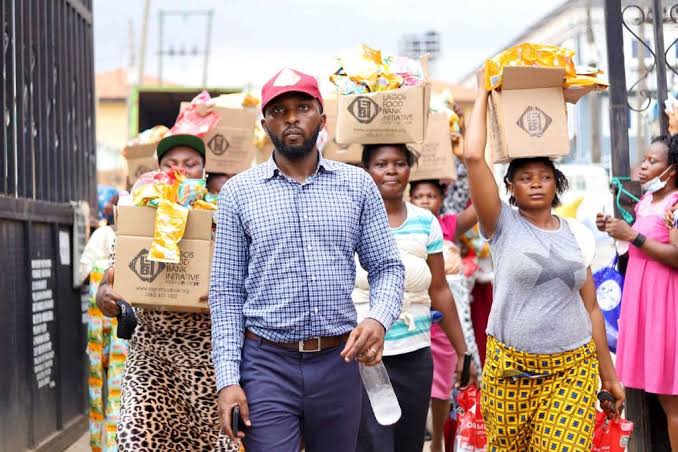
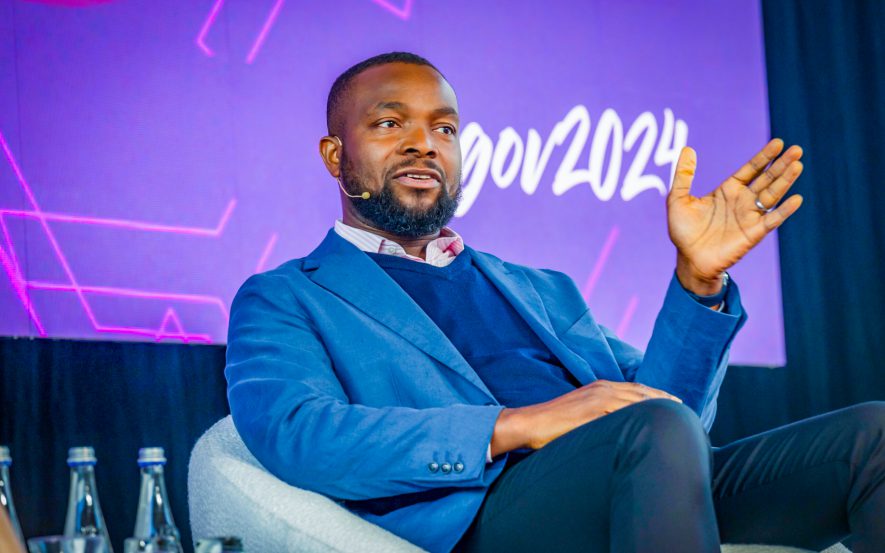
Founder/Executive Director of Lagos Food Bank Initiative, Dr Michael Sunbola, tells FELIX OLOYEDE how the not-for-profit organisation is helping Lagos residents overcome hunger
What inspired the Green Harvest Agri-food Initiative?
Green Harvest, of course, is an additional layer of the solution to hunger and malnutrition in Nigeria. On the broad spectrum, I’ve had a journey of being a humanitarian and a food system activist. That journey spans over 10 years already. What brought me to the development and humanitarian space still boils down to my childhood experience. And, of course, experiencing food insecurity, going to school, and not having lunch in school. And, of course, that kind of had an impact. In the sense that I was not interested in school; I felt I should be somewhere else rather than school. And I look at what impact that might actually be having on several families right now, several children. And, of course, that gave birth to the Lagos Food Bank, which then translated into serving families. And thereafter, the Green Harvest Agri-Food Initiative started to create a more sustainable pathway for beneficiaries to fend for themselves. Because we realise that the truth is we cannot distribute our way out of hunger. There has to be a more sustainable pathway for beneficiaries to fend for themselves, earn a decent income, become more economically viable, and grow healthy food by themselves while improving their income. So, that is what Green Harvest is about. I must also mention that Green Harvest focuses on curbing food waste.
Through the Agricultural Recovery Programme under Green Harvest, we partner with local farmers to recover surplus post-harvest produce. And then we, of course, have that redistributed to beneficiaries who are mostly in need of their daily meals. So instead of having a whole lot of food go to waste on the farms, what we do is partner with these local farmers and recover surpluses from them.
Do the farmers from whom you collect waste give it to you for free, or do you pay them?
We collect these items from them for a stipend. For instance, they might have sold a bunch of farm produce for maybe N500,000, and we pay them N50,000. Because instead of it going to waste, they could use that money to buy seedlings. So, it’s a stipend. It can’t be compared to the value. But if they don’t even get that, the entire produce goes to waste.
We see it as a way of supporting the farmers. So at least, it won’t be a total loss for them.
So, they can still buy seedlings; they can still do some basic things while we capture the rest and redistribute them.
How does this initiative plug into the initial objectives you had when you started the Lagos Food Bank 10 years ago?
The Green Harvest Agri-food initiative is the future of what we are doing at the Lagos Food Bank. Because we are now looking at food production, we are looking at empowerment for beneficiaries and getting them out of the hunger line. We are looking at also using the initiative to empower more families on a large scale. Also going to large-scale food production. So, most of what we are doing currently, while we understand it, still kind of focuses on interventions that are more into consumption. This focuses more on production, covering food waste and empowerment. We are also looking at smart agriculture. And some other innovations that are still coming in agriculture, like the Black Soldier Fly and all of that. All of it comes under Green Harvest Africa, Green Harvest Agri-Food Initiative.
In the short term, like five years, how much are you thinking of investing in this initiative?
In the next five years, I might not be able to give a specific figure for what would go into an investment. Because it is not a limited liability company, it is still a non-profit. But in terms of investment, we are still looking at how we are going to work with other development partners and how they can plug into investing. We might not be able to project value accurately, but we know we’ll be working with a lot of development partners.
What size of farm are you targeting?
We, of course, are looking at having farms. Right now, we are starting in the South-West.
Oyo State, Ogun State and the like. And the idea is for us to kind of control the supply chain for Lagos Food Bank. And we call that backward integration, where instead of getting some of this food, buying it, we could actually be producing it and then also serving it. It’s more like an initiative that helps us control our supply chain and helps improve income for beneficiaries. Because we are controlling our own supply chain through backward integration, we are also going to work with beneficiaries to empower them to grow their own food through backyard farming. There’s one for Lagos Food Bank, and there’s one for beneficiaries, like decentralised kind of farming where beneficiaries have their own farm in their backyards. It’s all part of the Green Harvest Aagri-food Initiative.
The United Nations, one of its agencies, said about 35 million Nigerians are facing hunger. What do you think is responsible for this large number of hungry people in the country? And how do you think we can tackle it holistically?
Hunger in Nigeria is widespread. It boils down to economic policies, the high cost of living, and the cost of fuel and other essential commodities. And when people can barely earn enough to make a living and sustain themselves, it, of course, leads to hunger and poverty. The NBS report, I think in 2023 or 2024, corroborates the fact that more than 60 per cent of our population are multidimensionally poor. Poverty breeds hunger and hunger breeds malnutrition.
I know there are short-term plans and there are long-term plans. We still have to look, in the short term, at how we can create more economic opportunities for people to earn a decent living. And how can the government look at some of its policies that would, of course, have a long-term impact on reducing the economic burden on the average person? And then we need to invest more in agriculture. We need to look at opening the borders, reducing the cost of food, and empowering more farmers to produce more food. It’s a matter of demand and supply. Food inflation is around 25 per cent or so. And we have the overall food inflation and headline inflation basically. So, if we are looking at all of this put together, they are major drivers of the high cost of food basically. Food prices should be reduced so the average person can afford food and, of course, eat decently and nutritiously.
The Family Farming Programme, under the Green Harvest Agri-food Initiative, focuses on training households in farming techniques. What successes have you recorded so far?
So far, we’ve empowered close to 6,000 families, women and youth. Families or households? Women, basically women and youth. Because women, of course, empower the family. They produce and help the families in the long run. We’ve done direct beneficiaries over 6,000. And as we speak, they have their farms in their backyards; they have livestock; they are growing vegetables. But mainly, much of the income they make comes from livestock. Chickens, snails and the impact of our backyard farming is widespread as we speak.
And we are able to partner with a number of corporate organisations and institutional developments and institutions as well to kind of scale the Backyard Farming Programme. This is one of the most impactful programmes we currently run under the Green Harvest Agri-Food Initiative. And of course, you can look it up where you see the impacts are there.
The country still faces high post-harvest loss. How is the Agricultural Recovery Company of the Green Harvest working to rescue these losses?
So, essentially, we work with local farmers, smallholder farmers. And we also work with large-scale commercial farms to recover their surpluses, to cut food waste and to reduce the impact of the amount of food that goes into landfills. This, of course, drives climate change. But the most important thing is: how do we reduce food waste across the entire agricultural value chain? From the farmers, from the food processing companies, or from the entire value chain, basically. Food loss and waste happen across the value chain. And what we do is we partner with these farms. They call us, “We have excess; come and pick it up.” We do the cleaning, we do the harvesting, we do everything. Because we have the manpower to work with over 45,000 volunteers to achieve some of these recoveries from the farms.
We also work with corporates in large-scale food processing. They also call on us, and we can recover a lot of kilos.
Like last year, can you give me a figure of tonnes of food you were able to recover through this initiative?
Last year, working across the entire value chain with farmers and food processing companies, we were able to recover at least 45,000 kg. Yeah. No, kg. Could you convert this to tonnes and let’s see what we have? 45, to be small.
What is the black soldier fly all about?
Black soldier fly farming helps convert organic waste into livestock feed, using one of the most innovative agricultural practices. And working with smallholder farmers to support them with livestock feed. For us, it is still in the early stages. In the next two to three years, we ought to have scaled this black soldier fly farming so we can produce more livestock feed and convert more organic waste, helping farmers with livestock feed.
You once said there is a need for government to give tax incentives to corporates who support food, who make food available for people. Why do you think government should give incentive to them?
What the government can do basically is to provide as much incentive for corporates who have taken it upon themselves to provide through their corporate social responsibilities, some form of support for vulnerable people. And the way it is done in other climes, when the corporate organisations put their resources together, they get incentive, they get tax returns, and such support is not treated as an income or expense, and you don’t tax expenses. But here, a whole lot of corporates that still do corporate social responsibility, they struggle to get such incentive from the government and tax bodies do not exempt that expense. So, if it’s not exempted, it’s part of profit which will be taxed. But if it’s an exempted expense, then it will not be, that way, they can get their returns. They won’t bear the burden.
So, that is even the least we’re expecting that the government could do or work with an organisation like ours to give such relief or exemptions to corporates that are supporting. But just to kind of give a bit of context to what I said earlier, the government creates the enabling environment; it creates support for farmers; it creates economic opportunities for people to fend for themselves. And then gives enough incentive to those who support.
How is insecurity threatening some of your agricultural initiatives?
It means that our current production cannot meet the demands of our population. So, what that implies is that it becomes a major driver of high food costs or food inflation. Because I think our issue here in Nigeria is kind of complex, in the sense that we are not just looking at how to increase yields or farmers’ production; we are dealing with a calculated effort as a result of insecurity towards farmers. When they attack farmers, they are not just afraid to go to the farm; production drops, and demand rises. So, it’s a major driver, and I believe one of the things I feel I think is high time the government implement is the state police. They’ve been on it for more than, for over a decade; in fact, more than two decades. The conversation around state police, I think, is that it’s high time it should be implemented.
It was part of the current government’s campaign promises, and I think we are overripe for it. Honestly, state police should be implemented and fully actioned so that people’s lives, property and farmers can be protected across borders. And the state should take responsibility for its security.
So, you are saying that state police will help curb insecurity among farmers?
Yes. There’s nothing the Federal Government has done unilaterally that it does as efficiently as it does when it is decentralised. Look at NITEL, look at electricity, etc. If it’s centralised, they don’t have the bandwidth to carry it because of our population. The same point applies to the police. Decentralise it; let the state take responsibility, and that will reduce and depopulate what we have on the exclusive legislative list and move it more to the concurrent list. Let the state take responsibility; let the Federal Government take responsibility. And then decentralise it; the effort is better felt that way.
What are the biggest opportunities and challenges for scaling up Green Harvest Agri-food Initiative nationwide?
The biggest opportunity for us still remains the partnerships we could leverage to scale our intervention across the country. The number of partnerships and how many, of course, people come on board, because we are not a business. We are a non-profit, so the only way we can scale is through partnerships, and because many people still need this empowerment and intervention, and the amount of food that still goes to waste across the entire value chain is massive. So, the opportunities are there.
What are the challenges?
The challenges are mainly limited funding, which still holds back how far we can go. As a non-profit, we can only work with partnerships. If there are no partnerships, there is limited funding. There is no funding, there is no impact. And another challenge could possibly be the fact that if we tend to kind of scale, if the issue of security is not addressed, we are still challenged in that; we are still in that particular pool of challenges that other farmers are facing.
How much support do you get from the government?
Currently, what we are doing is 100 per cent private-sector-driven. The government provides us much more support, but not in any financial terms. And to an extent, maybe personnel support. But finances, I can say categorically, not for now, but we are not foreclosing the possibility of working with the government in the future.
We believe we complement the government’s efforts to bring relief to people. And at the right time, we feel that if the government deems it fits, I think we should come on board. Of course, we have built enough capacity to help the government address the immediate and long-term needs of those in the line of work.
What is your vision for the Green Harvest Agri-food Initiative over the next decade?
Food production, empowerment on a large scale. So, we are looking at having at least a presence in all 36 states in Nigeria. And not just serving people directly, but empowering them and creating economic opportunities for families, for farmers. We also want to become a major player in Nigeria’s entire food system and ecosystem. We also want to be a major player in food production and humanitarian relief.
Source: punchng.com
FOLLOW US ON:
FACEBOOK
TWITTER
PINTEREST
TIKTOK
YOUTUBE
LINKEDIN
INSTAGRAM