Connect with us

News

Coup plotters will face justice – Air chief

Published

on

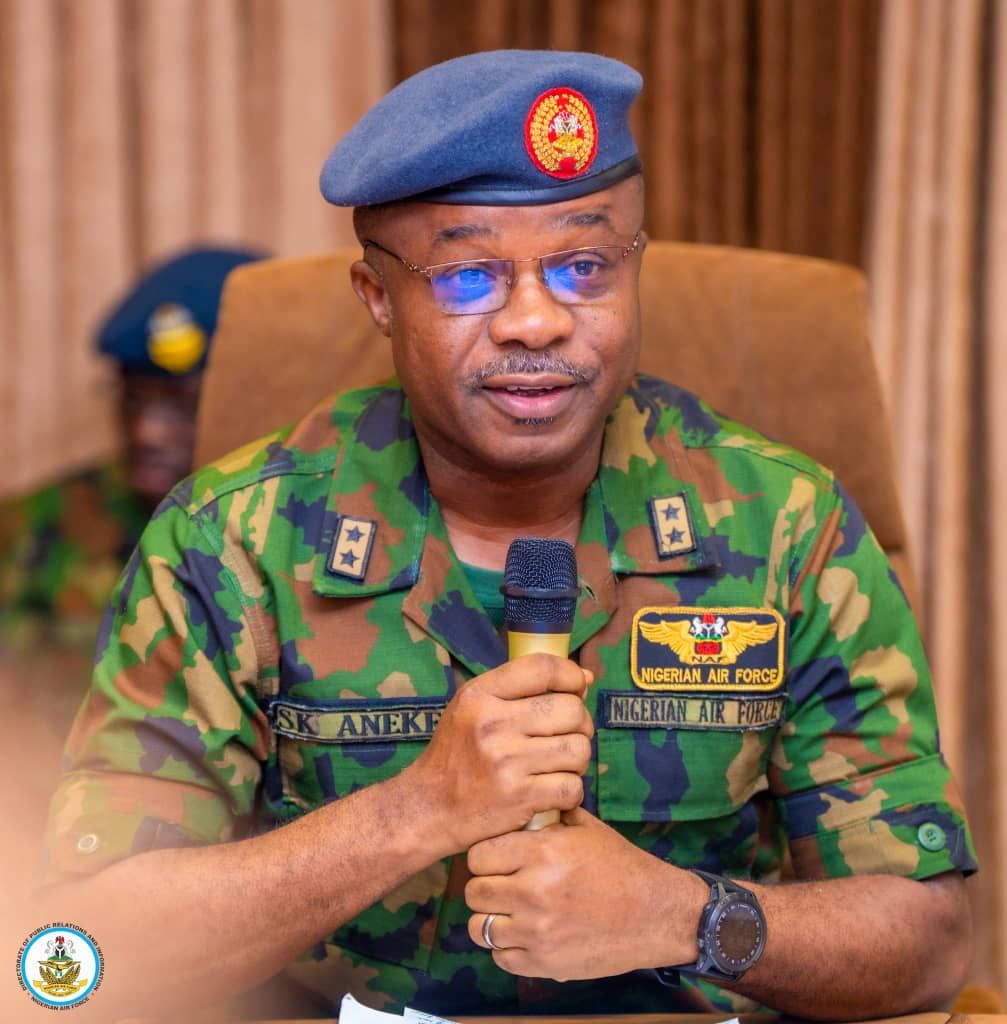
The Chief of the Air Staff, Air Marshal Sunday Aneke, on Wednesday condemned reports of plans by certain individuals to violently subvert Nigeria’s democracy, declaring that perpetrators would face the full wrath of the law.

Aneke spoke in Abuja during a meeting with branch chiefs, Air Force commanding officers and unit commanders, held as part of activities marking his first 100 days in office.

“In this context, I unequivocally condemn recent revelations that plans were made by certain individuals to subvert democracy and violently take over the government.

“Such actions are shameful, shocking and wholly reprehensible. Any perpetrator will face the full wrath of the law,” he said.

The PUNCH reports that a small group of serving military officers recently attempted to orchestrate a coup aimed at ousting President Bola Tinubu, according to official sources. The plot, which reportedly involved plans to violently subvert Nigeria’s democratic system on October 25, 2025, was uncovered and swiftly addressed by the country’s military hierarchy.

Early reactions from the military initially described the claims as speculative, but the Defence Headquarters confirmed that there was a plan, adding that 16 officers were in custody of the coup attempt.

Reaffirming the loyalty of the Nigerian Air Force to the Constitution and the democratically elected government, Aneke stressed that commanders must maintain unity and discipline within the ranks.

“The Nigerian Air Force remains loyal to the Constitution and the democratically elected government of the day.

“Accordingly, commanders are reminded of their responsibility to maintain unity and cohesion within the ranks, while checking all forms of indiscipline and unlawful activity,” he added.

See also  Nigeria, Britain set for fresh security alliance

Speaking on national security, Aneke linked Nigeria’s challenges to growing instability in the Sahel, noting that military coups in Mali, Burkina Faso and Niger had disrupted regional security cooperation and created gaps exploited by jihadist groups.

“Within our immediate neighbourhood, the Sahel remains highly unstable due to the expansion of jihadist groups linked to the Islamic State and Al-Qaeda.

“Military coups in Mali, Burkina Faso, and Niger have disrupted security cooperation and created gaps exploited by armed groups.

“Consequently, violence has intensified and now threatens to spill into coastal West African states like the Republic of Benin and Nigeria,” he said.

The CAS also referenced Nigeria’s recent designation by the United States as a country of particular concern, saying it had heightened global attention on the nation’s security challenges and underscored the urgency of decisive action.

“Nigeria’s recent designation by the United States as a country of particular concern has attracted global interest in Nigeria’s security challenges and heightened urgency of decisive action,” he said.

Domestically, Aneke acknowledged modest improvements in the security situation but noted persistent threats, including insurgency in the North-East, banditry and kidnapping in the North-West and North-Central regions, and farmer-herder conflicts.

“Of particular concern is the recent expansion of the Islamic State’s West Africa Province activities into Kwara, an alarming trend that must be decisively reversed,” he said.

The CAS noted that insecurity in the Niger Delta had declined over the past three months due to joint operations that reduced pipeline breaches and increased crude oil output to about 2.2 million barrels per day, though criminal exploitation of oil facilities remained a challenge.

See also  Poor diagnostic capacity driving misdiagnosis of acute fever – US CDC

In the South-East, he said the security situation had improved markedly, with joint operations dismantling separatist elements and ending the five-year sit-at-home order, allowing gradual restoration of economic and social activities.

With general elections about a year away, Aneke urged Air Force personnel to maintain professionalism and political neutrality.

“Our role remains to support civil authorities and safeguard democratic processes without partisanship,” he said.

The two-day meeting reviewed performance during Aneke’s first 100 days in office and featured briefings on key areas, including UAV development and refining air power for counterterrorism and counterinsurgency operations.

The air chief called for frank, solution-driven discussions to ensure measurable improvements across the service and pledged that the Air Force would remain mission-ready and committed to safeguarding Nigeria’s territorial integrity.

punch.ng

FOLLOW US ON:

FACEBOOK

TWITTER

PINTEREST

TIKTOK

YOUTUBE

LINKEDIN

TUMBLR

INSTAGRAM

Continue Reading
Click to comment

Leave a Reply

Your email address will not be published. Required fields are marked *

News

Tinubu signs ₦68.32trn 2026 budget, extends 2025 spending deadline

Published

on

President Bola Tinubu has signed the 2026 Appropriation Bill into law, authorising an aggregate expenditure of ₦68.32 trillion for the current fiscal year.

He also signed a separate bill extending the implementation period of the 2025 budget from March 31 to June 30, 2026.

The budget allocates ₦4.799 trillion for statutory transfers and ₦15.8 trillion for debt service.

It further sets aside ₦15.4 trillion for recurrent expenditure and ₦32.2 trillion for capital expenditure through the Development Fund.

The presidency made the disclosure in a statement signed by Special Adviser on Information and Strategy, Bayo Onanuga on Friday.

The statement read, “President Bola Ahmed Tinubu has assented to the 2026 Appropriation Bill, which provides for an aggregate expenditure of ₦68.32 trillion. He has also signed the bill extending the implementation period for the 2025 budget from March 31, 2026, to June 30, 2026.

“The N68.32 trillion budget for this year earmarks N4.799 trillion for statutory transfers and N15.8 trillion for debt service. It allocates N15.4 trillion to recurrent expenditure and N32.2 trillion to the Development Fund for Capital Expenditure.

“With capital expenditure accounting for about 50 per cent, the 2026 budget underscores the administration’s continued commitment to economic stability, national security, infrastructure development, and inclusive growth.

“The allocations reflect a strategic balance between statutory obligations, debt servicing, recurrent expenditure, and capital investments critical to driving productivity and improving the quality of life for Nigerians,” it added.

The 2026 Appropriation Act took effect on April 1, with the Federal Government commencing full implementation in line with what the presidency describes as the Renewed Hope Agenda.

See also  Nigeria, Britain set for fresh security alliance

Tinubu also assented to the Appropriation (Repeal and Enactment) (Amendment) Bill, 2026, which extends the capital component of the 2025 Appropriation Act by three months to June 30.

The presidency said the extension would ensure the full utilisation of appropriated funds, particularly for critical infrastructure projects at advanced stages of implementation.

“The extension will ensure the full and effective utilisation of appropriated funds, particularly for critical infrastructure and development projects that are at advanced stages of implementation across the country.

“It will enable Ministries, Departments, and Agencies (MDAs) to consolidate ongoing works, enhance project completion rates, and maximise value for public expenditure,” the statement read.

Tinubu directed MDAs to ensure disciplined, transparent, and efficient utilisation of allocated resources, with strong emphasis on value for money and timely project delivery.

He commended the leadership and members of the National Assembly for what the presidency described as their “diligence, cooperation, and patriotism in expeditiously considering and passing the budget.”

“The President reaffirmed the importance of sustained collaboration between the Executive and Legislative arms of government in advancing national development objectives,” the statement noted.

Tinubu also assured Nigerians of his administration’s resolve to deepen fiscal reforms and boost revenue generation.

“He further assured Nigerians of his administration’s resolve to deepen fiscal reforms, enhance revenue generation, and prioritise investments that will stimulate economic growth, create jobs, and strengthen social protection mechanisms,” the statement read.

The budget, titled “The Budget of Consolidation, Renewed Resilience and Shared Prosperity,” was originally presented to a joint session of the National Assembly on December 19, 2025, at a proposed sum of ₦58.47 trillion.

See also  Insecurity: Northern forum demands service chiefs’ removal

It passed second reading in the House of Representatives on January 29, 2026, before going through further legislative scrutiny and emerging at ₦68.32 trillion at the point of assent.

During the second reading debate in January, House Leader Julius Ihonvbere had urged lawmakers to support the proposal, pointing to a projected 3.98 per cent economic growth rate for 2026, a projected drop in inflation to 14.45 per cent, improved revenues, and foreign direct investment growth.

He also cited a stabilisation of the naira at around ₦1,400 to the dollar and a rise in Nigeria’s external reserves to a seven-year high of approximately $47 billion.

When Tinubu presented the bill to lawmakers in December, he described it as a defining moment in Nigeria’s reform journey, acknowledging the pressures the process had placed on households and businesses while insisting the sacrifices were necessary.

“The path of reform is seldom smooth, but it is the surest route to lasting stability and shared prosperity,” he told the joint session.

He vowed that 2026 would mark a decisive shift to stronger budget execution discipline, announcing an end to the long-standing practice of running overlapping budgets and perpetual rollovers.

The budget’s four stated objectives are consolidating macroeconomic stability, improving the business and investment environment, promoting job-rich growth, and strengthening human capital development while protecting the vulnerable.

Key sectoral allocations include ₦5.41 trillion for defence and security, ₦3.56 trillion for infrastructure, ₦3.52 trillion for education, and ₦2.48 trillion for health.

Minister of Information Mohammed Idris, writing in a January op-ed, described the budget as a commitment to consolidate what was working in the administration’s reform programme and ensure that shared prosperity became “a lived reality for more Nigerians, faster.”

See also  PHOTOS: Another fuel tanker explosion hits Jigawa

He pointed to expanding business activity, improving investor confidence, easing inflation, and stronger external reserves as early indicators of progress, and highlighted ongoing infrastructure projects including the Coastal Highway, Sokoto–Badagry Expressway, and Ajaokuta–Kaduna–Kano Gas Pipeline as evidence of the administration’s delivery record.

punch.ng

FOLLOW US ON:

FACEBOOK

TWITTER

PINTEREST

TIKTOK

YOUTUBE

LINKEDIN

Continue Reading

News

Nigeria, 116 Nations Without US Ambassadors – Report

Published

on

Ambassadorial positions of the United States Department of State in Nigeria and 116 other countries are currently vacant, highlighting a widening diplomatic gap across multiple regions of the world.

Official records published on April 8, 2026, via the US Department of State’s website and titled “Ambassadorial Assignments Overseas” by the Office of Presidential Appointments, show that Nigeria is among 117 countries yet to have a Senate-confirmed US ambassador.

According to The PUNCH, the unfilled positions cut across Africa, Europe, Asia, the Americas and Oceania, affecting both key allies and strategic regions.

In Africa, the vacancies exist in countries including Algeria, Angola, Benin, Burundi, Cabo Verde, Cameroon, Central African Republic, Chad, Comoros, Democratic Republic of the Congo, Côte d’Ivoire, Egypt, Eritrea, Eswatini, Gabon, The Gambia, Ghana, Guinea, Guinea-Bissau, Kenya, Lesotho, Liberia, Libya, Madagascar, Malawi, Mauritania, Mauritius, Mozambique, Niger, Nigeria, Republic of the Congo, Rwanda, Sao Tome and Principe, Senegal, Seychelles, Sierra Leone, Somalia, Sudan, Tanzania, and Togo.

In Europe, the list includes countries such as Albania, Belarus, Bosnia and Herzegovina, Bulgaria, Germany, Hungary, Iceland, Kosovo, Moldova, Montenegro, North Macedonia, Norway, Russia, Serbia, the Slovak Republic, Slovenia and Ukraine.

In Asia and the Middle East, those affected include Afghanistan, Armenia, Azerbaijan, Burma, Cambodia, Indonesia, Iraq, the Republic of Korea, Kuwait, Laos, Malaysia, Maldives, Nepal, Pakistan, Philippines, Qatar, Saudi Arabia, Sri Lanka, Syria, Tajikistan, Timor-Leste, United Arab Emirates and Vietnam.

In the Americas, the vacancies extend to countries such as Antigua and Barbuda, Barbados, Belize, Bolivia, Brazil, Colombia, Cuba, Commonwealth of Dominica, Ecuador, El Salvador, Grenada, Guatemala, Haiti, Honduras, Jamaica, Nicaragua, Paraguay, Saint Kitts and Nevis, Saint Lucia, Saint Vincent and the Grenadines, Suriname, Trinidad and Tobago and Venezuela.

See also  PHOTOS: Another fuel tanker explosion hits Jigawa

Meanwhile, in Oceania, several island nations are also without confirmed US ambassadors, including Australia, the Cook Islands, Fiji, Kiribati, the Marshall Islands, Nauru, New Zealand, Niue, Papua New Guinea, Samoa, the Solomon Islands, Tonga, Tuvalu, and Vanuatu.

This development followed earlier diplomatic changes reported in December 2025, when the administration of President Donald Trump recalled nearly 30 career diplomats from ambassadorial and senior embassy positions worldwide.

According to a report published in The Guardian, attributing it to AP, the move affected mission chiefs in at least 29 countries, including 15 in Africa.

FOLLOW US ON:
FACEBOOK

TWITTER

PINTEREST

TIKTOK

YOUTUBE

LINKEDIN

Continue Reading

News

PHOTOS: Over 700 repentant terrorists set for reintegration into society

Published

on

Over 700 repentant terrorists are set to be reintegrated into their communities after they were deradicalised and rehabilitated.

The African Independent Television reports that the Coordinator of Operation Safe Corridor, Brigadier-General Yusuf Ali, disclosed this during a media tour of facilities at the Deradicalisation, Rehabilitation and Reintegration Centre in Gombe, North-East Nigeria.

Brigadier-General Ali stated that many Nigerians lack adequate understanding of the Federal Government’s structured counter-terrorism programme under Operation Safe Corridor.

He explained that the program is aimed at rebuilding peace in communities affected by terrorism across the country.

According to the report, some of the clients at the camp explained their involvement in the offences that led to their admission into Operation Safe Corridor.

The media tour of the facility is in preparation for the graduation ceremony of over 700 clients who have been deradicalised, rehabilitated, and are set to be reintegrated into their communities.

This comes as the Nigerian military denied claims that deradicalised clients of Operation Safe Corridor are being recruited into military institutions.

FOLLOW US ON:

FACEBOOK

TWITTER

PINTEREST

TIKTOK

YOUTUBE

LINKEDIN

See also  Report of more children failing DNA test ignites fresh arguments
Continue Reading

Trending