Connect with us

News

US allies gather as Trump kicks off Board of Peace

Published

on

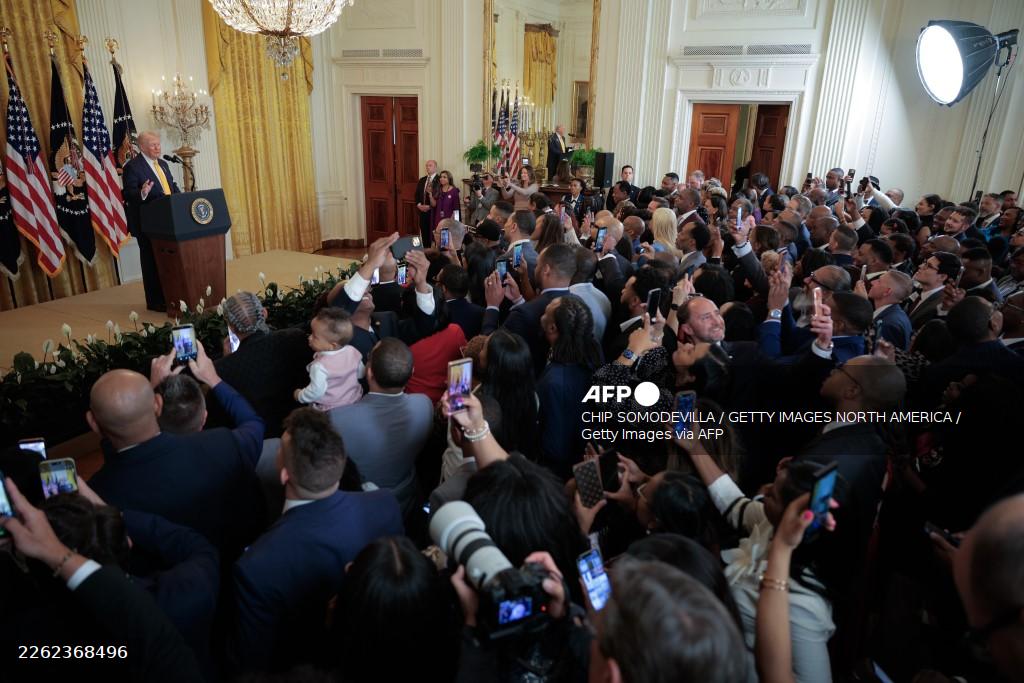
MUS President Donald Trump on Thursday gathers allies to inaugurate the “Board of Peace,” his new institution focused on progress on Gaza but whose ambitions reach much further.

Around two dozen world leaders or other senior officials have come to Washington for the meeting — including several of Trump’s authoritarian-leaning friends and virtually none of the European democrats that traditionally sign on to US initiatives.

The “Board of Peace” came together after the Trump administration, teaming up with Qatar and Egypt, negotiated a ceasefire in October to halt two years of devastating war in Gaza.

The United States says that the plan has now entered its second phase with a focus on disarming Hamas — the Palestinian militant group whose unprecedented October 7, 2023, attack on Israel triggered the massive offensive.

Gaza’s health ministry, which operates under Hamas authorities, says at least 601 people have been killed by Israeli forces since the truce began.

At the “Board of Peace” meeting, Trump is expected to detail pledges of more than $5 billion for Gaza, where the vast majority of buildings lie in rubble and the property-mogul-turned-president has improbably suggested developing resorts.

The meeting will also look at how to launch the International Stabilization Force that will ensure security in Gaza.

A key player will be Indonesia, the largest Muslim-majority country, which has said it is ready to send up to 8,000 troops to Gaza if the force is confirmed.

Indonesian President Prabowo Subianto will take part in the inaugural meeting in Gaza, after joining the launch event at the World Economic Forum in Davos, Switzerland, last month.

See also  Military investigation ends: DHQ moves to arraign alleged coup plotters

– Progress on Gaza? –

US officials including Steve Witkoff, Trump’s friend and roving negotiator, have insisted that solid progress is being made and that Hamas is feeling pressure to give up weapons.

Israel has suggested sweeping restrictions including seizing small personal rifles from Hamas.

“The heavy weapon, the one that does the most damage, is called an AK-47,” Israeli Prime Minister Benjamin Netanyahu said recently.

“That’s the main weapon, and that has to go,” said Netanyahu, whose government will be represented by the foreign minister.

Jeremy Issacharoff, a strategic affairs expert at Israel’s Reichman University, acknowledged that disarming Hamas would not be a “simple task” but said that for Israel, a credible pathway would be key to determining “whether this exercise can get off the ground.”

In one step towards a new Gaza, a technocratic committee was formed last month to handle day-to-day governance of Gaza headed by engineer and former official Ali Shaath.

Hamas spokesman Hazem Qassem told AFP that the “Board of Peace” should compel Israel to “stop its violations in Gaza” and to lift its long siege of the territory.

– ‘Ambition and narcissism’ –

The meeting will take place in the building of the US Institute of Peace, a longstanding institution that studied conflict resolution whose staff was fired by Trump, whose name was then chiseled on the entrance.

Under terms laid out by the White House, Trump will wield veto power over the “Board of Peace” and can remain its head even after leaving office, and countries that want to stay on permanently rather than enjoy a two-year stint will need to pay $1 billion.

See also  Kwankwaso, others may face US visa ban over religious freedom violations

US officials say Thursday’s meeting is about Gaza but have also spoken of the “Board of Peace” in broader, amorphous terms, saying it can address other global hotspots.

“It’s a confused mix of ambition and narcissism, unleavened by any effort at intellectual coherence,” said Bruce Jones, a senior fellow at the Brookings Institution.

The effort comes as Trump thumbs his nose at the United Nations, scaling back funding and withdrawing the United States from key bodies.

– Friends and suitors –

The inaugural meeting will bring ideological allies of Trump including Hungarian Prime Minister Viktor Orban, who is facing a tough reelection battle, and Argentina’s President Javier Millei.

Other leaders in attendance include some eager for US attention, such as Pakistani Prime Minister Shehbaz Sharif, who has courted Trump for support in his country’s conflict with India.

But major historic allies of the United States are not participating, including France and Canada.

Japan, usually among the most stalwart US allies, has not decided whether to join the board and will send an envoy handling Gaza.

Brazilian President Luiz Inacio Lula da Silva declined an invitation, saying the board should be limited to Gaza and “include a seat for Palestine.”

Lula last month dubbed Trump’s board “a new UN where only he is the owner.”

AFP

punch.ng

FOLLOW US ON:

FACEBOOK

TWITTER

PINTEREST

TIKTOK

YOUTUBE

LINKEDIN

TUMBLR

INSTAGRAM

Continue Reading
Click to comment

Leave a Reply

Your email address will not be published. Required fields are marked *

News

Ex-military chief gives reasons bandits kidnap people

Published

on

Former Field Commander of Operation Safe Haven, OPSH, Maj. Gen. Anthony Atolagbe, rtd, says bandits kidnap people to use them as human shields from the military.

General Atolagbe made this revelation on Tuesday when he featured in an interview on Arise Television’s ‘Prime Time’.

He was speaking about the rising insecurity confronting the country.

“The bandits have a pattern of taking people into their enclave, just to use them as sex slaves, but also as shields for negotiation.

“What I can say also is that I will not be able to dwell on specifics. But in Sambisa, some abducted people were freed. In fact, the first thing that happened was that over 100 of them escaped, based on the heat that was brought on the adversary.

“Now, what is playing out is that these guys are being dislodged, and when they are dislodged, and they lose contact with all these women and these men that are running, who are sex slaves and liberals for them within the theater or wherever they are in their enclaves, what happens is that they try to move to other locations where they think they will be safe.

“And the next thing is to start looking for who they can also grab and bring into their new locations.

“The other side is that it is also another strategy by those that are expecting the arrival of the military that are coming into their enclaves to come and chase them out by using some of these people as human shields when the military approach their location.

See also  U.S. lawmaker Riley Moore insists China cannot dictate America’s policy on Nigeria

“So you see that the analysis has brought it out that they have a pattern that they always want to take people into their enclave, not just to use them as slaves or whatever, but they will also want to use them to negotiate,” the retired military officer said.

FOLLOW US ON:

FACEBOOK

TWITTER

PINTEREST

TIKTOK

YOUTUBE

LINKEDIN

TUMBLR

INSTAGRAM

Continue Reading

News

War: Federal govt begins evacuation of Nigerians from Iran

Published

on

The Federal Government has commenced the evacuation of Nigerians who wish to leave Iran, escorting them across the Armenian border to ensure their safety as tension continues to escalate in the Middle East.

The development was disclosed on Tuesday by the Chairman and Chief Executive Officer of the Nigerians in Diaspora Commission (NiDCOM), Abike Dabiri-Erewa, in a post shared on her X handle.

According to her, officials of the Nigerian Embassy in Tehran are coordinating the evacuation process and assisting Nigerians willing to depart the country.

The evacuees are being escorted to the Armenian border where arrangements have been made to facilitate their safe passage.

The evacuation comes amid growing concerns over the security situation in the region following a series of coordinated military strikes on Iran by the United States and Israel on February 28.

The strikes reportedly triggered retaliatory missile and drone attacks across parts of the Middle East, raising fears of a broader regional conflict.

Despite the rising tension, Dabiri-Erewa reassured that no Nigerian in Iran has been affected by the ongoing hostilities.

She also noted that embassy officials remain stationed at the border to receive and assist Nigerians who decide to leave the country.

“Willing Nigerians being escorted across the Armenian border by officials of the Nigerian embassy in Iran for safe passage. No Nigerian in Iran has been affected by the war as officials remain at the border to receive all who want to leave,” she wrote.

This comes due to the ongoing military strikes between U.S, Israel and Iran.

See also  Over 3.7 million battling food crisis in northeast Nigeria – ICRC

FOLLOW US ON:

FACEBOOK

TWITTER

PINTEREST

TIKTOK

YOUTUBE

LINKEDIN

TUMBLR

INSTAGRAM

Continue Reading

News

Insurgency: FG knows every terrorist by name, says Gumi

Published

on

Kaduna-based Islamic scholar Sheikh Abubakar Gumi has stirred debate by claiming that the Nigerian government already knows the identities and hideouts of terrorists across the country. Speaking in a recent DRTV interview, he said his interactions with armed groups are coordinated closely with security agencies.

Gumi addressed rumours that he negotiates with bandits on his own, stressing the involvement of police, military, and other officials. “The government knows every terrorist by name and by location. I don’t go alone to negotiate I go with the police, military, and other security agencies,” he said.

The cleric revealed that some of his efforts take him deep into forests and remote communities, sometimes even accompanied by local women. “I would go to the Emirs. In fact, when we went to one forest, I even went with women into the bush,” he added.

Gumi has long advocated dialogue as a tool to reduce violence, often sparking controversy for interacting with groups considered enemies of the state. He argued that these efforts complement security operations rather than replace them, highlighting the importance of negotiation alongside law enforcement.

Observers note that Gumi’s approach underscores the complexity of addressing Nigeria’s insecurity, where military action alone may not suffice. His collaboration with traditional leaders and security agencies demonstrates a hybrid strategy aimed at curbing violence and encouraging disarmament.

Despite these efforts, insecurity remains high in several northern states, prompting debate on whether dialogue initiatives have tangible results. Critics argue that without accountability and transparency, negotiations could inadvertently legitimise armed groups.

See also  Military investigation ends: DHQ moves to arraign alleged coup plotters

Gumi’s statements have reignited national conversations on counterterrorism strategies, with many Nigerians discussing the balance between dialogue, intelligence gathering, and military action. His insights suggest that tackling terrorism in Nigeria may require innovative approaches that merge community engagement with formal security measures.

thesun.ng

FOLLOW US ON:

FACEBOOK

TWITTER

PINTEREST

TIKTOK

YOUTUBE

LINKEDIN

TUMBLR

INSTAGRAM

Continue Reading

Trending