Ahmed Isah, a former Almajiri pupil, who washed clothes and ran errands as a kid to survive before becoming a graduate, tells CHUKWUDI AKASIKE how he journeyed through the tough Almajiri system before becoming a graduate
Where are you from?
I was born in a small village called Gul, Gara Local Government Area of Kano State.
How old are you?
I am 29 years old.
How was growing up as an Almajiri boy?
It was not easy. I lost my father in my very early years. I never knew who he was. I only have my mum, my two sisters, and my elder brother; that is four of us. I happen to be the lastborn in the family. My mother decided to send me to an Almajiri school.
What year did your mum enrol you in an Almajiri school?
That was around 2003/2004. I was handed over to a man, Mallam Alhassan, who is like a brother to me, because we are from the same village. The man took me from the village and brought me here to Dutse, the capital of Jigawa.
Why did your mum decide to send you to an Almajiri school?
I have no father. So, instead of allowing me to roam up and down, she decided to enrol me in an Almajiri school to learn something. She decided not to leave me like that without having any knowledge of anything.
So, what specifically did you learn in the Almajiri school?
I learnt the Quran, and you know how tough the Almajiri system is. You have to take care of yourself by looking for what to eat; you are the one who will be responsible for what to wear.
How old were you at that time?
I was between five and six years old when I was enrolled in the Almajiri school; I was not even up to seven then.
It must have been very tough on you.
It was very tough. My colleagues and I were the youngest during our days in school.
What is the name of the school?
You know, all these Almajiri schools don’t have specific names, but the one I attended is called Tsangaya Almajiri School.
So, how did you run your daily schedule at school?
The teachers there wake us early, between 4 am and 5 am. We, as pupils, study that early in the morning. Then from 7 am to 8 am, you are told to go and look for what to eat in the morning. Then you are expected to come back between 9.30 am and 10 am.
Then you study again before you are dismissed to go and look for what to eat again, this time as lunch. Then you come back in the evening. That is how the system is. You have to come back and study in the evening, except on Fridays and Saturdays when you have a free day. You have a day to wash your clothes; you have a day to go and look for a little money to buy chalk and other things.
How many years did you stay in the Almajiri school?
Well, I stayed there for about… even when I was in JSS 1, 2, 3, and 4, and SS1 to SS2, I was still staying in the Almajiri school. It was when I sat my WAEC and JAMB (UTME) exams that I had to move out of the school because it is far from the university I was attending. So, I stayed there for more than 10 years.
Can you remember the year you left there?
I left in 2017.
Apart from your mother, who enrolled you in an Almajiri school who encouraged you to further your education?
Along the line, while I was in that Almajiri school, as young as I was at that time, I never liked begging for what to eat. So, some of us went to some people’s houses to tell them that we could fetch water for them and do other domestic work.
When we washed clothes belonging to their children, they gave us some clothes, food, or money in exchange so that we could take care of ourselves. In that process, I met a good man who is a very important person in my life.
What is his name?
His name is Danjuma Maiyaki Allah. He is from Edo State. The man was happy that I could do most domestic jobs. So, a woman connected me to him, and I started doing domestic work for him. I used to do anything that he told me to do for him.
The man described me as a very intelligent person who is hardworking and very honest. He used to test my level of honesty, and I passed all the tests.
What other factors propelled you to further your education?
When I was a kid, I used to admire students in their uniforms, especially when they were on their way to school. I saw them as gaining more knowledge than I. So, I wanted to also enjoy that aspect of life and was determined to go to school.
I spoke about it to my Almajiri teacher and my mother. I also told my brother about the need for me to go to school. Then I didn’t have any access to a mobile phone. So, I sent a message across to my parents, brothers, and sisters to ask for their permission to further my education up to primary school. They happily permitted me to do so.
I was nervous when I sent the message across, thinking they would not permit me. But they told me, ‘May God bless you. Go ahead and do it.’ I then came back to the man, Danjuma Maiyaki Allah, to tell him about my people’s approval.
He took me to a primary school; it is a public primary school in Dutse. The man (Mallam Danjuma) took me to the headmaster. He told the headmaster that I was his Almajiri and that I was working for him, and that he wanted the headmaster to register me in the school.
The headmaster said I should be interviewed to know if I could read and write. Though I read and wrote well in the Hausa language, I couldn’t write English. So, I had to learn how to write in English. After the interview, the primary school realised I was bigger than pupils in Primary 1, 2, and 3. They decided to register me in Primary 5.
When I got to Primary 6, I sat my Common Entrance and started JSS1 in the same school because it used to be a primary and junior secondary school altogether. I wrote my junior WAEC exam at the school in 2013.
What is the name of the primary and junior secondary school?
Dr Nuhu Muhammad Sanusi Government Day Junior Secondary School.
Did you pass your junior school exam?
Yes, I did, and my sponsor was impressed. So, instead of taking me to another public school, he decided to register me in a public/private school known as Dutse Capital School. In my primary and junior secondary school, pupils and students did not pay school fees, but we used to buy other things.
However, in Dutse Capital School, we paid little school fees. At the time, my sponsor, Mallam Danjuma, used to pay my school fees. Along the way, he asked me if I had an interest in learning a skill so that at a later stage of my studies, when I needed financial aid, money raised from the skill could help me.
So, I decided to learn tailoring. I started learning tailoring when I was in JSS2. After school hours, I used to go to a tailoring shop to learn the skill. When I got back home, I still did my Almajiri study. That was only in the night and early morning before I left for school. I was able to stay disciplined to attend a modern school, an Almajiri school, and still learn tailoring.
How did you gain entry into the university?
After I passed my WAEC and NECO exams, I then registered for UTME, which I passed. I scored 217.
What did you study?
I studied Criminology and Security Studies. The cut-off mark for the course was 195, and I scored 217. My SSCE result was very good for me to be offered admission in the first batch.
Surprisingly, my sponsor was not tired; he helped me financially from the first year all through. I studied seriously because I was always aware of the background I came from. When I started my Year 1, it was not easy for me, but later, I began to catch up.
When did you graduate?
I graduated in 2024.
What is the name of the university you graduated from?
Federal University Dutse.
What is your current occupation?
After my national youth service, I came back to my tailoring shop. I have not got a job except for my tailoring work. If I see any job opportunity, I will still apply.
What was life like when you were serving as a corps member?
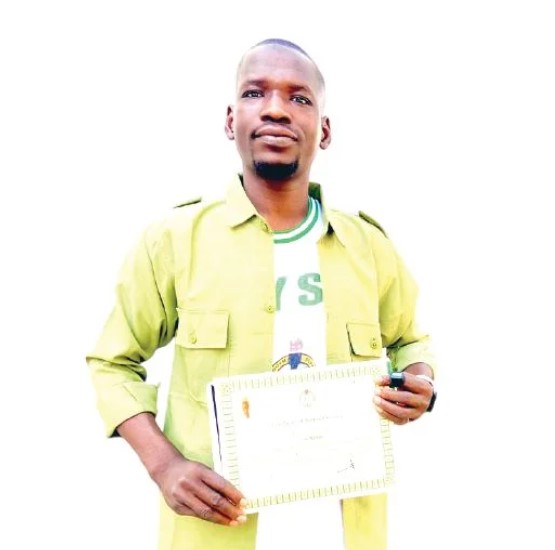
It was a very interesting experience. I used to admire corps members during my primary and secondary school days. I liked seeing them dressed in khaki. What gave me more joy was the way I succeeded in making it up to the extent of becoming a graduate and serving as a youth corps member. It was a very nice experience.
Where did you serve?
I served in Kaduna State.
Looking back at when you started up to the point of becoming a graduate and serving your fatherland, how do you feel?
It is inexplicable. I shed tears when I was collecting my NYSC certificate. It was a dream come true. It was something I felt would not be possible, but now I have achieved it. I remain very happy today because of these academic achievements.
Are you married or involved in any relationship?
No, I’m not married yet. I know what I have gone through. So, any relationship I know will not be serious, I will not involve myself in it. I will marry later when I get something that will give me a stable income.
How do you feel when you see Almajiri boys who beg on the streets?
I don’t like them begging because I know how it feels; I was in their shoes before. I know what they are going through. I know how it is. So, I don’t blame them because it is not completely their fault. Talking about begging, it is like they don’t have any other choice. But I used to sell pure water during my days as an Almajiri boy.
Have you at any time been moved to tell them to go to school?
In the Almajiri school I attended, I was like an inspiration to them. If you go to that Almajiri school now, you will see young men with Diploma certificates, and many people with secondary school certificates.
Many of them are attending modern schools now. It has now become a culture in that Almajiri school. When the pupils begin to grow, they always find one way or the other to go to school. My story inspired them to see the need to go to school. I serve as an inspiration to them because some of them who have Diplomas are saying they want to go to university.
How do your siblings and mother feel about the fact that you have become a graduate?
They are very happy. On my passing-out, they came to celebrate with me. My mum was even crying because she was not expecting such a joyful thing. It sounds very odd that an Almajiri will become a graduate.
punch.ng
FOLLOW US ON: