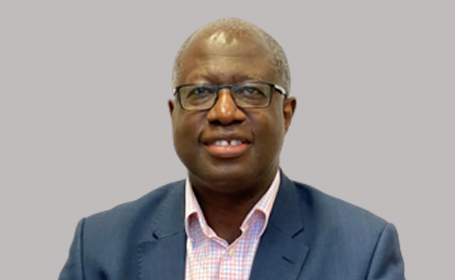
A London-based British-Nigerian consultant urological surgeon, Prof Francis Chinegwundoh, speaks with BIODUN BUSARI on his childhood experience and journey into the medical profession, among other issues
How was your childhood experience?
My dad came to the United Kingdom in the 1950s. He and my mum got married in London. They didn’t plan to stay in the UK, but something happened, and they ended up staying. Eventually, their four children, including me, were all doing very well at school.
With our academic performance, they decided we would stay rather than return to Nigeria, as other family friends had done. My parents thought going back would disrupt us.
What was growing up like among white children?
There were no majority-black schools. Every school then was predominantly white, with some black and Asian children. In those days, we lived in the mixed area of Balham, a suburb in south London. There was a majority of white people.
However, there were still quite a few black families from the Caribbean, West Africa, Asia, India, and Pakistan, and this made it a mixed area, and my siblings and I didn’t feel isolated because there were others like us. We went to school in a general environment, and the same applied to shops. It wasn’t much of a problem. It may have been different if we were not in London. Then and now, London is the most diverse part of the UK.
Did your parents influence your choice of medical career?
I guess I was about eight or nine years old when I started concentrating on medicine. Initially, it didn’t appeal to me, but there were television programmes that drew my interest. I can recall a programme called Emergency Ward 10 and another one called General Hospital. These were weekly soaps and programmes.
I just enjoyed those soap operas. I enjoyed the characters, and I started imagining and portraying myself as a doctor in those TV programmes. Then I remember getting one of the plastic toy sets. Then I decided that was what I wanted to do.
Academically, I was very strong. What my parents were interested in was my doing well in school. They didn’t focus on whether I should be a doctor or not. Of course, they were happy when I said I wanted to do medicine, but it was not something they pushed me into or suggested that I do. That impetus came from me. They encouraged me because I had the idea quite early on of what I wanted to do.
Can you share ideas about how your education was?
After primary school, I was able to attend a grammar school. Grammar schools are schools for academically bright students. These are free as opposed to private schools, which my parents could never have afforded. Private schools generally have very high academic standards, but they are expensive.
Grammar schools were a means of social mobility. They have very competitive exams. If you managed to get into a grammar school, then you were assured of an outstanding education, should you choose to take advantage of the opportunity.
I went to a grammar school. It was actually a Catholic school in south London called Salesian College. I did very well. I was second in class throughout. Then I applied to get into medical school. That was very competitive. You must be very good, with what we used to call O-Levels at that time, which are now called GCSEs.
You must have good grades for A-level. Then the support of your headmaster or headmistress, who would write a letter of support to buttress your application to medical school, was very important. Thankfully, I was able to secure entry to St. George’s Medical School, part of the University of London. It was in Tooting, south London.
What inspired you to pursue urology as an area of speciality?
It is quite a long journey. After I qualified at medical school at the age of 23, I was either 35 or 36 before I became a consultant urologist. It’s a long journey to reach consultant status in a surgical speciality. When you qualify, you do a series of house jobs or internships.
For two years, you rotate in general areas to have broad experience. After those two years, you then decide if you want to be a surgeon, physician, or general practitioner. You can even decide if you want to go to the army or the navy. There are exams to take for all these specialities.
For instance, if you want to be a surgeon, you must pass the exam of the Royal College of Surgeons. After passing the exam, you will enter a training programme. Under that training, you will still rotate in different areas. You might do some orthopaedics, cardiothoracic surgery, urology, or neurosurgery. This helps in getting experience in different surgical fields.
After these two or three years, you decide on the particular branch. It comes with competitive interviews, exams, written and published articles, journals presented, research, and so on, to secure a training post in your subspecialty.
I enjoyed urology as I found the consultants very amenable. I specialised in urology because it dealt with males and females as opposed to gynaecology, which deals with females only.
Based on your research, what is the correlation between black men and prostate cancer?
I have specialised in dealing with prostate cancer. I have been a consultant for almost 30 years. It was quite early when I took an interest in prostate cancer. I’ve seen a lot in my consultancy practice, and that led me to a lot of black men, making me wonder why I was seeing many black men with prostate cancer.
Then I decided to do some research in the late 1990s. I called the offices of the population census and surveys, basically the government statistical office in the UK, to know how many black men had prostate cancer. This statistical body said they didn’t know because there had not been any research into black men and prostate cancer in the UK.
That was why I embarked on doing the research. I was able to show and publish that black men were two times as likely to get prostate cancer as their white counterparts. I suspected something about our genetics, but exactly what we don’t know remains unknown.
So, having accepted the fact that black men have an increased risk of prostate cancer, we then focused on raising awareness in the community. For more than 25 years, I’ve been raising awareness that black men should be aware of their increased risk and therefore start getting themselves tested.
Unfortunately, prostate cancer is so common in Nigeria. I don’t think you’ll find any family where there are men over 50 and someone has not had prostate cancer. It’s the second most common cancer in men worldwide. In some countries, it’s number one, in others it’s number two. In fact, in the UK, more men get prostate cancer than women get breast cancer.
What should men, especially Nigerian men, do?
Get tested. Men should go for tests. I explain to men when I give talks that only men have a prostate gland, and it is usually the size of a small cherry or a walnut. It sits in front of the anus, in front of the back passage, deep inside the pelvis.
Its purpose is to produce the seminal fluid. So when a man climaxes, most of that fluid that comes out is prostate fluid. Some of it is sperm from the testicles, but most of that fluid is prostate fluid, which nourishes the sperm. So, it’s a sexual gland; it’s a sexual organ.
Secondly, the water pipe has to pass through it. So, the water pipe connecting the bladder to the penis, surrounding the exit of the bladder, is where the prostate lies. It surrounds the water pipe. As it gets bigger, which happens as you age, it begins to squeeze the water pipe.
So, most men will recognise that in their 40s, 50s, 60s onwards, the urinary flow becomes slower. When you’re very young, your urinary flow is very fast. As you age, the prostate begins to enlarge, and it squeezes the water pipe. Therefore, the flow becomes slow, and the bladder doesn’t empty as well.
Most men over the age of 50 will have what we call benign prostate enlargement, where the prostate naturally squeezes the water pipe. Men will recognise this: the flow is slower; it takes them a longer time to pass urine. They have to go more often, and they have to get up at night. This is not to be confused with prostate cancer.
The problem with the prostate gland is that the symptoms of enlargement and squeezing of the water pipe are the same symptoms that may indicate prostate cancer, including difficulty in passing urine. It could be some sexual issues as well.
But very importantly, and I always emphasise this, you can have prostate cancer with no urinary symptoms whatsoever. So, if you’re waiting for urinary symptoms before you see your doctor, it may be too late.
Interestingly, in Nigeria, my colleagues tell me that 90 per cent of men with prostate cancer are already advanced. To find it when it’s early and still a small thing that can be dealt with very well, you have to have the blood test.
It’s a blood test called Prostate Specific Antigen. It’s like an early warning sign. So, I encourage men every year to have this blood test. If the blood test is raised, it leads to further investigations to see if the man has prostate cancer or not.
At what age is it advisable for men to have the test?
At 40 years of age. The reason is that you can have prostate cancer without any symptoms. In the UK, for example, I would say 80 to 90 per cent of men, when we find prostate cancer, it is still in the prostate. It has not spread anywhere.
Based on this, we can cure those men. Whereas in Nigeria, it is the opposite. About 80 to 90 per cent of men, by the time their cancer is diagnosed, it has already spread into the bones, into the pelvis, and into certain lymph glands.
One of the things we know about prostate cancer is that there is a hereditary element to it. So, if your father has prostate cancer, your risk is double. If your dad and maybe your brother have prostate cancer, your risk is quadrupled.
So, it’s very important to know your family history. Also, if it turns out that on your mother’s side, there is a history of breast cancer or cancer of the ovary, your risk as a male of getting prostate cancer is also high.
I emphasise this because when I was a child, various family friends would pass away. I would ask what they died from, and parents would say, ‘I don’t know’. So, there’s secrecy as to what they died from.
I encourage people to share their family histories. As a parent, if you have cancer of this or cancer of that, tell your children so they can start getting themselves tested earlier than they might otherwise have done. Family history is very important.
Can you briefly speak about your role as a medical legal expert?
It encompasses a whole range of things. For example, if you are riding a motorbike and you have an accident, maybe a car bumps into you, you fall over, and you might fracture your arm, leg, or pelvis, or even injure your penis or testicles, you will then seek compensation from the person who caused the accident.
Now, someone has to assess what injuries you’ve suffered and what the long-term effects of those injuries are. That’s where a medical legal expert comes in. So, I, as a urologist, would be asked to assess injuries to the testicles, injuries affecting one’s sex life. Maybe you’ve injured the kidney or something.
I would go through all the records, examine the man, and do a report. These are the injuries this person has suffered. This is going to be a permanent problem, or it’s a temporary problem, or we can get things better by doing this. That is one aspect: personal injury.
The other aspect is clinical negligence. If you, as a patient, come to me as a urologist and you allege that maybe your operation was done wrongly or there was a delay in your particular diagnosis, you go to a solicitor because you are aggrieved.
The solicitor has to employ someone, an expert in the area, to look through the entirety of the case and come to some sort of opinion as to whether indeed it was negligence or whether it was just bad luck. I will look at whether they breached their duty of care to you and caused you harm.
How do you manage all these roles?
I haven’t even mentioned that I’ve been running a cancer charity for the last 26 years. There’s a charity organisation called Cancer Black Care, which is based in London. It supports black people throughout their cancer journeys, helping them with getting information, navigating the social services system, and a whole lot.
What it means is that you have to be very efficient with your time. At the same time, you have to enjoy your family and friends. I enjoy travelling but over the years, I’ve managed to blend all these things.
When I deliver lectures, it is academic. I’m very adept at using computers and the latest software. I’ve started using artificial intelligence in some of my work. I’ve been paperless for up to 10 years.
How do you explain the magnet pulling Nigerian medical experts to the UK?
It is the pay and conditions of work. That is what it is. Everything here is very orderly. Every health service has its challenges, but they are completely different in magnitude from what obtains in Nigeria. Some of my colleagues in Nigeria are frustrated by having to work extremely long hours.
In the UK, no long hours, the pay is good, the education system is good. You don’t have to worry about electricity, whether at home or in the hospital. You don’t have to worry about water or buying a generator. Everything is designed to make your life comfortable and easy.
Education is a big pull as well. Education is free in the UK. You can pay extra for private education. But I think about 90 to 93 per cent of children in the UK are educated in the state system, while seven to 10 per cent are in the private system. Primary and secondary education is free in the UK.
The only time you start paying is when you go to university. Even at that, it is heavily subsidised by the government if you become a British citizen. So, people leave for professional reasons.
Then think of security reasons—you get it in the UK. The thing about medicine and nursing is that they are transferable skills. You can go anywhere in the world with those skills.
How did you feel when you became a Member of the Order of the British Empire?
It was in 2013. These awards are given to recognise your contributions, and it’s not something you apply for. It means some people notice your work and appreciate you. About four or five people will get nominated and scrutinised by a committee.
If you merit it, you get a letter from the palace. You have to keep it quiet for the two months until it’s officially announced and it’s in the media. So, it’s a secret kind of thing.
I was blessed that both my parents were able to come to Buckingham Palace, where I received the medal from Prince Charles (as he was called then), now King Charles III. I have always believed that hard work, determination, and focus bring rewards, and that was what I experienced.
So, I always advise and encourage everyone, especially youths, that your diligence for great work will be honoured and rewarded at one point or another if you don’t relent.
punch.ng
FOLLOW US ON: