
Connect with us

News

Presidency Explains Nigeria-UK Migration Agreement, Warns Against Misinformation

Published

on

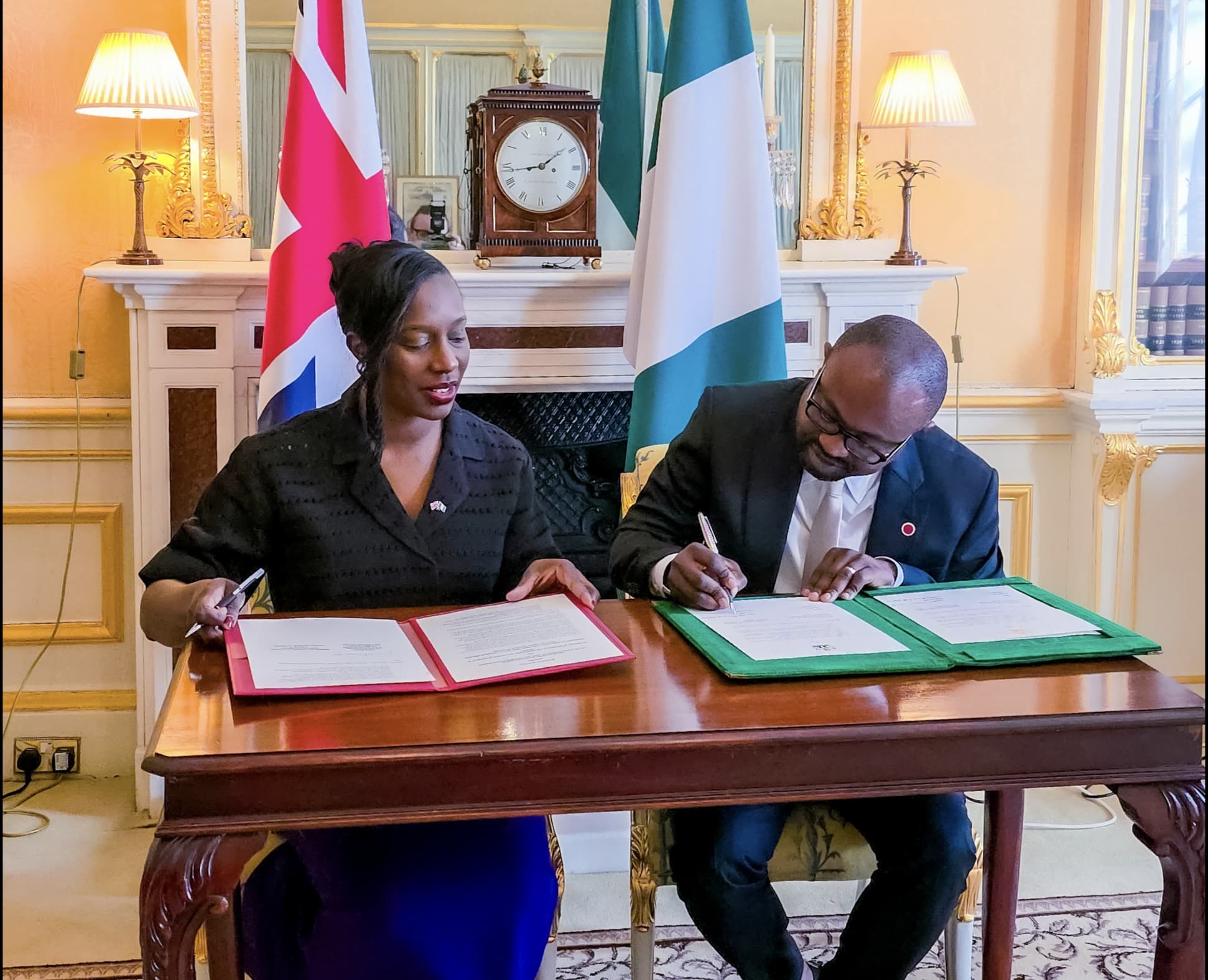
UK Trade Envoy, Florence Eshalomi and Nigeria’s Minister of Interior, Olubunmi Tunji Ojo

The Bola Ahmed Tinubu-led administration has clarified details surrounding the migration partnership between Nigeria and the United Kingdom, dismissing claims that the agreement compels Nigeria to accept foreign nationals.

It was reports that the clarification was contained in a statement issued by the Special Adviser to the President on Information and Strategy, Bayo Onanuga.

According to the Presidency, the Memorandum of Understanding signed during the visit of President Bola Ahmed Tinubu does not require Nigeria to receive non-citizens.

The statement emphasised that only verified nationals of each country would be repatriated under the agreement.

“Nowhere in the 12-page memorandum is Nigeria required to accept foreign nationals other than Nigerians,” the statement said.

The MoU, signed by Nigeria’s Minister of Interior and the UK Home Secretary, is aimed at promoting safe, orderly, and regulated migration between both countries.

The presidency noted that it also seeks to strengthen cooperation in tackling irregular migration and related offences.

The government explained that returnees must undergo multiple layers of identification and verification before repatriation.

Where errors occur, such individuals would be returned to the requesting country at its own cost, the presidency noted.

Onanuga said the agreement provides that all returnees must be treated with dignity and respect, in line with international human rights standards, adding that it also allows individuals to appeal deportation decisions under applicable domestic and international laws.

The Presidency stressed that Nigeria has not ceded control over its immigration processes, pointing out that under the agreement, the Nigeria Immigration Service retains sole authority to issue travel documents and manage all entry procedures.

The full statement reads: “It has become necessary to debunk the raft of misinformation assailing the migration partnership between Nigeria and the United Kingdom, as contained in the Memorandum of Understanding signed by the two nations on the sidelines of President Bola Ahmed Tinubu’s historic state visit to the UK.

“The memorandum on immigration cooperation, like other memoranda signed, aimed to strengthen the partnership between Nigeria and the United Kingdom.

“Nigeria’s Minister of Interior and the Secretary of State for the Home Department of the Government of the United Kingdom and Northern Ireland signed the Migration MoU.

See also  Bill, Hillary Clinton to testify in US House Epstein probe

“The MoU establishes a framework to facilitate a regulated and safe migration flow between the two countries and to encourage further bilateral cooperation in the fight against irregular migration and associated acts by citizens of each country, in accordance with their respective immigration and citizenship laws and extant international treaties, conventions, protocols, agreements, and charters.

“Nowhere in the 12-page memorandum is Nigeria required to accept foreign nationals other than Nigerians. Nationals to be repatriated must have undergone multiple levels of identification and verification, and, where errors occur, they are returned to the requesting country at the requesting country’s cost.

“Under the agreement, Nigeria and the United Kingdom will work together to secure the dignified return of their nationals who do not, or no longer, have the right to enter or remain in the territory of the other country.

“A clear condition in the MoU is that the returnees concerned are bona fide nationals of the country and are treated with dignity and respect, with due regard to their human rights and fundamental freedoms.

“Law enforcement officers in each country will take the necessary action to protect the interests and well-being of citizens of either party and to mitigate conflict triggers related to migration matters.

“A key provision in the MoU is that the migrant to be returned must carry his legally acquired personal belongings to the country of destination, unlike in the past when migrants left with nothing.

“Article 12 further reinforces this good deal: “Every returnee will be given ample opportunity to make adequate arrangements for the transfer or disposal of his property in the territory of the requesting party, under the supervision of the mission of the requested party.”

“Another provision is that where a return is being considered, and the person has made a claim under relevant domestic or international human rights legislation, that claim will be considered in line with the provisions under the party’s respective domestic legislation. The appeal may relate to circumstances in which the foreign nationals have been lawfully resident in the territory of the requesting party for most of their lives and socially and culturally integrated in the territory of the requesting party. Another ground of appeal may be where the nationals would face significant obstacles to their integration into the country to which they are to be deported.

See also  Tinubu returns to Abuja after counterterrorism talks in Rome

“Article 9 of the MoU sets out the conditions for the migrant’s return.

“Before departure, identification checks will be carried out by the officers of the requested party in the territory of the requesting party and on arrival by the competent authorities of the requested party. The requesting party will coordinate all returns with the officers of the requested party.

“A return may be conducted by means of a scheduled aircraft or an aircraft chartered specifically for this purpose by the authorities of the parties; the requesting party will provide the flight details and particulars of each returnee five (5) working days before the date of return.

“A return will be conducted using an original, valid passport, or, if the requesting party can biometrically match a returnee to a visa application made in the territory of the requested party, then an expedited process will be permissible, via which the requesting party will facilitate the return or repatriation using a UK Letter (UKL).

“If a returnee cannot be biometrically matched to a visa application by the requesting party, but there is otherwise strong evidence to confirm nationality, including a copy of a passport, a passport number or a national identity card, then an expedited process will again be permissible via which the requesting party will facilitate return or repatriation using a UK Letter (UKL).

“Should the requested party not be satisfied with a returnee’s identity within five (5) working days of submission of the UK Letter (UKL) to Nigerian authorities, detailed reasons should be presented to the requesting party why the identity cannot be satisfied. In these circumstances, removal will be deferred.

“If subsequent evidence shows that a returnee who has been returned is not a national of the requested party, the requesting party will take the person back to its territory at the requesting party’s cost and by the most efficient means possible. The request for the return of the person referred to in Article X will be made within ten (10) working days following the return exercise and carried out within fourteen (14) working days after acceptance of the request.”

See also  Conference committee must retain electronic transmission – Dickson

“Article 9, subsection 3, shows that Nigeria has not ceded to the UK the right to document the repatriated person.

“The section says: It shall be the sole responsibility of the Nigeria Immigration Service (NIS) to issue and handle, as is necessary under Nigerian domestic legislation, any Nigerian documentation (including the digital acknowledgement of receipt of a UK Letter) ahead of the notified date of return as stated in the UK Letter. This shall be distinct from the UK Letter process and remains the sole right and responsibility of Nigerian authorities, including the handling of the
travel document and any onward transmission required from the issuing office to enable entry.

“Article 11 deals with returnee reintegration assistance. It states that every returnee will be able to access basic on-arrival and reintegration assistance in the territory of the requested party.

“Short-term assistance may include airport reception, accommodation, onward transportation, care and provision packs and small cash assistance. Medium-term assistance can include support to find and reunite with family; support in obtaining the in-country documentation required, signposting to local services, and the potential provision of mental well-being and counselling services (if required).

“Longer-term assistance may allow access to a Returnee Education and Entrepreneurship Fund to enable sustainable reintegration. Support may include accessing the local job market, setting up a business, accessing vocational training or further education, and assistance with legal migration opportunities.

“Should the parties’ domestic legislation regarding the provision of reintegration support to all or certain categories of returnees change, or should the overarching non-legally mandated package of reintegration support change, the parties will inform each other as soon as is practicable.”

” The MoU, similar to those signed in 2012, 2017, and 2022, is for an initial period of five years, renewable for a further five-year period, as may be agreed by the parties.

“We reiterate that media organisations should seek clarification when uncertain about any issue to avoid misinforming the public.”

FOLLOW US ON:
FACEBOOK

TWITTER

PINTEREST

TIKTOK

YOUTUBE

LINKEDIN

Continue Reading
Click to comment

Leave a Reply

Your email address will not be published. Required fields are marked *

News

Nigerian soldiers should not earn less than N250,000 monthly — Enenche

Published

on

A former Director of Defence Information, Major General John Enenche, retired, has called on the Federal Government to review Nigerian soldiers’ welfare.

Speaking during an interview on Arise Television on Saturday, Enenche said Nigerian army’s personnel should not earn less than N250,000 a month.

“For me, a Nigerian soldier from the base, shouldn’t be paid anything less than N250,000 per month,” he said.

According to him, the amount was a modest benchmark considering the rising cost of living.

Enenche argued that military personnel make sacrifices that distinguish them from other public servants.

The retired Army general stressed that soldiers remain on duty round the clock and are required to respond whenever called upon, even after retirement.

“No soldier is ever off-duty, even as I’m retired now,” adding that a senior officer calls him now, ‘General Enenche, sir, we want you to…’ I would do it, even in retirement.”

FOLLOW US ON:

FACEBOOK

TWITTER

PINTEREST

TIKTOK

YOUTUBE

LINKEDIN

INSTAGRAM

See also  NDLEA trains NYSC members in Edo
Continue Reading

News

PHOTOS: Senior ISWAP finance operative surrenders to troops with his two sons in Borno

Published

on

A senior finance operative of the Islamic State West Africa Province (ISWAP), identified as Musa Usman, has surrendered to troops of Operation HADIN KAI in Borno State.

Acting Military Information Officer

Headquarters Joint Task Force(North East) Operates HADIN KAI, Captain Mohammed Goni, who disclosed this in a statement on Saturday, July 25, 2026 said the development marks another significant blow to the terrorist group’s financial and logistics network.

According to the statement, troops of 24 Task Force Brigade to the planned surrender of the high-profile ISWAP member along the Ladari–Jegarawaji–Tunokalia corridor on the Gamboru–Wulgo Main Supply Route.

Acting on the intelligence, troops of 3 Battalion (Mechanised), in conjunction with members of the Civilian Joint Task Force (CJTF) and Hybrid Forces, mobilised and intercepted the terrorist at about 6:45 a.m. on July 25.

The surrendered insurgent arrived with his two sons, Abubakar Musa, 10, and Awwali Musa, 15.

Preliminary interrogation revealed that Musa Usman served as the Chief Finance Officer of the ISWAP enclave at Jubillaram, where he was responsible for overseeing the group’s financial operations, logistics and resource management.

Items recovered from him include one AK-47 rifle, four AK-47 magazines, 101 rounds of 7.62mm special ammunition, one motorcycle, and N40,000 in cash.

“Troops of Operation HADIN KAI (OPHK) have recorded another major operational breakthrough with the surrender of a senior Islamic State West Africa Province (ISWAP) finance operative, underscoring the sustained impact of ongoing kinetic and intelligence-driven operations across the North East,” the statement read.

“The development comes amid a growing wave of terrorist surrenders, with approximately 46 terrorists and their family members voluntarily surrendering to troops in recent days, further highlighting the mounting pressure on terrorist strongholds.

See also  Conference committee must retain electronic transmission – Dickson

“The terrorist surrendered to troops of 3 Battalion under 24 Task Force Brigade at about 6:45 a.m. on 25 July 2026 along the Ladari–Jegarawa–Tunokalia axis on the Gamboru–Wulgo Main Supply Route.

“His decision to lay down his arms follows the recent series of coordinated and decisive land and air offensives conducted by Operation HADIN KAI against terrorist enclaves.

“Preliminary profiling indicates that the terrorist served as the Chief finance operative of the ISWAP enclave at Jubillaram, where he was responsible for managing the group’s financial activities and logistics. He surrendered alongside two male children.

“Items recovered from the terrorist include one AK-47 rifle, four magazines, 101 rounds of 7.62 mm special ammunition, one motorcycle, and the sum of N40,000.

“The individual is currently undergoing detailed profiling and interrogation to exploit actionable intelligence that will support ongoing operations and facilitate the targeting of remaining terrorist elements across the Theatre.

“The surrender of such a key finance operative represents another significant setback for ISWAP, reflecting the growing erosion of the group’s command structure, operational capability, and sustainment network under the relentless pressure of Operation HADIN KAI.

“Coupled with the increasing number of recent surrenders, this development confirms deepening disillusionment within terrorist ranks and points to an accelerating wave of defections from terrorist camps.

“Operation HADIN KAI remains steadfast in its mission to restore enduring peace, security, and stability across the North East.

“The Theatre Command therefore calls on all remaining terrorists to take advantage of the Federal Government’s non-kinetic initiatives by laying down their arms before it is too late.

See also  Customs intercept N48.5m cannabis, seize N220m contraband in Kaduna

“The Command also urges members of the public to continue supporting security agencies by providing timely and credible information that will enhance ongoing counter-terrorism operations.”

FOLLOW US ON:

FACEBOOK

TWITTER

PINTEREST

TIKTOK

YOUTUBE

LINKEDIN

INSTAGRAM

Continue Reading

News

Alleged Coup: Document Reveals People Assigned To Attack Aso Rock, Service Chiefs’ Residences, Airports

Published

on

Fresh details have emerged on how officers and civilians accused of involvement in an alleged plot to overthrow President Bola Tinubu’s administration were assigned specific roles targeting strategic locations across Abuja and other parts of the country.

According to Premium Times, investigative documents reportedly showed that participants were given responsibilities ranging from securing the Presidential Villa and Radio House to taking control of military facilities, airports and the residences of senior military officers.

The prosecution has also presented additional details of the alleged plan before the Federal High Court in Abuja, where some of the accused persons are standing trial.

According to the documents, one of the suspects, Mr Usman, was allegedly assigned to lead the operation at the Presidential Villa after conducting reconnaissance of the complex with the assistance of insiders, including a police officer identified as Ahmed Ibrahim.

During proceedings in May, the prosecution played a video exhibit in which one of the defendants, Zekeri Umoru, reportedly told investigators that the alleged planners considered cutting electricity supply to the Presidential Villa at the point of execution.

Umoru, an employee of Julius Berger Nigeria Plc attached to the Maintenance Department at the Villa, however, said he warned that an abrupt power outage would immediately attract scrutiny and could lead to workers on duty being detained and questioned.

He also claimed that the alleged planners intended to recruit between 18 and 19 persons from among soldiers, State Security Service operatives and Julius Berger employees working within the Villa.

See also  Tinubu returns to Abuja after counterterrorism talks in Rome

According to his account, after he raised concerns about the proposed blackout, the alleged leader of the plot considered using force to enter the Villa if insiders failed to cooperate.

Umoru and other defendants have challenged the admissibility of the video exhibits and their extra-judicial statements, citing the circumstances in which they were obtained.

Radio House, Military Residences Targeted

The documents also outlined assignments allegedly given to other participants.

Lieutenant-Colonel Shamsuddeen Bappah was reportedly assigned to take control of 102 Battalion in Zuma, Niger State.

Major Abdulkarim Ibrahim was initially said to have been tasked with securing the Armed Forces Headquarters complex before his responsibility was changed to Radio House in Abuja, where he was allegedly expected to read a nationwide broadcast announcing the takeover.

Ibrahim reportedly told investigators that Bappah was initially designated to make the announcement before the responsibility was reassigned to him.

A Nigerian Air Force squadron leader identified as S.B. Adamu was allegedly assigned to seize Air House.

Major Muhammad Jiddah was reportedly tasked with taking control of the residence of the then Chief of Army Staff, Olufemi Oluyede, while Major Daniel Yusuf was allegedly assigned to the residence of the then Chief of Defence Staff, Christopher Musa.

Captain Akinwale Yusuf, who was in Lagos, was allegedly expected to take control of a divisional headquarters in the state.

A retired colonel, M.M. Adamu, whom authorities said remained at large, was allegedly expected to coordinate activities from the entrance of Niger Barracks in Abuja.

Airports Marked As Key Targets

The documents further indicated that airports were considered crucial to the success of the alleged operation.

See also  Bill, Hillary Clinton to testify in US House Epstein probe

Ibrahim reportedly told investigators that the conspirators believed the takeover could be undermined if aircraft continued operating normally.

According to his statement, the plan allegedly included positioning a gun truck on an Abuja airport runway to disrupt flight operations during the operation.

Lieutenant Sunday Felix also reportedly told investigators that he was assigned to survey the Lagos airport, gather operational information and help disrupt flight activities on the execution day.

“I knew the airport’s security arrangements due to my role in traffic control during visits of VIPs,” Felix reportedly told investigators.

Troops, Vehicles Allegedly Mapped Out

Investigative records also reportedly showed that the alleged conspirators planned to mobilise personnel, vehicles, weapons and ammunition from several military formations.

Colonel Mohammed Ma’aji allegedly told investigators that Usman would source resources from the 45 Special Forces Battalion in Bida.

Lieutenant-Colonel Ponfa Dangnap was reportedly expected to mobilise troops and equipment from 134 Battalion in the North-East, while Ibrahim was allegedly tasked with sourcing resources from 198 Battalion.

Ma’aji also reportedly claimed that Dangnap and Lieutenant-Colonel Abulrahman Hayatu had assured him they had access to sufficient troops, vehicles, ammunition and weapons, although no final execution date had been communicated to them.

Ibrahim reportedly told investigators that Dangnap was expected to provide four gun trucks, while Hayatu would allegedly contribute two gun trucks and accompanying soldiers.

Another suspect, Bayawo Abdullahi, was said to have been assigned to mobilise personnel from a naval unit under his command.

He reportedly told investigators that he had about 14 personnel and access to three operational Hilux vehicles.

See also  Fubara to present Rivers 2026 budget today

Officers Disagreed Over Bloodshed

The documents also contained differing accounts about how senior military officers were to be treated if the alleged takeover succeeded.

Ibrahim reportedly told investigators that he warned Ma’aji against bloodshed, arguing that successful military takeovers historically depended more on securing the cooperation of senior officers than killing them.

Hayatu was also said to have opposed killing anyone. According to Ibrahim, the response from the alleged plot leader was that service chiefs and other designated individuals would instead be arrested.

However, another accused officer, Major A.D. Dauda, reportedly gave a different account.

Dauda allegedly told investigators that Ma’aji had said the former Chief of Defence Staff would have to be arrested or killed to prevent him from frustrating the operation.

Dauda reportedly said the conversation made him distance himself from the alleged conspiracy.

According to the investigative documents, some of the alleged operational assignments included:

Presidential Villa: Usman

Radio House: Abdulkarim Ibrahim

Air House: S.B. Adamu

Chief of Army Staff residence: Muhammad Jiddah

Chief of Defence Staff residence: Daniel Yusuf

102 Battalion, Zuma: Shamsuddeen Bappah

FOLLOW US ON:

FACEBOOK

TWITTER

PINTEREST

TIKTOK

YOUTUBE

LINKEDIN

INSTAGRAM

Continue Reading

Trending