Connect with us

Business

Marketers halt Dangote fuel loading, FG steps in on Dollar sale row

Published

on

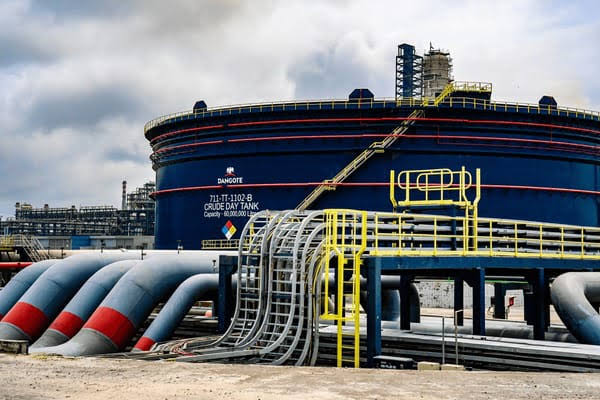
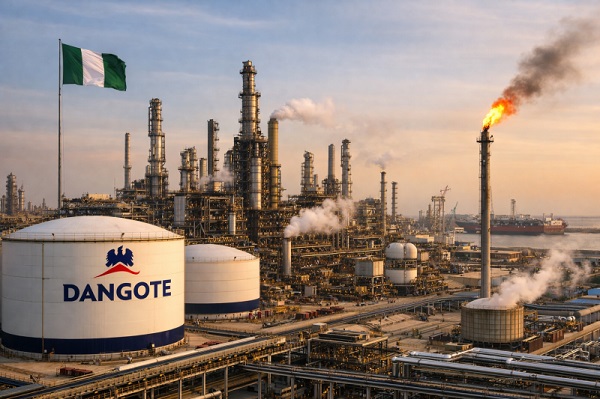
Marketers of petroleum products have stated that the loading of fuel has been put on hold at the Dangote Petroleum Refinery following the facility’s decision to sell fuel in dollars.

Many marketers told The PUNCH on Sunday that the facility was not even loading its trucks, sparking fear of possible fuel tightness across the country. But the refinery denied the claim, arguing that fuel loading was ongoing within the Lekki-based plant.

Petroleum marketers said they suspended large-scale fuel loading in the last few days as they await clarity on the new pricing template being adopted by the refinery. They also await the cost of newly imported petroleum products.

The development heightened uncertainty in the downstream petroleum sector, with marketers wary of buying large volumes of petrol at the prevailing prices only to see the cost of the product fall shortly after.

The National Publicity Secretary of the Independent Petroleum Marketers Association of Nigeria, Chinedu Ukadike, in a telephone interview on Sunday, said marketers were being forced to adopt a cautious approach because of the uncertainty surrounding the next price of petrol.

“The issue is simple; marketers are not buying because they are trying to look at the market dynamics. Whatever we are using today is existing products in tank farms, which we are buying around N1,250 and N1,300,” Ukadike said.

He said the uncertainty had been worsened by the expected arrival of new crude supplies and imported petrol, whose pricing templates remained unclear.

“The problem we are now facing is that this new crude oil that they are bringing- what will be the template? Also, those who have brought in petroleum products and are given licences are also estimated to place their price at N1,350, which marketers are also wary of,” he stated.

Ukadike said marketers were therefore reluctant to load large volumes because they could not predict whether the price of petrol would rise or fall after they had purchased the product.

“So everyone is just sceptical about loading products because when you load, you don’t know the next price, if it is going to reduce or go higher. You are still expected by consumers to sell at the prevailing price,” he said.

According to him, the uncertainty has not completely halted the distribution of petrol, but has significantly reduced the volume being loaded by marketers.

He urged the Federal Government to intervene and resolve the dispute over the pricing template, warning that continued uncertainty could further disrupt the downstream market. “The Federal Government has to look inward and resolve this issue once and for all. This template issue should be resolved immediately,” Ukadike said.

In a report by NAN, marketers in the South-West confirmed that the uncertainty over petrol prices has forced many to halt fresh purchases, leading to the temporary closure of some filling stations.

The Zonal Chairman of IPMAN, Western Zone, Oyewole Akanni, disclosed this in an interview with the News Agency of Nigeria on Sunday in Ibadan. Akanni said the situation was triggered by the suspension of loading of Premium Motor Spirit at the Dangote refinery about four days ago.

He said the development had forced marketers to source products from private depots at significantly higher prices. According to him, the cheapest ex-depot price at private depots in Lagos currently ranges between N1,200 and N1,220 per litre, excluding transportation costs.

He added that marketers who bought products on Friday paid between N1,210 and N1,220 per litre. “The non-availability of fuel at some filling stations and the closure of others are due to fluctuations in the price of lifting fuel from depots.

“Since the Dangote refinery stopped selling PMS about four days ago, private depot owners have increased their prices. Many filling stations that have exhausted their stock are waiting to see whether prices will come down when the Dangote refinery resumes sales or increase further. Only a few marketers are buying products for now because of the uncertainty,” he said.

See also  Tax reforms will modernise, boost economy – G24 chief

Akanni, however, maintained that there was no fuel scarcity, urging motorists and other consumers not to engage in panic buying. “There is no fuel scarcity. Members of the public should not panic. Although there is a possibility of an increase in the pump price if the current situation persists,” he said.

The zonal chairman said the Dangote refinery neither gave prior notice nor explained the reason for the suspension of PMS sales to marketers. Akanni said four truckloads of petrol meant for his filling stations had remained at the refinery since the suspension of loading.

“I was supposed to have received four truckloads of PMS four days ago, but that has not happened because the trucks are at the Dangote refinery, which has not been selling. The company is not even loading its own trucks. They are all parked there,” he said.

The IPMAN chief said the Nigerian National Petroleum Company Limited was also affected because it sourced products from the Dangote Refinery. According to him, private depots are now selling PMS for as much as N1,250 per litre, while marketers can obtain products from NIPCO and Aiteo at about N1,200 per litre.

“The major issue now is the fluctuation in depot prices, which has created uncertainty in the market,” Akanni said.

Official denies claim

However, a spokesman for the Dangote Group dismissed the report as “fake news”, accusing some marketers of spreading false information. The spokesman told one of our correspondents that the refinery had not stopped loading petroleum products.

“The refinery is loading. Anybody can go there to check. That’s fake news to say we are not loading,” the official, who pleaded not to have his name in print due to the sensitive nature of the matter, stated.

He noted that marketers importing petrol were finding it difficult to compete because prices in Lomé, Togo, had risen, making it increasingly difficult to match Dangote’s prices.

FG vs Dangote

The PUNCH reports that the Federal Government and the Dangote Petroleum Refinery have yet to reach an agreement on the issues that prompted the refinery to adopt a dollar-based pricing template, a development that could prolong uncertainty in the downstream petroleum sector and lead to a further increase in the price of Premium Motor Spirit, also known as petrol.

A senior government official involved in the ongoing discussions revealed on Sunday. The PUNCH gathered that the ongoing standoff is caused by the Dangote Petroleum Refinery grievance on the continued issuance of import licences to marketers and a row on the modalities of crude oil supply.

The official, who spoke on condition of anonymity because of the sensitivity of the negotiations, said the dispute had gone beyond the price of petrol, stressing that it was also linked to the volume of crude supplied to the refinery and the proportion of crude sold to it in naira.

According to the official, the refinery has been unhappy with the Federal Government over the continued issuance of import licences to some oil marketers despite its ability to refine large volumes of petrol for the domestic market.

The official said Dangote was also dissatisfied with the volume of crude supplied to the refinery by the Nigerian National Petroleum Company Limited, as well as the relatively small proportion of the crude purchased in naira.

“So the issue is that Dangote is unhappy about two things; one is that the government gave import permits. They issued import permits to some companies while his refinery is capable. So he was already angry on that level.

“Then number two is that the refinery is saying that it is not getting enough crude oil even from the Nigerian National Petroleum Company Limited. The percentage of naira for crude that they are giving to the facility is not a lot.

See also  Banks earn N225bn from ATM, e-banking charges

“Number one is that the facility is still not getting enough, according to him. And number two is that the portion they are selling to him in naira is still a little. So he still has to do most purchases in dollars. So the facility is saying that if the government cannot increase the crude they are giving to him in naira, the new dollar pricing template is what he will do. So those are the two issues.”

This movement has raised fresh concerns over the stability of petrol prices, with the refinery’s decision to price its products in dollars potentially exposing domestic fuel prices to movements in the foreign exchange market.

Already, this uncertainty over petrol prices has forced many marketers to halt fresh purchases, leading to the temporary closure of some filling stations, according to the Independent Petroleum Marketers Association of Nigeria.

The official said the Federal Government had continued to engage the refinery’s management in a bid to prevent the dispute from escalating. He, however, warned that the government could not allow any single player to hold the country to ransom by demanding restrictions on imports while the parties continued to disagree over crude supply and pricing.

“The government has been discussing this matter. He said he was going to do this (dollar sale of fuel). He said this two weeks ago. And the government was asking for patience. Let us keep engaging now. So now that the new dollar pricing template has been done, the government will still keep engaging,” the official said.

The official also argued that the Dangote refinery’s location within a free trade zone gave it considerable flexibility in determining how it conducted its commercial operations, including the currency in which it sold its products.

“Unfortunately, the facility is in a free trade zone, so the refinery is actually allowed to sell in any currency it wants to sell. The refinery is in a free trade zone. And there are so many taxes not paid,” he said.

“Yes, the refinery still pays, but there are a lot of taxes the refinery is excluded from, because it is in a free trade zone. Those are the benefits you get when you are in a free trade zone.”

FCCPC rejects dollar

However, the Federal Competition and Consumer Protection Commission has said the naira remains Nigeria’s only lawful currency for domestic commercial transactions, amid reports that the Dangote Petroleum Refinery is considering pricing petroleum products in US dollars.

The Director of Corporate Affairs, FCCPC, Ondaje Ijagwu, stated this in a response to enquiries on Sunday. On the reported proposal to price petroleum products in dollars, Ijagwu said, “The commission’s position is clear. The Nigerian naira is the legal tender in Nigeria and remains the lawful currency for domestic commercial transactions.”

On what would be the government’s next step if an agreement is not reached, the top official said, “If there is no agreement and he does not want to listen, the next step will be to allow more imports to come in. It is not possible to hold anybody to ransom

“Cement remains a good case study. The government banned cement importation. Has the cement price gone down? No. This is clear. So, why will he bring it down? He already controls the market. He’s not going to bring it down. So, that’s it.”

The official said Nigeria had imported petrol for decades and could continue to do so if necessary to guarantee adequate supply and prevent a monopoly in the downstream market. “This country has been importing petrol for over 35 years. The world did not stop,” he said.

The warning comes amid a legal challenge by three major oil marketers, Matrix Energy Group, AA Rano Nigeria and AYM Shafa Holdings, over the continued issuance and renewal of licences for the importation of petroleum products.

See also  Senate grills Edun, Adedeji over rising debt, budget assumptions

According to a report by African Intelligence, the companies are seeking an order of the Federal High Court in Abuja directing the Nigerian Midstream and Downstream Petroleum Regulatory Authority to continue granting, issuing, extending, renewing or re-issuing licences, permits and authorisations for midstream and downstream operations relating to petroleum product imports.

The marketers argued that they had invested billions of dollars in storage, logistics, and distribution infrastructure and had played a major role in supplying petroleum products to Nigerians for decades.

Their legal action has further complicated the Federal Government’s attempt to balance the protection of domestic refining.

The government official said the legal action was significant because the government could not simply prevent marketers from importing products if domestic supply was insufficient or if the courts ordered regulators to continue issuing the relevant licences.

“Already, some people have gone to court to try to stop the government from banning the importation of petrol. I hope you are aware. So, in case the government wants to bend to Dangote’s will, some marketers have gone to court to get a court order banning the government from stopping imports,” he said.

The official added that the government could not simply sell all crude to domestic refiners in naira without considering the foreign exchange implications.

“So this is the issue. What’s our main source of foreign exchange? It’s still crude. And where is it coming from? Royalty and crude sales. So NNPC is the one that is bringing in these things. So if they then sell everything in naira, where is the dollar going to come from to do other things?” he asked.

The official said the refinery had previously been receiving a significant portion of its crude supply in naira, although the government had to balance the arrangement against its own foreign exchange requirements.

“The last time it was checked, the refinery was getting at least 35 per cent to 40 per cent of its crude in naira of what was being sold to him. Because where will the country then get the dollar from if everything is sold in dollars?” he said.

The official said the Federal Government’s attempt to prevent the refinery from adopting a dollar-based pricing model had therefore not fully resolved the underlying dispute.

“At the end of the day, what the government was trying to avoid is still the same thing that has happened. He had been threatening before it was done, but engagement continues,” he said.

Speaking further, the FCCPC also expressed concern that the recent decline in international crude oil prices had not been reflected proportionately in the prices of petrol sold to consumers.

According to the FCCPC director, “The FCCPC remains concerned that recent declines in international crude oil prices have not been reflected proportionately in retail petrol prices. As the commission stated in its 28 June public statement, pump prices increased rapidly when crude oil prices rose, yet the subsequent decline in international crude oil prices has not translated into corresponding reductions for consumers.”

Ijagwu said the commission’s concerns had prompted the Federal Government to convene a stakeholders’ meeting involving regulators, refiners, marketers and other participants in the petroleum industry.

Ijagwu added, “The commission stands by this position and expects that, within a reasonable period, the benefits of lower international crude oil prices will be reflected in corresponding reductions in pump prices where market conditions justify such adjustments.

“The FCCPC will continue to monitor developments closely and will not hesitate to take appropriate enforcement action where there is credible evidence of anti-competitive conduct, consumer exploitation or any other contravention of the Federal Competition and Consumer Protection Act.”

punch.ng

FOLLOW US ON:

FACEBOOK

TWITTER

PINTEREST

TIKTOK

YOUTUBE

LINKEDIN

Continue Reading
Click to comment

Leave a Reply

Your email address will not be published. Required fields are marked *

Business

Oil cargoes meant for naira-for-crude deal supplied to Dangote – NNPC

Published

on

The Nigerian National Petroleum Company Limited has insisted that it supplied all available crude oil cargoes allocated under the Federal Government’s naira-for-crude initiative to the Dangote Petroleum Refinery, saying there had been no withholding on its part.

The national oil company stated this even as a top management official of the Dangote Group disclosed exclusively to The PUNCH that the refinery was receiving just four million barrels of crude oil monthly under the arrangement, instead of about 13 million barrels envisaged after President Bola Tinubu’s 2024 directive.

The refinery had attributed its decision to switch from naira-denominated fuel sales to dollar transactions to the crude supply shortfall, saying it would also increase exports of refined petroleum products to earn foreign exchange.

Responding on Monday, the NNPC, through its spokesman, Andy Odeh, said the company had fully discharged its obligations under the naira-for-crude policy. “As a 7.25 per cent equity shareholder in Dangote Petroleum Refinery and Petrochemicals, NNPC Limited has a direct and genuine interest in seeing the refinery operate at full capacity. That is not in dispute.

“What the figures being cited require is context. Under the naira-denominated crude supply arrangement, NNPC Limited has allocated 100 per cent of all available naira crude cargoes to DPRP in 2026 — there has been no withholding on our part. Actual off-take in any period is shaped by several variables: crude availability, nomination timelines, and the refinery’s own operational scheduling.

Odeh said the NNPC has met its obligations to the refinery, saying the two parties are resolving any existing gaps together. “NNPC Limited has met its 2026 supply obligations to the refinery. Our engagement with DPRP management remains constructive, and where any gaps exist, we are resolving them together — as the partners we are.

“A fully supplied, fully operational Dangote refinery serving the Nigerian market is an obligation NNPC Limited shares without reservation,” he added.

However, the Dangote Group maintained that the crude volumes supplied under the arrangement were inadequate to sustain naira-denominated fuel sales.

A top management official of the Dangote Group had told The PUNCH that crude supply under the naira-for-crude arrangement had been limited to just four million barrels monthly despite the increase in Nigeria’s crude oil production.

See also  Alleged terror financing: Malami faces long detention as DSS intensifies investigation

The official, who pleaded anonymity because of the sensitivity of the matter, said the refinery was now set to export a larger percentage of its products in exchange for foreign exchange.

“Since the traders have brought lots of imported products to the market, we are focusing on exports. We can’t, and we shouldn’t be fighting against the government’s policies,” the source said.

Our correspondent told the official that exporting without adequately supplying the domestic market would not be good for the country, but he responded with a question: “Is issuing massive import licences and releasing forex for imports good for the country, when 45 per cent of our production can meet 100 per cent of the entire country’s requirements in terms of petrol, diesel and aviation fuel?”

When told that the NNPC said it had increased crude supply to the Dangote refinery, the official replied, “Do you think that they will keep quiet if we process the naira crude and export the products? We are getting just four million barrels monthly.”

With the sale of petrol in dollars to local marketers, the Dangote official disclosed that the refinery would now process whatever crude it receives under the naira arrangement and supply the equivalent refined products in naira to the Nigerian market through the NNPC.

“We will account for every barrel of crude we receive against the naira payment by supplying equivalent products in naira. We will do that through the NNPC. The NNPC buys a lot from us,” he said.

The refinery had maintained that the inability to secure the expected crude volumes under the naira-for-crude initiative compelled it to abandon naira-denominated fuel sales and adopt dollar pricing for petroleum products.

Last week, the refinery announced a new dollar-denominated pricing template, fixing the ex-depot price of petrol at $0.779 per litre, diesel at $1.087 per litre and aviation fuel at $0.942 per litre.

The move has drawn criticism from petroleum marketers, who warned that it could increase pressure on fuel prices, although the Nigerian Midstream and Downstream Petroleum Regulatory Authority said the decision was consistent with the provisions of the Petroleum Industry Act, which allows refiners to recover their costs.

Supply worsens

Meanwhile, petrol supply in the Federal Capital Territory, Abuja, worsened on Monday with the closure of some major filling stations in Abuja and a fresh increase in the pump price of petrol.

See also  Senate grills Edun, Adedeji over rising debt, budget assumptions

Checks by one of our correspondents showed that some stations operated by NNPC Limited and MRS along the Airport Road Expressway were shut when visited on Monday.

At stations that were dispensing the product, petrol was being sold at between N1,250 and N1,280 per litre. Bovas sold petrol at N1,250 per litre, while Azman Filling Station at 6th Avenue dispensed the product at N1,280 per litre. Salbas also sold petrol at N1,280 per litre.

The development has further heightened concerns among motorists and other consumers over the rising cost and availability of petrol in the nation’s capital. For motorists in Abuja, Monday’s development meant longer searches for petrol, closed stations and prices as high as N1,280 per litre at outlets that had the product available.

Meanwhile, truck traffic has surged across major private petroleum depots in Lagos as marketers scramble for petrol supplies following the fifth consecutive day of suspended loading at Dangote Petroleum Refinery amid growing expectations that wholesale prices could rise when operations resume.

Expert reacts

Meanwhile, Professor Emeritus of Petroleum Economics and Principal Facilitator at the FUPRE Energy Business School, Wumi Iledare, said the Dangote refinery’s decision to sell petrol in dollars should be viewed within the broader context of petroleum economics and Nigeria’s energy security rather than merely the currency in which products are priced.

According to Iledare, the move is a commercial response to the realities of the global oil market, where crude oil, the refinery’s major feedstock, is traded in United States dollars.

Iledare explained that pricing refined products in dollars enables the refinery to reduce its exposure to exchange rate volatility and provides greater revenue certainty, although it shifts part of the foreign exchange risk to fuel marketers and, ultimately, consumers, where the costs are passed on.

He stressed that the refinery’s dollar pricing would not automatically translate to higher fuel prices, noting that domestic petrol prices would instead become more closely tied to movements in international crude oil prices and the naira-dollar exchange rate.

“Does this necessarily mean higher fuel prices? Not necessarily. What it does mean is that domestic fuel prices become more closely linked to two key variables: international crude oil prices and the naira-dollar exchange rate. If crude prices rise or the naira weakens, pump prices are likely to increase. Conversely, if crude prices decline or the naira strengthens, consumers should also expect prices to adjust downward. That is how a market-oriented pricing system is expected to function,” he said.

See also  Dangote exports 1.66bn litres fuel amid US-Iran tensions

The petroleum expert maintained that despite concerns over dollar-denominated pricing, the Dangote refinery had strengthened Nigeria’s energy security by reducing dependence on imported petrol and improving the availability of petroleum products.

He, however, noted that domestic refining alone could not guarantee affordability, saying fuel prices would continue to depend on exchange rate stability, international crude prices, logistics costs and the level of competition in the downstream sector.

“The refinery has significantly improved the availability of petroleum products by reducing Nigeria’s dependence on imported PMS. That alone makes the country less vulnerable to disruptions in international supply chains and enhances supply reliability.

“This is why I would say that Dangote Refinery can shield Nigeria more effectively from supply shocks than from price shocks. Domestic refining improves energy security, but it cannot completely insulate Nigeria from global petroleum market dynamics because crude oil still has an international opportunity cost, whether it is refined in Lagos, Rotterdam, or Houston,” he stated.

On the implications for the naira, Iledare argued that pricing petroleum products in dollars would not automatically weaken the local currency. “As for the impact on the naira, the answer is more nuanced than many assume. Dollar pricing by itself does not automatically weaken the naira. What matters is whether the arrangement increases or reduces Nigeria’s net demand for foreign exchange,” he said.

He urged policymakers to focus less on the currency in which petroleum products are priced and more on building an efficient and competitive downstream market.

“The real issue is therefore not the currency of pricing. The real issue is whether Nigeria’s downstream petroleum market satisfies the four tests of good public policy: efficiency, effectiveness, equity, and ethics. Those are the standards by which this development should be judged,” he added.

punch.ng

FOLLOW US ON:

FACEBOOK

TWITTER

PINTEREST

TIKTOK

YOUTUBE

LINKEDIN

Continue Reading

Business

143 firms battle for 50 oil blocks today; read details

Published

on

The Nigerian Upstream Petroleum Regulatory Commission will open the decisive commercial phase of the 2025 oil and gas licensing round on Tuesday (today), with 143 companies set to compete for 50 blocks across Nigeria’s major and emerging hydrocarbon basins.

The commercial bid conference, by invitation only, is scheduled to take place in Abuja. The development marks the latest stage in a licensing process that began in November 2025 and has attracted significant interest from companies seeking access to Nigeria’s upstream petroleum assets.

In a statement issued on Monday, the Head of Media and Corporate Communications at the NUPRC, Eniola Akinkuotu, said companies that successfully scaled the prequalification process had been notified and invited to physically attend the commercial bid conference.

According to the commission, the 50 blocks on offer cover a wide range of geological terrains and include 16 blocks in the Niger Delta Onshore, 18 in the Niger Delta Shallow Water and one in the Niger Delta Deep Offshore.

The assets also include three blocks in the Benin Basin Onshore, four in the Anambra Basin Onshore, four in the Chad Basin Onshore and four in the Benue Trough.

The statement read, “The Nigerian Upstream Petroleum Regulatory Commission has invited qualified companies to the highly anticipated Commercial Bid Conference slated for July 21, 2026.

“These companies, which scaled through the transparent and rigorous process, have been notified and are expected to physically attend the Commercial Bid Conference taking place at the Conference Centre, Transcorp Hilton Hotel, Abuja. Attendance is strictly by invitation.

See also  Apple to invest additional $100 bn in US – White House official

“On offer are 50 oil and gas blocks across diverse terrains: Niger Delta Onshore (16), Niger Delta Shallow Water (18), Niger Delta Deep Offshore (1), Benin Basin Onshore (3), Anambra Basin Onshore (4), Chad Basin Onshore (4) and Benue Trough (4).

“In line with the guidelines, the elements of the bid parameters include the signature bonus, the work programme commitment and commitment to performance security, culminating in a weighted technical and commercial score that will determine the winning bid.”

The spread of the blocks reflects the Federal Government’s effort to attract investment beyond the traditional Niger Delta producing areas and stimulate exploration in frontier basins with significant hydrocarbon potential.

The commercial bids will be assessed using key parameters, including signature bonus, work programme commitments and commitment to performance security. The parameters will be combined into a weighted technical and commercial score that will determine the successful bidders.

The commission said the companies invited to the conference had emerged from a transparent and rigorous prequalification process. The 2025 Licensing Round was first announced on November 11, 2025, in line with the provisions of the Petroleum Industry Act, 2021.

The bid portal was subsequently launched on December 1, 2025, to enable interested companies to register and participate in the process. A pre-bid conference was held on January 14, 2026, at Eko Hotels and Suites, Lagos, to explain the guidelines and procedures to registered bidders and other interested stakeholders.

The registration and submission of documents for prequalification closed on February 27, 2026, while the prequalification stage was completed on March 16, 2026.

See also  Court defers Nnamdi Kanu’s transfer appeal, rejects brother’s representation

A total of 286 companies submitted applications for prequalification. Following the evaluation process, 196 companies were prequalified to proceed to the technical and commercial bidding phase.

The commission said 143 of the prequalified companies subsequently submitted a total of 200 bids for the available assets. These 143 companies are now expected to participate in the commercial bid conference on Tuesday.

The number of bids submitted indicates that some companies are competing for more than one block, further underscoring the level of interest generated by the licensing round.

The commercial bid conference is expected to provide the commission with an opportunity to formally evaluate and compare the financial and operational commitments of the qualified bidders.

The process is also expected to test the seriousness of investors by placing emphasis not only on the amount offered as signature bonus but also on the work programmes and financial guarantees required to develop the assets.

The 2025 bid round is taking place against the backdrop of the Federal Government’s efforts to increase crude oil and gas production, attract fresh investment into the upstream sector and unlock previously underdeveloped petroleum assets.

Nigeria has struggled for years to attract sufficient investment into exploration and production due to concerns over regulatory uncertainty, insecurity, ageing infrastructure, project delays and the high cost of operating in the upstream sector.

The NUPRC has, however, said recent reforms under the Petroleum Industry Act and improvements in the regulatory environment are aimed at creating a more predictable framework for investors.

The licensing round also comes as the commission seeks to increase production to support government revenue, strengthen energy security and provide the feedstock required by Nigeria’s expanding domestic refining industry.

See also  Senate grills Edun, Adedeji over rising debt, budget assumptions

The successful conclusion of the commercial bidding phase will therefore be closely watched by investors and industry stakeholders as a key test of the country’s ability to convert its petroleum resources into new exploration activity, production and economic value.

The commission’s invitation to 143 companies for the commercial bid conference represents the latest milestone in a process that began with 286 applications and has now narrowed the competition to the companies that submitted 200 bids for the 50 blocks on offer.

Following the commercial bid conference and the completion of the subsequent stages of the process, successful bidders are expected to emerge in line with the applicable rules and evaluation criteria for the 2025 Licensing Round.

punch.ng

FOLLOW US ON:

FACEBOOK

TWITTER

PINTEREST

TIKTOK

YOUTUBE

LINKEDIN

Continue Reading

Business

Reps member faces petition over alleged N19m travel debt

Published

on

A member of the House of Representatives representing Obudu/Bekwarra/Obanliku Federal Constituency of Cross River State, Peter Akpanke, has been petitioned over an alleged unpaid travel debt of more than N19.15m arising from the procurement and reissuance of international and local airline tickets.

The petition, addressed to the Independent Corrupt Practices and Other Related Offences Commission and obtained by our correspondent, was written by Ohanele Udokanmma, solicitor to Johnson Ugochukwu of Havilah Global Travels Limited, who accused the lawmaker of failing to settle outstanding payments despite repeated demands.

According to the petition, Akpanke engaged the travel agency on January 16, 2026, to procure three Business Class airline tickets to Rome for himself and two associates at a total cost of N24.48m.

The solicitor stated that the tickets were purchased with the agency’s funds at the request of the lawmaker. The petition further alleged that while in Rome on January 24, 2026, Akpanke requested the reissuance of the tickets for two of his companions at an additional cost of N5.79m.

It added that he subsequently requested the reissuance of another passenger’s ticket at a further cost of N1.52m. According to the petitioner, the total value of the international tickets rose to N31m.

The solicitor, however, acknowledged that the lawmaker made part payments, stating that he paid N10m before embarking on the trip and another N4m upon his return from Rome, bringing the total amount paid to N14m.

The petition stated, “The total amount our client received so far from Hon. Peter Akpanke was N14,000,000 with a balance of N17,794,468 from N31,000,000.”

See also  Dangote exports 1.66bn litres fuel amid US-Iran tensions

It also alleged that the travel agency later procured an additional local airline ticket for the lawmaker valued at N1.36m, which also remains unpaid. Cumulatively, comprising the outstanding international ticket balance and the local ticket, the petitioner claimed that Akpanke is indebted to the agency in the sum of N19,154,468.

The petition further alleged that all efforts to recover the debt had failed. The solicitor wrote, “Owing to the above facts, Hon. Peter Akpanke is now indebted to our client in the sum of N19,154,468.

“Our client has made repeated demands for the payment of these sums of money due to him as debt from Hon. Peter Akpanke, which he has refused, failed and neglected to pay, with the sole aim of not paying our client his money.”

The solicitor urged the authorities to investigate the matter, saying, “We hereby indulge you to please use your good office to investigate the matter such that justice should be done.”

When contacted, Akpanke denied owing Havilah Travels the N19.15m claimed in the petition, insisting that while he had an outstanding balance with the travel agency, the figure being circulated was false.

Speaking on the possible motive behind the petition, the lawmaker said, “If it is not politically motivated, if he has petitioned me to an anti-graft agency, why is he getting across to journalists again today?”

He added, “Number one, it’s a lie. I’m not owing Havilah Travels N19m. I’m having some balances to pay them, but it’s not up to N19m.”

See also  Nigeria exits global money-laundering watchlist

Akpanke argued that having an outstanding business obligation was not a criminal offence, stressing that commercial debts should not automatically be portrayed as wrongdoing.

“To owe somebody is not a crime, my brother. That’s business. If we did business and maybe I’m owing him, a lot of people are owing me too. I’m not saying I’m not owing him. He has petitioned me to an anti-graft agency. Why not allow them do their work now? Why are you engaging journalists again?” he said.

Rejecting suggestions that he had used his political position to avoid payment, the federal lawmaker maintained that he had enjoyed a longstanding business relationship with the travel agency.

“What has political power got to do with buying tickets? Is that the first time he is buying tickets for me? He has bought tickets for me worth over N100m. Maybe I stayed owing him for some time and it made him petition me. That man had no business doing that,” Akpanke said.

He further defended the practice of purchasing airline tickets on credit, saying, “Which law says you cannot buy tickets on credit? I don’t like blackmailing people because tomorrow is pregnant.”

While admitting that he had transacted with Havilah Travels, Akpanke insisted he had been making payments and could provide proof.

“I will not tell you that I didn’t do business with Havilah Travels. I did. And I’m not owing them N19 million. I’ve been paying. I can show you evidence of the last payment I made to him. So what is all that rubbish now? The person who introduced us together has even told him, ‘Don’t worry, I will bear the liabilities.’ So why is he going to journalists?” he said.

See also  Court defers Nnamdi Kanu’s transfer appeal, rejects brother’s representation

He warned that he could also publicise his experience with the agency, adding, “I can equally blackmail them and let Nigerians know that when you do business with them, once you owe them, they begin to petition you to the EFCC and all those places. Has it ever stopped me from paying? I know that I have an obligation to pay him.”

punch.ng

FOLLOW US ON:

FACEBOOK

TWITTER

PINTEREST

TIKTOK

YOUTUBE

LINKEDIN

Continue Reading

Trending