Connect with us

News

Imo Speaker pledges support for women’s reserved seats bill

Published

on

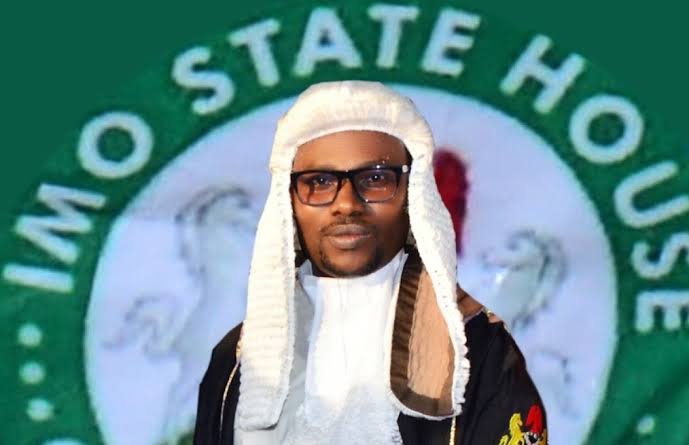
The Speaker of the Imo State House of Assembly, Chike Olemgbe, has assured stakeholders that the House will give favourable consideration to a bill seeking to reserve three additional seats for women in the state legislature.

Olemgbe gave the assurance on Monday when the Imo State chapter of the League of Women Voters of Nigeria paid an advocacy visit to members of the Assembly, urging support for the proposed legislation.

He told the delegation that if the bill is presented before the 10th Assembly during its tenure, it would receive positive legislative attention, stressing the need to support women to contribute their quota to the development of the state.

The Speaker also recalled that Governor Hope Uzodimma had supported the emergence of four female candidates of the All Progressives Congress, who may join the Assembly in the 11th House.

Speaking during the group’s one-day state-level electoral college meeting with lawmakers, a former member of the Assembly, Uju Onwudiwe, said there was a need to reserve three seats for women, with one drawn from each of Imo State’s three senatorial districts.

She said the campaign was not intended to displace men from elective offices.

“We cannot achieve anything as women without the support of the men. The women need a space to discuss on issues concerning them”.

According to Onwudiwe, “This bill which is the first in the constitution amendment town hall meeting is aimed at promoting participation of women in the political decision making in the state. The bill talks about all-inclusiveness”.

She explained that the proposal seeks to create three additional seats in the House of Assembly, increasing the number of lawmakers from 27 to 30.

See also  Reps query defence spending, summon NSA, ministers on Insecurity

“The special seats offers three extra seats for the House of Assembly, so that instead of having 27 lawmakers, Imo Assembly will now have 30 member-house. It will go through a electoral college model that brings stakeholders together for decision-making”.

She urged the Imo State House of Assembly to give the bill favourable consideration when it is listed on the Order Paper.

Also speaking, Mrs Ogechi Ikeh, who represented the National President of NILOWV, Mrs Irene Awunah-Ikyegh, urged the Speaker and members of the House to support the proposed legislation to enable women to participate more actively in decision-making.

“There’s need to bring women with capacity, integrity and competence into the corridors of power for contributions on matters that concern them and to bring a balance to national growth.

“It will be recalled that the Reserved Seats for Women Bill (House Bill 1349) is a proposed constitutional amendment in Nigeria designed to address the severe underrepresentation of women in legislative bodies by creating additional, exclusive seats for female candidates”.

punch.ng

FOLLOW US ON:

FACEBOOK

TWITTER

PINTEREST

TIKTOK

YOUTUBE

LINKEDIN

Continue Reading
Click to comment

Leave a Reply

Your email address will not be published. Required fields are marked *

News

Gbajabiamila reveals 24 state assemblies approve state police amendment

Published

on

The proposed constitutional amendment to establish a dual policing system in Nigeria has secured approval from 24 State Houses of Assembly, meeting the two-thirds threshold required for constitutional alteration.

The Chief of Staff to the President and Chairman of the Presidential Working Group on the National Policing Bill, Femi Gbajabiamila, disclosed this in a statement on Friday, October 23, 2026.

The statement said the approval of 24 of the 36 state assemblies met the constitutional requirement for the Constitution (Sixth Alteration) Bill, 2026, which provides for a dual policing system.

The Working Group commended the state assemblies for their action and the National Assembly for passing the amendment in both chambers.

“In line with Section 9 of the Constitution, the amendment can now be returned to the National Assembly for transmission to Mr President for assent,” the statement read.

The proposed amendment is expected to provide constitutional backing for the policing framework contained in the draft National Policing Bill, 2026, prepared by the Presidential Working Group.

October 30 timeline

The group said the draft bills were undergoing legislative drafting review and validation at the Federal Ministry of Justice and were expected to be returned on or before Friday, October 30, 2026.

It added that the group would give the bills final consideration before presenting them to President Bola Tinubu.

The Working Group urged stakeholders to support what it described as a smooth transition to a dual policing system aimed at making Nigerians safer.

PUNCH had reported in September that the National Assembly transmitted the Constitution (Sixth Alteration) Bill, 2026, to the 36 state Houses of Assembly on September 16 for consideration and approval, giving them an expected administrative timeframe of 30 days to communicate their decisions.

See also  Big money, small impact: Governors face fire over N9tn FAAC windfall

The proposed amendment seeks to establish a dual policing system comprising the Federal Police Service and state police services.

On October 9, the Senate was confident the amendment would secure the required backing, with Senate Committee on Media and Public Affairs Chairman Yemi Adaramodu saying at the time that four states — Edo, Oyo, Osun and Rivers — had approved the bill.

However, in a report published on October 16, PUNCH said five state assemblies — Edo, Osun, Oyo, Rivers and Zamfara — had approved the amendment, while the remaining 31 were yet to do so.

Meanwhile, PUNCH reported on October 15 that the Chief of Staff to the President, Femi Gbajabiamila, had said the draft National Policing Bill was 90 per cent ready for transmission to the National Assembly after further deliberations by the Presidential Working Group.

On October 21, PUNCH reported that five additional state assemblies — Ogun, Delta, Plateau, Kwara and Adamawa — had approved the amendment, bringing the number of approving states to 10.

Continue Reading

News

One dies, three injured in Lagos building collapse

Published

on

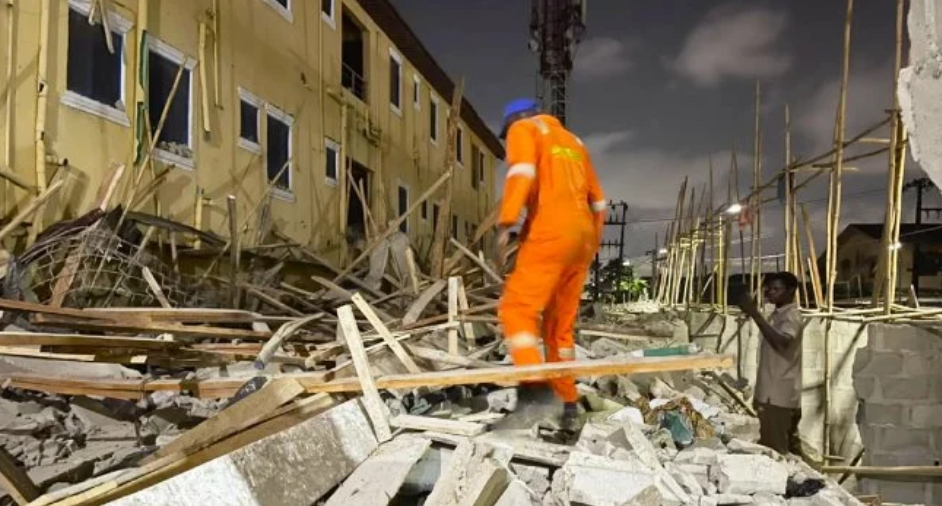
One person has died while three others sustained injuries following the collapse of a building in the Fadeyi area of Lagos State.

The building collapsed on Akinola Street, off Ikorodu Road, on Friday morning.

Lagos building collapse
An emergency responder carries out a search-and-rescue operation at the scene of a building collapse in Lagos State on October 23, 2026. Photo: Channels TV

The Lagos State Emergency Management Agency said the cause of the incident was yet to be established, while rescue teams were working to determine how many site workers remained trapped beneath the rubble, Channels TV reports.

The agency said, “Emergency responders had launched a coordinated search-and-rescue operation to locate and evacuate any victims trapped under the collapsed structure.”

Lagos building collapse
An emergency responder carries out a search-and-rescue operation at the scene of a building collapse in Lagos State on October 23, 2026. Photo: Channels TV

LASEMA added that it was coordinating the response at the scene alongside other agencies and emergency personnel, including LRU paramedics, the Lagos State Fire Service, LASASA and the Alakara Division of the Nigeria Police Force.

Details later…

See also  Former Minister Prof. Joy Ogwu dies at 79
Continue Reading

News

Umahi says South-East will vote differently in 2027 over Tinubu’s projects

Published

on

The Minister of Works, David Umahi, has described the South-East’s overwhelming support for Peter Obi in the 2023 presidential election as an “accident of history”, attributing the voting pattern to anger over the region’s alleged marginalisation under the previous administration.

Umahi said the region’s political outlook had changed under President Bola Tinubu, citing federal infrastructure projects and appointments as reasons he believed voters would respond differently in the 2027 election.

Speaking in an interview with ARISE News published on Friday, the minister said the South-East had reasons to feel aggrieved before Tinubu assumed office.

“In 2023, it was an accident of history,” Umahi continued, “It was a demonstration of the anger of the people of South East on how they were treated.”

He added, “We’ve been marginalised in the past, but it’s no longer so.”

Umahi argued that Tinubu had changed the situation through what he described as increased federal infrastructure investments and appointments for the region.

“If in 2023 they demonstrated their anger, in 2027 they are going to demonstrate their joy on how the President has treated them,” he said.

The former Ebonyi State governor maintained that the South-East would acknowledge Tinubu’s commitment to the region, particularly through major federal road projects and other investments.

He also said serving and former governors, traditional rulers and other influential figures in the South-East were increasingly aligning with Tinubu.

Umahi argued that voters would be reluctant to abandon what he described as infrastructure gains for another political “gamble”.

See also  Big money, small impact: Governors face fire over N9tn FAAC windfall

The minister rejected suggestions that South-East leaders supporting Tinubu were betraying the region or Obi, arguing that the region’s political interests should not be permanently tied to one candidate.

He also criticised social media supporters who insult South-East political leaders for backing Tinubu, saying such attacks would not advance Obi’s political interests or those of the region.

Umahi maintained that the South-East needed to engage and negotiate with other parts of Nigeria if it hoped to produce a president in the future.

Asked whether he believed Tinubu would defeat Obi in the South-East in 2027, Umahi responded, “Why do you say I believe? That is what is going to happen!”

The minister insisted that the circumstances that shaped the region’s voting pattern in 2023 had fundamentally changed.

Continue Reading

Trending