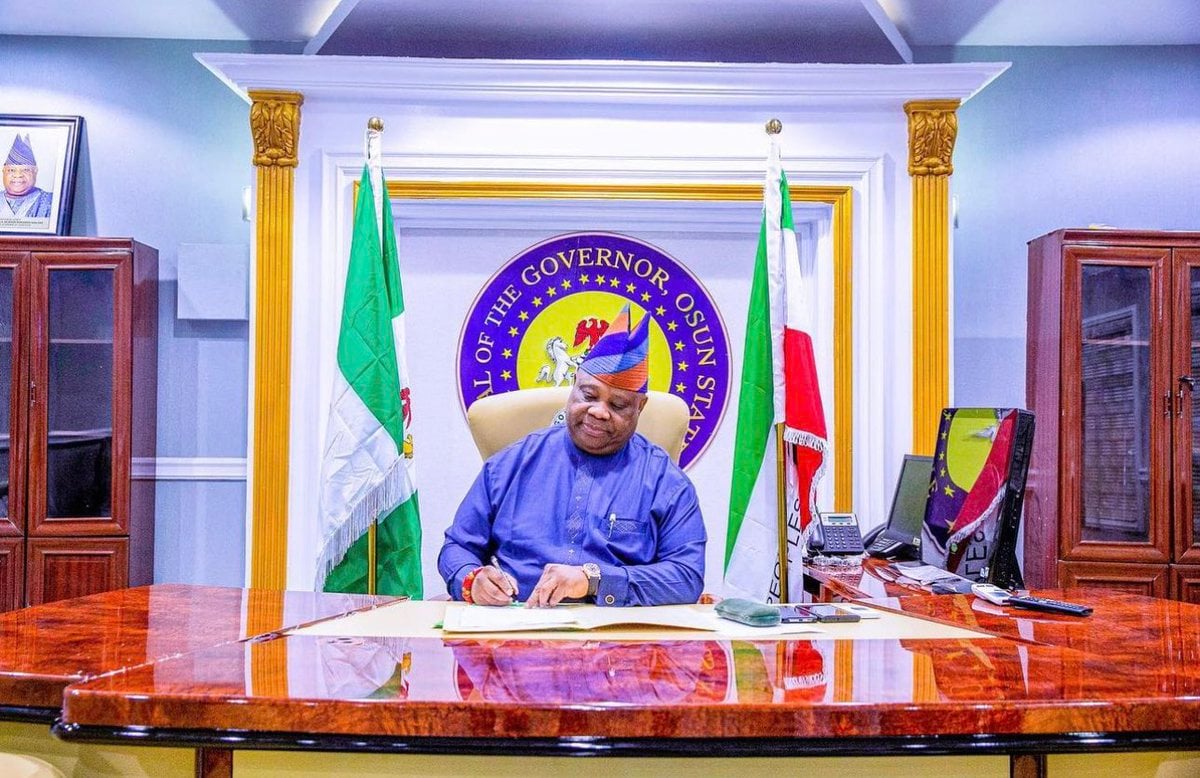
The Nigerian Bar Association has faulted the Economic and Financial Crimes Commission over the reported freezing of Osun State Government bank account, saying the anti-graft agency lacks the constitutional power to impose a blanket restriction on a state’s finances without due legal process.
The EFCC on Wednesday directed that no money be withdrawn from the Osun State Government’s statutory allocation account as part of an ongoing investigation.
A letter dated August 5, 2026, and signed by the Assistant Commander of the EFCC, Adenike Babalola, for the Director of Investigation, instructed the bank to place a post-no-debit restriction on the account pending the conclusion of the probe.
The letter, referenced 3000/EFCC/ABJ/HQ/PFS/TA/OSUN/VOL.17/666, was addressed to the Managing Director of First Bank, with attention to the Chief Compliance Officer.
It identified the affected account as “Osun State Government Statutory Allocation” with account number 2017170947.
The EFCC in a statement on Wednesday night said the action followed suspicious movement of funds amid an ongoing investigation into alleged fraudulent handling of about N11billion in Ecology Funds, Intervention Funds and Federal Account Allocation Committee allocations.
In a statement on Wednesday signed by its Head of Media and Publicity, Dele Oyewale, the anti-graft agency said it was “compelled to publicly address issues pertaining to its preventive moves in freezing the bank account of the Osun State government, without prejudice to the imminent governorship election in the state.”
The commission said it had been investigating the state government since March 2026 over the alleged mismanagement of the funds, disclosing that some officials, particularly the state’s Accountant-General, had been interviewed by its investigators.
According to the statement, the decision to place a Post No Debit order on the account was triggered by unusual fund movements detected from August 2, 2026.
“These ongoing investigations of the state government would not have warranted any placement of Post No Debit order on its account but for the precipitate and unwarranted movement of funds from the accounts to different suspicious accounts since August 2, 2026.
“The Commission noticed huge transfers of funds into different corporate entities and had to swiftly halt the trend by freezing the accounts from which such heavy funds are being moved,”it said.
The EFCC insisted its action was not politically motivated despite the timing ahead of the Osun governorship election, stressing that it could not overlook financial infractions on account of the poll.
“While the commission is fully aware of the impending governorship election in Osun State, it has a responsibility to act in defence of the sanctity of the funds of the state. It will be uncharitable for the Commission to allow an excuse of an upcoming election to fold its arms to perform its legally-assigned functions.”
The commission further disclosed that Osun was not the only state under its watch, noting that several other states remained under investigation.
“The commission has always pointed out that it is non-partisan and non-sectarian but always working in the overall interests of Nigerians,” it said.
It urged the public to disregard claims that the action was politically motivated, stating, “The public is enjoined to ignore false narratives and deliberate demonization of the works of the EFCC. The interests of all Nigerians are greater and will always be protected by the commission.”
NBA kick
However, NBA president, Afam Osigwe (SAN), in an interview with The PUNCH on Wednesday, warned that any directive restricting withdrawals from accounts belonging to a state government would effectively cripple governance and amount to an abuse of power.
His comments followed the EFCC’s directive to First Bank to place a post-no-debit restriction on Osun State’s statutory allocation account as part of an ongoing investigation, a move that has generated legal and political controversy ahead of the August 15 governorship election in the state.
Osigwe acknowledged that the EFCC could seek court orders against specific accounts suspected to be linked to fraud but insisted that the commission could not lawfully freeze all accounts belonging to a state government.
He said, “No government agency or any person has the right or the power to restrict withdrawals from the account of any state because, first of all, the order has the effect of grounding the activities of a government. If the EFCC knows that any particular account is being used for the purpose of fraud, it may be able to obtain a court order, but it cannot make a blanket order freezing the accounts of any state.”
The senior advocate added, “Such an order would be unconstitutional and also violate the powers of the EFCC and may actually amount to an abuse of power. We should not have such a situation.”
He maintained that any decision to freeze the account of an individual or government institution must be supported by sufficient legal grounds and a valid court order.
According to him, “If there is a need to freeze the account of a person or government, there is a need to provide a proper basis for it and get a proper order.”
Although he said he was unaware whether the EFCC had indeed issued such a directive, Osigwe advised banks not to comply with any instruction seeking to halt transactions across all state government accounts.
He stated, “I don’t think it would be proper if indeed the EFCC made such an order. I’m not aware of it, but if they made such an order, I would advise that no bank should obey such an order.”
He further urged the anti-graft agency to avoid actions capable of creating the impression that it intended to financially cripple a state government.
Similarly, a Senior Advocate of Nigeria, Adeyinka Olumide-Fusika, questioned the legality of the alleged no-debit restriction, and also insisted that the EFCC must first obtain a court order before freezing any account.
He said Nigerian courts had consistently ruled that anti-graft agencies could not freeze accounts without judicial authorisation.
“There is a no-debit order on Osun State’s account. My question is: Does the EFCC have the power to do that? I don’t think they got any order from the court,” he said.
Olumide-Fusika noted that while the EFCC regularly imposed restrictions on individual accounts, the alleged action against a state government had attracted wider public attention because of its constitutional implications.
He said, “The courts have been consistent on that: don’t do it without a court order. Anybody can go to court to seek an order, but the decision belongs to the court.”
The senior lawyer, however, linked the controversy to the forthcoming Osun governorship election, arguing that concerns over the possible use of public funds for electioneering could have informed the alleged restriction.
He nonetheless maintained that any preventive action must comply with the law.
Also weighing in, Isiaka Olagunju (SAN) described the freezing of the bank account as a serious violation of the 1999 Constitution and contrary to the principles of federalism.
He said, “The EFCC’s action is a serious infraction of the Constitution of the Federal Republic of Nigeria, 1999, as amended. If at all there is an allegation of embezzlement against any official of a state, the EFCC needs to be specific instead of obtaining a blanket order freezing the funds of the state.”
According to him, restricting access to state funds could adversely affect governance and undermine the government’s ability to discharge its constitutional responsibilities.
However, Professor Damilola Olawuyi (SAN) defended the use of account freezing as a recognised preventive tool in tackling economic and financial crimes, provided it is exercised within the limits of the law.
He said, “The EFCC has inherent statutory powers to take anticipatory measures to prevent and eradicate the commission of economic and financial crimes.”
Olawuyi explained that temporary restrictions on accounts had become an internationally recognised mechanism for disrupting illicit financial flows, money laundering and terrorist financing.
He, however, cautioned that such powers “should not be used as a cudgel to settle political scores, neither should they be used as a substitute for proper investigations or a tool to block legitimate transactions.”
Another Senior Advocate of Nigeria, Wolemi Esan, said the EFCC could place a temporary stop order on a suspected account for up to 72 hours without first obtaining a court order under Section 7(6) of the Money Laundering (Prevention and Prohibition) Act.
He explained that any restriction beyond the statutory period must be backed by judicial authorisation.
“If the directive was intended to operate as a stop order for a period not exceeding 72 hours under Section 7(6) of the Money Laundering Act, a prior court order was not required. However, if the EFCC intended the restriction to continue beyond the statutory 72-hour period, it ought to obtain an interim freezing order under Section 34 of the EFCC Act,” Esan said.
Also commenting, Chief Mike Ahamba (SAN) said he was unaware of any legal provision empowering the Federal Government or the EFCC to freeze a state’s account.
“I don’t think there’s such an authority. I don’t know on what grounds they did it. Let us go to court and see what the court says. If they don’t have that power, then people will naturally describe it as harassment,” he said.
CSOs kick
Executive Director of the Civil Society Legislative Advocacy Centre, Auwal Musa Rafsanjani, urged the Osun State Government to seek judicial redress if it believed the restriction was unlawful.
He said, “If the state government has any valid reason, it can use legal means to seek the reopening of its account.”
The Chairman of the Centre for Anti-Corruption and Open Leadership, Debo Adeniran, said the EFCC would be justified if it had reasonable suspicion that public funds were being misapplied, but stressed that the commission must demonstrate that its action was evidence-driven rather than politically motivated.
“If it is merely for political considerations, then it will not be justifiable. The commission doesn’t have the right to stop government activities just because of politics,”Adeniran said.
A civil society organisation, Peering Advocacy and Advancement Center in Africa, said it may be irresponsible for an anti graft agency like the Economic and Financial Crimes Commission to freeze Osun government’s accounts without valid reason.
The Executive Director of the Centre, Ezenwa Nwagwu, disclosed this on Wednesday while speaking with The PUNCH on the alleged restriction of Osun State Government’s accounts by EFCC.
Nwagwu, who also said fact regarding the matter was not immediately available to him, added that there must be some conditions that necessitated the restriction.
“In this period of political campaigns and tantrums, it is important that we don’t allow politicians to give us talking points. What may be necessary will be for the media and for interested parties to give the public the true picture of the events, not from the side of the politicians. I cannot really imagine that the EFCC will, because of political purposes, go and freeze state government accounts.
“It doesn’t look plausible to me. I do not have the facts from the EFCC. There must be some conditions that necessitated that action.
The fact that an election is coming does not mean that the EFCC will not do its work. I think (Ola) Olukayode, the boss of EFCC, will be completely irresponsible to get involved in politics or align an institution like the EFCC to serve the interests of anybody. That does not look possible to me.”
Opposition knocks EFCC
Meanwhile, opposition parties, including the African Democratic Congress, Labour Party, Nigeria Democratic Congress, Social Democratic Party and the Young Progressives Party, condemned the reported freezing of the Osun State account, accusing the Federal Government of using federal institutions to gain political advantage ahead of the August 15 governorship election.
The ruling All Progressives Congress, however, backed the EFCC’s action, insisting that anti-corruption agencies should be allowed to carry out lawful investigations without political interference.
The ADC, in a statement signed by its National Publicity Secretary, Mallam Bolaji Abdullahi, described the development as “political terrorism,” alleging that it formed part of a broader strategy to weaken the Osun State Government before the governorship poll.
According to the party, withholding a state’s fund was not merely an administrative or legal matter but a deliberate political tactic aimed at undermining the opposition.
“This is not an administrative decision or a legal dispute. It is political terrorism by the Bola Tinubu-led APC government carried out with the instruments of the Nigerian state in order to achieve the singular objective of undermining the state government ahead of the coming governorship election in the state,” the statement read in part.
The ADC argued that the consequences of the action would be borne by ordinary residents, saying the freezing of funds could affect workers’ salaries, primary healthcare services, education, rural infrastructure and other critical public services.
It further accused the Federal Government of treating political competition as warfare, insisting that democratic contests should not come at the expense of citizens’ welfare.
“Political opponents are not enemy combatants. Opposition-controlled states are not occupied territories. Public institutions do not belong to whichever party temporarily controls the federal government,” the party stated.
The opposition party also alleged a sustained campaign to destabilise Osun State through what it described as the continued occupation of local government councils by unelected APC loyalists, the arrest of opposition figures and the alleged use of armed political thugs operating with the protection of security agencies.
According to the ADC, taken together, the developments point to “the deliberate promotion of a state of anarchy by federal authorities and agencies whose constitutional duty is to preserve law, order and democratic stability.”
The party called for the immediate restoration of all statutory allocations due to the state’s local governments, an end to what it termed federal intimidation and the restoration of constitutional order.
Similarly, the Young Progressives Party condemned the reported freezing of the accounts, describing it as an abuse of state institutions capable of undermining democratic governance.
In a statement signed by its National Publicity Secretary, Wale Egbeola-Martins, the party said the timing of the action had fuelled concerns that the forthcoming governorship election was being turned into a political contest in which federal institutions were being used against perceived opponents.
“This development is deeply troubling and should be condemned by all lovers of democracy. Freezing the accounts of the Osun State Government at this critical period is an excessive action that raises serious concerns about the abuse of state institutions for political purposes,” the statement read.
The YPP warned that withholding public funds could delay the delivery of essential services and unfairly punish innocent citizens rather than any individual or institution.
“The timing of this action inevitably creates the impression that the Federal Government is turning the forthcoming election into a do-or-die affair. Democracy thrives on fairness, due process and a level playing field, not actions that could be perceived as intimidating or weakening political opponents through state institutions,” the party added.
It urged residents of Osun State to remain vigilant and defend the integrity of the democratic process, insisting that political power must be won through the ballot box rather than through actions capable of eroding public confidence in democratic institutions.
Reacting, the National Publicity Secretary of the NDC, Osa Director, said, “What I can say is that what the APC government has done is a brazen display of executive rascality and irresponsibility. It has never happened in the history of Nigeria that we have this kind of undemocratic practices where a federal agency will be muscling the opposition without any iota of pretense and decency.
“So, the approach Osun State Government is taking now is in the right direction. As I said before, the judiciary is the last hope of the common man. And the survival of democracy in this country rests solely on the judiciary and, to an extent, understands the media.
“So, I hope the judiciary will give this matter an accelerated hearing so that the account can be unfroze. It’s the subnational that has the right of existence and independence under the Nigerian constitution. So the EFCC has no power whatsoever to freeze the account of the state, especially during an election period. It’s very disappointing and disgraceful.
“I don’t know the impression they are conjuring before the international community. If it can be so brazen in the way and manner to muzzle opposition, I think every responsible and right thinking Nigerian should rise and speak out against this condemnable act.”
Asked about calls for the resignation of the EFCC chairman, Ola Olukoyede, Director said the commission’s chairman should reverse the action or quit office.
He said, “Yes, if he assists his alliance himself. I must confess that on a personal note, I have loved some of his actions before now because he’s not really a media person. Other EFCC chairmen would have done their work on the pages of newspapers and the media, really.
“But he has been a bit reserved. But now that he has done this, I think it’s only important for him to reverse himself immediately. Otherwise, he should be kicked out of that place.”
Similarly, the National Publicity Secretary of the SDP, Rufus Aiyenigba, said the unfolding events in Osun posed a threat to democracy and national stability, urging all parties to exercise restraint.
He said, “Everything that is happening in Osun right now is a threat to our democracy and national stability. On both sides, there needs to be a sense of decency and commitment to peace and national stability. Election is not a war.
“Deploying state authority to oppress, suppress and intimidate is criminal. This is anti-democracy and executive rascality. Also, on the part of the state government, there is a need to ensure the rule of law, transparency and be seen above the board.
“Elections should not be a reason to plunge a state into social tension and anarchy. If you are popular, you win. If you are not popular, you lose. And life goes on. There will be Osun after the election and there will be Nigeria after 2027.”
On demands for Olukoyede’s resignation, Aiyenigba said Nigerians had the right to hold public office holders accountable.
He said, “Let Nigerians continue to demand for accountability and responsibility on the part of office holders. Anyone who is seen to be underwhelming in terms of conduct and in terms of mandate delivery, it is within the rights of Nigerians to ask for interrogation and possibly call for the removal of such public officers.
“Every public office is a trust and every public office holder should see it from that perspective. We must not disappoint Nigerians and undermine the public good in the name of serving the interests of one principal or the other.
“We are to serve Nigeria, defend the constitution and work for the true interests of the country, including the EFCC and INEC chairmen, party leaders, president, governors and others. As I said, every public office is a trust that we must all respect and work to defend, not to undermine.”
The party’s National Publicity Secretary, Ken Asogwa, however, adopted a more measured position, acknowledging the statutory powers of the EFCC while insisting that every action taken by the commission must comply with constitutional provisions and due process.
He said, “The Labour Party acknowledges the statutory powers of the Economic and Financial Crimes Commission to investigate allegations of financial crimes involving any individual or institution. However, LP urges all parties involved to exercise restraint and act strictly within the confines of the Constitution and the rule of law.
“If, as alleged by the Osun government, the state’s accounts were frozen without a valid court order, then the EFCC must appreciate that Nigeria is a nation governed by laws, where every exercise of governmental power must be backed by due process.
“Considering that the state governorship election is only days away, some may be tempted to view the development through the prism of political persecution.
“Nevertheless, if the EFCC possesses credible evidence of financial infractions by the state government, no one can legitimately dictate to the Commission when it should discharge its statutory responsibilities. The party therefore encourages the Osun State government, as it has already indicated it intends to do, to seek judicial redress.
“The courts remain the constitutionally recognised forum for the determination of disputes, and history has shown that the Nigerian judiciary has consistently risen to the occasion in defence of justice and the rule of law, even in the most challenging of times.”
APC backs EFCC
The ruling All Progressives Congress, however, threw its weight behind the action of the anti-corruption agency, stating that it must have acted based on facts that are not readily available to the public.
Speaking exclusively to The PUNCH, APC Director of Publicity, Bala Ibrahim, noted that the EFCC was set up to investigate financial crimes.
“For it to freeze the account of a government, it might have its reasons. If what it did is within the powers of the commission, I don’t think anyone should question it. I don’t have all the facts before me now, but I believe the commission would not act outside the law. They must have their reasons,” he said.
He urged the public to remember that the accounts so frozen belong to the state government and not governor Adeleke.
“It’s one thing to freeze the account of a government, and it’s another thing to freeze the account of a governor who enjoys constitutional immunity,” he added.
Osun vs EFCC
Osun State’s Attorney General and Commissioner for Justice, Oluwole Jimi-Bada on Wednesday, said he had the mandate of the governor to sue the Economic and Financial Crimes Commission after the anti- graft agency froze government accounts.
Jimi-Bada said a ‘Post no debit’ letter from the EFCC was forwarded to the management of First Bank where Osun government accounts were domiciled on Wednesday.
The commissioner, who expressed readiness to proceed to court, said the move by the anti-graft agency may hamper government’s business, noted that Governor Ademola Adeleke was not using state funds to run its campaign for reelection.
“I have the mandate of the governor to proceed to the Federal High Court to challenge this move. EFCC can investigate the accounts but it can’t freeze the accounts without order of court.
Corroborating the Attorney General, Osun State Commissioner for Finance, Sola Ogungbile, alleged that police operatives had stormed the main branch of First Bank in Osogbo and arrested staff members of the bank. He also said Adeleke was not using state funds for his campaigns and urged the anti-graft agency to consider the implications that the move will have on the general well-being of the residents.Earlier, Adeleke raised the alarm that EFCC was planning to freeze all Osun State government accounts.
punch.ng
FOLLOW US ON: