Connect with us

Business

Drivers, cooks, traders can own refinery shares, says Dangote

Published

on

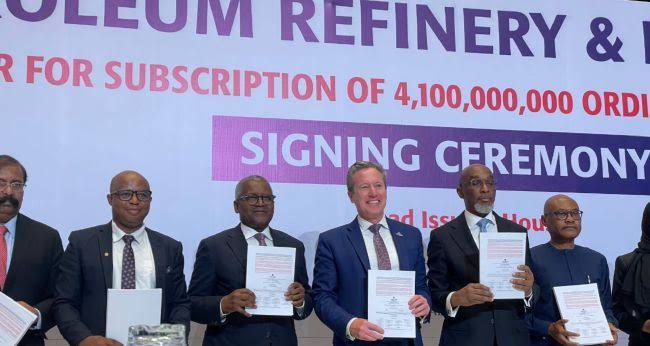
President of Dangote Industries Limited, Aliko Dangote, on Monday, signed registration documents for the proposed initial public offering of Dangote Petroleum Refinery and Petrochemicals FZE, with the billionaire businessman saying drivers, cooks, traders, servants and managers will have an opportunity to own shares in the refinery.

Dangote stated this at the signing ceremony held in Lagos, describing the transaction as an “IPO for the people” designed to democratise ownership of the massive industrial facility.

The IPO comprises 4.1 billion ordinary shares at N525 each and is expected to raise just over N2tn, according to Dangote.

The businessman said the minimum subscription would be 10 shares.

“But it is not only to fund the expansion of the refinery, of course, it’s a bigger amount. What we are trying to do is to make sure majority of all these my—our drivers, our cooks, our, you know, servants, our managers, everybody, they will have an opportunity to have a stake in this refinery,” Dangote said.

He said the transaction was not solely about raising funds for expansion, adding that the objective was to give people across the continent an opportunity to own shares in the refinery.

“So, this is why we have actually called it the IPO for the people. This is why we say that this is democratizing,” he said.

“There is no segregation on who can own these shares. We want every human being living on the continent to be part of this action, and I’m sure they will continue to be happy now, future, and forever.”

‘Waiting for my dollar dividend’

Dangote also spoke about the potential returns to shareholders, referring to the possibility of dollar-denominated dividends.

See also  Crude-for-loans: NNPCL battles N8.07tn outstanding debt

He said investors could eventually use such dividends to meet expenses outside Nigeria.

“When, uh, they will end up having to say that yes, I’m waiting for that check for my dollar, uh, dividend to send for the school fees of my daughter in UK or anywhere in the part of the world,” he said.

The signed prospectus puts the value of the offer at about $1.6bn, while the IPO values the refinery at about $49bn.

The IPO is scheduled to open on September 14 and close on October 13.

From bankers’ trust to refinery IPO

Reflecting on the refinery’s journey, Dangote said the project began with bankers providing financial backing even before the company had settled on the refinery’s location or secured its licence.

“…bankers without them even seeing which site we were going to use. Without seeing the license, we didn’t even have a license of the refinery. But the shared trust between us and our bankers made them to put money on the table without asking too many questions. We thank you for your trust,” he said.

He said the company faced several hurdles in determining where to locate the refinery.

“Even though we had very false starts, several hurdles, in fact, on the land itself, we struggle for five years trying to find which land we’re going to use,” he said.

Dangote said the company spent three years and eight months at Olokola before moving to the Lekki Free Zone.

“Three years, eight months in Olokola, and then we spent over a year and a half before we got access to our land at Lekki Free Zone,” he said.

He also recalled resistance from members of the community when the company attempted to gain access to the Lekki site.

See also  Presidency waves off Atiku threat as ex-VP woos Amaechi ahead of 2027; Read details

“We tried to enter, but I think the first fight where Mr. Dishi lost his life at the Lekki Free Zone because, you know, there was fight with the community and, you know, not on our own side. Our side is right inside, but the community were actually resisting, and that actually made them, you know, to understand what we wanted to do, and later on I think they allowed us in.”

Dangote acknowledged the contributions of former Lagos governors Babatunde Fashola and Akinwunmi Ambode, as well as Governor Babajide Sanwo-Olu, to the project.

“So, list of names, and the former governor of Lagos, Fashola, and also Ambode, they did extremely very well, and then later on, Sanwo-Olu, they did even better.”

‘Nothing is impossible’

Dangote said he was grateful to have witnessed the refinery reach the IPO stage.

“So today, I am indeed grateful to Almighty Allah for having spared our lives to witness this day.”

He urged Nigerians and Africans to take the lead in developing their economies.

“As I have said repeatedly, we as Nigerians and Africans must be bold and lead the change to develop our economies and our continent. And by doing so, we provide opportunities for our people, we’ll also create prosperity.”

“Only then will the others take us very seriously. Only then we will be in the position to negotiate and walk away with terms that we desire, not those terms that are given to us.”

Dangote said the refinery represented more than an industrial project for Nigeria.

“The refinery means so much to our continent, from the man working in Simandou mines to the woman in the rich agricultural fields in Amhara, to the fisherman in Walvis Bay, and to the custodians of our ancient history in the desert at the northern tip of our continent.”

See also  Alaafin to install Seyi Tinubu as ‘Okanlomo of Yorubaland’ Saturday

“Today, indeed, is a day of collective pride for all of us.”

He added: “This event signals that we can dream and dream big while we create prosperity for our people. Today also shows that nothing is impossible for us to achieve once we are focused and determined.”

Energy security key to industrialisation

Dangote said the refinery was part of the Dangote Group’s broader plan to accelerate industrialisation across Africa.

“Our Vision 2030 mantra at the Dangote Group is ‘accelerating Africa’s industrialization.’ We have learned the hard way and we cannot industrialize if we do not have energy security.”

He said the group had changed its mindset as it continued to invest in Nigeria and expand into other African countries.

“That is why there has been a shift in the mindset of the group. As we continue to invest in Nigeria as the powerhouse in Africa, we must also preach and take this gospel to other parts of the continent.”

He cited expansion plans in Ethiopia, Kenya, Tanzania and Namibia.

“Through these plans, we have also inspired many other African entrepreneurs to join us in this journey to industrialize our continent.”

Meanwhile, the public offer is expected to open to investors on September 14.

An independent check by our correspondent on Monday afternoon on the Nigerian Exchange, Bamboo and other investment platforms showed that the refinery had not yet been officially listed or commenced trading.

Source: punchng.com

FOLLOW US ON:

FACEBOOK

TWITTER

PINTEREST

TIKTOK

YOUTUBE

LINKEDIN

INSTAGRAM

Continue Reading
Click to comment

Leave a Reply

Your email address will not be published. Required fields are marked *

Business

Step-by-step guide to buying Dangote Refinery shares

Published

on

The Dangote Petroleum Refinery and Petrochemicals FZE will open Africa’s largest-ever Initial Public Offering on Monday, September 14, 2026, giving Nigerians a chance to own equity in the refinery.

Dangote Group Chief Executive Officer, Aliko Dangote, signed the offer documents at a ceremony held at Eko Hotels and Suites, Victoria Island, Lagos, on Monday, September 7, 2026, alongside the advisers and issuing houses managing the sale.

The offer comprises 4.1 billion ordinary shares priced at N525 each, with the company targeting about N2.15tn to part-fund an expansion that would nearly double the refinery’s capacity to 1.4 million barrels per day.

Subscription opens at a minimum of 10 shares, costing N5,250.

Dangote said the low entry threshold was a deliberate choice to let ordinary workers — drivers, cooks and domestic staff among them — become shareholders, describing the offer as “the IPO for the people.”

Lagos-based Vetiva Advisory Services Limited is coordinating the capital raise, which follows approval from the Securities and Exchange Commission. The offer opens September 14 and is expected to close October 13, 2026.

For readers wondering how to actually take part, here is a step-by-step breakdown.

STEP 1: SET UP A BROKERAGE ACCOUNT

Ordinary shares on the Nigerian Exchange are bought through licensed stockbroking firms, not directly from the company.

If you do not already have a trading account, you will need to open one with a broker registered by the SEC and the NGX.

Most brokers now let you register online by submitting your Bank Verification Number, a valid ID and passport photograph as part of standard Know-Your-Customer checks.

See also  Obi, Amaechi, Duke differ over insecurity, subsidy ahead of 2027

Before committing funds, confirm the broker’s registration status on the SEC or NGX website to avoid unauthorised operators.

STEP 2: LINK OR OPEN A CSCS ACCOUNT

Shares are not issued as paper certificates; they are held electronically in the Central Securities Clearing System. When you open a trading account, your broker will typically set up a CSCS account for you at the same time, or link an existing one. Any shares allotted to you in the IPO will be credited to this account once trading begins.

STEP 3: COMPLETE IDENTITY VERIFICATION

Your broker will ask for documentation to verify your identity and activate your account before you can subscribe. Requirements differ slightly from one brokerage to another, so follow whatever checklist your chosen firm provides rather than assuming a uniform process across the industry.

STEP 4: FUND YOUR ACCOUNT AHEAD OF THE OFFER

Once your account is active, deposit the sum you plan to invest. At N525 per share, the minimum commitment of 10 shares costs N5,250. The exact increment for applications above that minimum has not been detailed in public reporting so far, so confirm it against the final prospectus before deciding how many additional shares to apply for. Investors should have their funds ready before the offer opens on September 14 rather than scrambling once subscription begins.

STEP 5: WATCH FOR THE OFFICIAL OPENING

The offer opens September 14 and is billed to run until October 13, 2026. Given the scale of public interest already generated by Dangote’s private placement in July — reportedly oversubscribed by 270 per cent — investors should rely only on the final prospectus and offer documents published by the issuing houses for exact dates, application procedures and any changes, rather than dates circulating informally.

See also  Ending fuel subsidy was tough but necessary — Tinubu

STEP 6: SUBMIT YOUR APPLICATION THROUGH APPROVED CHANNELS

Applications will run through participating stockbrokers and any other platforms named in the official offer documents, which may include selected fintech and mobile investment apps. Specify how many shares you want, review the application carefully and submit before the deadline. The SEC has previously warned Nigerians against unauthorised parties soliciting money for Dangote Refinery shares outside verified channels, so cross-check any platform against the official list before paying anything.

STEP 7: AWAIT ALLOTMENT

Submitting an application does not guarantee the full number of shares requested. If the offer is oversubscribed — a real possibility given the scale of demand already reported — allotment may be scaled down, and any unallotted portion of your payment should be refunded according to the terms set out in the prospectus. Successful allotments are credited directly to your CSCS account.

STEP 8: TRACK YOUR HOLDINGS AFTER LISTING

Once the shares list on the Nigerian Exchange, you can monitor their value through your broker’s trading platform or app. Prices will move with company performance, investor sentiment and broader market conditions, and shareholders can choose to hold for the long term or sell through their broker whenever they wish, subject to prevailing market prices.

Before applying, investors should read the official prospectus and offer documents once published, and confirm details such as the exact offer price, subscription deadlines and approved application channels directly through the issuing houses, the Nigerian Exchange or the Securities and Exchange Commission.

Source: punchng.com

FOLLOW US ON:

FACEBOOK

TWITTER

PINTEREST

TIKTOK

YOUTUBE

LINKEDIN

INSTAGRAM

See also  UK bans over 100 jobs from foreign recruitment to curb migration

Continue Reading

Business

Nigeria imports N1tn steel despite N7.2bn Ajaokuta spend

Published

on

The Federal Government spent about N7.21bn running Ajaokuta Steel Company Limited between 2020 and 2025, even as the nearly 50-year-old complex in Kogi State remained largely dormant.

The expenditure spanned 501 transactions and covered taxes and other statutory obligations, pension and housing-fund contributions, maintenance, road works, and other infrastructure-related payments, according to spending records obtained from GovSpend and reviewed by The PUNCH on Monday.

GovSpend tracks and analyses Federal Government spending over time.

The spending occurred as Nigeria continued to rely heavily on imported steel, with the country’s iron and steel imports exceeding $1tn in 2025, according to data from the National Bureau of Statistics.

Nigeria’s iron and steel imports averaged about N526bn annually over the past six years, the NBS data showed. The figures represent officially recorded trade and exclude possible unrecorded or under-reported imports.

Ajaokuta was conceived in 1979 and built with Soviet backing as a cornerstone of Nigeria’s industrialisation drive.

The complex was designed to produce up to five million tonnes of steel annually, using the country’s iron-ore reserves to reduce dependence on imports and support industrial development.

Yet the spending records show that the company continued to incur substantial costs during the six years despite the plant’s inability to deliver the large-scale steel production for which it was designed.

In 2020, spending linked to Ajaokuta stood at about N795.4m across 57 transactions. The figure rose to N1.19bn in 2021, when 119 transactions were recorded, before falling to about N1.01bn in 2022.

See also  Ogun debt hits N494bn, IGR rises above N240bn

Spending increased to N1.36bn in 2023 and peaked at about N1.66bn in 2024 across 107 transactions. It then fell to approximately N1.20bn in 2025. The figures indicate that the expenditure was not a one-off intervention but a recurring cost associated with the state-owned steel company.

Some payments were routine obligations, including taxes, value-added tax, pension contributions, National Housing Fund contributions, and other statutory payments.

Others were linked to maintenance and infrastructure, including road rehabilitation, repairs to access roads, and the installation of solar street lights.

The records also show payments for infrastructure work in Lagos, including projects around Obalende, Okofaji, Olowogbowo and Isale Eko, as well as the rehabilitation of a 250-metre access road at Idoluwo Street on Lagos Island.

The payments raise questions about the scope of Ajaokuta’s responsibilities and why a steel company whose primary industrial asset is in Kogi State was involved in some infrastructure-related expenditure in Lagos.

The purpose of those payments and their relationship with Ajaokuta would need to be established through the relevant authorising agencies, contracts and procurement records.

The continued expenditure comes as the government renews efforts to revive the steel complex and attract investment into the long-delayed project.

The Ajaokuta Presidential Project and Implementation Team, inaugurated in May 2020, was established to accelerate the revival of the plant, coordinate a work plan and help structure the project for possible concession or implementation with private and international partners.

In July 2026, Ajaokuta Steel Company signed a reported 20-year gas supply agreement with the Nigerian National Petroleum Company Limited, with the Gas Aggregation Company of Nigeria and NNPC Exploration and Production Limited also involved.

See also  UK bans over 100 jobs from foreign recruitment to curb migration

The agreement provides for three million standard cubic feet per day of firm gas and up to 47 million standard cubic feet per day of interruptible gas, according to reports. The supply is intended to support power generation and the eventual revival of the steel complex.

Ajaokuta’s Managing Director, Nasir Naeem Abdulsalam, who was appointed in April 2025 to lead the turnaround, said prospective investors had repeatedly identified gas availability as a major concern.

“Without gas, you can’t operate the steel plant,” Abdulsalam said, describing gas supply as critical to steel production and the independent power generation serving the complex.

There are limited signs of production at the site, with engineers operating a modular blast furnace producing manhole covers, utility poles and rail-track components for a small domestic market.

The limited output contrasts sharply with the scale of the complex, which was designed to produce millions of tonnes of steel annually.

The development comes as President Bola Tinubu’s administration seeks to expand domestic manufacturing and has set a target of 10 million tonnes of annual crude-steel production by 2030.

Nigeria continues to spend hundreds of billions of naira importing steel despite having a major steel complex built to support domestic production.

The Minister of Steel Development, Abubakar Audu, has estimated that Nigeria spends about $4bn, or roughly N5.6tn, annually on iron and steel imports.

Source: punchng.com

FOLLOW US ON:
FACEBOOK

TWITTER

PINTEREST

TIKTOK

YOUTUBE

LINKEDIN

INSTAGRAM

Continue Reading

Business

Oil marketers withhold N431bn levies— Auditor-General

Published

on

The Nigerian Midstream and Downstream Petroleum Regulatory Authority has come under fresh scrutiny after the Office of the Auditor-General for the Federation uncovered over N432bn in unpaid debts, statutory levies and other outstanding obligations involving petroleum marketers.

The bulk of the liabilities, N431.01bn, consisted of legacy National Transport Average and bridging allowance debts owed to the petroleum sector regulator by marketers, according to the recently released Auditor-General’s 2024 Annual Report on Non-Compliance and Internal Control Weaknesses in Ministries, Departments and Agencies.

The report obtained from the OAGF office and analysed by our correspondent on Monday disclosed that Federal Government Ministries, Departments and Agencies were linked to at least N1.39tn in recurring financial irregularities, control failures and breaches of public finance regulations in 2024.

The amount, representing the cumulative value of 30 monetary cross-cutting issues identified by the Office of the Auditor-General for the Federation, underscores the scale of recurring weaknesses in the management of public funds across government institutions.

The largest component of the audit queries was N882.75bn in unrecovered debts involving six MDAs, accounting for about 63 per cent of the total amount implicated in the cross-cutting issues.

The Transmission Company of Nigeria accounted for the largest portion of the unrecovered debts, with N446.70bn, according to the report. The Nigerian College of Aviation Technology, Zaria, recorded the least amount among the affected agencies, with N935.56m.

For the NMDPRA, the report showed that the massive outstanding debt had remained substantially unresolved years after it was incurred, with auditors stating that as of August 2025, there was no evidence that the position had changed.

The N431.01bn debt dwarfed other financial irregularities identified at the authority, including N1.06bn in outstanding statutory levies owed by 14 oil marketers and N217.84m in unremitted Industrial Training Fund contributions.

See also  See presidency response to opposition faulting Tinubu's ambassadorial nominations

An analysis of the audit findings showed that the N431.01bn legacy debt accounted for virtually all the N432.29bn in major outstanding financial issues identified in the sections of the report relating to the NMDPRA.

The Auditor-General said the N431.01bn represented accumulated indebtedness arising from the National Transport Average, bridging allowance and legacy obligations.

A breakdown of the debt showed that the Depot and Petroleum Products Marketers Association of Nigeria accounted for N315.18bn, comprising N132.56bn in bridging allowance debt and N182.62bn in National Transport Average obligations.

The Major Energy Marketers Association of Nigeria accounted for another N106.30bn, while N9.53bn represented an unissued legacy debt in promissory notes by the Federal Ministry of Finance.

The report stated, “Section 47(1) of the Petroleum Industry Act (2021) states, “The Authority shall maintain a Fund (in this Act referred to as “the Authority Fund”) into which money accruing to the Commission shall be paid. Audit observed that: i. The sum of N431,012,935,018.88 was the National Transport Average, legacy debt and bridging allowance indebtedness to NMDPRA as at May 2023.”

It added that, “As at the time of this audit in August, 2025, nothing came to the knowledge of the auditors to have changed the position of the amount of the indebtedness, and There was no justification provided for non-recovery of the third parties’ indebtedness to the Authority.”

The auditors further said, “The above anomalies could be attributed to weaknesses in the internal control system at the Nigerian Midstream and Downstream Petroleum Regulatory Authority, Abuja.

The Office of the Auditor-General attributed the anomaly to weaknesses in the NMDPRA’s internal control system and warned that the situation exposed government funds to possible loss and diversion.

Although the NMDPRA acknowledged the outstanding liabilities, the authority described the N431.01bn as legacy receivables due from marketers.

Management said efforts were underway to reconcile the balances with the affected companies.

See also  Revised Executive Order: FG quietly adjusts oil revenue remittance framework, see details

“Management notes that the sum of N431,012,935,018.88 represents a legacy receivable due from marketers. Efforts have been made to engage the affected marketers for reconciliation and sign-off of the outstanding balances,” the NMDPRA said.

However, the Auditor-General rejected the explanation. “The management’s response to the issue has been noted; however, it is deemed unsatisfactory. Consequently, the findings remain valid until the recommendations are implemented,” the report stated.

The auditors recommended that the Authority Chief Executive should explain the non-recovery of the N431.01bn to the Public Accounts Committees of the National Assembly and recover and remit the money to the Treasury.

The report also warned that sanctions could apply for failure to collect and account for government revenue and gross misconduct if the recommendations were not implemented.

In another finding, the Auditor-General said 14 oil marketers owed N1.06bn in unpaid statutory levies on petroleum products. Under the Petroleum Industry Act, the NMDPRA is entitled to collect 0.5 per cent of the wholesale price of petroleum products sold in Nigeria from wholesale customers as part of its funding sources.

The audit found that N1.06bn remained outstanding as of January 24, 2025. “The sum of N1,059,622,848.29 was standing as the amount of indebtedness for the year 2024, by fourteen oil marketers,” the report stated.

The amount included penalties imposed on defaulting marketers, excluding Premium Motor Spirit. The NMDPRA, however, said it had recovered N3.19bn from total outstanding levies of N4.25bn covering January to December 2024.

The authority said, “Following reconciliation exercises, the Authority recovered N3.19bn of the N4.25bn outstanding 0.5 per cent Authority Levy for January-December 2024. The remaining balance of N1.06bn is being pursued through Demand Notices issued to the defaulting marketers.”

The auditors sustained the finding to the extent of the N1.06bn still outstanding and directed the authority to recover and remit the money to the Treasury. The report further found that the NMDPRA failed to remit N217.84m to the Industrial Training Fund in 2024.

See also  UK bans over 100 jobs from foreign recruitment to curb migration

According to the audit, the authority’s payroll for the year stood at N21.78bn, making it liable to remit one per cent of its total payroll to the ITF under the Industrial Training Fund Act. “The unremitted 1 per cent statutory Industrial Training Fund from the gross salary in the payroll of the Authority amounted to N217,841,922.18,” the report said.

The NMDPRA said it was in the process of settling the obligation. “The Authority is in the process of settling the outstanding 1 per cent Industrial Training Fund obligation. Evidence of payment will be submitted to the Office of the Auditor-General for the Federation upon completion of the remittance,” management said.

But the Auditor-General again described the response as unsatisfactory and maintained that the finding would remain until the money was remitted.

The findings come amid growing scrutiny of government agencies over revenue collection and remittance, particularly following repeated calls for stricter accountability in the management of public funds.

The NMDPRA was established under the Petroleum Industry Act 2021 to regulate Nigeria’s midstream and downstream petroleum sectors, including petroleum product distribution, transportation, storage and marketing.

The audit report now places renewed pressure on the authority to recover billions of naira tied up in legacy petroleum sector debts while strengthening its internal controls to prevent further revenue leakages.

However, some major oil marketers denied owing the agency when contacted for comments on the development, as they insisted that their obligations to the authority had been cleared.

Source: punchng.com

FOLLOW US ON:

FACEBOOK

TWITTER

PINTEREST

TIKTOK

YOUTUBE

LINKEDIN

INSTAGRAM

Continue Reading

Trending