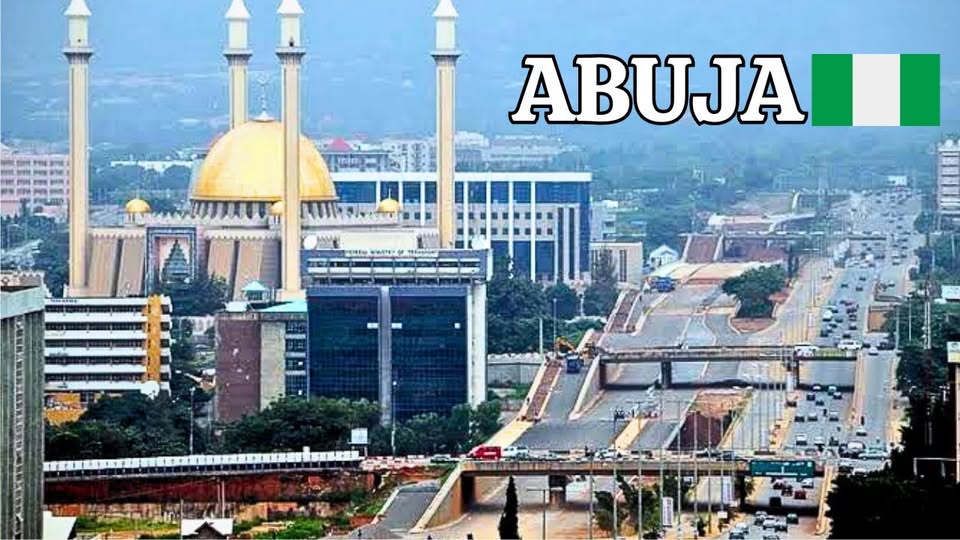
Abuja officially became the capital of Nigeria on December 12, 1991, replacing Lagos. The decision to move the capital was made to address issues such as overpopulation, congestion, and the geographic limitations of Lagos.
Located at the geographic center of Nigeria within the Federal Capital Territory, Abuja was planned and developed beginning in the late 1970s to serve as a neutral, accessible, and modern administrative center for the country.
Why Was The Capital Moved From Lagos To Abuja?
The decision to move Nigeria’s capital from Lagos to Abuja was influenced by several reasons: political, economic, geographic, and symbolic.
Lagos had served as the capital since 1914, but by the 1970s, it had become increasingly overcrowded and unsuitable for national administration.
Lagos had grown into one of Africa’s largest cities and Nigeria’s main commercial center. But this growth came with problems.
The city faced constant traffic, housing shortages, poor sanitation, and overstretched infrastructure. Its location, surrounded by water and limited by natural barriers, made expansion difficult.
Another major concern was political neutrality. Nigeria is home to hundreds of ethnic groups. Lagos, located in the Yoruba-dominated southwest, was seen as favoring one region over others.
Abuja was chosen because it sits near the geographic center of the country and doesn’t belong to any major ethnic group.
Abuja’s central location also made it more accessible from all parts of Nigeria. Unlike Lagos, which sits on the far southwest coast, Abuja allows for easier coordination and travel from different states.
This strategic positioning supports national governance and the development of interior regions. Security played a part, too. Lagos, being a coastal city, was harder to defend and more exposed to external threats.
Abuja offered a more secure inland site with better control over access and planning. There was also symbolic meaning. Lagos had been the colonial capital under British rule.
Moving the capital to Abuja was a way to show Nigeria’s independence and growth as a nation. However, the move began in the mid-1970s under General Murtala Mohammed.
A panel led by Justice Akinola Aguda recommended Abuja. Construction started in the late 1970s, and by December 12, 1991, the capital officially moved under General Ibrahim Babangida’s leadership.
Who Declared Abuja The Capital Of Nigeria?
Abuja was officially declared the capital of Nigeria by General Ibrahim Badamosi Babangida on December 12, 1991. However, the journey to that declaration began much earlier and involved some key leaders.
The first person to propose moving the capital was General Yakubu Gowon in 1974. At the time, Lagos was overcrowded, chaotic, and geographically limited.
Gowon believed a more central and neutral location would be better for the country’s unity and administration. But it wasn’t until General Murtala Mohammed came into power in 1975 that the idea gained real momentum.
Murtala Mohammed created a seven-man committee, led by Justice Akinola Aguda, to study whether Lagos should remain the capital or not.
After detailed research, the committee recommended relocating the capital to a new area in the center of the country, which we now know as the Federal Capital Territory (FCT).
The location was chosen for its neutrality among Nigeria’s major ethnic groups and its central position, which made it easier to access from all parts of the country.
Sadly, Murtala Mohammed was assassinated in 1976, and the project slowed down. But the idea didn’t die. In 1979, President Shehu Shagari revived the effort. By 1980, the planning phase began.
An American firm, International Planning Associates, designed the master plan. Japanese architect Kenzo Tange also contributed to the city’s modern design. Eventually, under Babangida’s leadership, Abuja was developed quickly.
Despite facing major challenges, like limited infrastructure and air access, his administration made the final move. On December 12, 1991, the seat of Nigeria’s federal government was officially moved from Lagos to Abuja.
Which Is bigger, Lagos Or Abuja?
When comparing Lagos and Abuja, Lagos is the biggest city in terms of population, economic significance, and urban scale. While Abuja is Nigeria’s capital and growing rapidly, it still lags behind Lagos in several key areas.
Population Size
As of 2025, Lagos has an estimated population of about 17.16 million people, making it the largest city in Nigeria and all of Africa.
Abuja’s population is around 4.2 million, roughly one-quarter the size of Lagos. Lagos has grown from just 325,218 people in 1950 to over 17 million today, with an annual growth rate of around 3.75%. Though Abuja’s growth rate is slightly higher at 4.58%, it is still much smaller in overall numbers.
Geographical Size And Density
Geographically, Abuja is larger. It spans about 1,769 square kilometers, compared to Lagos’s 1,171 square kilometers.] But Lagos is far more crowded.
Its population density is about 6,871 people per square kilometer, while Abuja has far fewer people spread over a larger area. This makes Abuja feel more open and organized, while Lagos is often congested and densely packed.
Economic And Social Value
Lagos is Nigeria’s economic capital. It produces roughly 25% of the country’s GDP and is home to major industries, ports, and businesses.
It’s also extremely diverse, with over 250 ethnic groups living and working there. On the downside, about 66% of Lagos residents live in slums and face major infrastructure challenges.
Abuja, also, is the political and administrative center. It houses the Presidency, National Assembly, foreign embassies, and other federal institutions.
FOLLOW US ON:
FACEBOOK
TWITTER
PINTEREST
TIKTOK
YOUTUBE
LINKEDIN
TUMBLR
INSTAGRAM









 News21 hours ago