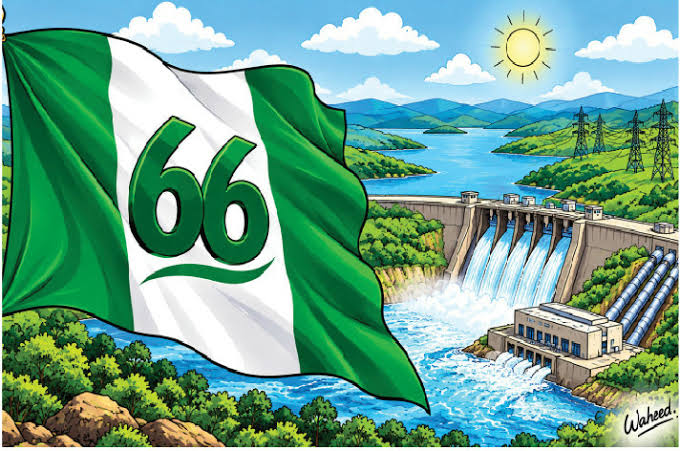
SIXTY-SIX years after flag independence, millions of Nigerians remain hungry. Millions of children are out of school. Infrastructure is grossly inadequate. The country still depends far too heavily on crude oil income.
Nigeria’s resources, including vast arable land, water bodies, oil, gas, solid minerals, a young population, and extraordinary human talent, have yet to translate into the prosperity, security and dignity the people deserve and the founding fathers espoused.
The country’s greatest tragedy is no longer that it has failed to realise its potential. It is that it has become accustomed to failing to realise it.
The political class has shown a disturbing disdain for good governance. Leadership has been anything but visionary. It’s been more about power grabbing, access to the public purse, deceit, sloganeering, and unbridled arrogance.
Yet, it is not that Nigeria has achieved nothing in 66 years. The truth, rather, is that what it has achieved pales distressingly to what it could have achieved.
At 66, there is a pervading sense of despondency, dashed hopes and, more disturbingly, a fragile future.
October 1, 1960 was supposed to mark the beginning of Nigeria’s great national journey. With a functioning parliamentary system, a strong regional structure and an agriculture-powered economy, the country seemed headed towards remarkable prosperity.
The North built an economy around groundnuts, cotton and livestock. The West became synonymous with cocoa and rubber. The East exploited palm oil, palm kernels and extensive trading networks. Agriculture employed the vast majority of the population. The three regions – later four –built schools, roads, hospitals, universities and other infrastructure.
The First Republic wasn’t flawless, it must be said. Ethnic rivalry, electoral manipulation and power struggles tainted it. This eventually contributed to military intervention on January 15, 1966, the suspension of democratic institutions and the devastating Civil War of 1967-1970.
But the First Republic left one unforgettable lesson: regional autonomy can drive rapid development when government and the people have both responsibility and incentives to perform.
Sadly, the military era ended the parliamentary system and destroyed the vibrant regional governments, replacing them with a centralised federation.
Agriculture lost its primacy as attention turned to crude oil. Petrodollars weakened the urgency to diversify the economy.
That false choice has haunted Nigeria ever since.
Fixated on easy oil cash, Nigeria neglected to build the infrastructure, institutions and human capital required to transform the country. Rather, it developed a morbid taste for everything imported, bleeding its resources to sustain others.
The return to civilian rule in 1979 rekindled some hope. But the military soon returned in 1983 as politicians squandered another opportunity to reset the national trajectory.
On June 12, 1993, more than 10 years later, Nigerians voted in large numbers in a presidential election that produced a clear victory for MKO Abiola of the Social Democratic Party.
History will not forget that the Ibrahim Babangida junta annulled the freest and fairest election ever held in Nigeria. Abiola never assumed the presidency. He died mysteriously in detention in July 1998.
A democratic possibility was insidiously aborted. Nigeria has spent decades trying to recover from that indecent, violent assault.
Since 1999, however, democracy has survived. The military has remained in the barracks. Elections have taken place regularly, and government has changed hands peacefully. Civilian rule has become the country’s political norm.
These are achievements that must be acknowledged.
Nigeria demonstrated during the COVID-19 pandemic that with coordination, institutions and governments can respond effectively to extraordinary challenges.
The country expanded testing capacity rapidly and mobilised its existing disease-surveillance infrastructure. It limited the spread of the disease and kept deaths significantly low, drawing commendation from the World Health Organisation.
This year, Nigeria has demonstrated that technological ambition is not beyond its reach. A surgeon in Lagos recently performed a tele-robotic procedure on a patient in Abuja, a striking pointer to what Nigeria can achieve with expertise and the right infrastructure.
In between, Nigeria has seen advancements in ICT and financial services. Its Diaspora has recorded feats in academia, sciences and enterprise. Its creative industry has virtually gone global.
There has also been a substantial, even if painful, reset in the petroleum industry since the petrol subsidy was removed in 2023.
The chronic scarcity and long queues that periodically became a symbol of governmental failure have largely disappeared as the new Dangote Refinery repositioned Nigeria as a major exporter of petroleum products rather than an import-dependent country.
These achievements deserve recognition. But they also trigger the question: if Nigeria can do these things, why has it not done far more?
Other countries that gained independence around the same period offer uncomfortable comparisons.
Singapore transformed itself from a corrupt, poor, newly independent city-state into a major global centre for finance, trade, logistics and advanced services.
South Korea has transformed from a rural economy to a global tech and industrial powerhouse.
China’s ascendancy to world economic dominance is an enduring testimony to visionary leadership.
Even Botswana, once among the world’s poorest territories, used diamond wealth alongside strong institutions and fiscal management to build a much more prosperous economy.
From dependence on rubber and tin, Malaysia transformed into a manufacturing, technology and export-capacity country, sending palm oil products to Nigeria.
Nigeria, meanwhile, remains stuck on crude oil proceeds, using it as an excuse not to build anything else.
The country was called the Giant of Africa because of its size and potential. But at 66, the giant has spent too long sleeping and is now ranked fourth-largest economy on the continent, down from first.
Nigeria’s democratic record is particularly abysmal. The Economist Intelligence Unit’s 2024 Democracy Index places Nigeria in the “hybrid regime” category, meaning its democratic profile is horrendous. The index evaluates the electoral process, functioning of government, political participation, political culture and civil liberties.
Sixty-six years after independence, Nigeria’s elections remain tainted by disputes over transparency, electoral administration, vote buying, violence and litigation. Courts, rather than the voters, now determine electoral outcomes. This must stop.
Democracy cannot thrive merely because elections occur every four years. It thrives when citizens trust the process and institutions enforce the rules impartially.
At 66, Nigeria is still struggling to feed its citizens despite arable land larger than many countries combined and over 800km of coastline.
The 2025 Global Hunger Index ranks the country 115th among 123 countries, with a score of 32.8, placing the country in the “serious” hunger category. This is shameful.
The National Bureau of Statistics’ landmark 2022 Multidimensional Poverty Index found that 133 million Nigerians (about 63 per cent of the population) were multidimensionally poor. A few million have been reportedly added to the tally in the last few years.
In 2018, Nigeria overtook India as the global capital of poverty with 87 million citizens living in extreme poverty. For a resource-rich country, the irony is profound.
The country struggles to supply electricity, generating only 5,000 megawatts 127 years after the first power plant was installed. Its continental peers, Egypt and South Africa, generate 55,000 MW each.
Education is no less alarming. Between 18 million and 20 million Nigerian children are out of school, the world’s largest burden, though the government argues that figure is exaggerated.
This is not merely education data. It is a warning about Nigeria’s future.
Every out-of-school child represents lost productivity, diminished opportunity and a potential security risk.
Infrastructure tells the same story. The World Bank estimates that the country would need to invest about $3 trillion over 30 years (roughly $100 billion yearly) to close its huge infrastructure gap.
At independence, Nigeria had roughly 45 million people. Today, the population is more than five times that figure. Yet the scale of government planning and infrastructure provision seems fixed on 1960 figures. The bitter truth is that Nigeria has failed much more than it has succeeded.
President Bola Tinubu’s 2025 Independence Day address struck a celebratory note, including the assertion that “the worst is over” and that improvements were being recorded in education, healthcare and infrastructure. Government declarations must match the people’s lived experiences.
For far too long, Nigeria’s leaders have indulged in self-praise over woeful performance. Worse, citizens, blinded by ethnic, religious and sundry base sentiments, tolerate such travesty. Many trudge through life waiting endlessly for their turn to “eat.”
This need not be the case if the socio-political and economic structures are designed to work.
The presidential system has concentrated enormous political and financial power at the centre.
Abuja exercises influence over resources and responsibilities that, in a genuinely competitive federation, should be handled by the sub-entities, which are much closer to the people.
The result is a peculiar political economy in which states frequently look towards the centre for allocations, projects and patronage instead of competing to build productive economies based on their own comparative advantages.
Local governments, once the custodians of basic education, have become mere spectators.
This is where the true federalism question comes in. The future is foreboding without it. The perpetual and intense competition for power at the centre remains a dysfunctional, centrifugal force that prevents a national consensus on the path to real progress.
In the 2024 Fragile States Index, Nigeria ranked the 15th most fragile country with a score of 96.60 out of 120 (where higher scores mean greater vulnerability and instability).
The country, for all its acknowledged promise, has been ravaged by Islamic terrorism, banditry, separatist agitation and militancy for most of the Fourth Republic.
Widespread violence has become a real and existential threat.
Corruption remains a heavy chain around Nigeria’s neck, despite the efforts to contain it. With a score of 26 out of 100, Nigeria ranked 142 out of 182 countries and territories assessed in the 2026 Corruption Perceptions Index by Transparency International.
Wrongdoing, lawlessness and impunity must be confronted forcefully and completely.
The First Republic was not perfect. But Nigeria needs a federation in which federating units possess meaningful authority, clear responsibilities and strong incentives to develop their own economies and human capital.
True federalism, properly designed and accompanied by strong institutions, could encourage states and regions to compete on education, agriculture, industry, infrastructure, healthcare and investment. The result would be collective progress and prosperity for which citizens yearn.
Nigeria has shown resilience through the years, but at 66, it should not congratulate itself merely for surviving. Survival is not the same as success. Hopes should be fulfilled, the future clear.
This demands a reinstatement of the visionary leadership that produced Nigeria’s independence in the first instance.