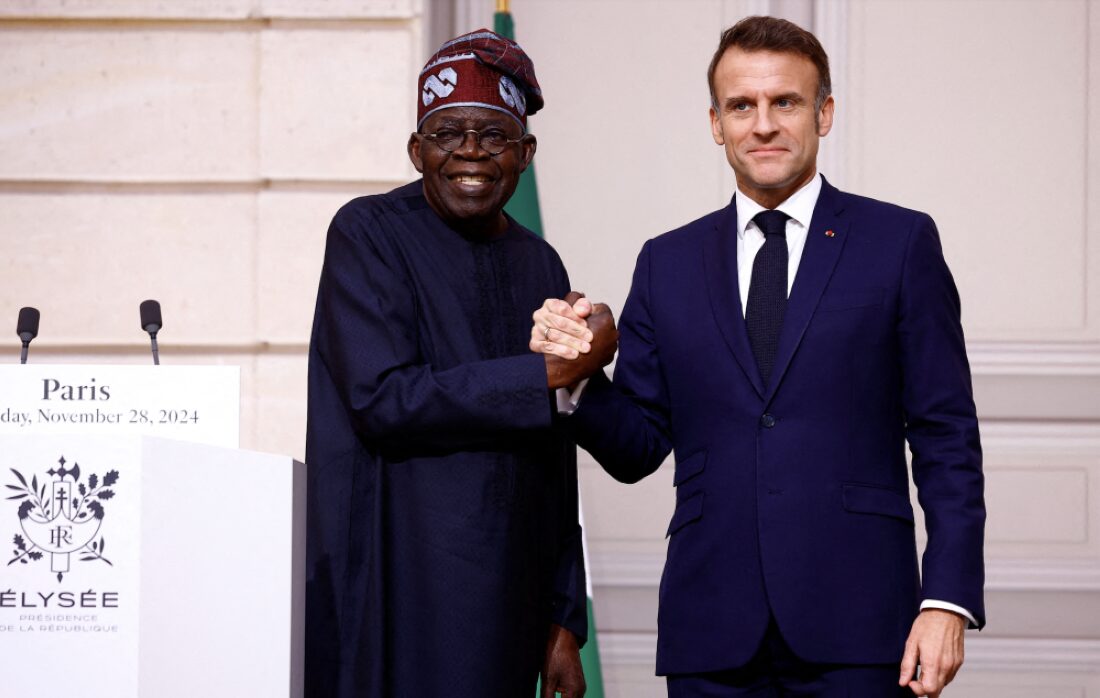
President Bola Tinubu and his French counterpart, Emmanuel Macron, on Sunday held talks on the security crisis facing the country, touching on areas of collaboration.
The telephone conversation held as a United States delegation comprising the US ambassador to Nigeria and other top officials parleyed with the National Security Adviser, Nuhu Ribadu, in Abuja, on the reported Christian persecution and killings in the country.
In a message posted on X on Sunday, Macron said he spoke with President Tinubu and affirmed that France will strengthen its partnership with Nigerian authorities.
He wrote, “I spoke with President Tinubu of Nigeria, @officialABAT. I conveyed France’s solidarity in the face of the various security challenges, particularly the terrorist threat in the North.
“At his (Tinubu’s) request, we will strengthen our partnership with the authorities and our support for the affected populations.
“We call on all our partners to step up their engagement. No one can remain a spectator,” the French President added.
Macron also stated that, in fulfilment of Tinubu’s request, his government will cooperate with the Federal Government to provide support for the affected populations.
Macron’s statement follows a wave of gun attacks and kidnappings, particularly in schools and communities across the northern region, that have drawn international condemnation.
The French leader’s solidarity comes days after Tinubu swore in a new Minister of Defence, Gen. Christopher Musa (retd.), with a charge to deliver quick results.
On November 26, Tinubu declared a nationwide security emergency, ordering the army, police and intelligence services to immediately expand recruitment and deploy thousands of additional personnel.
He had also asked security agencies to prioritise the safety of schools, farms and places of worship, while governors step up local early-warning systems.
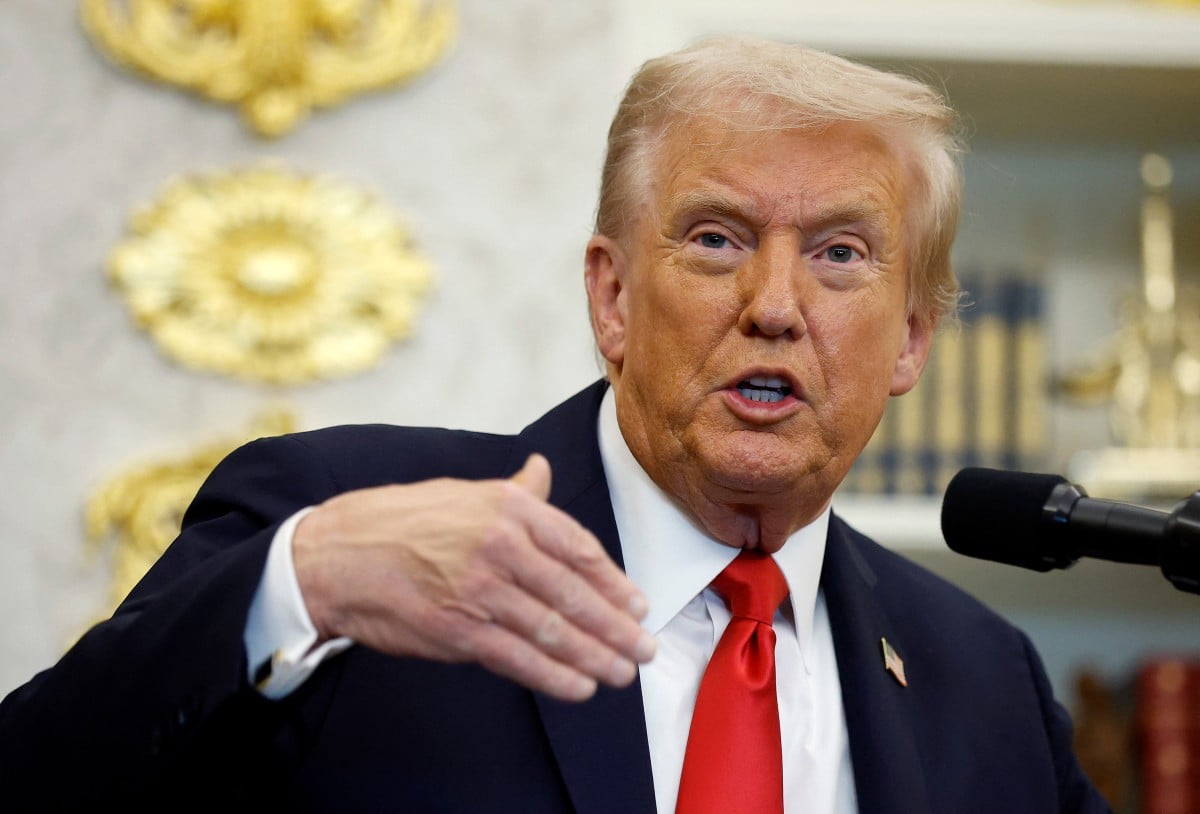
Tinubu’s conversation with Macron also follows broader international scrutiny of Nigeria’s security crisis, especially from US President Donald Trump, who, in early November, threatened to invade the country, citing an alleged genocide against Christians.
Trump recently re-designated Nigeria as a Country of Particular Concern for religious freedom violations and threatened military intervention.
The Federal Government has consistently rejected claims of Christian persecution, insisting that insecurity in Nigeria cuts across all religions.
The situation has prompted the Federal Government to seek diplomatic aid from the international community.
On November 20, Secretary of War Pete Hegseth hosted Ribadu at the Pentagon to discuss strategies to solve the problem.
That same day, the US House Subcommittee on Africa held a public hearing to examine the re-designation of Nigeria as a Country of Particular Concern, while lawmakers also held an open briefing to assess the potential implications of the designation.
Last Tuesday, House Republicans issued warnings about rising religious violence in Nigeria during a joint briefing convened at the instance of President Trump, who on October 31 instructed Moore and the House Appropriations Committee to investigate what he described as the slaughter of Christians in the country and report their findings to the White House.
Confirming his meeting with the US officials, the NSA disclosed he hosted a US Congressional delegation as part of ongoing security consultations between both countries.
In a message shared on his X handle, Ribadu said the visit followed earlier talks held in Washington, DC, centred on mutual security interests.
“This morning, I received a US Congressional delegation on a fact-finding mission to Nigeria, following our earlier engagements in Washington, DC, on shared security priorities,” he said.
He added that the US Ambassador to Nigeria, Richard Mills, was also present, a development he said “reflected the importance both nations attach to this engagement.”
According to Ribadu, discussions focused on “counter-terrorism cooperation, regional stability,” and ways to “strengthen the strategic security partnership between Nigeria and the United States.”
“I’m optimistic this engagement will deepen trust, collaboration, and shared commitment to peace and security,” he said.
Also, a member of the US House of Representatives, Riley Moore, said on Sunday that he had concluded a very productive visit to Nigeria, sharing the message in a post on his X account.
“I came to Nigeria in the name of the Lord and on behalf of the American people,” Moore wrote.
Announcing the end of his trip, he added, “Just ending a very productive visit to Nigeria and rounds of meetings. More details to come. Happy Sunday. God is Great!”
Moore did not provide further information about the purpose of the visit or the Nigerian officials he met.
In a related development, the US Assistant Secretary of State and the US Ambassador to Nigeria, Richard Mills, visited Benue State on Saturday.
The team met Governor Hyacinth Alia at the Government House, Makurdi, as well as the Catholic Bishops of Makurdi and Katsina-Ala dioceses, Most Rev. Wilfred Anagbe and Bishop Isaac Dugu, respectively.
The delegation also visited the paramount ruler of the Tiv nation and Chairman of the Benue State Traditional Council, the Tor Tiv, HRM Prof. James Ayatse.
Though the purpose of the visit to the state was not disclosed, reports indicated that it may be connected to US allegations of religious persecution in Nigeria.
Anagbe has twice addressed the US Congress in 2025 on the persecution of Christians and security crises in Nigeria, calling on the US to take concrete action.
The Tor Tiv had similarly admonished President Bola Tinubu during his visit to the state shortly after the Yelwata attack, in which about 200 people were killed. He described the crisis as “nothing but genocide.”
However, Governor Alia, at a recent consultative forum on protecting the rights of Internally Displaced Persons and Forcibly Displaced Persons organised by the National Human Rights Commission in Abuja, denied claims of genocide.
He said, “I am a Reverend Father, so being in governance does not take that away from me. In my state of Benue, we do not have any religious, ethnic, racial, national or state genocide. We do not have that.”
The Chief Press Secretary to the governor, Kula Terso, stated that he was informed the visit was private.
“They told me it was a private visit. That is why the media was not invited to cover it. That is all I can say on that. Thanks,” he said.
Meanwhile, Iorbee Ihagh, leader of the three major socio-cultural groups in the state — Mdzough U Tiv, Ochetoha K’Idoma and Om’Ngede — said the visit by the American officials may not be unconnected with the allegations of religious genocide.
He said that although the state government denied claims of genocide, it should have used the opportunity to take the team to Yelwata and other IDP camps along the highway.
The retired Comptroller of Prisons said, “Everyone in Benue State believes that the ongoing attacks and killings in the state amount to genocide. The Tiv paramount ruler, the Tor Tiv, made this declaration during President Bola Tinubu’s visit to the state following the Yelwata attack.
“The Catholic Bishop of Makurdi Diocese has visited the US Congress and presented papers on how Christians are being killed in the state and in Nigeria as a whole.
“So, it is the state government that is playing politics with the killings. This was an ample opportunity to take the US team to Yelwata, which is along the Lafia road, and to the IDP camps in Makurdi or those along the highway for them to see things for themselves.”
On a positive note, the Federal Government has reportedly secured the release of 100 schoolchildren abducted from St. Mary’s Private Catholic Primary and Secondary School, Papiri, in the Agwara Local Government Area, Niger State.
However, the authorities have yet to confirm the release of the pupils as of the time of filing this report.
The development happened one week after the NSA visited the school, where he reassured the parents and proprietor that the pupils would be rescued.
He conveyed President Tinubu’s message of hope, noting that efforts to rescue the children were progressing and security deployment in the affected area had been intensified.
“God is with them and God is with us. Evil will never win. They are going to come back. I give you that assurance,” Ribadu said during a visit to the Catholic Bishop of Kontagora Diocese and Proprietor of the school, Bulus Dauwa Yohanna, as well as parents of the abducted children.
Bandits on 21 November 2025, attacked the school in the remote community of Papiri. The gunmen stormed the school dormitories, abducting 315 people—303 students and 12 teachers.
Fifty pupils later escaped and were reunited with their families. However, 265 individuals—including 253 children and all 12 teachers—remained in captivity.
The Federal Government responded by launching a rescue mission, deploying aerial surveillance across parts of Kwara, Kebbi, and Niger States.
The authorities also shut down the schools in Niger State and many unity colleges across several northern states.
Ex-presidential aspirant blames North
Former presidential aspirant and international businessman, Gbenga Hashim, has said Northern political and social elites must accept responsibility for the worsening insecurity across the region, insisting that decades of failed governance have fuelled extremist recruitment and mass violence.
Hashim, in a statement on Sunday, welcomed the appointment of Gen Musa as Nigeria’s new Minister of Defence, describing it as “a crucial opportunity that must deliver practical and immediate results.”
The Peoples Democratic Party chieftain said he watched Musa’s Senate screening and was impressed by what he called the nominee’s sincerity and clarity of purpose.
“I watched General Musa’s Senate clearance. He sounded like someone genuinely committed to Nigeria,” Hashim said.
“I hope he receives the full executive backing needed to succeed in this critical assignment.”
The businessman warned that Nigerians and international security observers were becoming increasingly impatient with political rhetoric, adding that the country had entered a phase where only measurable action would be tolerated.
“This is not the season for symbolism. This is the season for action,” he said.
“Nigerians want immediate steps. This appointment must not become another publicity stunt. We want policies, programmes and results.”
Hashim also urged both the executive and the National Assembly to accelerate legislation enabling the creation of state and local government police structures, arguing that Nigeria cannot curb insecurity without building a strong local security culture.
He said the rise of banditry, kidnapping and extremist attacks across Northern Nigeria was a direct result of cumulative leadership failures at the sub-national level.
“That extremists are finding recruits in their thousands is not accidental,” he noted.
“It is the product of deep poverty caused by decades of governance failure at the state and local government levels. While the Sahel crisis has played a role, poor local governance has compounded the problem.”
Hashim contrasted today’s insecurity-ridden North with the more stable First Republic era, which he said was marked by disciplined and integrity-driven leadership.
He cited leaders such as Sir Ahmadu Bello, Aminu Kano, Joseph Tarka and Sir Kashim Ibrahim as examples of public figures who lived modestly and earned the trust of ordinary people.
“In those days, the North was safer, more united and governed with honesty and discipline.
“Today, too many Northern leaders live like oil sheikhs in the midst of mass poverty,” he said.
The former presidential aspirant said the North must now confront the truth about governance collapse and embrace a new generation of leaders committed to transparency, accountability and people-focused development.
“It is time for the North to replace leaders who live like oil sheikhs amidst poverty and hold onto power through ethnic and religious manipulation,” he declared.
In the same vein, a university don and Director of the Centre for Democratic Development Research and Training, Zaria, Kaduna State, Prof. Abubakar Siddique, has raised alarm that the rising insecurity in northern Nigeria poses a grave threat to the stability of the entire country.
Siddique, a professor of Political Science at Ahmadu Bello University, Zaria, said the North had become the epicentre of multidimensional poverty, economic stagnation and worsening security crises, warning that unless decisive action is taken, the situation could undermine national cohesion.
He spoke as a guest speaker at the General Hassan Usman Katsina 2nd Memorial Conference organised by the New Vision Development Initiative, led by a former military administrator of Niger State, Col. Lawan Gwadabe (retd.), in Kaduna.
According to him, statistics show that 65 per cent of Nigerians classified as multi-dimensionally poor reside in the North, making the region the most deprived in the country.
He added that the worsening poverty indices are fuelling insecurity, creating what he described as a “poverty–insecurity trap.”
“The implications for northern Nigeria are profound,” he warned.
“The region’s economic stagnation and human-capital crisis are undermining national growth and development. As Nigeria’s population continues to grow, the need for effective solutions to these challenges becomes increasingly urgent.”
The professor painted a bleak picture, noting that an estimated 10 million Nigerian children are out of school, 60 per cent of whom are in northern states. He also disclosed that youth unemployment has exceeded 50 per cent in some parts of the North.
Beyond economic deprivation, he said, climate stress was aggravating insecurity, pointing to the loss of 350,000 hectares of land to desertification annually.
He added, “The security situation is equally alarming. Since 2009, the Boko Haram insurgency has claimed over 35,000 lives and displaced 2.5 million people. Banditry and kidnappings have also become rampant, with hundreds of villages raided and thousands abducted. These crises are interconnected, fuelling a poverty–insecurity trap that threatens national stability.”
Siddique called for urgent and holistic interventions, including governance reforms, security sector re-engineering, massive educational transformation and economic diversification tailored to the needs of northern communities.
He stressed that failure to address these structural problems would continue to erode Nigeria’s unity, weaken institutions and compromise national security.
The conference, which attracted retired military leaders, academics, policymakers and civil society actors, also witnessed tributes to the late General Hassan Katsina, the former Military Governor of Northern Nigeria who died in 1995.
A former Chief of Defence Staff, Lt-Gen Alani Akirinade (retd.), hailed the late Katsina as a “distinguished military leader and patriot”, recalling his legacy of service, integrity and dedication to Nigeria’s unity.
Represented by former Commandant of the Nigerian Defence Academy, Maj Gen Paul Tarfa (retd.), Akirinade said General Katsina’s leadership during the civil war was particularly remarkable.
According to him, Katsina oversaw the expansion of the armed forces, ensured the timely payment of soldiers’ entitlements, and spearheaded post-war resettlement and rehabilitation efforts.
He added, “He was a prince among soldiers and a soldier among princes. His exemplary leadership during Nigeria’s most trying times stands out in our military history.”
Katsina, who died at 62, served as Military Governor of the then Northern Region, Chief of Army Staff, and later Deputy Chief of Staff, Supreme Headquarters. He was widely credited with helping to preserve national unity during and after the Civil War.