
Connect with us

Business

Without Ooni’s Intervention, Refinery Couldn’t Have Been Built — Dangote

Published

on

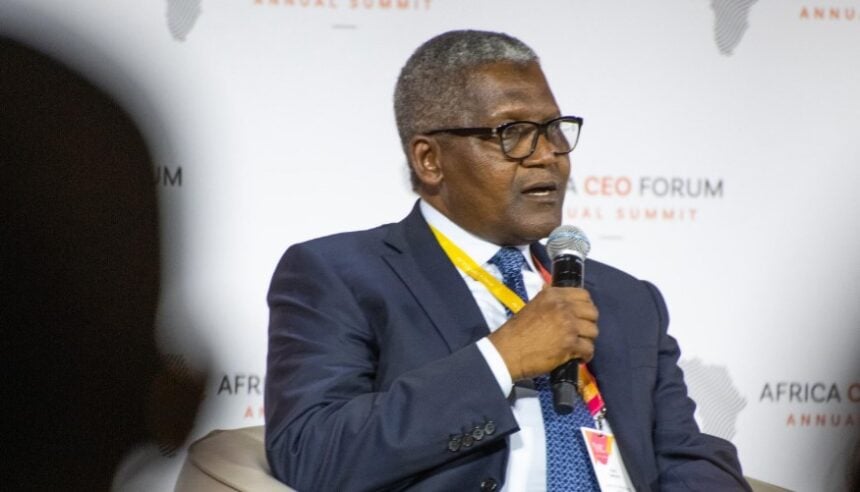
Businessman and President of Dangote Group, Aliko Dangote, has credited the Ooni of Ife, Oba Adeyeye Ogunwusi, with making the construction of his multi-billion-dollar refinery possible by intervening to remove 19 shrines from the project site.

Speaking in a video shared by The Cable via X on Friday, the billionaire industrialist revealed that construction workers were unable to proceed with the project in Ibeju-Lekki, Lagos, due to the presence of numerous shrines.

Dangote said, “I must recognise and thank the Ooni of Ife for enabling the building of our factory. What happened was that when we got there, there were over 19 shrines at the site. Nobody was able to go near there to do anything.”

The business mogul explained that the traditional ruler personally visited the site and boldly ordered the removal of all the shrines, despite the spiritual implications.

“But Ooni went there, stood there and said ‘remove all of them. Let the gods come and talk to me’. Your Royal Majesty, I want to thank you from the bottom of my heart because without that singular act of yours, I don’t think we would have been able to build the refinery,” Dangote stated.

PUNCH Online reports that the Dangote Refinery, located in the Dangote Industries Free Zone in Ibeju-Lekki, is the world’s largest single-train refinery with a capacity of 650,000 barrels per day.

The industrialist had earlier disclosed that he paid $100 million to the Lagos State Government for the massive land, but construction faced significant delays due to community issues surrounding the shrines.

See also  N15bn Benue brewery set for inauguration in October

The refinery, which began operations in 2024, is expected to transform Nigeria’s petroleum sector by ending decades of fuel importation and creating thousands of jobs for Nigerians.

FOLLOW US ON:

FACEBOOK

TWITTER

PINTEREST

TIKTOK

YOUTUBE

LINKEDIN

TUMBLR

INSTAGRAM

Continue Reading
Click to comment

Leave a Reply

Your email address will not be published. Required fields are marked *

Business

FG recorded N30tn revenue shortfall in 2025 – Edun

Published

on

The Minister of Finance and Coordinating Minister of the Economy, Wale Edun, opened up on Tuesday that the Federal Government recorded a significant revenue shortfall in the 2025 fiscal year.

He noted that while the Federal Government projected N40.8tn revenue for this year, it ended up making only N10.7tn.

Edun made the disclosure while appearing before the House of Representatives Committees on Finance and National Planning during an interactive session on the 2026–2028 Medium Term Expenditure Framework and Fiscal Strategy Paper.

He recalled that the Federal Government had projected a revenue target of N40.8tn in 2025 to fund the N54.9tn “budget of restoration,” designed to stabilise the economy, secure peace and lay the foundation for long-term prosperity.

However, the minister said current fiscal performance shows that total revenue for the year is likely to end at about N10.7tn.

According to him, the sharp shortfall is largely attributable to weak oil and gas earnings, particularly Petroleum Profit Tax and Company Income Tax from oil and gas companies, alongside persistent underperformance across several revenue subheads.

“The current trajectory indicates that federal revenues for the full year will likely end at around N10.7tn compared to the N40.8tn projection,” Edun told lawmakers.

The minister’s disclosure on Tuesday is in sharp contrast to the declaration by President Bola Tinubu in September that the Federal Government had already met its revenue target

“Today I can stand here before you to brag: Nigeria is not borrowing.

We have met our revenue target for the year and we met it in August,” Tinubu had told members of  The Buhari Organisation who visited him at the Presidential Villa in Abuja.

See also  States to earn over N4tn yearly from VAT reforms

However, speaking on Tuesday, the finance minister admitted that revenue shortfall harmpered the implementation of the N54.9tn 2025 budget.

He explained that although the Federal Government also raised about N14.1tn through borrowing, the combined inflows still fell far short of what was required to fully fund the 2025 budget.

Despite the revenue gap, Edun said the government had continued to meet critical obligations through what he described as prudent treasury management.

He noted that salaries, statutory transfers, as well as domestic and foreign debt service obligations, had been paid as and when due through “skillful, imaginative and creative handling” of available resources.

Providing further insight into expenditure performance, the minister said capital releases to ministries, departments and agencies in 2024 stood at N5.2tn out of a budgeted N7.1tn, representing 73 per cent performance.

He added that total capital expenditure, including multilateral and bilateral-funded projects, reached N11.1tn out of N13.7tn, or 84 per cent.

The minister cautioned that expenditure plans heavily tied to oil revenues must remain flexible, warning against committing the government to spending obligations based on projections that have consistently failed to materialise.

“We must be ambitious, but given the experience of the past two years, spending linked to these revenues must depend on the funds actually coming in,” he said.

Also speaking at the session, the Minister of Budget and National Planning, Atiku Bagudu, said the MTEF and FSP were developed through extensive consultations with key stakeholders, including government agencies, the private sector, civil society organisations and development partners

See also  APC’s gov candidate slams Otti’s ‘harsh’ tax hike on Aba traders

Bagudu acknowledged that revenue assumptions remained a subject of intense debate within the Economic Management Team, explaining that while some members favoured conservative projections informed by historical performance, others argued for ambitious targets to compel revenue-generating agencies to improve efficiency and collection.

He disclosed that although the government retained an oil production target of 2.06 million barrels per day for policy planning, a more cautious assumption of 1.84 million barrels per day was adopted for revenue calculations in the 2026 budget framework.

Earlier, the Chairman of the House Committee on Finance, James Faleke, called for a more critical and realistic approach to budget preparation, warning against bloated budgets that often face serious implementation challenges.

Nigeria’s revenue performance in 2025 has been undermined by a combination of structural and cyclical factors.

punch.ng

FOLLOW US ON:

FACEBOOK

TWITTER

PINTEREST

TIKTOK

YOUTUBE

LINKEDIN

TUMBLR

INSTAGRAM

Continue Reading

Business

Nigeria exports N707bn petrol in three months

Published

on

Nigeria’s export profile to African markets is beginning a notable shift from crude-only trade dominance, as new figures from the National Bureau of Statistics showed a sharp rise in the export of refined petroleum products, signalling the country’s transition into a continental fuel supplier.

According to an analysis of the latest third-quarter Foreign Trade Statistics Report of the bureau, sales of Premium Motor Spirit (petrol) emerged as Nigeria’s second-largest export commodity to other African countries.

Petrol export was valued at N707.05bn and accounted for 14.42 per cent of total shipments to the continent. Only crude oil, which generated N1.94tn or 39.57 per cent, earned more during the period.

The surge in refined product exports comes months after the Dangote Petroleum Refinery commenced operations. Further analysis by our correspondent revealed that there were no recorded sales in the first and second quarters of the year, with commercial activity only taking off between July and September 2025.

Beyond petrol, the report shows that gas oil (diesel), worth N692.08bn (14.12 per cent), and kerosene-type jet fuel, valued at N383.02bn (7.81 per cent), also featured prominently among the top exports to African markets.

Together, the top five export commodities, including crude oil and specialised marine vessels, accounted for 86.08 per cent of Nigeria’s shipments to the continent.

The report read, “Analysis by commodities showed that the main commodities exported to African countries in the quarter under review were ‘petroleum oils and oils obtained from bituminous minerals, crude’ valued at N1.94tn accounting for 39.57 per cent of total exports to Africa, ‘Motor Spirit, Ordinary’ with N707.05bn or 14.42 per cent, ‘Gas oil’ with N692.08bn or 14.12 per cent, ‘Lightvessels, fire-floats, floating cranes, and other vessels not specified in 8905’ N497.96bn or 10.16 per cent, and ‘Kerosine type jet fuel’ with N383.02bn or 7.81 per cent.

See also  Reps to mediate in PENGASSAN, Dangote refinery dispute

The top five products accounted for 86.08 per cent of total exports to Africa.”

In total, fuel exports to African countries reached N4.9tn in Q3 2025, a figure significantly larger than the N595bn recorded as imports from African nations during the same period.

Ivory Coast remained Nigeria’s biggest African market, taking in goods valued at N1.44tn, followed by Ghana (N714bn), South Africa (N710bn), Togo (N531bn), and Senegal (N418bn). These five countries alone accounted for 77.8 per cent of the total export value.

Although the NBS did not reveal the source of export, the growing share of refined petroleum in Nigeria’s export basket mirrors early signs of the “Dangote effect”, the shift in regional trade expected from Africa’s largest refinery.

Until recently, Nigeria was almost entirely dependent on imported petrol despite being Africa’s biggest crude producer. But the entry of the 650,000-barrels-per-day Dangote Refinery into the market has increased domestic availability and opened a pathway for surplus production to be sold across African markets.

It is also predicted that the refinery’s full ramp-up could deepen Nigeria’s integration into the African Continental Free Trade Area by enabling competitive pricing and shorter supply routes for fuel-dependent economies.

On the import side, the NBS noted that Nigeria’s biggest purchases from African countries were crude petroleum valued at N96.27bn, fertiliser inputs (diammonium hydrogen orthophosphate) worth N48.96bn, and light commercial vehicles totalling N39.93bn.

In his Independence Day broadcast, President Bola Tinubu said Nigeria has become a net exporter after recording a trade surplus for five consecutive quarters. He said this in a broadcast to mark Nigeria’s Independence Anniversary.

See also  FG unveils agric reforms, moves to create 21m jobs

“We are now selling more to the world than we are buying, a fundamental shift that strengthens our currency and creates jobs at home,” he said.

With petrol now one of its strongest export items to Africa, Nigeria is gradually becoming a petrol-exporting nation, a remarkable turnaround for a country long known for chronic fuel shortages and refinery failures. This trend could strengthen in subsequent quarters as more local refining capacity comes online, signalling the beginning of a new era in Nigeria’s energy trade.

punch.ng

FOLLOW US ON:

FACEBOOK

TWITTER

PINTEREST

TIKTOK

YOUTUBE

LINKEDIN

TUMBLR

INSTAGRAM

Continue Reading

Business

MRS begins N739/litre petrol sales, PETROAN kicks

Published

on

Some MRS filling stations in Lagos on Tuesday dropped the price of petrol to N739 per litre, triggering long queues of vehicles seeking to buy the commodity at the outlets.

Our correspondent, who visited parts of Lagos and Ogun states, observed that the MRS filling station in Alapere recorded a large turnout of buyers, many of whom boycotted other outlets selling petrol above N800 per litre.

However, it was observed that MRS filling stations along the Mowe/Ibafo axis of the Lagos-Ibadan Motorway in Ogun State retained their prices at about N875 per litre as of Tuesday evening.

Following the reduction of petrol gantry price from N828 to N699 per litre on Friday, the President of the Dangote Group, Alhaji Aliko Dangote, had vowed to enforce a new pump price regime of N739 per litre.

Dangote said on Sunday that he was aware that, despite lower gantry prices, some filling stations often chose to retain high pump prices, thereby undermining his efforts. According to him, MRS would commence the sale of petrol at N739 per litre from Tuesday, while other partners would follow.

“I was told that the marketers have met with (some officials) and were told to make sure that the price is maintained high. But this price we are going to introduce, we are going to start with MRS stations, most likely on Tuesday in Lagos; that N970 per litre, you won’t see it again. We have also asked members of IPMAN to come now. We have asked anybody who can buy 10 trucks to come and buy 10 trucks at N699.

See also  Lagos doctors declare three-day warning strike

“We are going to use whatever resources we have to make sure that we crash the price down. For this December and January, we don’t want people to sell petrol for more than N740 nationwide. Those who want to keep the price high to sabotage the government, we will fight as much as we can to make sure that these prices are down. If you have money to come and buy, you can pick up petrol at N699,” he said.

It was confirmed on Tuesday that the N739-per-litre price had been kick-started by MRS in Lagos. Our correspondent observed that other filling stations sold PMS at prices ranging between N850 and N890 per litre on Tuesday.

Reacting, the President of the Petroleum Products Retail Outlet Owners Association of Nigeria, Billy Gillis-Harry, stated that PETROAN strongly condemned the announcement or pronouncement of petroleum product prices by any individual, corporate body, or agency, in what appeared to be a veiled reference to Dangote.

According to him, the new price cut allegedly contravenes the provisions of the Petroleum Industry Act, 2021, which he said clearly stipulates that petroleum product prices in the downstream sector should be determined by market forces and competitive commercial engagement.

“PETROAN strongly condemns the announcement or pronouncement of petroleum product prices by any individual, corporate body, or agency. This, PETROAN emphasises, is contrary to the provisions of the Petroleum Industry Act 2021, which clearly directs that petroleum product prices in the downstream sector should be determined by market forces and competitive commercial engagement. Section 205(1) of the PIA specifically states that wholesale and retail prices of petroleum products shall be based on unrestricted free market conditions, subject only to limited regulatory oversight and protection against monopolistic practices,” he stated.

See also  World’s largest tech expo opens in Dubai

The PETROAN boss said the “current dirty price war is already causing collateral damage to all parties involved.” According to him, most of the “aggressive price crashes appear designed to frustrate importers and are often executed below cost”.

Consequently, he said, “all parties in the price war may be operating at a loss in a bid to gain market dominance, a development PETROAN considers unsustainable and harmful to the long-term stability of the downstream sector.”

He further warned that prolonged conflict among key stakeholders could expose the sector to risks of market monopolisation, reduced competition, and heightened operational uncertainty for retail outlet owners, with increased pressure on consumers through unstable pricing regimes and wider adverse implications for the economy.

The association stressed that only constructive negotiation and fair commercial engagement could encourage importers who favour international markets to patronise local refineries, cautioning against what it described as compelling or brutal price-ambushing strategies that undermine market confidence and distort fair competition.

Independent marketers told The PUNCH that they could lose up to N80bn as a result of Dangote’s new price cut. Findings by The PUNCH showed that petrol importers were on the verge of losing as much as N102.48bn monthly following the Dangote refinery’s reduction of its gantry price from N828 per litre to N699.

At the same time, the refinery is projected to lose about N91bn in a month as a direct consequence of the price cut, underscoring the intensity of the competition reshaping Nigeria’s downstream oil market.

punch.ng

FOLLOW US ON:

FACEBOOK

TWITTER

PINTEREST

TIKTOK

YOUTUBE

LINKEDIN

TUMBLR

INSTAGRAM

Continue Reading

Trending