

Connect with us

Business

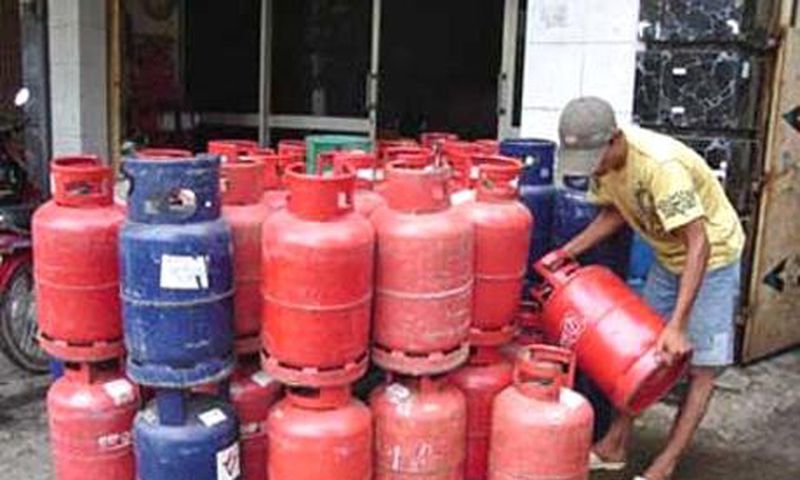
‘Price Of 5kg Cooking Gas Increased To ₦8,324’

Published

on

According to the National Bureau of Statistics (NBS), there was an increase in the average prices of cooking gas and kerosene across Nigeria in June 2025.

It was reports that the NBS revealed this in its “Cooking Gas Price Watch” report for June 2025, released on Thursday in Abuja.

The report disclosed that the average price of 5kg of cooking gas rose by 1.92 per cent to ₦8,323.95, up from ₦8,167.43 in May.

On a year-on-year basis, this marks a 19.49 per cent increase from ₦6,966.03 in June 2024.

Delta State recorded the highest average price at ₦9,243.38, while Oyo had the lowest at ₦7,100.00.

“Regionally, the South-South zone had the highest average price at ₦8,871.63, and the South-West the lowest at ₦7,960.42,” the report revealed.

Similarly, the average price of 12.5 kg of cooking gas increased by 1.46 per cent to ₦21,010.56 in June, compared to ₦20,709.11 in May.

This represents a 33.52 per cent year-on-year rise from ₦15,736.27 in June 2024.

Delta, Cross River, and Rivers recorded the highest prices, while Yobe, Niger, and Jigawa recorded the lowest.

Kerosene Price Watch

In its Kerosene Price Watch for June 2025, the NBS said the average price per litre of kerosene rose to ₦2,192.63, a 0.80 per cent increase from ₦2,175.29 in May.

“Year-on-year, the price increased by 41.00 per cent from ₦1,555.11 in June 2024. Kaduna recorded the highest average at ₦2,681.58, while Abia had the lowest at ₦1,659.35.

“The average price per gallon of kerosene climbed by 2.38 per cent to ₦8,684.15 in June, from ₦8,482.22 in May, and by 52.39 per cent compared to ₦5,698.68 in June 2024,” the NBS stated.

See also  CBN targets N2.83tn cash in private hands ahead of 2027 polls

The report said Edo recorded the highest price per gallon at ₦10,321.63, while Abia had the lowest at ₦6,737.40.

“Zone-wide, the South-South consistently reported the highest average prices across all petroleum products, while the South-West recorded the lowest,” the NBS said.

FOLLOW US ON:

FACEBOOK

TWITTER

PINTEREST

TIKTOK

YOUTUBE

LINKEDIN

TUMBLR

INSTAGRAM

Continue Reading
Click to comment

Leave a Reply

Your email address will not be published. Required fields are marked *

Business

Dangote refinery imports first UAE crude cargoes

Published

on

The Dangote Refinery has purchased two cargoes of crude oil from the United Arab Emirates, marking its first-ever procurement of Middle Eastern crude as it expands its feedstock sources amid persistent domestic supply constraints.

According to a report by S&P Global Commodity Insights, the two cargoes will be the first sourced by the 700,000-barrels-per-day refinery from any Middle Eastern supplier, signalling a shift from its traditional reliance on Nigerian, African, and United States crude grades.

The report said the purchases followed the resumption of oil exports from the Middle East after the United States and Iran reached an interim peace agreement that restored confidence in shipping through the Strait of Hormuz.

The refinery, designed primarily to process Nigeria’s light sweet crude, has increasingly diversified its crude slate as operations ramp up. S&P Global reported that an agreement between the refinery and the Nigerian National Petroleum Company had guaranteed the supply of between 13 and 15 cargoes of Nigerian crude monthly in naira, helping the refinery reduce its foreign exchange exposure.

However, the arrangement has faced challenges due to inadequate crude availability and operational issues at export terminals. According to the report, Dangote Refinery Chief Executive Officer David Bird had previously disclosed that these constraints had compelled the company to seek additional crude sources outside Nigeria.

The report added that the refinery’s expansion plans would further increase its crude requirements. Dangote plans to double the refinery’s processing capacity to 1.4 million barrels per day by the end of 2028, a level that would enable it to process about 80 per cent of Nigeria’s recent crude oil production in a single day.

See also  World Bank unveils $510m deal to boost investments

Speaking earlier this year, Bird said the refinery intended to increase the share of heavier crude grades in its feedstock mix. “We definitely want to heavy up the barrel,” Bird said in April.

He added, “We will be in the crude blending game. So you can easily imagine at 1.4 million b/d we could process 30 per cent Middle Eastern grades on each train.”

According to S&P Global, the refinery has been broadening the range of crude grades it processes as part of its ambition to operate as a fully merchant refinery. The report noted that in 2025, about 70 per cent of the refinery’s crude imports came from Nigeria, while 24 per cent originated from the United States.

punch.ng

FOLLOW US ON:

FACEBOOK

TWITTER

PINTEREST

TIKTOK

YOUTUBE

LINKEDIN

Continue Reading

Business

Five-month crude oil exports fetch Nigeria N20tn

Published

on

Nigeria exported an estimated 148.9 million barrels of crude oil valued at about N20.22tn in the first five months of 2026, showcasing the scale of the country’s oil trade despite persistent concerns over production levels.

The crude barrels were exported by both international and indigenous oil companies, including the Nigerian National Petroleum Company Limited.

While the export of crude oil may lead to a lack of sufficient domestic feedstock for Dangote Petroleum Refinery and other local refineries, it boosts the country’s foreign exchange earnings.

An analysis of crude oil production and export data for January to May 2026 showed that the country’s crude exports were worth approximately $14.66bn, equivalent to N20.22tn at an exchange rate of N1,380 to the dollar.

In comparison, Nigeria exported 154 million barrels of crude worth about $11.32bn during the same period of 2025. Although export volume in 2026 fell by 5.1 million barrels, representing a 3.3 per cent decline, the export value jumped by about $3.33bn, or 29.5 per cent, driven by significantly higher crude oil prices this year.

The figures obtained from the Central Bank of Nigeria indicate that the total volume of crude oil produced by the country during the five-month review period in 2026 was 216.85 million barrels, with a gross market value of approximately $21.28bn, or about N29.36tn, using the same exchange rate.

The calculations were derived from the average daily crude oil production and export volumes for each month, multiplied by the number of days in the respective months, and valued using the corresponding average monthly Bonny Light crude oil prices.

A breakdown of the CBN figures showed that Nigeria produced about 45.26 million barrels in January, 36.68 million barrels in February, 42.78 million barrels in March, 44.70 million barrels in April, and 47.43 million barrels in May.

Crude exports followed a similar trend, with 31.31 million barrels exported in January, 24.08 million barrels in February, 28.83 million barrels in March, 31.20 million barrels in April, and 33.48 million barrels in May.

See also  Class of 99: Create cottage industries, not N5,000 palliative – Former Govs tell Tinubu

Using the prevailing average crude prices for each month, January’s exports were valued at about $2.13bn, February $1.74bn, March $3.06bn, April $3.95bn, and May $3.77bn, bringing the cumulative export value to $14.66bn.

On the production side, crude output was valued at approximately $3.08bn in January, $2.65bn in February, $4.54bn in March, $5.67bn in April, and $5.34bn in May, resulting in a cumulative value of $21.28bn.

The data further showed that average daily crude oil production improved over the review period. Output increased from 1.46 million barrels per day in January to 1.53 million barrels per day in May after dropping to 1.31 million barrels per day in February.

Average daily crude exports also rose from 1.01 million barrels per day in January to 1.08 million barrels per day in May, despite recording 0.86 million barrels per day in February.

Overall, Nigeria exported about 68.7 per cent of the crude oil it produced during the five months, leaving roughly 67.95 million barrels available for domestic refining, storage, operational use, and inventory adjustments.

The effect of the US-Iran war was also felt in the monthly average prices of crude from March to May. In January and February, before the war started, average crude prices were $68.05 and $72.33 a barrel. But the prices jumped to $106.09 in March, $126.71 in April, and $112.63 in May, reflecting the sharp rise in crude prices due to the closure of the Strait of Hormuz.

The estimated values represent the gross market value of the crude oil based on average monthly international crude prices and do not reflect actual government revenue, which is affected by production-sharing contracts, royalties, taxes, operational costs, domestic crude supply obligations, and other commercial arrangements.

Year-on-year comparison

Meanwhile, Nigeria’s crude oil export earnings rose by almost 30 per cent in the first five months of 2026 despite a decline in export volumes, as higher international oil prices more than offset the lower shipments.

While the country exported an estimated 148.9 million barrels of crude oil during the period, approximately 154.0 million barrels were exported in the corresponding period of 2025.

See also  NNPC eyes $60bn investment, targets 600tcf in new master plan

The figures indicate that crude export volumes declined by about 5.1 million barrels, representing a 3.3 per cent year-on-year decrease. Average daily crude exports also dropped from 1.02 million barrels per day in the first five months of 2025 to 0.984 million barrels per day during the same period in 2026, a decline of 3.5 per cent.

Despite the lower export volumes, the estimated value of Nigeria’s crude oil exports surged to about $14.66bn between January and May 2026 from approximately $11.32bn recorded during the corresponding period of 2025.

This represents an increase of about $3.34bn, or 29.5 per cent, within one year. This highlighted the effect of the US-Iran conflict on crude prices this year.

At an exchange rate of N1,380 to the United States dollar, the estimated value of crude exports for the first five months of 2026 translates to approximately N20.22tn, compared with about N15.62tn in the same period of 2025.

The analysis showed that the increase in export earnings was driven largely by stronger international crude oil prices rather than higher export volumes.

Although Nigeria exported fewer barrels in 2026, the significantly higher crude oil prices, particularly in March, April, and May, boosted the overall market value of the country’s crude exports.

Domestic crude supply to Nigeria’s refineries declined to 15.84 million barrels in May 2026, even as the facilities achieved a combined intake of 17.92 million barrels for the month, according to the latest midstream and downstream statistics released by the Nigerian Midstream and Downstream Petroleum Regulatory Authority.

Across the first five months of the year, domestic supply to refineries had shown a generally upward trend, rising from 8.83 million barrels in January and 8.86 million barrels in February to 11.49 million barrels in March, before peaking in April and moderating in May.

See also  Fuel distribution controversy: Dangote restores marketers amid mounting pressure

As oil producers make money from high oil export volumes, local refiners said this was against the domestic crude supply obligation of the Petroleum Industry Act.

The Dangote refinery has recently accused the Federal Government and its agencies of alleged deliberate sabotage, undermining its operations and frustrating its investment in Nigeria’s downstream petroleum sector, an allegation the Federal Government denied.

In a recent affidavit filed before the Federal High Court in Lagos seeking an interim injunction to stop the issuance and renewal of petroleum import licences, the company said its operations are anchored on crude oil supply arrangements with the Nigerian National Petroleum Company Limited, which it described as central to its refining business.

The refinery said its business operations include purchasing crude oil from the Federal Government through the NNPC and refining products for sale to Nigerians to ease pressure on the government to make petroleum products available for local consumption.

The refinery, however, alleged that the government had failed in its obligation to ensure adequate crude supply to local refineries, claiming the development was deliberate and harmful to its investment.

Speaking with our correspondent, the publicity secretary of the Crude Oil Refinery Owners Association of Nigeria, Eche Idoko, said modular refineries did not receive crude from the Federal Government but from private oil producers.

“None of the modular refineries I know have gotten crude under the Federal Government arrangement. But I know that through private arrangements, the Edo refinery is getting it from Ingenti. Aradel is getting crude from EOP and a couple of other fields, too. Opac is getting from Pillar,” he said in a chat on Sunday.

Idoko appealed to the Federal Government to effectively implement the DSCO and make enough crude available to local refineries.

punch.ng

FOLLOW US ON:

FACEBOOK

TWITTER

PINTEREST

TIKTOK

YOUTUBE

LINKEDIN

Continue Reading

Business

VIDEO: My Mother Sold Akara And Bananas – Tinubu’s Aide Defends First Lady

Published

on

The Special Assistant to President Bola Tinubu on Media and Public Communications, Sunday Dare, has defended the recent statement by First Lady, Senator Oluremi Tinubu, on empowering Nigerians to explore small-scale businesses such as akara, roasted corn, and kuli-kuli, which require little capital.

It was reports that the First Lady, while speaking with journalists in a video that is making rounds online, explained the administration’s support for small businesses through grants rather than loans.

However, her comment angered many netizens, who argued that the remarks were insulting and failed to reflect or address the economic challenges facing many Nigerians.

Speaking against the backdrop of this development during an interview with Seun Okinbaloye on the Mic On podcast, Dare revealed that his mother trained him by selling bananas and oranges in Jos, Plateau State.

He added that he himself hawked the fruits in the Jos markets.

He argued that the resilience of Nigeria’s small-scale businesses continues to lift the country’s economy.

The presidential media aide submitted that the First Lady’s point was simply an encouragement for people to have some level of entrepreneurial skill and not remain idle.

According to him, if his own mother could do that sixty years ago and train him successfully, there is nothing wrong with what the First Lady said.

“My mother sold akara and bananas. I carried bananas on the trays on my head to the market in Jos. My mother sold oranges, and through this, they were able to train me,” the media aide said.

See also  Fuel distribution controversy: Dangote restores marketers amid mounting pressure

See the video.

FOLLOW US ON:

FACEBOOK

TWITTER

PINTEREST

TIKTOK

YOUTUBE

LINKEDIN

INSTAGRAM

Continue Reading

Trending