Connect with us

News

PHOTOS: Police disburse N29.6m to families of deceased officers in Sokoto

Published

on

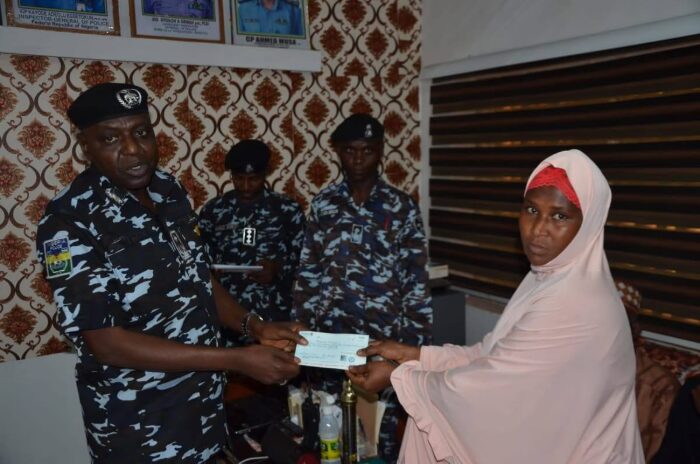
Sokoto State Police Command has disbursed N29.6 million in Group Life Assurance benefits to families of officers who died or sustained serious injuries in the line of duty.

The cheques, totalling N29,638,584.78, were presented to 10 beneficiaries on Tuesday.

The presentation was carried out on behalf of the Commissioner of Police, Ahmad Musa, by the Deputy Commissioner of Police in charge of Finance and Administration, Umar Sokoto, alongside members of the command’s management team.

Umar said the payment was part of the Nigeria Police Force’s Group Life Assurance Scheme aimed at providing financial support to families of deceased officers.

He urged the beneficiaries to make prudent use of the funds to support their households.

Speaking on behalf of the beneficiaries, Mrs Hamimatu Ahmad, widow of one of the deceased officers, expressed appreciation to the police authorities for the intervention.

The command said the disbursement forms part of ongoing welfare efforts for personnel and families of officers who died in active service.
FOLLOW US ON:


FACEBOOK

TWITTER

PINTEREST

TIKTOK

YOUTUBE

LINKEDIN

TUMBLR

INSTAGRAM

See also  Pope Leo names Nigeria among countries witnessing Christian persecution
Continue Reading
Click to comment

Leave a Reply

Your email address will not be published. Required fields are marked *

News

PHOTOS: Nigerian Army Attack, Burn Terrorist Camps In Kogi State

Published

on

Troops of the Nigerian Army, belonging to the 12 Brigade and operating under Operation Igbo Idanu I, have recorded a major victory against terrorists operating in Kogi State.

According to a statement by the Army on Wednesday, the troops dealt a decisive and strategic blow to a notorious terrorist network linked to Kachalla Ibrahim and Shu’aibu in Kogi State.

It was reports that the operation was personally led by the Commander of 12 Brigade, Nigerian Army, Brigadier General Kasim Umar Sidi.

During the operation, significant quantities of arms and ammunition, including eight boxes of 7.62 x 54 link ammunition containing bandolier of 250 rounds each and one box of high-velocity grenades were recovered from the terrorists’ base.

However, the terrorists themselves escaped into the bush upon sighting the advancing troops.

The terrorist camp and operational base were thereafter set ablaze to deny the criminals any opportunity of reoccupation.

The full Army statement on the operation reads: “Troops of 12 Brigade, Nigerian Army, have recorded a major operational success under Operation IGBO IDANU I, dealing a decisive strategic blow to a notorious terrorist network linked to Kachalla Ibrahim and Shu’aibu in Kogi State.

“Advancing through dense forest, difficult terrain, and multiple riverine obstacles, the troops displayed exceptional resilience, professionalism and tactical discipline. Despite severe movement constraints caused by fallen trees and marshy ground, the force pressed forward with determination, highlighting the unflinching resolve of the Nigerian Army to dismantle terrorist strongholds and restore lasting security in the area.

“The operation, personally led by the Commander 12 Brigade Nigerian Army Brigadier General Kasim Umar Sidi, involved troops dismounting and advancing on foot to achieve tactical surprise and operational dominance. This bold manoeuvre enabled the force to penetrate deep into the terrorist enclave, resulting in the complete overrun of the camp. Although the terrorists fled on sighting the advancing troops, a thorough exploitation of the objective led to the recovery of significant quantities of arms and ammunition, including eight boxes of 7.62 x 54 link ammunition containing bandolier of 250 rounds each and one box of high-velocity grenades. These recoveries have significantly degraded the terrorists’ operational capability and logistics base.

See also  Court bars Pat Utomi from establishing shadow government

“Following the successful clearance operation, the terrorist camp was systematically destroyed and set ablaze to deny the criminals any opportunity of reoccupation. Troops have continued aggressive patrols and sustained offensive operations within the general area to exploit the success, disrupt fleeing elements and prevent regrouping.

“This operation sends a clear and resounding message to terrorist elements that their hideouts will continually be identified and neutralised, reaffirming the firm commitment of the Nigerian Army to safeguarding lives, protecting communities and ensuring lasting peace and security across the region.”

FOLLOW US ON:

FACEBOOK

TWITTER

PINTEREST

TIKTOK

YOUTUBE

LINKEDIN

TUMBLR

INSTAGRAM

Continue Reading

News

US deploys 200 troops to Nigeria

Published

on

The United States has deployed about 200 troops to Nigeria to train the country’s military in the fight against Islamist militants, according to a report by The Wall Street Journal on Tuesday.

An American military official told the newspaper that the deployment comes weeks after US President Donald Trump accused Nigeria of failing to protect Christians from terrorist attacks.

The report said the troops were expected to strengthen Nigeria’s counterterrorism capacity through training and operational support.

It added that the newly deployed personnel would supplement a small number of US military advisers already in Nigeria, who assist local forces with intelligence to identify targets for military strikes, US and Nigerian officials said.

Speaking during a virtual briefing last Tuesday, the Commander of the United States Africa Command, Gen Dagvin R. Anderson, confirmed increased collaboration between both countries following high-level engagements.

He said, “I was able to meet President Tinubu. We were able to share some thoughts and agree that we needed to work together on a way forward in the region.

“That has led to increased collaboration between our nations, including a small US team that brings unique capabilities from the United States to augment what Nigeria has been doing for several years.”

The Defence Headquarters also clarified that Nigeria’s security partnership with the United States was focused on capacity building rather than combat operations.

According to the military, the collaboration covers professional military education, intelligence sharing, logistics support, and strategic dialogue aimed at addressing shared security challenges, particularly terrorism.

See also  VIDEO - Dangote Trucks Move Freely in China But Face Roadblocks in Nigeria | Must Watch!

This clarification followed media reports and public speculation suggesting the deployment of US troops in Nigeria.

In a statement, the Director of Defence Information, Maj Gen Samaila Uba, said all engagements with the United States were conducted with full respect for Nigeria’s sovereignty and within established bilateral frameworks.

“The Defence Headquarters has noted recent media reports and public speculation suggesting the presence or deployment of United States troops in Nigeria.

“The Armed Forces of Nigeria wishes to state that Nigeria maintains a long-standing and structured security partnership with the United States,” the statement read.

Also, President Tinubu on Sunday received a high-level US delegation led by the Commander of USAFRICOM at the State House in Abuja.

The delegation included Gen Anderson and his team, as well as the Chargé d’Affaires of the US Embassy in Nigeria, Keith Heffern.

The meeting focused on strengthening defence cooperation and regional security efforts.

Continue Reading

News

Electoral Act Amendment: Opposition protests as senators back manual results transmission

Published

on

The Senate on Tuesday bowed to intense public pressure and approved the electronic transmission of election results to the Independent National Electoral Commission’s Result Viewing Portal, IReV, while permitting manual collation to serve as a backup where technology fails.

The decision followed an emergency reconsideration of a disputed clause in the Electoral Act (Repeal and Re-enactment) Amendment Bill, 2026, after days of nationwide outrage, street protests, and sustained criticism from opposition figures, civil society organisations and youth movements.

However, the Upper Chamber stopped short of making electronic transmission compulsory and rejected calls for the explicit inclusion of real-time upload of results, a key demand by protesters who accused lawmakers of attempting to weaken electoral safeguards ahead of the 2027 general elections.

Under the reviewed provision, presiding officers at polling units are required to electronically transmit results to the IReV portal after voting and documentation have been completed.

The amendment, however, provides that where electronic transmission cannot be carried out due to communication or network challenges, the manual result sheet, Form EC8A, shall become the primary basis for collation and declaration.

While putting the motion to a voice vote, Senate President Godswill Akpabio urged senators who opposed the amendment to formally challenge it on the floor.

“It’s very simple. If you disagree with him, move your counter motion. So, if you agree with him, you agree with me when I put the votes,” Akpabio said.

He explained that the motion before the chamber sought to reverse an earlier Senate decision on Section 60, Subsection 3 of the Electoral Act, which had triggered public backlash.

“When I ask for the votes, when I ask for your consent, let me read the motion. His earlier motion, which passed in our last sitting, he has sought to rescind that. That is in respect of Section 60, Subsection 3. And this is what he said,” Akpabio stated.

Reading the amended clause, the Senate President said, “That the presiding officer shall electronically transmit the results from each polling unit to the IReV portal.

“And such transmission shall be done after the prescribed Form EC8A has been signed and stamped by the presiding officer and/or countersigned by the candidates or polling agents, where available at the polling units, because sometimes you don’t see any polling agent.”

Akpabio added that the law now accommodates situations where electronic transmission becomes impossible.

“Provided that if the electronic transmission of the results fails as a result of communication failure — in other words, maybe network or otherwise — and it becomes impossible to transmit the results electronically in Form EC8A signed and stamped by the presiding officer and/or countersigned by the candidates or polling agents where available at the polling units, the Form EC8A shall in such a case be the primary source of collation and declaration of results,” he said.

Despite the Senate’s clarification, the amendment has continued to raise concerns among opposition parties and civil society groups, who argue that allowing manual results to override electronically transmitted ones could weaken transparency and reopen the door to manipulation, particularly in areas with poor network coverage.

Dramatic reversal

The emergency plenary followed chaotic scenes in the Senate chamber earlier, after the Senate Chief Whip, Senator Tahir Monguno (APC, Borno North), raised a point of order seeking the rescission of the chamber’s earlier approval of Clause 60(3) of the bill.

Monguno anchored his motion on Orders 1(b) and 52(6) of the Senate Standing Orders, 2023 (as amended), and was seconded by Senator Abdul Ningi (PDP, Bauchi Central).

The move immediately sparked tension, with several senators raising points of order and shouting across the aisle.

Trouble escalated when Monguno read the revised Clause 60(3) without the phrase “real-time,” replacing the word “transmission” with “transfer.”

Senator Enyinnaya Abaribe (APGA, Abia South) objected strongly, repeatedly raising points of order as the chamber descended into uproar.

According to page 45 of the report of the Senate Committee on Electoral Matters, Clause 60(3) states: “The Presiding Officer shall electronically transmit the results from each polling unit to IREV portal in real time and such transmission shall be done after the prescribed Form EC8A has been signed and stamped by the Presiding Officer and/or countersigned by the candidates or polling agents available at the polling unit.”

At the height of the disagreement, Abaribe invoked Order 72 of the Standing Orders, calling for a formal division of the chamber.

Senate appoints committee

Amid mounting pressure, the Senate also appointed a 12-member conference committee to harmonise differences between its version of the Electoral Amendment Bill and that passed by the House of Representatives.

See also  Nigeria’s Inflation rate falls to 21.8% — NBS

Akpabio announced the names during the emergency plenary.

The committee is chaired by Senator Simon Lalong, with Senator Orji Uzor Kalu, Senator Tahir Monguno, Senator Adamu Aliero, Senator Abba Moro, Senator Asuquo Ekpenyong, Senator Aminu Iya Abbas, Senator Tokunbo Abiru, Senator Niyi Adegbonmire (SAN), Senator Jibrin Isah, Senator Ipalibo Banigo and Senator Onyekachi Nwebonyi as members.

Akpabio said, “After consultation with the leadership, we have moved the number from nine to 12. I will now read out the names of the conference committee members from the Senate.

“When you meet, you should recognise that this is a matter of urgency. I believe that if you are able to conclude within the next few days or one week, the President should be able to sign the amended Electoral Bill into law within the month of February.”

He added that the harmonised bill would be transmitted to President Bola Tinubu for assent before the end of the month.

Reacting to the development, Senator Orji Uzor Kalu, representing Abia North, defended the Senate’s position, describing it as a balanced approach.

In a statement shared on his Facebook page, Kalu said, “Today (Tuesday) at emergency plenary, I supported and added my voice to the Senate’s new position approving the electronic transmission of election results from polling units across Nigeria.”

He said the amendment makes electronic transmission the primary method when technology is available.

“This means electronic transmission becomes the primary method where the technology is available and functional.

“However, where it fails or becomes impossible, the duly signed Form EC8A remains the valid and primary source of results,” he added.

Kalu said the approach ensures inclusivity for communities with network challenges.

“This balanced approach strengthens transparency, fairness, and credibility in our electoral process, while ensuring that voters in network-challenged communities are not disenfranchised.

“Our democracy must work for every Nigerian, everywhere,” he said.

However, Senator Natasha Akpoti-Uduaghan (PDP, Kogi Central) publicly dissented, backing calls for the retention of real-time electronic transmission.

In a Facebook post ahead of the decisive sitting, she said Nigerians deserved elections that inspire trust.

“As I step into the Senate chamber today, I carry with me the hopes and expectations of millions of Nigerians who yearn for stronger democratic safeguards enshrined in our laws,” she wrote.

“Real-time electronic transmission of election results is a critical step toward deepening transparency, preserving the sanctity of the people’s mandate, and restoring public confidence in our electoral process.

“Our democracy must continue to evolve with systems that ensure every vote truly counts and every voice is faithfully represented.

“Nigeria deserves elections that inspire trust, strengthen unity, and reflect the genuine will of the people.”

Her intervention followed mass protests at the National Assembly Complex, where demonstrators under the banner Occupy the National Assembly accused lawmakers of rolling back reforms ahead of 2027.

Atiku, Amaechi, El-Rufai

Former Vice President Atiku Abubakar also slammed the Senate over the manual transmission clause.

At a press briefing in Minna, Niger State, following a closed-door meeting with former Military President General Ibrahim Babangida, Atiku said the current mixture of electronic and manual transmission could create challenges for voters and electoral officials.

“The expectations of Nigerians, Nigerians who are expecting real-time electronic transfer to the various levels of the elections, but what we got is a mixture of electronic and manual transmission, which is going to cause more confusion or chaos than if we had a single-tier, you know, electoral transmission system, which is real-time electronic.

“That would be our preference. And I think there is a need for all the opposition political parties to come together to pursue this issue,” he said.

He described the Senate’s recent adoption of the amended Clause 60(3) of the Electoral Act—which allows electronic transmission of results while keeping manual collation as a backup—as a compromise that falls short of full transparency.

“I mean, we shouldn’t allow it to rest where they wanted it to rest today. Absolutely not. I don’t support that,” he added.

Former Rivers State Governor Rotimi Amaechi joined protesters at the National Assembly, warning that real-time transmission could save lives.

Amaechi joined protesters on Tuesday at the National Assembly Complex in Abuja, demanding that the proposed amendment to the Electoral Act explicitly require the Independent National Electoral Commission to transmit results electronically in real time from polling units.

“The advantage is that very few people will die on the election field, very few Nigerians. You are saving the lives of Nigerians,” Amaechi told the crowd, warning that every election season sees citizens killed in large numbers while officials shield themselves behind security forces.

“If you think they won’t rig, you’re wasting time. To stop them from rigging, we must come out in large numbers. We must mobilise to march police for the police. When they see the number of people who have come out, they will join,” he added.

See also  Pope Leo names Nigeria among countries witnessing Christian persecution

Amaechi expressed frustration with what he described as indifference from government authorities.

“The problem is not even Ribadu. Even the President doesn’t think the citizens matter,” he said, referencing previous election-related violence.

“The only way to save Nigerians from electoral violence is to allow transmission, re-transmission.”

Former Kaduna State Governor, Nasir El-Rufai, has said he would have joined the protest led by former Labour Party presidential candidate, Peter Obi, against the National Assembly if he had been in the country.

Speaking during an interview on Trust TV on Monday, El-Rufai criticised the Senate for altering provisions on the electronic transmission of election results in the proposed Electoral Act amendments, stressing that real-time transmission is critical to preventing manipulation.

He added that the delays and resistance surrounding the reform are politically motivated and designed to preserve electoral advantages.

“It’s unfortunate I have not been able to return to Nigeria, I would have joined Mr Peter Obi and other party leaders in protesting to the National Assembly to restore the real-time and mandatory transmission of results from the polling unit,” El-Rufai said.

He argued that adopting real-time electronic transmission would significantly reduce rigging and improve the credibility of elections, accusing the ruling party of opposing the measure for survival reasons.

The former governor also noted that while the House of Representatives had aligned with the reform, the Senate had yet to fully embrace it.

Former presidential candidate and activist Omoyele Sowore also stormed the National Assembly complex in Abuja to join protesters demanding electoral reforms.

Sowore, who addressed supporters shortly after his arrival, said Nigeria’s political class could not reform itself, accusing elected officials of betraying the electorate once they assume office.

“Prepare to see the end of this political class. Nobody can reform them. Some of the people who voted for the removal of this particular section of the electorate were people who were with you, deceptively, in 2022 and 2023.

“The moment they entered that evil chamber, they switched seats. They forget you,” he said.

The activist urged Nigerians to remain united, insisting that the protest was part of preparations for future actions rather than a one-off demonstration.

“We are doing this when you see us. It’s not for the sake of protesting alone that I’m here. We are here to prepare for the near future,” he said.

Sowore further declared that sustained mass action would be necessary to achieve meaningful change in the country.

He argued that elections alone could not resolve Nigeria’s challenges, calling instead for what he described as an “electoral revolution.”

“I don’t believe that elections by themselves can resolve Nigeria’s problems. It has to be an electoral revolution, or a revolution that brings about an election,” Sowore said.

Opposition, CSOs

Opposition parties also kicked against the retention of the manual transmission of electoral results.

The Peoples Democratic Party criticised the Senate’s decision, describing the inclusion of a manual transmission clause as a “backdoor move” that could weaken electoral reforms.

In a statement by its National Publicity Secretary, Ini Ememobong, the PDP said the Senate’s decision fell short of public expectations.

“We have taken note of the Senate’s reconsideration, which introduced an addendum permitting manual transmission where technology is said to fail,” the party said.

“We hold the firm view that this addendum is a backdoor attempt to achieve the same objective as the earlier outright rejection of electronic transmission.”

The party also questioned claims that technology would fail, noting that the Bimodal Voter Accreditation System had consistently functioned during elections.

The PDP urged the conference committee of the National Assembly to adopt the version of the bill passed by the House of Representatives as the harmonised position ahead of the 2027 general elections.

The New Nigeria People’s Party also expressed reservations over the Senate’s proviso.

Its National Publicity Secretary, Ladipo Johnson, said the clause created room for manipulation.

He said, “The Senate and the APC generally have proved themselves to be unwilling participants in the process of ensuring that our democracy becomes more transparent and efficient. Therefore, it is difficult to trust them.

See also  US gospel music icon Ron Kenoly dies at 81

“They have left a proviso. And that proviso means that if they do instigate the rigging that Nigerians are so afraid of, nothing stops polling units officers in areas that are determinants to the nation from beginning to say, ‘my network is not going, and I have to take it by hand.’

“So, Nigerians should still be wary and should remember that this party is the one that failed and has shown itself to be reluctant to push democracy and elections to where we want them to be.”

The African Democratic Congress commended Nigerians for forcing the 10th Senate to reverse controversial provisions in the Electoral Act Amendment Bill, describing the development as a victory for democracy and people-driven civic action.

In a statement on Tuesday by its National Publicity Secretary, Bolaji Abdullahi, the party urged Nigerians to remain vigilant and sustain pressure until the amended bill is assented to by the President, gazetted and fully implemented.

“The decision of the 10th Senate to urgently reverse the contentious provisions of the Electoral Amendment Bill is a significant victory for the Nigerian people,” the party said.

“It demonstrates that when citizens act with unity, clarity of purpose and resolve, they can move mountains. This is not just a legislative U-turn but a testament to the vigilance and resilience of Nigerians.”

Abdullahi warned that the Senate’s action marked only a step forward, urging citizens to ensure the process is not undermined at later stages.

“We must remain vigilant to ensure there are no last-minute betrayals or technical ambiguities that could undermine the will of the people,” he added.

Similarly, the National Coordinator of the Obidient Movement Worldwide, Dr Yunusa Tanko, described the Senate’s decision as inconclusive.

According to him, allowing manual transmission could lead to chaos and manipulation at polling units.

He said, “The truth about it is that the pressure that was put on the Senate actually led to this particular inconclusive decision. I call it an inconclusive decision because it’s going to lead to a chaotic situation at each of the polling units. It is going to give more room for people to manipulate the system.

“They need to be decisive on this particular matter. It’s not as if one is pushing it beyond the boundary, but there must be more clarity into it. I’ll give you an example. If you go to an area where you assume that the place does not have a network, that can be said by any agent of the party, even though there is a network there.

‘How do we ensure that their particular result will get even the transmission that we need? So, it’s a chaotic situation, and it’s embarrassing that one senator will say that his area does not have a network. That senator should be recalled because he did not serve the people.

“In the 21st century, we are talking about no network in certain areas. It’s quite embarrassing. India alone would mean that billions of people can transmit results in one day during their general election. And they have more population and landmass. It is not rocket science,” he fumed.

Civil society organisations also criticised the Senate’s decision, warning that it could weaken electoral transparency.

The Executive Director of the Civil Society Legislative Advocacy Centre, Auwal Musa, also known as Rafsanjani, described the action as contradictory.

“What they have done is to give Nigerians something with one hand and take it back with the other,” he said.

Musa warned that retaining manual collation created excuses for manipulation and undermined public trust.

“Election rigging starts from the legal framework,” he said, urging Nigerians to sustain pressure until credible reforms are achieved.

The Coordinator, Nigeria Civil Society Situation Room, Agianpe Onyema, said civil society groups would focus on engaging the conference committee of both chambers.

She urged lawmakers to adopt the House of Representatives’ version of the bill, insisting on mandatory real-time electronic transmission of results to the IReV portal.

“What we are asking for is simple — real-time, mandatory electronic transmission of results, no more, no less,” Onyema said.

As pressure mounts, attention has shifted to the conference committee and President Bola Tinubu’s eventual assent.

With the 2027 general elections approaching, analysts say the final outcome of the Electoral Act amendment may shape not only the credibility of future polls but also public trust in Nigeria’s democratic institutions.

Continue Reading

Trending