

Connect with us

Education

At least five girls k!lled after missile strikes Iranian primary school

Published

on

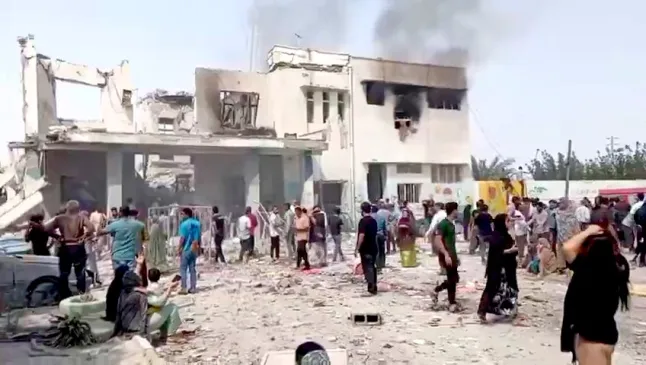
At least five people have been killed in an airstrike on a girls’ school in southern Iran, according to local officials, with dozens more reported injured in what has become one of the deadliest incidents since the latest wave of regional attacks began.

The strike reportedly hit Minab Girl’s Primary School in Hormozgan province. Authorities in the area attributed the attack to Israeli forces, according to Sky News. One official said: “In today’s attacks by the Zionist regime on Minab city, a girls’ elementary school was targeted and so far 5 students have been martyred”.

Iran’s state-run IRNA news agency reported a significantly higher toll, claiming that more than 40 people were killed at the school. It added that a further 45 were wounded, though no additional details were provided about the nature or severity of their injuries.

Minab is believed to host a base linked to the Islamic Revolutionary Guard Corps (IRGC), the powerful military organisation at the centre of Iran’s security apparatus.

The strike came hours after US President Donald Trump issued a warning to the IRGC, telling the group to lay down its arms or “face certain death”. In a speech earlier in the day, Trump said he would “raze” Iran’s military sites to the ground and called on Iranian citizens to remove Supreme Leader Ali Khamenei’s government from power.

The Israel Defense Forces (IDF) said it had carried out strikes on multiple targets in western Iran as part of a joint military campaign with the United States, referred to as Operation Roaring Lion. An Israeli official told journalists that the operation had been planned for months and was intended to go beyond previous strikes conducted last year, when Trump said he had “obliterated” Iran’s nuclear facilities.

See also  Rivers to partner stakeholders for educational development

In Tehran, highways became gridlocked as large numbers of residents attempted to leave the capital amid reports of incoming strikes. Witnesses described long queues forming at petrol stations and cash machines, while images circulating online showed charred vehicles and debris scattered across city streets. Many residents expressed fears that an internet blackout would leave them unable to contact family members abroad.

Maryam, a 54-year-old housewife in Tehran, told Reuters she was leaving the city with her family for northern Iran. “We are being killed by the regime and by Israel. We are the victims of this regime’s hostile policies,” she said.

In his address, Trump urged Iranian civilians to remain sheltered during the operation, saying they would later have an opportunity to “take over the government”.

Satellite imagery cited by the New York Times appeared to show extensive destruction at a compound in Tehran believed to be the residence of Supreme Leader Ali Khamenei. However, reports indicate he was not present in the capital at the time of the strike, having been moved to a “secure location”. He has not appeared publicly for several days.

Officials have said that several senior Revolutionary Guard commanders and political figures have been killed in the broader wave of attacks. The escalation has not been confined to Iran. Airstrikes have also been reported in neighbouring countries, including at a US air base in Bahrain.

Explosions were heard across the United Arab Emirates, including in Abu Dhabi and Dubai, prompting the suspension of flights from both cities. Doha airport in Qatar, a major hub for regional travel, was also affected as airlines responded to the growing instability across the Gulf.

See also  Some private universities running like business centres – Ex-NOUN VC

FOLLOW US ON:

FACEBOOK

TWITTER

PINTEREST

TIKTOK

YOUTUBE

LINKEDIN

TUMBLR

INSTAGRAM

Continue Reading
Click to comment

Leave a Reply

Your email address will not be published. Required fields are marked *

Education

JAMB releases Monday’s UTME results

Published

on

The Joint Admissions and Matriculation Board (JAMB) has released the results of candidates who sat the 2026 Unified Tertiary Matriculation Examination on Monday, April 20.

Its spokesperson, Fabian Benjamin, disclosed this in a statement released on Tuesday, directing affected candidates to the board’s standard result-checking channels.

“The results for Monday, 20th, have been released. Candidates can view their results using the usual process,” the statement read.

Candidates can access their scores by sending “UTMERESULT” to 55019 or 66019 via SMS, using the phone number with which they registered for the examination.

Monday’s release is the latest in a series of daily result announcements that JAMB has been making since the 2026 UTME commenced on Thursday, April 16.

The exercise, which involves over two million candidates sitting computer-based tests at centres across the country, has seen the board publish results in batches corresponding to each examination day.

The board started the process by releasing results for Thursday’s candidates, followed by a combined batch covering Friday, April 17, and Saturday, April 18.

The Friday-Saturday release, however, came later than candidates had expected. JAMB had initially indicated the results would be available on Saturday but failed to meet that timeline, drawing frustration from candidates who waited through the night.

The board subsequently apologised, attributing the delay to the absence of its chief executive, who was occupied with an official engagement.

The results were eventually published on Sunday, April 19, before the board moved on to process and release the Monday batch.

See also  2026 CBT rollout on track, says WAEC

punch.ng

FOLLOW US ON:

FACEBOOK

TWITTER

PINTEREST

TIKTOK

YOUTUBE

LINKEDIN

INSTAGRAM

Continue Reading

Education

JAMB releases over 1.8 million UTME results nationwide

Published

on

The Joint Admissions and Matriculation Board (JAMB) has announced the release of results for candidates who sat the 2026 Unified Tertiary Matriculation Examination on Friday, April 17, and Saturday, April 18.

In a statement issued on Sunday by its spokesperson, Fabian Benjamin, the board said 1,264,940 results from the two days had been processed and made available for candidates.

“The results of candidates who sat the examination on Friday, 17 April and Saturday, 18 April 2026 have now been released.

“A total of 1,264,940 results from these two days are available for candidates to check/view,” the statement read.

The board noted that this latest batch follows an earlier release of results for candidates who wrote the examination on Thursday, April 16.

“The board had earlier released 632,752 results of candidates who sat the examination on Thursday, 16 April 2026. This brings the total number of results released so far to 1,897,692,” it said.

JAMB urged candidates to access their results through its designated SMS channels, maintaining its standard result-checking procedure.

“To view their results, candidates should send UTMERESULT to 55019 or 66019 using the phone (SIM) number they used to register for the 2026 UTME,” the statement added.

The examination body further explained that the results released so far represent outcomes from the first three days of the nationwide exercise.

The UTME, which commenced nationwide on Thursday, is expected to have over two million candidates participating across various computer-based test centres.

punch.ng

FOLLOW US ON:

FACEBOOK

TWITTER

PINTEREST

TIKTOK

YOUTUBE

LINKEDIN

INSTAGRAM

See also  Some private universities running like business centres – Ex-NOUN VC
Continue Reading

Education

SSANU rejects FG’s 30% pay rise offer

Published

on

The Federal Government has approved a 30 per cent increase in the consolidated salary structure of SSANU – non-academic staff in federal universities, polytechnics and colleges of education under.

The move is aimed at easing long-standing labour tensions and boosting morale across Nigeria’s tertiary education system.

The approval comes after years of agitation by non-academic staff unions, particularly the Senior Staff Association of Nigerian Universities and the Non-Academic Staff Union, over salary disparities and unpaid allowances.

It also followed approval of a 40 per cent pay rise granted to the Academic Staff Union of Universities by the Federal Government.

However, the National Executive Council of the SSANU has insisted that no final agreement has been reached.

It threatened industrial action if talks were not concluded by the end of April.

In a letter dated March 30, 2026, and signed by the Minister of Education, Dr Tunji Alausa, the government said the increment would be implemented as a Consolidated Non-Teaching Tools Allowance.

“I write to convey the approval of His Excellency… for a thirty per cent (30%) increase in the consolidated salary structures of non-academic staff of federal universities, polytechnics and colleges of education,” the minister stated.

The directive, addressed to the Executive Secretary of the National Commission for Colleges of Education, National Universities Commission and the  National Board for Technical Education, indicated that details of the implementation are contained in an attached memorandum.

Alausa said the decision reflected the government’s commitment to improving the welfare and productivity of non-academic staff, who play critical administrative and technical roles in higher institutions.

See also  Some private universities running like business centres – Ex-NOUN VC

“This approval underscores the Federal Government’s commitment to enhancing the welfare, motivation, and productivity of non-academic staff,” he said, adding that it would also strengthen “the quality, stability and global competitiveness of Nigeria’s tertiary education system.”

He further urged relevant agencies to ensure the smooth execution of the policy.

“We look forward to your usual cooperation and support for the seamless and timely implementation of this approval,” the minister added.

SSANU’s position rejecting the agreement was contained in a communiqué issued at the end of a special NEC meeting held on Saturday at the union’s National Secretariat in Abuja, where leaders reviewed developments in the negotiation process.

According to the communiqué signed by the National President of SSANU, Muhammad Ibrahim, and forwarded to the press on Sunday, the NEC reaffirmed that “the renegotiation process with the Federal Government is still ongoing and has not been concluded.”

The council also expressed concern over what it described as misleading reports in the public space, suggesting that the process had been concluded.

It specifically pointed to the circulation of a letter allegedly indicating approval of a 30 per cent increase in allowances, insisting that discussions were still ongoing and no binding agreement had been signed.

NEC stated that “SSANU will not accept any outcome that falls below the negotiated understanding reached in the course of the renegotiation process, and insists that fairness, due process, and collective bargaining principles must be respected.”

Reiterating its earlier stance under the Joint Action Committee of NASU and SSANU, the council maintained the ultimatum given to the Federal Government from April 1 to April 30, 2026, to conclude negotiations and sign agreements.

See also  NELFUND extends loan application deadline

It warned that failure to meet the deadline would leave the unions with no choice but to embark on industrial action.

The communiqué stated that SSANU “will have no alternative but to, along with NASU, commence an indefinite, comprehensive, and total industrial action.”

The council urged members across all branches to remain calm but vigilant, and to stay united in readiness to comply with any directives issued by the union leadership.

“NEC called on all members of the union across the branches to remain calm, vigilant, united, and prepared to fully comply with the decisions of the Union in defence of their welfare, dignity, and collective interest,” the communiqué read.

It further reiterated SSANU’s commitment to defending members’ rights and welfare, stating that the union “will continue to pursue justice with firmness, unity, and resolve.”

The latest warning follows an earlier communiqué issued after SSANU’s 54th National Executive Council meeting held at Ekiti State University, where the union expressed dissatisfaction with the slow pace of renegotiations and issued a final ultimatum to the Federal Government.

At the time, SSANU also raised concerns over salary delays, poor funding of universities, and deteriorating working conditions across the system.

Meanwhile, the National Commission for Colleges of Education has directed provosts of federal colleges of education to commence necessary processes for the implementation of the new payment plan.

The memo, issued on behalf of the Executive Secretary, Dr Angela Ajala, instructed bursars and institutional heads to take note of the development and align with the new salary structure.

See also  NANS faults Daniel’s endorsement, hails Abiodun

“On behalf of the Executive Secretary… I write to respectfully bring to your attention the recent approval by the Federal Government… the thirty per cent (30%) increase in the consolidated salary structure of non-teaching staff,” the commission stated.

It added that the minister’s approval had been attached to guide execution, signalling the start of formal rollout across federal colleges of education.

Both unions have repeatedly embarked on industrial actions in recent years, protesting what they described as inequitable treatment compared to academic staff under the Academic Staff Union of Universities.

Strikes by SSANU and NASU have disrupted administrative operations across campuses, affecting student services, examination processing, and institutional governance.

Their demands have typically included improved remuneration, payment of earned allowances, and inclusion in government intervention funds.

Continue Reading

Trending