Connect with us

Education

School owners fear 700,000 Ogun students may miss WASSCE, see reason

Published

on

Private school proprietors in Ogun State have raised concerns over what they described as stringent conditions imposed by the state government before granting clearance for students to register for the May/June West African Senior School Certificate Examination.

The proprietors, who spoke on condition of anonymity, warned that over 70 per cent of students in private schools across the state could miss this year’s WASSCE if the issues are not urgently addressed.

They alleged that while schools in other states had largely completed registration with the West African Examinations Council, private schools in Ogun State were facing administrative challenges arising from new compliance requirements.

One of the proprietors said the dispute centres on the mandatory requirement for students to possess a Learner Identification Number before being registered for WASSCE.

“The issue we are having with the government revolves around making it mandatory for the students to be registered for the WASSCE to have a Learner Identification Number.

“Though the LIN is usually given to the students by the government once enrolled in any school in the state, be it public or private, there has been so much chaos, complaints and challenges with the online platform through which these numbers are generated.

“We were formerly on OGSERA, but recently we have migrated to DIPER. However, there have been so many problems with the platform; some students whose names were originally registered on the platform can no longer find their names.”

He further stated that the government had directed that Senior Secondary School 3 students who transferred from other states and did not have LIN must present additional documentation.

See also  FG and ASUU clash over 2021 agreement

“The government has also demanded that the SS3 students who probably migrated from another state into the state and join our schools in SS2 and are without the LIN should produce their JSS3 certificates in addition to their first, second and third term results which they obtained in their former schools while they were in SS1 and SS2 before such students could be registered for WASSCE,” he added.

According to him, meeting the requirements within the limited timeframe is impractical.

“We are even wondering where all of these conditions are coming from because this is not the case in any state around us.

“And even if we say that we want to fulfil these conditions, the time is not just there. Some of these students may not even be able to produce their results because of some circumstances that may be beyond their control.

“We are saying that the government should allow us to register these children because the time they rolled out these policies and the time for implementation is too short.

“We therefore plead with the government to shelve this policy for now because if the government fails to shift ground, nothing less than 70 per cent of students in private schools in the state will not sit for the examination.”

Another proprietor corroborated the concerns, describing the implementation timeline as unrealistic.

“We also want the state to move forward, but our policies must wear a human face.

“Asking us to produce the SS1 and SS2 first, second and third term results of students who came from other states and are now in SS3 before we can register them for WASSCE within the time frame is not just realistic.

“The WAEC registration schedule has been extended for about two or three times; the registration can close anytime from now, and that is why we are begging for Governor Dapo Abiodun’s intervention.

See also  NDLEA, HEPPWAS warn students against drug abuse

“The governor should please prevail on the Commissioner for Education, Science and Technology, Prof Abayomi Arigbabu, to put on hold this policy until we are given sufficient notice, maybe against next year for the implementation of this policy,” he said.

In a separate statement, another school owner warned that more than 70 per cent of private school SS3 students risk being unable to sit for the examination if the matter was not resolved.

“The major concern is that students who previously had valid LIN (Learners Identity Numbers) on the system are now unable to retrieve or verify them.

“Despite these technical inconsistencies, the state has insisted that no student will be cleared for WAEC registration unless properly validated on the platforms.

“Public policy must always wear a human face. In seeking to correct irregularities within the system, care must be taken not to punish compliant schools and innocent students because of the misconduct of a few,” the school proprietor warned.

A viral message circulating on Sunday and addressed to the Speaker of the state House of Assembly also warned that not fewer than 700,000 private school students might miss the examination if the issues were not resolved.

Responding, the Ogun State Commissioner for Education, Science and Technology, Prof Arigbabu, said the government’s action was aimed at curbing examination malpractice.

He explained that the LIN, introduced about five years ago, was designed to enable the state to maintain comprehensive data on students in both public and private schools.

“Every student schooling in the state is supposed to have the Learner Identification Number. It is what every student is given once you are registered in any school in the state, and this is what we started five years ago, so it is not what you should be looking for when you are in SS3,” the commissioner said.

See also  Ekiti schools to resume Monday – Commissioner

He dismissed allegations that the policy was punitive.

“Many of these private schools will register all kinds of persons for WASSCE, and I don’t even have problems with that, but most of the candidates registered won’t be the ones sitting for the examination.

“So, if you cannot produce the LIN, we will definitely know that you have something up your sleeves. For those having genuine problems with their LIN as regards the technical glitches, we are addressing that genuinely,” he added.

Arigbabu maintained that while the government was willing to consider genuine complaints, it would not compromise on efforts to sanitise the examination process.

“We are just very keen to sanitise the entire process, and we shall definitely look at those with genuine complaints, but I can tell you that many of those complaining are actually feeling the heat.

“We have continued to block every leakage to fight these challenge and we won’t relent,” he said.

punch.ng

FOLLOW US ON:

FACEBOOK

TWITTER

PINTEREST

TIKTOK

YOUTUBE

LINKEDIN

TUMBLR

INSTAGRAM

Continue Reading
Click to comment

Leave a Reply

Your email address will not be published. Required fields are marked *

Education

Abia varsity chancellor tasks new veterinary doctors on food safety, public health

Published

on

The Vice-Chancellor of Michael Okpara University of Agriculture, Umudike, Prof. Ursula Ngozi Akanwa, has charged new veterinary doctors of the University to uphold the ethics and values of their profession while ensuring food safety and safeguarding public health.

Prof. Akanwa gave the charge while addressing graduands of Doctor of Veterinary Medicine (DVM) during the 12th Induction and Oath-taking Ceremony organised by the University in collaboration with the Veterinary Council of Nigeria (VCN) on Wednesday.

The VC, represented by the Deputy Vice-Chancellor Academic, Prof. Nneoma Elechi Obasi, said the induction confers legal rights on the graduands to practice Veterinary Medicine and places on them the responsibility of safeguarding animal health, food systems and public health.

“Today is not merely ceremonial; it marks the transition of our graduands into professionals entrusted with the health of animals, the safety of our food systems and the protection of public health,” she said.

She stressed that the ceremony reflects the University’s mandate to produce professionals with competence, character and conscience, describing the new veterinarians as critical to agricultural growth and national food security.

The VC also commended the Veterinary Council of Nigeria for granting full accreditation to the University’s Veterinary programme and acknowledged the partnerships with industry operators that support practical training of MOUAU Vet. students.

On its part, the Veterinary Council of Nigeria, led by its President, Prof. Mathew Adamu and Ag. Registrar, Dr. Oladotun Fadipe, while issuing practising licenses to the graduands, congratulated the University for regularly churning out quality DVM Graduands, who are found worthy in learning and character.

See also  How Edo man sponsored me from Almajiri school to university – Jigawa varsity graduate

A total of 48 DVM Graduands were inducted into the profession, with Dr Chimezie Amarachi Blessing emerging as the overall best graduating student, and Dr Aniorji Sandra Chinonso won the Farm Alert Award.

punch.ng

FOLLOW US ON:

FACEBOOK

TWITTER

PINTEREST

TIKTOK

YOUTUBE

LINKEDIN

INSTAGRAM

Continue Reading

Education

School closures threaten national stability, FG warns

Published

on

The Secretary to the Government of the Federation, Dr George Akume, on Wednesday warned against the continued closure of schools due to insecurity, saying it poses a serious threat to Nigeria’s education system and long-term national stability.

Akume said shutting down schools in unsafe areas not only disrupts learning but also deepens the country’s education crisis.

A statement by Akume’s media aide, Yomi Odunuga, said the SGF spoke in Abuja at the first triannual meeting of the Nigerian Inter-Religious Council, held under the theme, “Religious Literacy for National Cohesion.”

The SGF called for the strengthening of government policies on safe schools and violence-free learning environments.

“The SGF also raised concerns over insecurity in the education sector, warning that attacks on schools and prolonged closures in unsafe areas continue to worsen Nigeria’s education crisis.

“He said government policies on safe schools and violence-free learning environments must be strengthened to protect children and ensure uninterrupted learning,” the statement partly read.

According to him, it was impossible to encourage children to learn when schools were not secure.

“A child cannot learn fraternity in fear; a nation cannot preach literacy while schools are under threat,” he said.

Akume emphasised that while religious studies are already part of the school curriculum, priority must now be placed on improving teaching quality through better-trained educators, enhanced learning materials and value-based education that promotes tolerance and responsible citizenship.

Beyond education, the SGF urged religious and traditional leaders to play a more active role in preventing violence and fostering unity as the country prepares for the 2027 general elections.

See also  Ondo approves N350m for student scholarships, bursaries

He said faith-based and traditional institutions must lead efforts in grassroots mobilisation, youth education and peace-building to counter misinformation, stereotypes and identity-based divisions that often trigger conflict.

“The 2027 general elections are fast approaching, and religious and traditional leaders have a moral responsibility to strengthen collaboration, promote tolerance and ensure peaceful coexistence in their communities,” Akume said.

He warned against the manipulation of religion and identity for political or economic gains, noting that such actions often fuel violence and social unrest.

Akume also stressed the importance of combining religious literacy with media and information literacy to combat the spread of falsehoods and hate speech, referencing Nigeria’s collaboration with the United Nations Educational, Scientific and Cultural Organisation on promoting responsible information sharing.

He added that the Federal Government had put measures in place to support religious and traditional institutions in sustaining peace and security ahead of the elections.

The SGF expressed optimism that deliberations at the NIREC meeting would yield practical solutions to strengthen national cohesion, while urging stakeholders to prioritise education and literacy as key tools for peace-building and development.

punch.ng

FOLLOW US ON:

FACEBOOK

TWITTER

PINTEREST

TIKTOK

YOUTUBE

LINKEDIN

INSTAGRAM

Continue Reading

Education

FG loans N11.8bn to 6,842 tertiary institution workers

Published

on

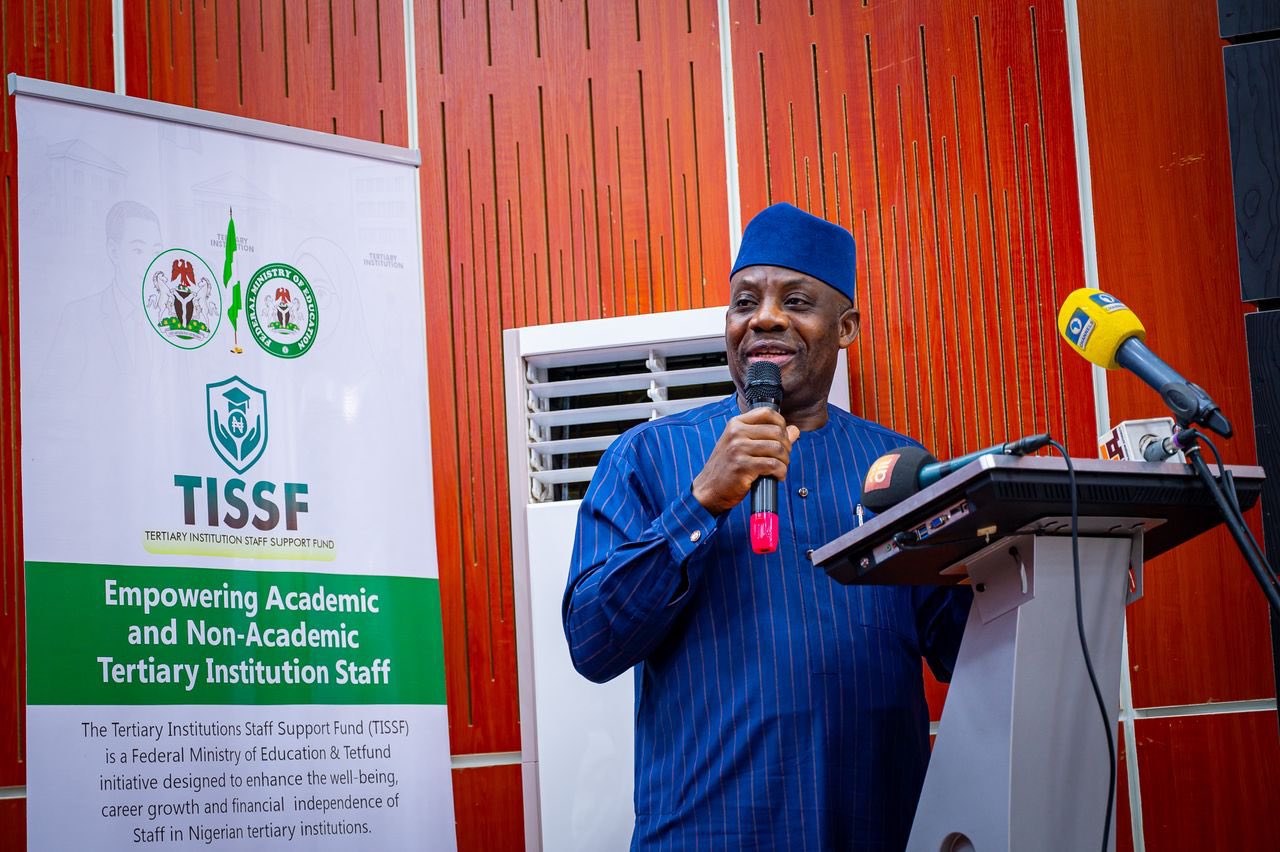
The Federal Government has disbursed N11.8bn to 6,842 academic and non-academic staff across Nigerian tertiary institutions under the Tertiary Institutions Staff Support Fund.

The beneficiaries span 141 institutions, including federal universities, polytechnics, and colleges of education.

The TISSF, launched in August 2025, is a Federal Ministry of Education and TETFund-funded programme dedicated to enhancing the well-being, career development and financial stability of tertiary institution staff across Nigeria.

The joint initiative of the FME and TETFund aims to deliver zero per cent interest loans to enhance the welfare, career development and financial stability of tertiary institution staff.

The fund provides interest-free loans of up to N10m to eligible academic and non-academic staff.

Data published on the website of the Federal Ministry of Education, obtained by our correspondent, showed that there have been 34,000 verified applicants from 219 institutions so far.

Staff members of federal universities constitute the highest number of applicants (59 per cent), followed by those of polytechnics (23 per cent) and colleges of education (18 per cent).

Also under the Nigeria Education Sector Renewal Initiative, 240 e-tricycles are reported to have been distributed across 12 institutions.

Key facts published on the website include: “Loans up to N10m per staff (0% interest); N11.8bn disbursed to 6,842 beneficiaries from 141 institutions.

“34,000 verified applicants from 219 institutions; Federal universities (59%), polytechnics (23%), COEs (18%); minimum five years to retirement required for eligibility.”

Other ongoing programmes under the initiative include the EduRevamp Teacher Platform, a digital training system introduced earlier this year to strengthen educators’ skills, and the School Safety Portal, developed in partnership with the Nigeria Security and Civil Defence Corps to improve security management in schools.

See also  Ondo approves N350m for student scholarships, bursaries

The ministry said the EduRevamp platform, launched at the first National Teacher Summit in January 2026, has recorded “37,000 registered users, with 18,000 teachers fully enrolled in its training modules.”

The platform provides audio and video lessons, case studies and certification opportunities for continuous professional development.

The School Safety Portal, created under the School Safety Act of 2025, currently contains data on more than 156,000 geolocated schools.

punch.ng

FOLLOW US ON:

FACEBOOK

TWITTER

PINTEREST

TIKTOK

YOUTUBE

LINKEDIN

INSTAGRAM

Continue Reading

Trending