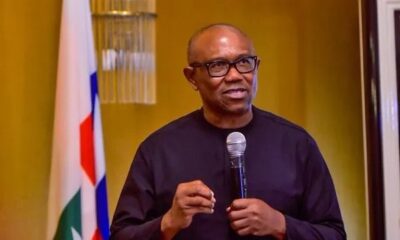


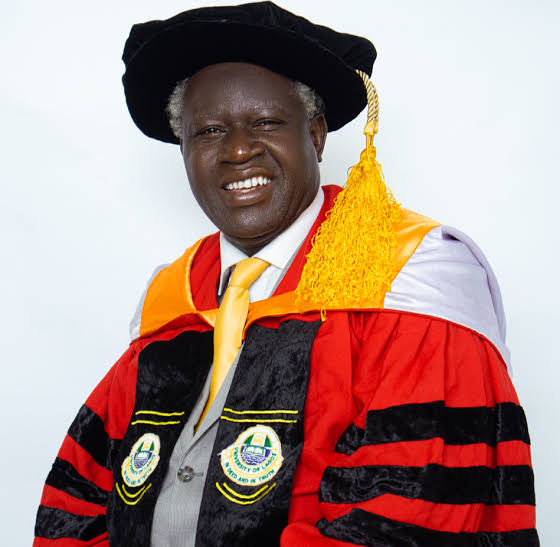
A professor of Comparative Political Economy at the University of Lagos, Adelaja Odukoya, has asserted that Nigeria’s economic policies promote investment without sufficiently strengthening domestic production.
Odukoya argued that the contradiction had weakened the country’s productive foundations, with policies encouraging investment and entrepreneurship while failing to create the technological capacity, productive employment and processing industries needed to drive sustainable development.
Odukoya spoke at the maiden edition of the Adeleke University Toyin Falola Annual Lecture, held on Thursday at the Performing Arts Theatre, Adeleke University, Ede.
The lecture had as its theme, “History, Power and Accumulation: Reimagining Africa in the Globally Disorderly Order.”
Odukoya identified several contradictions in the way the Nigerian state manages economic activity.
He said, “The state promotes investment without creating conditions for technological transfer. It encourages entrepreneurship without generating sufficient productive employment.
“It expands primary-product exports while leaving processing capacity undeveloped. It constructs infrastructure without establishing strong linkages with domestic production.”
According to him, the contradictions explain why increased economic activity and accumulation do not necessarily translate into development.
“Accumulation is not synonymous with development,” Odukoya stated.
He argued that genuine development should be measured by the expansion of productive, technological, institutional and human capabilities.
“A country could attract investment, export minerals and agricultural commodities and record economic activity while still failing to build the domestic industries and technological capabilities required for long-term development,” he said.
His argument was echoed by Prof Toyin Falola, who said Africa’s vast natural resources would continue to reinforce dependency unless governments developed the industrial, technological and institutional capacity to transform them into productive power.
Falola said Africa’s resource problem was not simply one of historical exploitation, but also the continent’s failure to convert its resource endowments into power.
“The issue, however, is not just to repeat the history of exploitation. It is more important to know how Africa turns its great resources into power,” Falola said.
He argued that Africa could not afford to remain a spectator as global economic and geopolitical arrangements continued to change, stressing that resource ownership without the capacity to add value would not guarantee influence.
Falola said the continent required a combination of knowledge, government policy and industrial capacity to change its economic position.
“There must be universities that generate new knowledge; there must be governments that translate this knowledge into policies; there must be industries that add value to the continent’s natural resources,” he said.
He added that Africa needed more than improved infrastructure and stronger economies if it wanted to exercise greater influence in the global system.
“The future of the continent will require more than just better infrastructure, improved economies, and more effective political institutions,” Falola said.
Source: punchng.com
FOLLOW US ON: