Connect with us

Politics

Ogun monarchs, traders mobilise for Tinubu’s re-election, Yayi’s gov bid ahead of 2027

Published

on

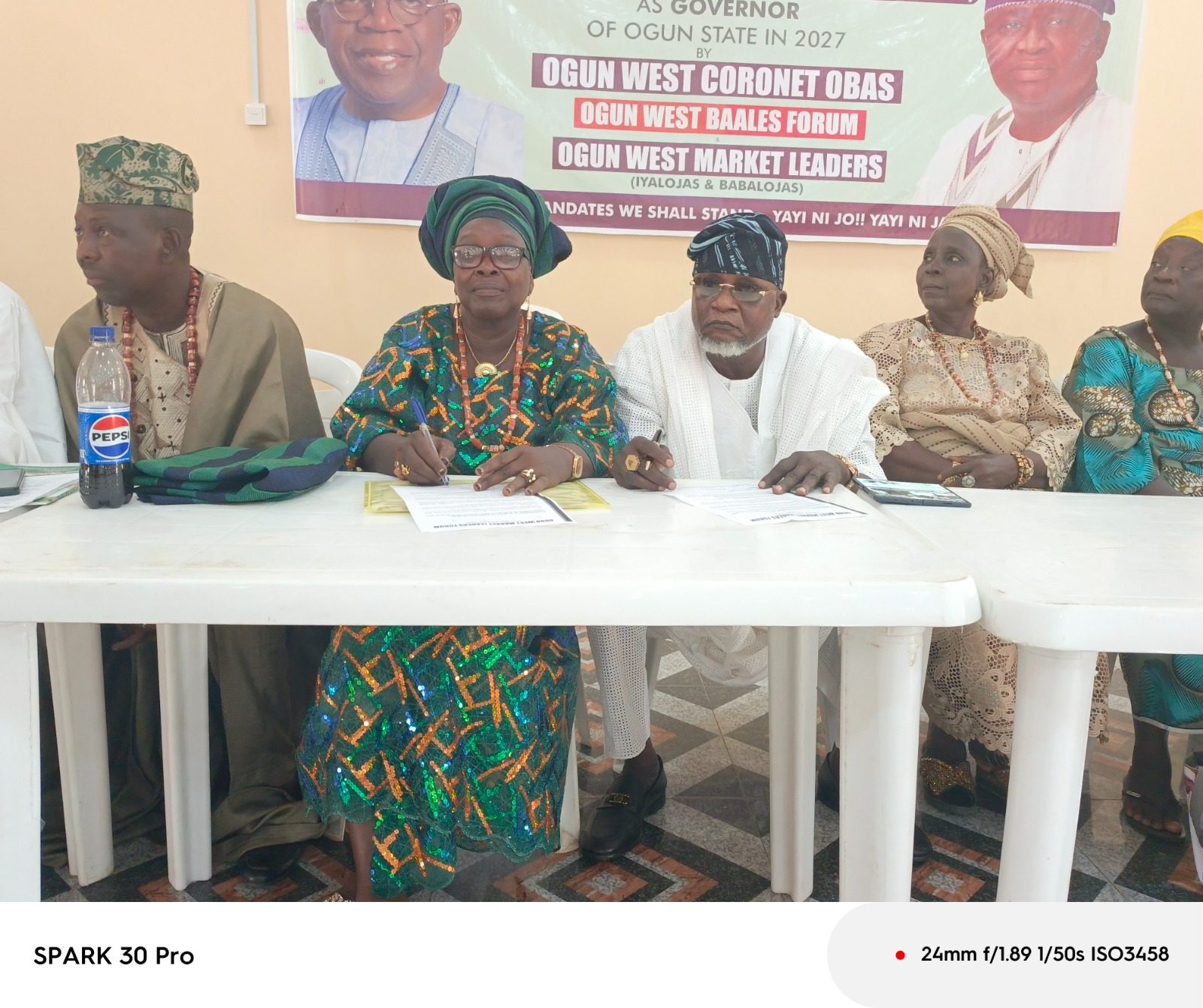
Market traders in Ogun West, alongside coronet traditional rulers and community heads under the aegis of the Baales Forum, on Wednesday declared support for the re-election bid of President Bola Tinubu and the 2027 governorship ambition of Senator Solomon Adeola.

The groups, at an event held in Ilaro, expressed their readiness to embark on grassroots mobilisation to ensure the second-term victory of Tinubu as well as the emergence of Adeola, popularly known as Yayi, who currently represents Ogun West Senatorial District, as the next governor of the state.

Speaking at the programme, the Babaloja of Yewaland and Ogun State, Chief Adewale Adesina, said the support for Tinubu and Adeola was based on their perceived contributions to infrastructural development and interventions that have positively impacted the well-being of the people.

Adesina said, “President Bola Tinubu, since assuming office, has spared no effort to reposition the country. He has taken some tough economic reform decisions that are beginning to stabilise our finances.

“We can see his efforts across the country, and it is because of this purposeful leadership that we believe he should be supported to continue beyond 2027.

“It is also in light of the leadership demonstrated by Senator Adeola, fondly called Yayi, in the past few years that we believe he is capable of sustaining and improving on the achievements of Governor Dapo Abiodun.

“He has facilitated the construction of schools, road projects, hospitals, and various empowerment initiatives that have benefited residents of the state. We are confident that if given the APC governorship ticket, he will further develop Ogun State.”

See also  2027 battle: Rivers crisis escalates as top APC govs back Fubara

The market leader, however, noted that endorsement alone would not be sufficient without voter participation, urging residents to obtain their Permanent Voter Cards.

“Yes, it is good for us to gather here in large numbers and endorse President Tinubu for a second term and Senator Solomon Adeola for his governorship ambition, but this must be backed by action.

“Politics is a game of numbers. Without a voter card, you cannot vote, and if you do not vote, then you are not counted. This endorsement will only be meaningful if people participate in the electoral process.

“It is against this background that we are mobilising at least 500,000 votes for President Tinubu and Senator Adeola in the 2027 election. We shall soon begin an operation tagged ‘Show Your PVC.’ In addition to declaring support, we must all register and come out en masse to vote in 2027,” he said.

Also speaking, the Iyaloja of Yewaland and Iyaloja-General of Ogun State, Chief Yemisi Abass, said the traders’ declaration of support was intended to encourage continuity of what she described as the good work of both leaders.

“We want their good work to continue, and that is what we are committed to achieving through massive mobilisation,” she said.

Speaking on behalf of the Baales Forum, Simeon Fagbohun said the various community heads, numbering over 1,000, are prepared to mobilise support for Tinubu’s second term and Adeola’s governorship ambition.

“We are satisfied with the representation of Senator Adeola, who has facilitated various developmental projects across the senatorial district.

See also  PDP remains most united party in Nigeria – Jonah Jang

“His efforts in the provision of roads, schools, markets, health centres, and support initiatives for residents have been commendable.

“We believe he has the capacity to transform the state, which is why we are endorsing him as our preferred candidate for governor.

“We also support President Bola Ahmed Tinubu for another term of four years to consolidate on the work he has started to reposition the country on the path of economic growth and stability,” he said.

Similarly, Oba Isaac Adeisa, the Ogiyan of Alari, who read the communiqué on behalf of other coronet traditional rulers in Ogun West, said the monarchs had resolved to support Tinubu’s re-election and Adeola’s governorship ambition in 2027.

Oba Adeisa said, “Having considered the efforts of President Tinubu in revamping the economy, as well as the developmental projects facilitated by Senator Adeola, the coronet Obas have decided to endorse Tinubu’s re-election for another term of four years and also support the 2027 governorship ambition of Senator Adeola, popularly known as Yayi.”

punch.ng

FOLLOW US ON:

FACEBOOK

TWITTER

PINTEREST

TIKTOK

YOUTUBE

LINKEDIN

Continue Reading
Click to comment

Leave a Reply

Your email address will not be published. Required fields are marked *

Politics

APC sets stage for Saturday convention with zonal elections

Published

on

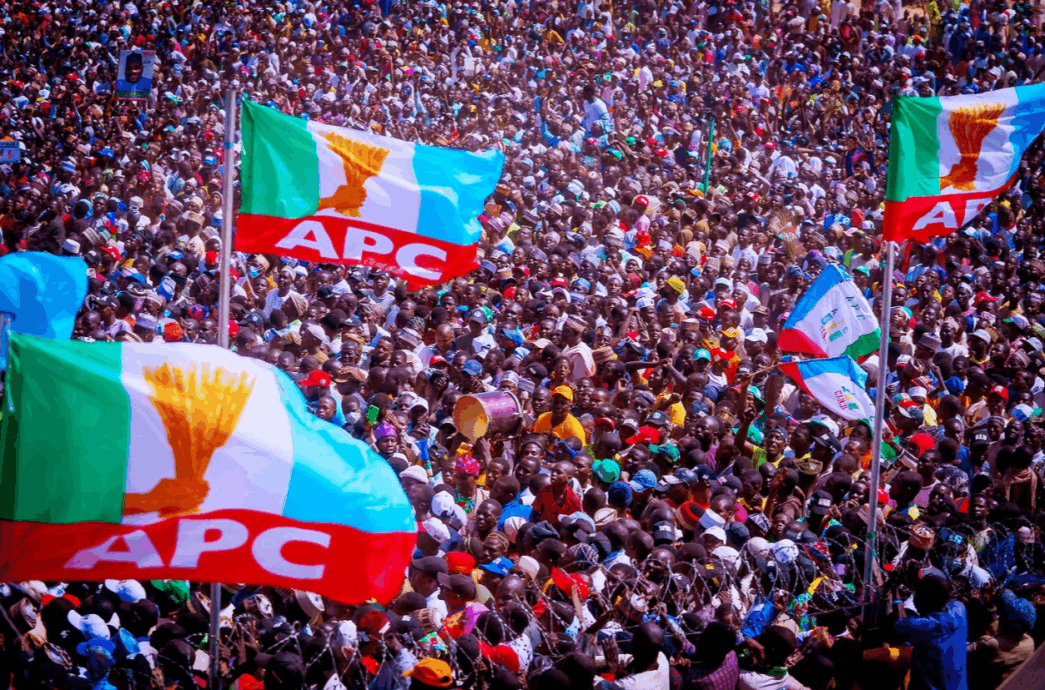
Zonal executives of the All Progressives Congress (APC) emerged on Wednesday, pledging to mobilise overwhelming votes for President Bola Tinubu to secure a landslide victory in the 2027 election.

The congress was a prelude to the national convention scheduled for March 27 and 28 in Abuja.

Prior to the convention, the President, on Wednesday evening, returned to Abuja after observing the Eid-el-Fitr celebrations in Lagos.

Tinubu had earlier returned to Nigeria on Friday from the United Kingdom, where he went for a state visit. During his stay in Lagos, he held a series of high-level engagements, receiving 23 governors and also met with business mogul Aliko Dangote, a European Union delegation, and members of the Lagos State Governance Advisory Council.

His return to Abuja and the successful conduct of the zonal congresses across the six geopolitical zones of the country signalled that the party was ready for the convention.

At the various zonal congress venues, consensus followed by voice affirmation was adopted as the mode of election, producing excos ranging from re-elected to newly elected members.

Governors, federal and state lawmakers, party chieftains, and stalwarts thronged the congress venues, declaring that Tinubu was poised to implement a coordinated nationwide strategy to secure overwhelming votes for the APC in the next presidential election.

The South-West congress, held at the Mobolaji Johnson Stadium with 3,188 delegates, saw Dr Isaacs Kekemeke re-elected as National Vice Chairman (South-West).

Chairman of the Zonal Congress Committee, Jide Jimoh, said the consensus option was adopted in line with the provisions of the 2026 Electoral Act.

Other exco members who emerged were Femi Aluko (Secretary), Lateef Ibirogba (Organising Secretary), Ayo Afolabi (Publicity Secretary), Adeduyi Daramola (Youth Leader), Ismail Majaro (Legal Adviser), and Dayo Ishola (Representative of People with Disabilities).

Dignitaries at the event included Governors Babajide Sanwo-Olu (Lagos), Dapo Abiodun (Ogun), Biodun Oyebanji (Ekiti), and Lucky Aiyedatiwa (Ondo).

Also present were former Ogun State Governor, Chief Olusegun Osoba; Lagos Deputy Governor, Obafemi Hamzat; Speaker of the Lagos State House of Assembly, Mudasiru Obasa; Osun governorship candidate, Bola Oyebamiji; state and federal lawmakers; and party stalwarts from across the region.

Speaking on behalf of the South-West APC governors, Sanwo-Olu said, “Today, we have seen the conduct of a free and fair election, following the provisions of the 2026 Electoral Act. This congress shows that the South-West is united and a formidable political bloc.”

See also  Will PDP masquerades fight in the open again?

The National Secretary of the APC, Dr Ajibola Basiru, represented by National Youth Leader, Dayo Israel, congratulated the new executives and urged collective efforts to ensure Tinubu records a resounding victory in the South-West in 2027.

In his remarks, Kekemeke expressed confidence in the party’s strength across the six South-West states, promising overwhelming votes for Tinubu in the zone.

The APC zonal chairman also called for massive support for the party’s candidate in the forthcoming Osun governorship election, Bola Oyebamiji, urging voters to align with the APC’s progressive vision to unlock opportunities for growth and stability.

He said, “The immediate challenge is that by June, Governor Biodun Oyebanji must return, and by August, Oyebamiji must be in Osun State. With the leadership of our governor, Oyebanji must break the jinx in Ekiti.

“Our duty as South-West is to ensure an overwhelming victory and support for our President, Bola Tinubu.”

The South-South zonal congress, held at the Dome Event Centre, Asaba, Delta State, produced Victor Giadom as chairman.

Other executives elected were Ita Udosen (Secretary), Neworld Safugha (Legal Adviser), Samuel Nwanosike (Publicity Secretary), Urhoro Koyoyo (Youth Leader), Suobankuo Omoni (Women Leader), Prince Edward (Organising Secretary), and Ayo Peter (Representative of Persons with Disabilities).

President of the Senate, Godswill Akpabio, noted the region had witnessed a remarkable transformation, moving from minimal APC presence to a strong political bloc with increasing alignment from governors and stakeholders.

Akpabio challenged party faithful to position the South-South as the highest vote-delivering region for the APC in 2027, stressing that this goal was both achievable and necessary.

Delta State Governor Sheriff Oborevwori emphasised sustained grassroots mobilisation, urging party members to deepen internal cohesion, strengthen structures, and maintain strong connections with the people.

He described the congress as “a demonstration of the party’s strength, unity, and readiness for future political engagements.”

Chairman of the South-South Governors’ Forum and Bayelsa State Governor, Douye Diri, underscored the importance of unity, noting that adopting consensus was a major step in reducing internal conflicts and fostering collective ownership within the party.

He added that, for the first time in recent political history, the South-South was speaking with one voice, with full attendance of governors demonstrating shared commitment to the region’s progress.

Governors Umo Eno (Akwa Ibom), Bassey Otu (Cross River), Monday Okpebholo (Edo), and Siminalayi Fubara (Rivers) stressed the importance of aligning the zone with the Federal Government.

See also  Ekiti, Osun Polls Test For 2027 Elections – INEC Chair Amupitan Tells Staff

In his acceptance speech, Giadom expressed optimism that the party would continue to expand its influence ahead of the 2027 elections.

Fubara, through Chief Press Secretary, Onwuka Nzeshia, urged the South-South leadership to work in unity and with a common purpose to deliver optimally for the party, expressing confidence that the new leadership was equal to the task.

The South-East zonal congress saw a new executive led by Dr Ijeoma Arodiogbu.

Other members included Innocent Azuoba (Secretary), Rex Ogbonna (Legal Adviser), Henry Onwughalaonye (Publicity Secretary), Chima Ogbonnaya (Youth Leader), Dr Oby Aji (Women Leader), and Arinze Ikedife (Organising Secretary).

Held at Hotel Presidential, Enugu, the congress was attended by Governors Peter Mbah (Enugu), Hope Uzodimma (Imo), and Francis Nwifuru (Ebonyi).

Speaking at the event, Uzodimma, who chairs the South-East Governors’ Forum, stressed the need for unity.

Nwifuru moved a motion to dissolve the outgoing executive, seconded by Senator Patrick Ndubueze.

Deputy Speaker of the House of Representatives, Benjamin Kalu, presented the list of consensus candidates, announcing Arodiogbu as vice chairman for the South-East zone.

He also moved motions adopting consensus as the mode of the congress, in line with Section 84(2) of the Electoral Act, ratifying outcomes of ward, local government, and state congresses.

Enugu State House of Assembly Speaker, Uchenna Ugwu, seconded the motions, which were approved by delegates.

Mbah described the congress as a demonstration of unity within the South-East APC, saying, “APC in the South-East is solid. Our presence today is proof that APC is South-East, and South-East is APC.”

He also commended President Tinubu for reforms that had placed the country on the path of economic growth.

The congress attracted leaders, including former Senate President Ken Nnamani; Deputy National Chairman (South) Emma Eneukwu; Senators Osita Izunaso, Ezenwa Onyewuchi, Uche Ekwunife, Onyekachi Nwebonyi, Kelvin Chukwu, and Osita Ngwu; Ministers Nkeiru Onyejeocha and Kingsley Udeh; former minister Chris Ngige; members of the House of Representatives; and other stakeholders.

The North-West APC congress held in Kaduna produced Garba Babao as chairman and National Vice-Chairman of the zone.

Dignitaries at the congress included Deputy Senate President Barau Jibrin, House Speaker Tajudeen Abbas, and Governors Uba Sani (Kaduna), Abba Yusuf (Kano), Dikko Radda (Katsina), Aliyu Ahmed (Sokoto), Umar Namadi (Jigawa), and Dauda Lawal (Zamfara), alongside Minister of State for Defence, Bello Matawalle.

Governor Sani called for unity among North-West party members, describing the congress as a reflection of the party’s democratic strength and grassroots orientation.

See also  Abiodun Urges Soludo To Do More For Anambra People

A highlight was the reception of new entrants, particularly Governors Yusuf and Lawal, who were welcomed as significant for the party’s growth.

Sani defended President Tinubu’s reform policies, citing measurable impacts in agriculture, oil and gas, student loans, and infrastructure investments in roads, rail, and energy.

He said security had improved, markets were thriving, and economic confidence was being restored in the North-West.

He urged party members to remain united and disciplined, stressing that the congress was about strengthening unity and aligning strategies.

The North-East zonal congress, held in Gombe, attracted governors, lawmakers, executives, and stakeholders.

The congress saw Mr Idris Shuaibu emerge as the Zonal Vice Chairman and Mr Baba Ali as Zonal Secretary.

Also elected is Mr Tako Dauda as Zonal Legal Adviser; Mr Nitte Amangal as Zonal Publicity Secretary; Mr Joseph Muadali as Zonal Youth Leader.

In addition, Abubakar Musa emerged as Zonal Organising Secretary, Lumbi Abubakar Zonal Women Leader, while Mr Haruna Tata was elected as Zonal Leader for Persons with Disabilities.

Governor of Yobe State and North-East APC Coordinator, Mai Mala Buni, said the zone sustained a culture of internal democracy and peaceful political processes, contributing to the APC’s growth since its formation.

Buni urged adherence to due process, unity, and collective mobilisation ahead of 2027. He expressed support for Tinubu’s administration, particularly efforts to tackle insecurity in the North-East.

Adamawa State Governor, Ahmadu Fintiri, called for sustained unity, urging party members to campaign for leaders and secure electoral victory, stressing that the essence of politics is to win elections. He commended the acceptance of the consensus arrangement and the emergence of new leadership.

The North-Central zonal congress, held at the late Aliyu Akwe Doma Banquet Hall, Government House, Lafia, Nasarawa State, adopted President Tinubu as its sole 2027 presidential candidate.

The motion, moved by the Secretary to the Government of the Federation, George Akume and seconded by Governor Abdullahi Sule of Nasarawa State, cited Tinubu’s economic reforms as the reason for support.

APC National Chairman, Prof Nentawe Yilwatda, represented by Deputy National Secretary, Prof Abdulkarim Kana, commended the zone for its loyalty, describing it as “a bedrock of stability” for the administration.

Former national chairman Abdullahi Adamu expressed satisfaction with adherence to the party constitution.

punch.ng

FOLLOW US ON:

FACEBOOK

TWITTER

PINTEREST

TIKTOK

YOUTUBE

LINKEDIN

Continue Reading

Politics

PDP factions open peace talks as Wike denies split

Published

on

The two Peoples Democratic Party factions have restarted the faltering peace process ahead of the March 29-30, 2026, national convention being championed by the bloc led by the Minister of the Federal Capital Territory, Nyesom Wike.

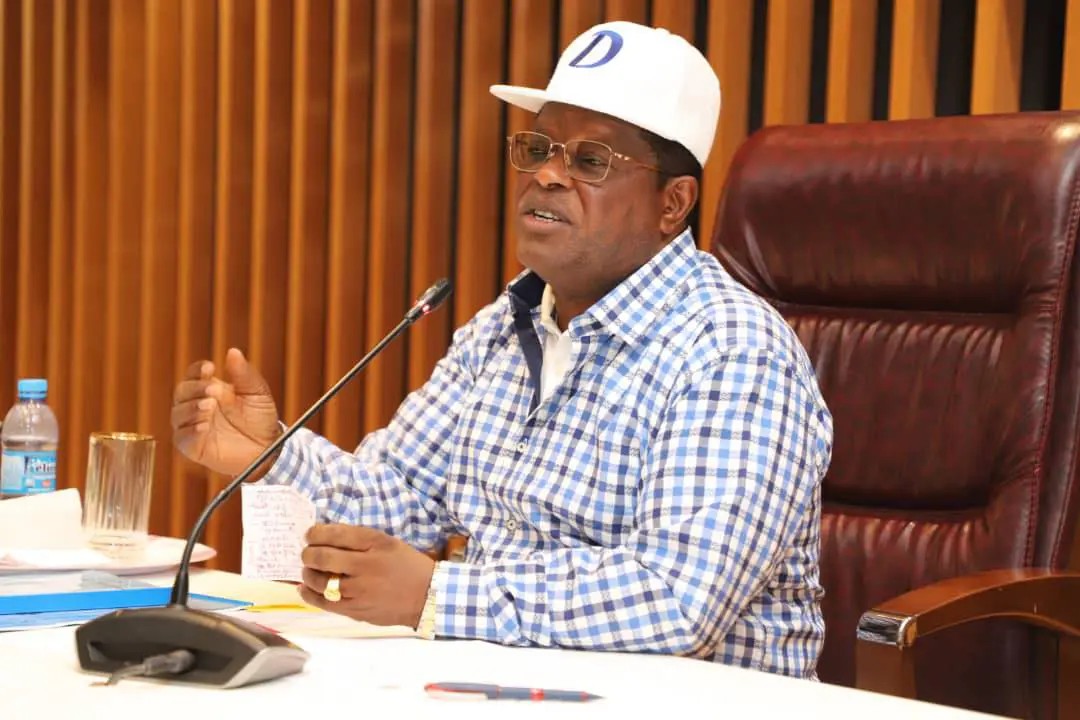
The bloc headed by Tanimu Turaki (SAN) and supported by the party governors confirmed on Wednesday that a fresh reconciliation process aimed at uniting aggrieved factions within the party had commenced.

Turaki, who disclosed this while addressing newsmen in Abuja, explained that the reconciliation, which was kick-started on Tuesday night, is yielding some results.

He stated, “In obedience to the advisory of the Court of Appeal, Ibadan, a few weeks ago, that parties in the suit should explore reconciliation to save the party from further strife and provide a platform for aspirants to seek elective offices in the coming elections, the Board of Trustees of the party, ably led by His Excellency, Sen. Adolphus Wabara, constituted a high-powered committee to interface with our estranged party members, with a view to resolving outstanding issues and repositioning the party for the elections.

“In furtherance of this, the National Working Committee immediately issued a notice postponing the National Executive Committee and National Caucus meetings earlier scheduled to be held two days later, as a demonstration of good faith. We also de-escalated combative communication on all fronts. ‘’

He adds, “While we expected a reciprocal gesture, what we have witnessed instead is the weaponisation of hurtful rhetoric and the issuance of derogatory statements.”

Turaki said they were mindful of the dispute’s implications amid the tight Electoral Act timelines and urged the other faction to act in the party’s overall interest.

“I can unequivocally confirm that, as of today, leaders on both sides have broken the ice and are exploring various pathways towards a lasting resolution. We urge our supporters across the board to immediately de-escalate high-tempered communications and actions, so as not to jeopardise the ongoing peace efforts.

“To all aspirants who have stood with us thus far, we assure you that, by the grace of God, our party will field candidates for all elective offices, in compliance with Article 6(2) of the Constitution of the PDP (as amended in 2017).

“As we are aware, democracy is not merely about the periodic conduct of elections; it also requires a virile opposition and an active civil society to hold government accountable. As Nigeria’s only surviving legacy party in the current republic, with the rare privilege of having led this country for 16 years, we remain committed to defending and consolidating our democracy, even as an opposition party.”

See also  2027: ‘Stay In Labour Party, Don’t Chase Two Rabbits’ – Shehu Sani Advises Peter Obi

Turaki expressed confidence in the Wike faction, noting that reconciliation is still possible.

“We have confidence that we can still work together and that this reconciliation will work. In life, there are times to fight, and there are also times to make peace. But even when you choose to fight and go to war and win the war, you also need to win the peace. So, if you have a pathway to winning the peace without necessarily going to war, why not take peace and forego the war?

“Let me also add that we understand that in human life, every time something good is coming your way, there are people from unimaginable and unbelievable quarters; sometimes, those you think are friends or family who will be the first to rise and truncate those good things coming your way.

“I am not saying there are no good elements on both sides whose sole intention is to prevent peace in this country. I am saying some people are fighting so that this party will go down. From last night, these two elements have been identified and flushed out in the discussions between the two sides.”

The party leader vowed to deploy all available means to achieve peace and promised that all the court cases would be withdrawn once the reconciliation is concluded.

He noted, “Matters in court continue. Even as I speak, there are cases filed by both parties, including appeals at the Court of Appeal. Some appeals have been filed by them, others by us, though some have not been taken.

‘’As a senior lawyer, I can say that the best judges would advise parties to explore out-of-court settlements whenever possible.

“In Nigeria, once parties go to court, more issues emerge, and relationships rarely recover. We have chosen the path of peace in the overall interest of party members, particularly our teeming supporters who want PDP to remain an effective platform for the forthcoming elections.

‘’As soon as we reach agreeable terms, which we will honour even in the Court of Appeal, we will willingly withdraw all cases whether at the Federal High Court, Court of Appeal, Supreme Court, or elsewhere to give peace a chance. All cases will give way to peace as soon as we reach that point.

See also  PDP remains most united party in Nigeria – Jonah Jang

Asked if his bloc was willing to compromise for the peace process to succeed, he responded, “On the issue of compromise, we are willing to bend as far as our necks and backs allow. We are ready to make all sorts of sacrifices in the overall interest of the party. PDP will not die. Everything possible will be done to make this reconciliation work; nothing is impossible.

‘’Issues such as attendance at the convention are among those to be discussed. Once these matters are deliberated, the parties and delegates will decide whether the convention needs to continue. These issues are on the table and will be considered carefully.”

Meanwhile, the FCT minister has dismissed reports of a split within the PDP, insisting the party remains united as it prepares for its national convention.

Wike spoke to journalists in Abuja on Wednesday, after inspecting several ongoing and completed infrastructure projects across the capital city.

Addressing speculation about internal divisions, he maintained that disagreements among members do not amount to factionalisation.

“We have only one PDP, no faction,” he said. “I don’t know which camp you are talking about. There is only one PDP. Some individuals may not be happy, yes, but there is no faction.”

The minister noted that while some grievances may exist, reconciliation efforts are still ongoing and can proceed alongside preparations for the convention.

“That there is a convention does not mean there will be no reconciliation. Everything has its own time,” he said.

Wike’s claim comes against the backdrop of a protracted leadership crisis plaguing the party.

Governors of the PDP had earlier backed the Ibadan convention held on November 15, which produced Kabiru Turaki and other members of the National Working Committee for a four-year tenure.

However, a faction loyal to Wike later formed a 13-member Caretaker Committee, naming Mohammed Abdulrahman as Acting National Chairman and Senator Samuel Anyanwu as Acting National Secretary, among others, with a 60-day mandate pending a substantive convention.

Attempts by both factions to hold meetings at the PDP National Secretariat on November 18 descended into chaos, prompting the Nigeria Police Force to seal the secretariat.

Legal battles followed, culminating in a February 12 hearing at the Court of Appeal. On March 9, the court ruled that the Ibadan convention violated the Electoral Act, the Constitution, and the party’s constitution, nullifying the convention that produced Turaki and his committee.

See also  Ekiti, Osun Polls Test For 2027 Elections – INEC Chair Amupitan Tells Staff

During the inspection tour, Wike reiterated the commitment of the FCT Administration to ensuring quality and timely delivery of projects.

“In our usual programme, we make sure we go round to see what the contractors are doing and the quality of jobs they will hand over,” he said.

He disclosed that a bridge project near the Fire Service in Abuja is nearing completion, with contractors projecting delivery within five months.

“From what we have seen, it is a very quality job. I commend the company,” Wike stated.

The minister also confirmed that the N5 road project, handled by Julius Berger, has been completed and will be inaugurated as part of activities marking President Bola Tinubu’s third anniversary in office.

At the Nigerian Law School, Wike expressed satisfaction with the completion of 10 staff bungalows, describing them as fully furnished and ready for use.

He also assessed ongoing hostel projects, commending progress on the female hostel while raising concerns about delays in the male hostel.

“I am quite impressed with the female hostel, but I am not impressed with the level of work on the male hostel. They were awarded at the same time,” he said, noting that contractors have pledged completion by October or November.

Describing the intervention as unprecedented, Wike said the government’s effort marks a significant milestone for the institution.

“This is the first time a government is trying to provide basic infrastructure for the Nigerian Law School,” he stated.

On funding and project execution, the minister attributed the administration’s performance to prudent resource management and political will.

“It is not about the amount of money, but commitment. You can have all the money and still not achieve results if you are not committed,” he said.

According to him, the FCT relies largely on internally generated revenue and avoids awarding contracts it cannot fund. “Projects we don’t have money for, we will not award them,” Wike stressed.

He credited the pace of development to the support of the president, saying, “The momentum we are getting is because we have a President who believes in providing infrastructure. That support makes the difference.”

Wike assured residents that all ongoing projects would be completed as scheduled, reaffirming the administration’s commitment to improving infrastructure and service delivery across the FCT.

Continue Reading

Politics

Ministers gauge support, popularity ahead of resignation deadline

Published

on

Serving ministers and appointees angling for gubernatorial tickets in 2027 are in a dilemma as the resignation deadline draws near.

The government officials, following the President’s March 31, 2026, resignation directive, have begun weighing their options, chances in their various states, ahead of the major cabinet-exit decision. Their choices are not any lighter by the competing interests and feisty internal politics across states.

Already, no fewer than nine ministers in the Tinubu administration are expected to step down over renewed political ambitions across their respective states.

While some of the ministers may have already been preparing to exit, the stark reality is that they will have to return to their home states and reconnect with grassroots politics to determine their political fate ahead of 2027.

Among those likely to make the move is the Minister of Power, Adebayo Adelabu, who is expected to rejoin the race for the Oyo State governorship. Similarly, the Minister of Health and Social Welfare, Muhammad Ali Pate, is being linked with the governorship contest in Bauchi State, where the Minister of Foreign Affairs, Yusuf Maitama Tuggar, is also believed to be nursing similar ambitions.

In the South-East, Nkeiruka Onyejeocha, Minister of State for Labour, may either return to the National Assembly or seek the governorship seat of Abia State. For Borno State, the Minister of Agriculture, Abubakar Kyari, is widely speculated to be preparing for a governorship bid, while Saidu Ahmed Alkali is linked to the race in Gombe State.

Also on the radar is the Minister of Communications and Digital Economy, Bosun Tijani, who may test his popularity in Ogun State. In Plateau State, the Minister of Humanitarian Affairs, Bernard Doro, is reportedly eyeing a senatorial seat, while Ekperikpe Ekpo is projected to join the governorship race in Akwa Ibom State.

Most of these ministers are expected to step down before the commencement of party primaries, scheduled between April 22 and May 20, 2026, in compliance with electoral guidelines and party requirements.

Also linked to the 2027 governorship ambition in Kwara State are the Director General of the National Orientation Agency (NOA), Issa Onilu; the Director General of the National Institute for Legislative and Democratic Studies (NILDS), Abubakar Olanrewaju Suleiman; and the Pro-Chancellor of the Federal University of Health Sciences, Ila Orangun, Wale Sulaiman.

The possible obstacles and advantages
For Adelabu, his ambition would immediately confront a combination of political, structural and perception challenges capable of defining the trajectory of his campaign long before the general election.

At the centre of these hurdles is the dominance of Governor Seyi Makinde and the entrenched structure of the Peoples Democratic Party (PDP) in the state. Although Makinde will complete his tenure before the election, his influence over party succession and grassroots mobilisation remains formidable. Any PDP candidate emerging with his backing would inherit an already functional political machinery, placing Adelabu at a structural disadvantage from the outset.

Equally significant are internal divisions within the All Progressives Congress (APC) in Oyo State. Years of factional disputes have weakened party cohesion, and Adelabu’s shifting political alignments, from APC to Accord Party and back, may fuel resistance among party stakeholders.

Securing the APC ticket could therefore become his first major battlefield, especially against strong aspirants with established grassroots networks and longstanding party loyalty.

The most defining challenge lies in the public perception of his performance as Minister of Power. Nigeria’s electricity sector remains one of the most sensitive governance issues, directly affecting households and businesses.

Zoning politics also complicates his path. While Adelabu is from Ibadan, the state’s dominant political bloc, growing agitation from Oke-Ogun, Ogbomoso and Oyo zones for power rotation could reshape party calculations and weaken consensus around another Ibadan candidate.

See also  Abiodun Urges Soludo To Do More For Anambra People

Beyond party primaries, Adelabu must also rebuild trust among voters following previous electoral defeats and political realignments, while countering any anti-federal sentiment that may arise from economic pressures linked to the ruling party.

Ultimately, Adelabu’s challenge extends beyond contesting an election; it involves reconciling party factions, defending his ministerial record and constructing a persuasive narrative capable of overcoming the PDP’s entrenched dominance in Oyo politics.

He will also contend with names such as Adebo Akande, Adegboyega Adegoke, Nureni Adeniran and Niyi Aborisade, all seen as figures capable of inheriting Makinde’s political base if backed by the governor.

For Adelabu within the APC, contenders such as former governorship candidate Teslim Folarin, House of Representatives member Remi Oseni, former deputy governor Rauf Olaniyan and erstwhile Minister of Communications Adebayo Shittu are also strong aspirants. Other hopefuls, including Azeez Adeduntan, Akeem Agbaje and Saheed Oladele, are mobilising support, while Senator Sharafadeen Alli is frequently mentioned in ongoing consultations.

If Pate resigns to pursue the 2027 governorship in Bauchi State, he will face steep political headwinds despite his strong technocratic profile.

Top among these is the zoning reality that has historically favoured Bauchi South, leaving contenders from Bauchi Central, like Pate, at a structural disadvantage in the state’s power calculus. This long-standing arrangement could limit his ability to galvanise broad-based support across key voting blocs.

Equally significant is his limited grassroots political machinery. Unlike entrenched politicians, Pate is not deeply rooted in ward-level mobilisation and patronage networks that often determine electoral outcomes in Bauchi.

Within the APC, he must also contend with intense primary battles from established figures who command loyalty among delegates and local power brokers, further complicating his path to securing the party’s ticket.

On the opposition front, the influence of incumbent governor Bala Mohammed remains formidable. His political structure, whether retained within the PDP or realigned, will significantly shape the contest.

Compounding this is the elite perception challenge, with Pate often viewed as a policy expert rather than a grassroots politician, which could hinder acceptance among local stakeholders. Together, these hurdles underscore the complexity of his potential bid.

For Tuggar, several structural and political factors will shape both his viability and the challenges ahead.

He would require a cohesive and united party structure in Bauchi. However, internal factionalism within the APC in the state, often driven by legacy disputes and competing interests, could weaken his chances if not resolved before the primaries.

Another key factor is grassroots acceptability. While Tuggar possesses strong diplomatic credentials and national visibility, governorship contests in Bauchi are heavily influenced by local networks, traditional institutions and ward-level mobilisation.

Zoning and regional balance may also come into play. Bauchi politics is sensitive to senatorial distribution of power, and any perceived imbalance could trigger resistance from key blocs.

Tuggar’s ambition would therefore hinge on his ability to consolidate APC structures, neutralise PDP influence and translate his national profile into local political capital.

For Onilu, Suleiman and others, the disposition of the outgoing governor of Kwara State, AbdulRahman AbdulRazaq, will largely determine how far their ambitions can go, alongside the determination of opposition parties such as the PDP, whose candidates will also seek to unseat the ruling APC.

Minister of Communications and Digital Economy, Bosun Tijani, faces a different calculation. His achievements in broadband expansion and digital innovation have strengthened his technocratic credentials, but analysts say translating federal technology reforms into grassroots political support in Ogun State may prove challenging without a visible local economic impact.

Similarly, the Minister of Agriculture and Food Security, Abubakar Kyari, confronts perhaps the toughest political test, as rising food prices may shape public judgment of his performance should he pursue governorship ambitions in Borno State.

See also  Ekiti, Osun Polls Test For 2027 Elections – INEC Chair Amupitan Tells Staff

In contrast, the Minister of Interior, Olubunmi Tunji-Ojo, faces less immediate electoral pressure. With the Ondo State governorship election scheduled for 2028, analysts believe his ongoing reforms in passport administration and immigration services are aimed at building long-term political capital rather than preparing for an imminent resignation.

Wike option in PDP’s revised game plan
BARRING any contrary signal from the Presidency, the Minister of Federal Capital Territory, Nyesom Ezenwo Wike, may announce his resignation from the Federal Cabinet in what insiders say would be the first step towards actualising his revised game plan for the 2027 general election.

The Guardian learned that the Caretaker National Working Committee, led by Abdulrahman Mohammed, which is loyal to the FCT Minister, sees the recent Appeal Court ruling on the lingering leadership dispute within the Peoples Democratic Party (PDP) as a tacit endorsement of their leadership.

On March 9, 2026, the Court of Appeal, while dismissing the appeal filed by the Kabiru Tanimu Turaki-led NWC, discovered that the party’s failure to abide by the statutory regulations and improper notification of the Independent National Electoral Commission (INEC) violated the steps towards a proper convention.

However, while upholding the restraining order placed on INEC against recognising the outcomes of the Ibadan Convention, the court encouraged the party to seek an alternative dispute resolution approach to settle their family differences.

However, it was gathered that shortly after the ruling, the FCT Minister, who hailed the judgment of the Appellate court as a victory for due process, started oiling his political machinery towards a possible contest for the PDP presidential ticket.

An insider confided in The Guardian that the initial plan was for the former PDP National Secretary, Senator Sam Anyanwu, to fly the PDP presidential flag and later announce his withdrawal for President Tinubu.

“But, from the look of things, our leader thinks that flying the PDP flag will enhance his capacity to mobilise support for the President, especially in Rivers, Imo and Enugu States. His experiment in the FCT election was found to be very effective. So, he wants to repeat them in the states he has an interest in,” the source stated.

The source said that the Minister was planning to see President Tinubu in Lagos to finalise arrangements towards adopting the strategy, stressing that the Minister’s move was instrumental to recent calls for the zoning of the PDP tickets.

Shock directive, performance record
The Guardian gathered that despite the clear deadline, some expected aspirants are not in a hurry to step down, as sources disclosed that remaining in office provides strategic advantages they are reluctant to relinquish.

Leaving too early may mean losing these benefits without any guarantee of electoral success.

There is also uncertainty within political parties, as many aspirants continue to wait for clear signals, endorsements or zoning decisions before taking the final step.

Stakeholders’ views on the ministers
However, stakeholders across the political spectrum believe that the hesitation shown by aspiring appointees could stem from their assessment of their platform’s popularity or from fears about the impact of the direct primary method on their chances of clinching party tickets.

A member of the opposition coalition, Dr Umar Ardo, said that as politicians, some aspirants may be buying time or seeking the approval of their principal before quitting to avoid negative interpretations or possible vendetta, as their actions could be viewed as sabotage.

Also, the Executive Director of the Human Rights Writers Association (HURIWA), Emmanuel Onwubiko, stated that contrary to speculations that appointees are reluctant to resign, they will eventually do so.

He noted that while some aspirants may still be negotiating presidential endorsement, others may wait until the final moments before stepping down.

See also  What miracle did Obi perform in Anambra? – APC chieftain

In an interview with The Guardian yesterday, public affairs analyst Tony Ogbebor downplayed the potential impact of ministers resigning to run for elective office, insisting that governance would continue uninterrupted.

He stated: “The exit of such cabinet members would merely trigger a routine administrative process, where permanent secretaries assume acting roles pending fresh appointments by President Bola Tinubu.

“None of the appointees is indispensable. Their absence, particularly in the power sector, would hardly be felt given the observed underwhelming performance.”

Ogbebor accused the Power Minister of presiding over persistent challenges, including repeated national grid collapses, even as he questioned the minister’s readiness to seek elective office.

“His track record at the federal level raises doubts about his capacity to govern effectively at the state level. If he could not fix power with all the support at his disposal, what exactly is he going to campaign with?” he asked, adding that he would not support such a candidate if allowed to vote.

While offering a more measured assessment of Tuggar, whom he rated as “barely average,” and a slightly above-average rating for the Minister of Health, Ogbebor maintained that technocratic credentials alone do not guarantee effective leadership.

He warned that Nigeria has witnessed instances in which technocrats in government performed worse than career politicians, while expressing support for enforcing provisions of the Electoral Act requiring political appointees to resign before contesting elections.

“This is a step toward ensuring fairness. Those seeking elective positions should step down and face the electorate on equal terms. The political space should reward competence and accountability,” he asserted.

In his intervention, the Initiator of the Creative Change Centre, Omole Ibukun, said Nigeria’s public institutions are unlikely to experience meaningful structural shifts despite the expected exits, as they are largely driven by political leadership rather than strong bureaucratic systems.

According to him, the absence of ministers and agency heads will expose institutional weaknesses and create temporary governance gaps.

“These MDAs are not driven by institutional continuity because they are run by political appointees sitting atop weak bureaucracies,” he said. “What you will see is acting leadership, permanent secretaries or senior directors, stepping in, but decision-making will slow down, especially on politically sensitive issues. Some programmes may enter a holding pattern, while internal jockeying will intensify as different power blocs position themselves ahead of new appointments.”

Ibukun further noted that the potential exits of key cabinet members reflect deeper governance challenges across critical sectors. He pointed to the Coordinating Minister of Health and Social Welfare, Muhammad Ali Pate, noting that his departure would come at a time when the country’s health system remains “broken, underfunded, unequal and crisis prone.”

He also criticised the performance of the Minister of Foreign Affairs, Yusuf Tuggar, arguing that Nigeria’s foreign policy has yet to achieve a significant economic impact. “Nigeria’s foreign policy still lacks economic depth, with trade, diaspora leverage and regional influence largely under-optimised,” he stated.

On the National Orientation Agency (NOA), Ibukun was even more scathing, accusing its Director General, Issa Onilu, of failing to make the agency relevant. “You cannot ‘orient’ citizens in a state that materially disorients them. Under his leadership, NOA became largely irrelevant,” he said.

Ibukun suggested that the anticipated resignations underscore a recurring pattern in Nigerian governance, where public office is often treated as a stepping stone to higher political ambition rather than an opportunity for reform. “What this situation shows is that many of them came to prepare for the next office, not to transform the current one,” he told The Guardian.

The Guardian

FOLLOW US ON:

FACEBOOK

TWITTER

PINTEREST

TIKTOK

YOUTUBE

LINKEDIN

Continue Reading

Trending