Connect with us

Business

Nigeria’s foreign debt to hit $72.6bn after 2027 polls – IMF

Published

on

Nigeria’s public external debt is projected to rise by $20.7bn by 2027, the country’s election year, according to the International Monetary Fund.

The IMF disclosed this in its 2026 Article IV Consultation report on Nigeria released on Tuesday, projecting that public external debt would increase from $51.9bn in 2025 to $72.6bn by 2027.

The projected increase represents a 39.9 per cent rise within two years and underscores growing concerns over the country’s debt burden despite recent improvements in macroeconomic stability.

The Fund noted that Nigeria’s next presidential election would take place in January 2027 and warned that spending pressures associated with rising poverty, food insecurity and the election cycle could widen fiscal deficits and increase borrowing requirements.

“Spending pressures from elevated poverty and food insecurity, including in the run-up to the elections, could widen fiscal deficit and increase financing needs,” the IMF stated.

According to the Fund’s Balance of Payments projections, public external debt is expected to rise from $51.9bn in 2025 to $66.5bn in 2026 before climbing further to $72.6bn in 2027.

The IMF’s projection broadly aligns with the latest Debt Management Office data, which showed that Nigeria’s public external debt stood at $51.86bn as of December 31, 2025.

Based on the Fund’s forecast, the debt stock would increase by about $20.74bn between the end of 2025 and 2027.

Beyond public debt, the IMF projected that Nigeria’s total external debt stock, which includes both public and private sector obligations, would rise from $109.3bn in 2025 to $119.3bn in 2026 and further to $132.0bn in 2027.

This indicates that total external debt could increase by $22.7bn between 2025 and 2027, with $12.7bn of the increase occurring in 2027 alone.

The report showed that public external debt would remain elevated relative to the size of the economy and export earnings. Public external debt is projected to increase from 17.9 per cent of GDP in 2025 to 18.7 per cent in 2027. As a share of exports of goods and services, it is expected to rise from 82.9 per cent in 2025 to 104.3 per cent by 2027.

The IMF also projected a deterioration in debt service indicators over the period.

Public external debt service due is expected to increase from 8.1 per cent of exports of goods and services in 2025 to 8.8 per cent in 2027, after easing to 5.0 per cent in 2026. The Fund further projected that interest payments on public debt would rise from $2bn in 2025 to $3bn by 2027.

At the Federal Government level, debt servicing is expected to continue consuming more than half of government revenue. The IMF estimated that interest payments absorbed 53.2 per cent of Federal Government revenue in 2025 and projected the ratio at 53.7 per cent in 2026 before easing marginally to 52.4 per cent in 2027.

See also  Average city bus fare rises 2.43% to N1,431 in May

The report highlighted the growing role of external borrowing in financing government operations. According to the IMF, financing for the 2026 consolidated government deficit is expected to rely more on external than domestic sources, with plans including a proposed $5bn total return swap with an international bank and another Eurobond issuance.

The Fund expressed reservations about the proposed swap arrangement, noting that it carried borrowing costs comparable to Eurobond yields and could expose the government to margin calls if the value of the naira-denominated collateral declines.

“The arrangement exposes the government to margin calls if the FX value of the naira securities drops (naira depreciation, higher interest rates) and could thus give rise to political constraints on monetary or exchange rate policy,” the IMF said.

The PUNCH earlier reported that the IMF warned Nigeria to tread carefully in pursuing a proposed $5bn Total Return Swap financing arrangement with First Abu Dhabi Bank, describing such structures as opaque and potentially risky despite the country’s improved access to international capital markets.

The IMF Resident Representative for Nigeria, Christian Ebeke, disclosed this on Tuesday during a virtual press briefing on the Fund’s 2026 Article IV Consultation Report on Nigeria.

Speaking on the proposed transaction, Ebeke said, “We say in the report, and our view is that the transaction and these types of structures carry risks. Usually, they are opaque. So, the terms are not always very transparent when we review these instruments across countries.”

His comments come weeks after the Senate approved the Federal Government’s request to raise up to $5bn through a Total Return Swap arrangement with a Middle Eastern bank, widely reported to be First Abu Dhabi Bank.

Ebeke noted that beyond concerns over transparency, such financing arrangements could expose countries to additional financial risks if underlying assets lose value or exchange rates move adversely. “They also carry risk, as we flag in the report: the margin calls in the case of the value of the asset drops or the currency depreciates,” he said.

According to him, Nigeria currently has alternative funding options that may be less complicated and more transparent. “We think that Nigeria has market access. Nigeria can issue euro bonds to finance the deficit. And we also think that there are other avenues for Nigeria to raise funds, including on concessional terms,” Ebeke added.

While noting that the Fund did not yet have detailed information on the proposed swap structure, he urged authorities to closely monitor the transaction’s potential risks. “At this point, we don’t have any further information on the TRS. But our view is that it carries risk, and it’s important to monitor those risks very, very carefully,” he said.

The IMF’s caution formed part of a broader assessment in which the Fund acknowledged that economic reforms undertaken by the Nigerian government over the past three years had strengthened macroeconomic stability and improved the country’s ability to withstand external shocks.

See also  CBN extends anti-money laundering compliance deadline for banks

Despite the projected increase in debt, the Fund maintained that Nigeria’s sovereign debt position remains manageable. “The risk of sovereign stress is assessed as moderate,” the IMF stated, noting that public debt fell to 36.1 per cent of GDP in 2025 from 39.3 per cent in 2024 due to stronger growth, naira appreciation and improvements in macroeconomic stability.

However, it warned that weak revenue mobilisation, expenditure slippages, contingent liabilities and election-related fiscal pressures could worsen the debt outlook if not carefully managed.

The Fund urged the government to strengthen fiscal transparency, improve budget implementation, sustain revenue mobilisation reforms and avoid spending outside the budget framework in order to contain borrowing needs and preserve debt sustainability.

At the virtual briefing, the IMF Mission Chief for Nigeria, Axel Schimmelpfennig, said recent reforms had enhanced resilience and helped the country manage the economic fallout from the ongoing conflict in the Middle East. “One of the key messages from the report is that strong reforms over the past three years have improved macroeconomic outcomes and improved resilience,” he said.

According to Schimmelpfennig, higher global oil prices resulting from the conflict could improve Nigeria’s export earnings and government revenues, but would also create inflationary pressures through increased fuel, food and fertiliser costs.

He said the IMF recommended a broadly neutral fiscal stance for 2026, with the budget deficit remaining largely unchanged relative to 2025 to support macroeconomic stability and complement the Central Bank of Nigeria’s efforts to curb inflation.

“We continue to think that the flexible exchange rate regime is serving Nigeria well, and we’ve even seen an appreciation against the US dollar since the start of the year,” he said.

The IMF also projected that Nigeria’s economy would grow by 4.1 per cent in 2026 and 4.3 per cent in 2027, although these forecasts were lower than previous projections due to the economic consequences of the conflict in the Middle East. “For 2026, we project real GDP growth to be 4.1 per cent. And for 2027, we see some acceleration to 4.3 per cent,” Schimmelpfennig stated.

He stressed that monetary policy should remain restrictive for longer than previously anticipated, given renewed inflationary pressures stemming from global developments.

The IMF chief further urged the government to continue expanding its cash transfer programme to cushion the impact of economic shocks on vulnerable households while sustaining reforms aimed at improving infrastructure, electricity supply, security, agriculture, education and healthcare.

The Fund also reiterated its support for efforts to increase government revenue, noting that Nigeria remains one of the countries with the lowest revenue-to-GDP ratios globally.

See also  CBN tightens monitoring of banks due to terror funds

Schimmelpfennig said strengthening tax administration and, over time, aligning some tax rates with those of peer countries would be necessary to create fiscal space for development spending, while ensuring that vulnerable citizens are protected through targeted social interventions.

Obi tackles FG

In a related development, the 2027 presidential candidate of the Nigeria Democratic Congress, Peter Obi, has criticised President Bola Tinubu’s administration over what he described as excessive borrowing and poor fiscal accountability.

Obi said Nigeria’s total public debt has risen to about N200tn, which he attributed to what he called “imprudent governance” under the current administration. He said the debt level represents an increase of over N100tn in three years, contrasting it with the approximately N49tn accumulated during the eight-year administration of former President Muhammadu Buhari.

The former Labour Party presidential flagbearer in the 2023 election stated this in a statement posted on his X handle on Tuesday, saying the situation reflected a lack of accountability and transparency in the management of borrowed funds.

“President Bola Tinubu’s administration has engaged in remarkably imprudent borrowing, escalating Nigeria’s total debt to approximately N200tn. This represents an increase of over N100tn within a mere three years, a stark contrast to the roughly N49tn accumulated during President Muhammadu Buhari’s eight-year tenure, which would have projected to around N80tn.

“As millions of Nigerians grapple with the shock of this unsustainable debt accumulation, the situation is exacerbated by the government’s reckless approach to borrowing and a profound absence of accountability and transparency in the utilisation of these funds,” he said.

However, the Presidency has dismissed claims by Obi that the administration of President Bola Tinubu has accumulated more than N100tn in debt within three years, attributing the increase in Nigeria’s debt profile largely to the impact of naira devaluation.

Special Assistant to the President on Social Media, Dada Olusegun, stated this on Tuesday while responding to Obi’s criticism of the government’s borrowing record and fiscal management.

“For the umpteenth time, Nigeria’s obvious debt portfolio increase over the past three years under the administration of President Tinubu is not a function of new borrowings rather; vast majority of them are mathematical impacts of currency devaluation which you also promised to implement during your campaigns,” Olusegun said.

Olusegun also maintained that Nigeria’s public debt figures include obligations incurred by state governments over the years and should not be attributed solely to the Federal Government.

Questioning Obi’s interpretation of the debt figures, the presidential aide said fluctuations in exchange rates significantly affect the naira value of external debt. The aide further argued that Nigeria’s debt stock in dollar terms had remained relatively stable.

punch.ng

FOLLOW US ON:

FACEBOOK

TWITTER

PINTEREST

TIKTOK

YOUTUBE

LINKEDIN

INSTAGRAM

Continue Reading
Click to comment

Leave a Reply

Your email address will not be published. Required fields are marked *

Business

Nigeria can gain additional $22.9bn annually by closing gender gaps — World Bank reveals

Published

on

Nigeria could generate an additional $22.9 billion in annual economic output by addressing gender inequalities in economic participation and investing in childcare services, the World Bank Group has said.

The global financial institution said the disproportionate burden of unpaid childcare responsibilities on women was limiting their ability to participate fully in the labour market, grow businesses and access better-paying employment opportunities.

Senior Economist at the World Bank Group’s Gender Innovation Lab, Ayodele Fashogbon, disclosed this at the National Care Forum in Lagos on Tuesday, with the theme, ‘Advancing Nigeria’s Care Economy: Jobs, Growth and Opportunity’.

Fashogbon said Nigerian women spend an average of 76 minutes daily caring for children, compared with 13 minutes for men, indicating that women devote almost six times as much time to childcare.

He said the disparity was even wider in rural communities, where women spend approximately eight times as much time on childcare as men.

According to him, the unequal distribution of unpaid care responsibilities has significant economic consequences, particularly for women between the ages of 25 and 39, who spend an average of 139 minutes daily on childcare.

He noted that the period coincides with the critical years when many people build careers, establish businesses and acquire professional skills.

Fashogbon explained that household responsibilities become more demanding when a child below six years joins a family, with women’s working time declining by about 36 per cent, from 244 minutes daily to 156 minutes.

In contrast, men’s working time increases by approximately 30 per cent, highlighting the unequal impact of childcare responsibilities on women’s economic activities.

See also  Customer sues bank over alleged unlawful account freeze

He also identified inadequate access to affordable childcare as a major constraint to women’s economic participation, noting that fewer than five per cent of Nigerian children below three years are enrolled in centre-based childcare services.

The economist said about 75 per cent of childcare providers reported difficulties accessing financing, while only five per cent of private-sector employers invest in childcare services.

Also speaking, Head of Office, International Finance Corporation (IFC), Nigeria, Christian Mulamula, said 92 per cent of childcare facilities in the country were small and independently owned, while 76 per cent of childcare entrepreneurs lacked access to formal financing.

He said improved access to finance would enable childcare businesses to expand their operations, employ trained personnel and improve service quality.

Mulamula added that 67 per cent of working parents believed they would become more productive if they had better access to childcare services.

Fashogbon said investment in childcare could deliver wider economic benefits through increased female employment, higher household earnings and improved child development.

Citing research in Jamaica, he said children who benefited from childcare services during their early years earned about 25 per cent more in later life than those without access to such services.

Speaking at the forum, the Minister of Women Affairs and Social Development, Hajiya Imaan Sulaiman-Ibrahim, called for increased investment in childcare and other essential care services to unlock Nigeria’s economic potential.

Represented by the Director of the Child Development Department, Andrew Madugu, the minister said childcare should be recognised as economic infrastructure rather than treated solely as a family responsibility.

See also  CBN tightens monitoring of banks due to terror funds

She argued that government could not independently finance or provide the services required to expand the care economy, urging private investors, employers and development partners to support the sector.

According to her, financing, institutional coordination, community-based infrastructure and the development of a skilled care workforce are critical to implementing Nigeria’s National Care Policy.

Earlier, Lagos State Governor, Babajide Sanwo-Olu, represented by the Commissioner for Finance, Abayomi Oluyomi, called for stronger collaboration between government and private-sector investors to develop sustainable care solutions.

Oluyomi said economic productivity depended not only on jobs, infrastructure and investment capital but also on support systems that enabled people to participate fully in economic activities.

He observed that many workers, particularly women, struggled to balance employment and business activities with childcare and other family responsibilities.

“These responsibilities determine whether they can take up employment opportunities, expand their businesses or pursue opportunities that will improve their livelihoods,” he said.

Source: tribuneonlineng.com

FOLLOW US ON:

FACEBOOK

WHATSAPP CHANNEL

TWITTER

PINTEREST

TIKTOK

YOUTUBE

LINKEDIN

INSTAGRAM

Continue Reading

Business

FAAC allocation rises to N2.44tn despite revenue decline, read details

Published

on

The Federal Government, 36 states and 774 local government councils shared N2.441tn from the Federation Account in November 2026, representing an increase of N13bn, or 0.54 per cent, from the N2.428tn distributed in October, despite a decline in gross revenue collections.

The increase marked the second consecutive monthly rise in Federation Account Allocation Committee disbursements, following the sharp decline recorded in September, when allocations fell by 22.2 per cent from the record N3.007tn shared in August.

The latest allocation, which represents revenue generated in October, was approved at the November FAAC meeting held in Abuja.

The Office of the Accountant-General of the Federation disclosed this in a statement issued on Wednesday by its Director of Press and Public Relations, Bawa Mokwa.

According to the statement, “A total sum of N2.441tn, being October 2026 Federation Account Revenue, has been shared to the Federal Government, States and the Local Government Councils.”

An analysis by The PUNCH showed that the N2.441tn distributed in November was N13bn higher than the previous month’s allocation but remained N566bn, or 18.8 per cent, below the record N3.007tn shared in August.

The November distribution also exceeded the N2.338tn shared in September by N103bn, or 4.4 per cent, although it remained N109bn below the N2.550tn distributed in July.

The latest figures indicate that allocations to the three tiers of government have continued to recover gradually from September’s decline, despite weakening revenue collections.

According to the FAAC communiqué, total gross revenue fell by N102bn, or 2.6 per cent, from N3.913tn in September to N3.811tn in October.

See also  Nigeria must stop depending on imported finished goods — BUA founder

Gross statutory revenue declined by N97.323bn, or 3.1 per cent, to N2.999tn in October from N3.096tn in September.

The statement said, “According to the communiqué, gross statutory revenue of N2.999tn was received for the month of October 2026. This was lower than the sum of N3.096tn received in the preceding month by N97.323bn.”

The decline reversed the recovery recorded in September, when gross statutory revenue increased by N246.384bn from N2.850tn in August.

Similarly, gross Value Added Tax collections declined for the second consecutive month, falling by N4.426bn, or 0.54 per cent, from N816.872bn in September to N812.446bn in October.

VAT collections had previously declined by N17.972bn in September, following an increase of N40.875bn in August.

The statement read, “Gross revenue of N812.446bn was available from the Value Added Tax in October 2026. This was lower than the N816.872bn available in the month of September 2026 by N4.426bn.”

Despite the decline in gross collections, the amount available for distribution increased because deductions, transfers, refunds and savings fell during the month.

According to the communiqué, N128.797bn was deducted as cost of collection in October, compared with N131.758bn in September, representing a reduction of N2.961bn.

Similarly, transfers, refunds and savings declined by N111bn, or 8.2 per cent, from N1.352tn in September to N1.241tn in October.

The combined reduction of approximately N114bn in these two categories helped offset the N102bn decline in gross revenue, allowing distributable revenue to increase by N13bn.

The N2.441tn available for distribution comprised N1.688tn in statutory revenue and N752.488bn from VAT.

See also  Presidential fleet operations gulp N4.24bn in six months – Read report details

Distributable statutory revenue increased by N16bn, or approximately 0.96 per cent, from N1.672tn in September, while distributable VAT declined by N4.099bn, or 0.54 per cent, from N756.587bn.

A breakdown of the allocation showed that the Federal Government received N856.065bn, compared with N832.242bn in October, representing an increase of N23.823bn, or 2.9 per cent.

The 36 state governments received N809.909bn, up by N10.037bn, or 1.25 per cent, from N799.872bn in the previous month.

Similarly, the 774 local government councils received N568.701bn, representing an increase of N8.041bn, or 1.43 per cent, from N560.660bn.

Source: punchng.com

FOLLOW US ON:

FACEBOOK

WHATSAPP CHANNEL

TWITTER

PINTEREST

TIKTOK

YOUTUBE

LINKEDIN

INSTAGRAM

Continue Reading

Business

Lagos moves to convert $50bn climate target into investments, read details

Published

on

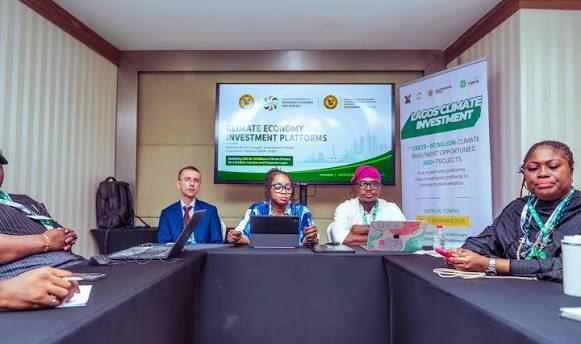
The Lagos State Government says investors have begun expressing interest in partnerships across its climate investment projects, following engagements with financial institutions, energy companies and project developers at the ongoing 31st United Nations Climate Change Conference in Antalya, Türkiye.

The discussions have produced initial partnership opportunities in healthcare, solar energy, women’s empowerment and clean transportation, as the state seeks to turn its previously unveiled $25bn-$50bn investment pipeline into bankable projects.

The engagements followed the presentation of more than 300 potential climate projects by the state, with investors participating in project pitches, exchanging contacts and exploring financing arrangements with government representatives and local businesses.

In a statement issued on Tuesday following a reception at the Lagos Climate Investment Day, which capped a week-long engagement with investors, the Special Adviser to the Governor on Climate Change and Circular Economy, Titilayo Oshodi, said the interactions had strengthened the state’s confidence in its ability to attract private capital for climate investments.

She said, “We’ve brought in the public sector. We’ve brought in the private sector. We’ve brought in young enterprises who are already doing stuff in the green economy. We’ve brought in financial institutions who are ready to show that where we can take the risk, we can begin to fix green finance.

“We have experimented with these things and we have seen that there’s a possibility in them, and it gives us a lot of confidence right now. So, I just want to say thank you to our financial institutions, once again, Sterling Bank, for taking the pain, for taking a shot at us, taking a chance on government.”

Oshodi disclosed that project developers and investors had held discussions after a full day of presentations, with participants asking questions and exploring possible areas of cooperation.

See also  Customer sues bank over alleged unlawful account freeze

“We had a full day of pitches just a few hours ago. The investors that we brought in asked questions, they were exchanging cards. They were having conversations to discover themselves, and they are beginning to look at what is possible going beyond now,” she said.

She added that the objective was to move beyond announcements and ensure that investment discussions translated into projects, employment and improved living conditions.

“Let’s carry this momentum. Let’s take it along with us. Let’s turn our pledges into projects. Let’s turn our projects into jobs. Let’s turn our jobs into real impact for Lagos State and, by extension, for Nigeria,” she said.

One of the private-sector partners, Tonye Cole, said the initiative provided an opportunity to connect international capital with sustainable development projects and businesses across Africa.

Cole, who said he had spent decades developing and financing sustainable projects, explained that he had worked with his partner, Funke Shobanjo, to establish a platform connecting available global funding with investment opportunities at the grassroots.

He said, “Together, we have developed this platform, and the platform works. What we are now working with Lagos State Government to bring to COP is the opportunity to partner with businesses like ours, with the state government, to develop and work on how sustainable projects and finance can meet the people that need it the most.

“This is an invitation to help you make a difference in a world that needs a difference. Let’s work together to make this happen.”

The Chief Operating Officer of FBNQuest Merchant Bank, Funke Shobanjo, also pledged support for the initiative, saying private investors were prepared to provide financing through a pan-African sustainable finance platform.

See also  CBN orders banks to freeze six terror suspects’ accounts

She said, “We are extremely excited about what Lagos State is doing, and we are passionate about driving the climate ambition forward for the projects under the umbrella.

“Our commitment is in private individuals coming together to provide capital and financing through a pan-African sustainable finance platform. I want to congratulate Lagos State on this goal and ambition and commit, on behalf of my co-founder and myself, our support to see the projects in the pipeline.”

The early engagements have also produced interest in social-sector projects. A member of the Lagos delegation disclosed that five investors had indicated willingness to partner with projects, including healthcare insurance initiatives aimed at reducing out-of-pocket medical expenses.

The delegate said Sterling Bank had also indicated support for providing between 50 and 100 tricycles for women’s empowerment programmes in Lagos, while Worldwide Energy had promised to solarise a primary healthcare centre.

Climate and carbon asset expert, Dr Adebola Odunsi, described the engagements as an opportunity to unlock economic value through partnerships across states and sectors.

He said the waste generated in one state could serve as raw material for businesses in another, creating opportunities for trade, investment and shared climate benefits.

“The waste that is being generated in one state can become the raw material in another state. So very soon, there are trade opportunities and climate outcome opportunities that we can share, all for the shared climate prosperity of our beautiful country, Nigeria,” Odunsi said.

He added that the investment platform had taken years of work to develop and had attracted considerable interest from international stakeholders.

See also  Dangote pumps 43 million litres, denies petrol shutdown

The engagements come as Lagos seeks to bridge the financing gap between its climate ambitions and actual project delivery. Its previously announced pipeline covers more than 300 potential projects across clean energy, transportation, water management, climate resilience, circular economy, agriculture and green enterprise.

In a related development, the Lagos State Commissioner for Energy and Mineral Resources, Biodun Ogunleye, has identified private capital as a critical factor to addressing the state’s electricity supply deficit and financing its energy transition.

He said Lagos, with an estimated electricity demand of 12,000 megawatts, could not depend solely on government resources to finance the infrastructure required to bridge the gap.

“Our goal as government is to create an enabling environment and not to generate the power ourselves. But reforms alone must not build power plants. Indeed, capital does.

“Government balance sheet alone cannot fund the investment that we know is required,” Ogunleye said.

He disclosed that the state was targeting an additional 2,000 megawatts of electricity capacity and had established regulatory institutions to encourage private investment across generation, distribution and mini-grid development.

Ogunleye urged investors to take advantage of financing mechanisms, including the Global Fund for Infrastructure and Investment Finance, to support project preparation and reduce investment risks.

He said, “Government provides legitimacy, enabling policy and a pipeline, while the private sector provides structuring, capital, credit decisions and asset management.”

He added that the state was ready to share priority projects with financing partners and explore guarantees and other risk-sharing arrangements to make the investments attractive to lenders.

Source: punchng.com

FOLLOW US ON:

FACEBOOK

WHATSAPP CHANNEL

TWITTER

PINTEREST

TIKTOK

YOUTUBE

LINKEDIN

INSTAGRAM

Continue Reading

Trending