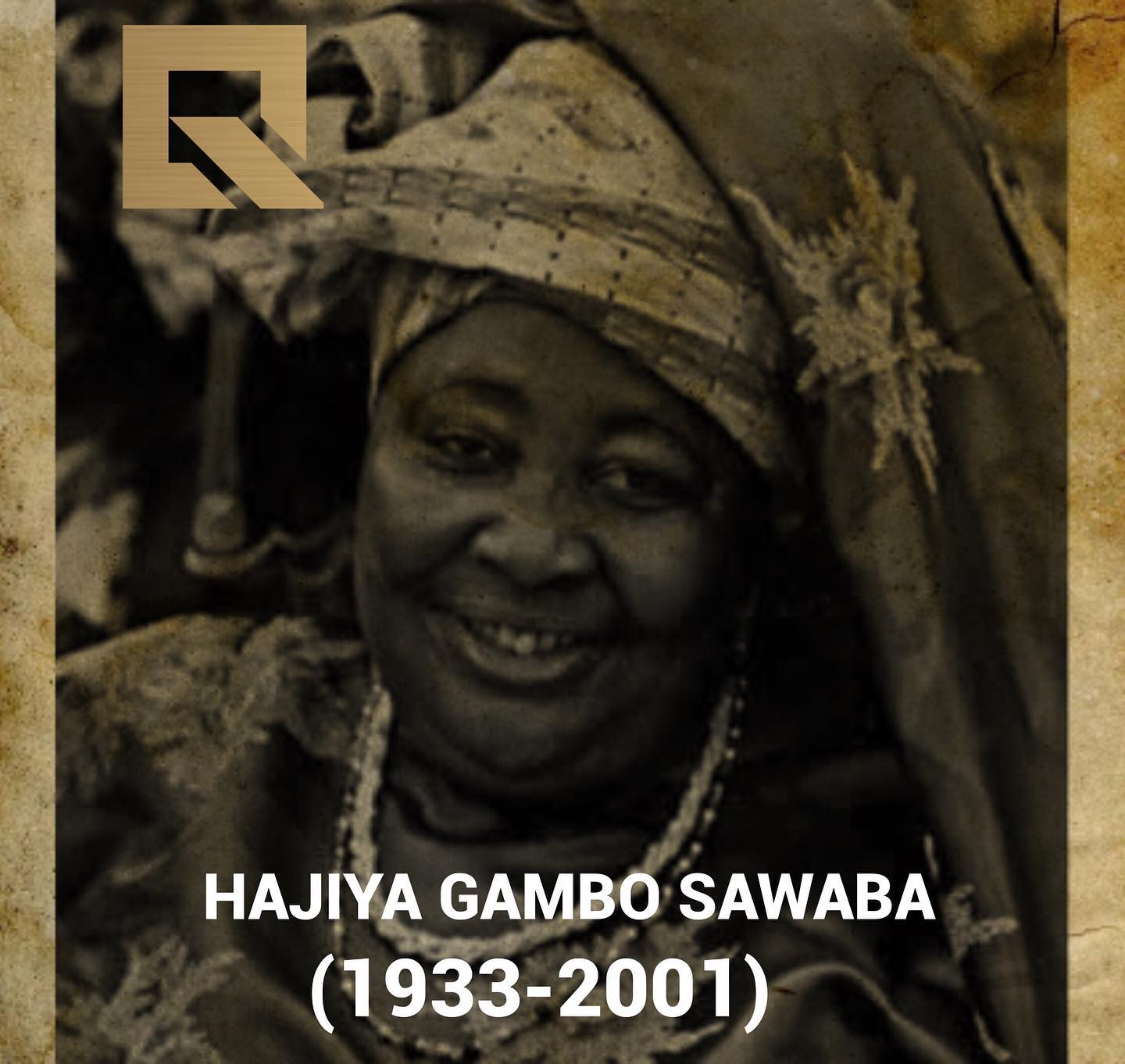
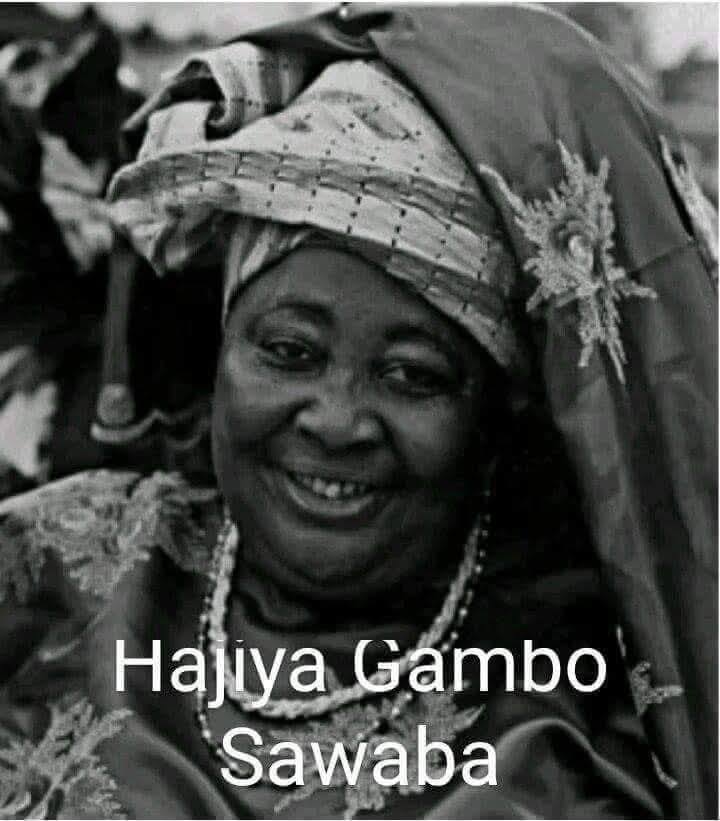
In the conservative heart of Northern Nigeria, where purdah (the seclusion of women from public life) confined women to silence and politics was a forbidden arena, one woman roared loudly enough to shake the foundations of power — Hajiya Gambo Sawaba.
She was arrested no fewer than sixteen times, flogged in public, brutalized in jail, stripped naked, and tortured, and yet never silenced. History remembers her as the most jailed female activist in Nigeria’s history.
Born Hajaratu Gambo Sawaba on 15 February 1933 in Tudun Wada, Zaria, she was the daughter of Isa Amartey Amarteifio, a Ghanaian migrant who worked with the Nigerian Railway Corporation, and Fatima Amarteifio, a Nupe woman from Lavun, Niger State. She was the fifth of six children. By Hausa custom, any child born after twins was called “Gambo,” a name she bore for life.
From childhood, she displayed an untamable spirit. Folklore remembers her as a girl who always fought for the underdog. Whenever she saw children fighting, she would step in for the weaker one and declare:
“I have bought this fight from you.” Her clothes were often torn in these scuffles, until her mother, tired of constant repairs, began sewing her dresses from tarpaulin. Even as a child, Gambo revealed what would define her entire life: she was a fighter for the oppressed.
Tragedy struck early. Her father died when she was just 10 years old, and her mother three years later. Orphaned at 13, she was quickly married off to Abubakar Garba Bello, a World War II veteran. At 16, she gave birth to her only child, Bilikisu, but her husband abandoned her soon after, leaving her to raise her daughter largely alone. By 17, however, Gambo was already forging her own path in defiance of the strictures that confined Northern women.
In 1950, when Malam Aminu Kano founded the Northern Elements Progressive Union (NEPU) as a radical alternative to the conservative Northern People’s Congress (NPC), Gambo became one of its earliest female members. NEPU pushed for education, social justice, and women’s empowerment in sharp contrast to the NPC, which insisted: “We in the North are happy, our women are happy about their condition. We know what is right for women.”
Her fearlessness soon caught Aminu Kano’s attention. He gave her the name “Sawaba”, meaning redemption or freedom. An alternative story claims she earned the name after boldly addressing a rally in Jakara Market, Zaria, before the official male speaker arrived. When the councilman Alhaji Gambo Sawaba finally came, he declared that since she was the first woman to speak at a political rally in the North, she would henceforth be called Gambo Sawabiya. She, however, preferred the male version, “Sawaba,” and it became inseparable from her identity.
Her rise was meteoric. She was soon elected President-General of NEPU’s women’s wing, leading campaigns that shook the North. She went from house to house, speaking directly to women in purdah, addressed crowds in markets, and organized political meetings where no woman had dared to speak before. Her advocacy was fearless, she condemned child marriage, forced and unpaid labour, punitive taxes, and the denial of education and political rights to women.
But this activism came at a heavy price. In 1952, she was arrested in Kano and charged with “drawing women out of purdah.” She was sentenced to three months in prison, the first of sixteen prison sentences she would endure. She was jailed in Zaria, Kano, Kaduna, and Jos. Sometimes she was stripped naked and flogged several lashes; on other occasions, her hair was shaved off with a broken bottle. She was beaten so severely by thugs that she once lost all her front teeth, which had to be replaced with artificial ones. In 1957, she underwent surgery to remove her womb after brutal torture in prison.
Sawaba became so familiar with arrests that she always kept a blanket inscribed “Prison Yard” near her bed, ready for the next time police came knocking. Yet prison only strengthened her resolve. Crowds of women and men often packed the courtroom during her trials, chanting in her support.
Her fight extended to the ballot box. In 1956, she and other NEPU women marched to the office of Premier Sir Ahmadu Bello in Kaduna to demand voting rights for Northern women. He promised to consider their request but unfortunately he never fulfilled it. While women in the South gradually gained the franchise (1951 in Lagos, 1954 in the East, 1959 in the West), Northern women were told they would receive the vote only “in God’s time.” Sawaba mocked the excuse, declaring that had women been enfranchised earlier, she would have contested against these men. Ultimately, Northern women did not get the vote until 1976.
Her activism was not without personal sacrifice. After her separation from her first husband, she married three more times, a railway worker, a Cameroonian boxer (regularly threatened with deportation by her political enemies), and a businessman. None of the marriages lasted. She endured physical attacks, including one where six men beat her unconscious and left her for dead in the bush.
Despite all this, Sawaba remained a pillar of courage. Her home on Benin Street in Zaria became a hub for political meetings, filled with posters of Karl Marx, Thomas Sankara, and Samora Machel. She maintained an open-door policy, raising not only her daughter but also dozens of adopted children, relatives, orphans, and street kids. By the time of her death, she had taken in over 30 children, some from the hospital just days before her passing.
At home, she was warm and unpretentious. Her daughter Bilikisu remembered her love of cooking and her favourite dishes: Nupe dukuno, tuwo shinkafa, and sakwara. Yet beyond the domestic space, she remained an indomitable lioness of politics, blunt, non-conformist, outspoken.
In 1998, disillusioned by corruption and the loss of ideology in Nigerian politics, she formally retired, declaring: “Politics in the country has lost its flavour and is no longer a game of ideology, but a game of self-aggrandisement.” She died three years later, in October 2001, at the age of 68.
Her funeral in Zaria was attended by two former heads of state, a testament to her political stature. Tributes poured in, with the New Nigerian describing her as “the most tortured and jailed Nigerian female politician.” Her daughter Bilikisu summed up her mother’s life simply: “She never stopped hoping for a better society and remained optimistic that Nigerians, especially women, would be free from tyranny and dictatorial leadership.”
Hajiya Gambo Sawaba lived and died as she had always been, a fighter, a redeemer, a lioness who roared for the voiceless.
Today, her memory endures in monuments such as the Hajiya Gambo Sawaba General Hospital in Zaria, a hostel at Bayero University, Kano (BUK) named after her, and in the many statues raised in her honour.
Hajiya Gambo Sawaba fought, bled, and endured for the rights of women and the poor. She never asked for applause but her legacy roars on, immortalizing her as the true Lioness of Zaria.
One day, someone will pronounce your name for the last time. The house you struggled to build will belong to someone else. The money you sacrificed your peace to acquire will eventually be spent by other people. And the world you thought could never exist without you will continue moving after you are gone.**
So, what exactly are we fighting for?
Life is beautiful, but it is temporary. This is one of the greatest lessons humanity must learn. Yet, many people spend their entire lives chasing wealth, power, fame, and recognition as if they will remain on earth forever.
In Yoruba wisdom, the expression *“Àṣán ohun ni adùn ayé, ohun gbogbo máa dé òpin”* reminds us that the pleasures of life are temporary and that everything eventually comes to an end.
## The Endless Pursuit of Wealth and Power
There is nothing wrong with working hard, building a successful business, owning a house, or providing a better future for your children. In fact, financial stability can bring security, dignity, and opportunities.
The problem begins when the pursuit of wealth becomes more important than the people around us.
Some people destroy family relationships over inheritance. Friends become enemies because of money. Neighbours fight over small pieces of land. People who once supported one another begin to compete endlessly over who is richer, more successful, or more powerful.
But have we stopped to ask ourselves whether these battles are truly worth the price we pay?
What is the value of a mansion if the person living inside it has no peace? What is the value of millions in the bank if the pursuit of that money destroys every meaningful relationship? And what is the purpose of power if it is used to humiliate people who have less?
Life has a way of reminding us that no position is permanent.
The person who is celebrated today may be forgotten tomorrow. The individual who enjoys enormous wealth may face unexpected difficulties. The powerful leader will eventually leave office, and another person will take their place.
Even the strongest among us cannot control every chapter of life.
That reality should not make us hopeless. Instead, it should encourage us to live with humility, gratitude, and compassion.
We should remember that the security, opportunities, and privileges we enjoy today are not guaranteed forever.
## What Will You Leave Behind?
When people remember your life, what will they say about you?
Will they remember you as someone who helped others when they were struggling? Will your children remember the love and wisdom you gave them? Will your community remember your contribution?
Or will your entire legacy be measured by the money you accumulated and the possessions you left behind?
Material wealth can improve lives, but character determines how we use it. A person’s influence is not measured only by what they own, but also by how they treat others.
Sometimes, a small act of kindness leaves a deeper mark than an expensive gift. Sometimes, a sincere apology saves a relationship that money could never repair.
## Live Well, but Remember That Life Is Temporary
The lesson is not to abandon ambition or stop pursuing success. It is to pursue those things without losing your humanity.
Build your house, but build relationships too. Make money, but do not make money your god. Protect your interests, but do not allow greed to consume you. Teach your children how to succeed, but also teach them compassion, honesty, and respect.
Spend time with the people you love. Appreciate your parents while they are alive. Give your children memories worth keeping. Help someone who cannot repay you. And learn to enjoy the simple blessings that are often overlooked in the race for material success.
**Life is sweet, but nothing lasts forever. Everything has an end.**
Perhaps the real measure of a successful life is not simply how much we acquire before we leave this world, but how wisely we live and how positively we affect the lives of others.
### NEWSBREAK365 ASKS:
If we all know that we will eventually leave everything behind, **why do people allow money, power, pride, jealousy, and property to destroy their peace and relationships?**
Is the problem human nature, the pressure of society, or our desire to prove that we are better than others?
Share your opinion in the comments. Your perspective could make someone think differently about life.
The family of Nigerian gospel singer, Olayemi Bolaji, popularly known as Toluwanisings, has announced his death.
The announcement, posted on the singer’s TikTok account on Wednesday, noted that he died in the early hours of October 14, 2026.
The statement read, “With deep sorrow, the family announces the passing of Minister Olayemi Bayonile Bolaji, Toluwani Gospel Music Ministry (TOGOMM), who passed away in the early hours of 14 October 2026.
“A dearly loved husband, family member, and gospel minister.
“Please keep his wife, family, and loved ones in your prayers during this difficult time.”
The statement also noted that funeral arrangements would be announced by the family in due course.
The singer’s death has sparked concerns, with fans and colleagues expressing grief on social media.
The Convener of the Coalition of Public Interest Lawyers and Advocates, Pelumi Olajengbesi, expressed distress over the development in a post on Instagram, pleading for God’s mercy.
Sharing a picture of the singer, Olajengbesi wrote, “My God! What a life! No, Lord! We plead for Your mercy upon Toluwanisings.
“I am deeply troubled by the deaths of young men and women. This is not God’s plan for us.
“We say no to untimely death.”
An X user, Ennybets, also shared an account of the incident on Wednesday.
He stated that he was at a hospital when the singer was brought in.
He wrote, “Brought my wife to the hospital for antenatal, and some car rushed in here bringing a popular gospel man.
“Come and see how BBO and the rest are crying so bad, I pray he survives this though.”
In a follow-up post, Ennybets expressed grief over the singer’s passing, saying he witnessed members of his band crying at the hospital.
He wrote, “I cried about this man’s passing. The fact that I was seeing over 10 grown men who are his band members, crying heavily in front of me is giving me trauma.”
Reacting to the news, gospel artiste Mega99 described the late singer as a rare talent.
He wrote, “A rare gem with a unique voice is gone. This life.”
The cause of his death remained unknown as of the time this report was filed.
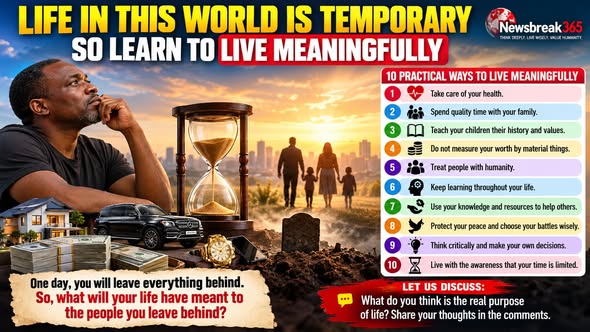
One day, you will leave everything behind. Your money, house, cars, fame, position, and possessions will remain in this world. The important question is: what will your life have meant to the people you leave behind?**
We spend years chasing wealth, competing with others, fighting over religion, politics, ethnicity, and social status. We sometimes sacrifice our health, peace of mind, family relationships, and happiness just to acquire things we cannot take with us when we die.
Yet, life continues to remind us that nobody stays here forever.
The rich will die. The poor will die. The powerful will die. The unknown will die. No amount of money can make human life permanent.
Does this mean life is meaningless? Not necessarily. **Perhaps the fact that life is temporary is precisely why we should be more careful about how we spend it.**
If we have limited time in this world, how can we live meaningfully?
### 10 PRACTICAL WAYS TO LIVE A MEANINGFUL LIFE
**1. Put your health before unnecessary competition.**
Do not destroy your body trying to impress people. Eat wisely, exercise regularly, get enough sleep, manage stress, and seek medical attention when necessary. Wealth means little if you neglect the body that allows you to enjoy life.
**2. Spend quality time with your family.**
Your children need more than money, clothes, and expensive gifts. They need your attention, guidance, affection, and wisdom. Call your parents if they are alive. Check on your siblings. Make time for the people who genuinely care about you.
**3. Teach your children their history and values.**
Tell them where they come from, the stories of their ancestors, their language, their culture, and the lessons of previous generations. Teach them critical thinking, honesty, responsibility, and respect for others. Do not leave their entire education about life to social media.
**4. Stop measuring your worth by material possessions.**
You do not have to own the biggest house, drive the most expensive car, or wear designer clothes to have value. Build financial stability, but do not make material wealth the only measure of your success.
**5. Treat people with humanity.**
Be kind to people who cannot reward you. Respect workers, the elderly, children, and those who have less than you. A person’s dignity should not depend on their bank balance, religion, tribe, nationality, or social position.
**6. Keep learning until the end of your life.**
Read books, learn new skills, ask questions, and challenge your assumptions. Do not allow age, tradition, or fear to prevent you from discovering better ways to live. An educated mind is better equipped to make informed decisions.
**7. Use your knowledge and resources to help others.**
Share useful information, mentor a young person, support someone who is struggling, volunteer, or help a neighbour in need. You do not have to be rich to make a positive difference. Sometimes, a little assistance can change someone’s entire day.
**8. Protect your peace and choose your battles wisely.**
Not every insult deserves a response. Not every disagreement requires a fight. Learn to walk away from destructive relationships, unnecessary arguments, and endless competition. Your peace of mind is worth protecting.
**9. Think critically and make your own decisions.**
Do not blindly accept everything you hear from politicians, religious leaders, traditional authorities, celebrities, or social media influencers. Ask questions, examine evidence, and be willing to change your mind when you discover better information.
**10. Live with the awareness that your time is limited.**
Do not postpone every important thing until tomorrow. Apologise when you are wrong. Express love while you can. Pursue worthwhile goals. Repair relationships where possible. Write down the lessons you have learned and pass them on to the next generation.
Remember, living meaningfully does not mean abandoning ambition, money, religion, or personal success. It means putting these things into perspective and refusing to let them consume your entire existence.
You can build wealth without becoming arrogant. You can practise religion without hating people who believe differently. You can be successful without exploiting others. You can enjoy life without forgetting your responsibilities.
**THE REAL QUESTION IS NOT JUST HOW LONG YOU LIVE, BUT HOW YOU CHOOSE TO LIVE WHILE YOU ARE ALIVE.**
### A CHALLENGE FOR EVERYONE READING THIS
Starting today, choose three practical actions:
– Do one thing to improve your health.
– Do one thing to strengthen your family or help another person.
– Do one thing to increase your knowledge or become a better human being.
Repeat these actions consistently, and let your life reflect the values you claim to believe in.
💭 **LET US DEBATE: If life is temporary and everything we own must eventually be left behind, what should be the most important purpose of human existence — wealth, family, happiness, knowledge, service to humanity, or something else?**