
Lifestyle
Hajiya Gambo Sawaba: The Lioness of Zaria

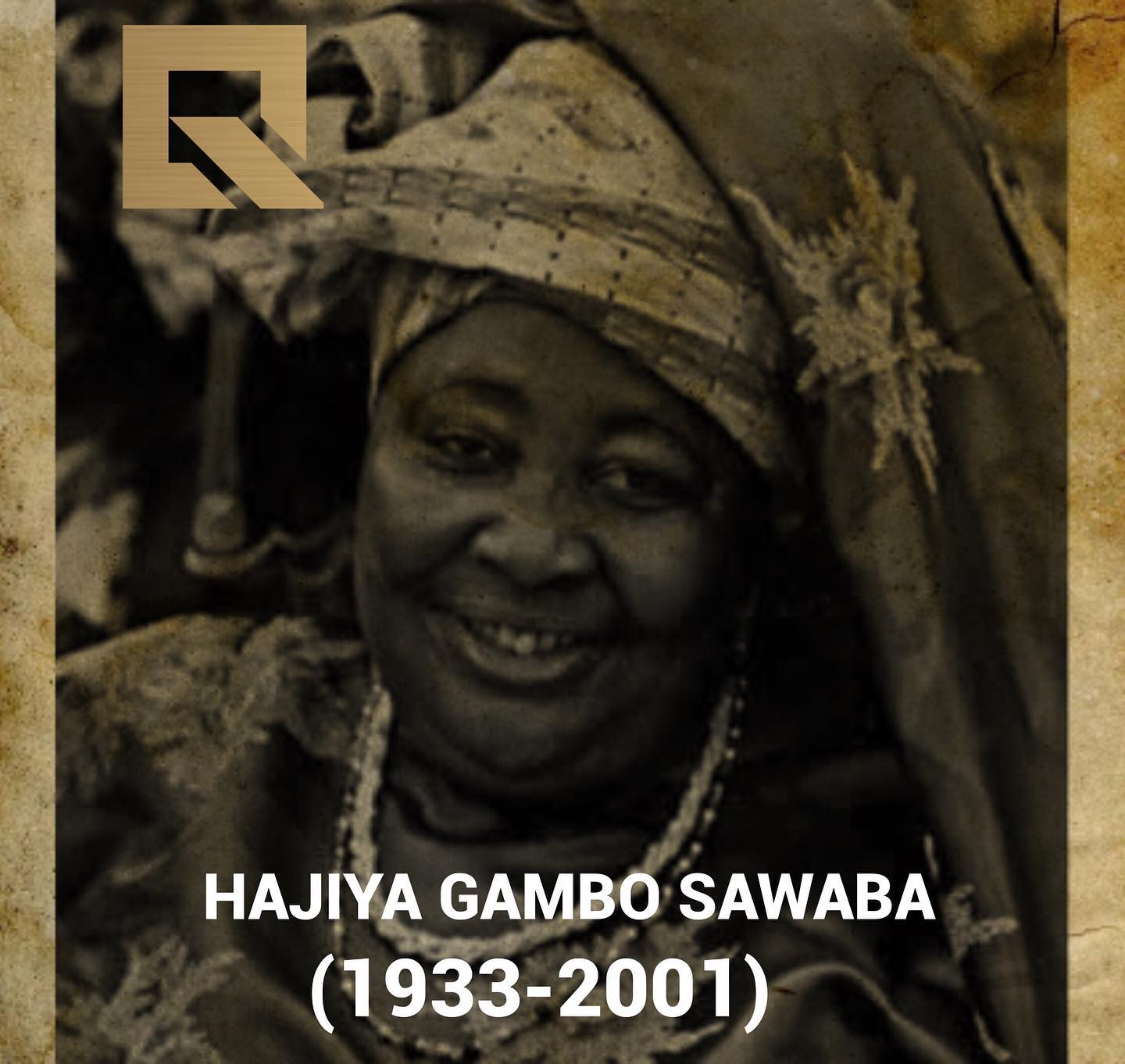
In the conservative heart of Northern Nigeria, where purdah (the seclusion of women from public life) confined women to silence and politics was a forbidden arena, one woman roared loudly enough to shake the foundations of power — Hajiya Gambo Sawaba.
She was arrested no fewer than sixteen times, flogged in public, brutalized in jail, stripped naked, and tortured, and yet never silenced. History remembers her as the most jailed female activist in Nigeria’s history.
Born Hajaratu Gambo Sawaba on 15 February 1933 in Tudun Wada, Zaria, she was the daughter of Isa Amartey Amarteifio, a Ghanaian migrant who worked with the Nigerian Railway Corporation, and Fatima Amarteifio, a Nupe woman from Lavun, Niger State. She was the fifth of six children. By Hausa custom, any child born after twins was called “Gambo,” a name she bore for life.
From childhood, she displayed an untamable spirit. Folklore remembers her as a girl who always fought for the underdog. Whenever she saw children fighting, she would step in for the weaker one and declare:
“I have bought this fight from you.” Her clothes were often torn in these scuffles, until her mother, tired of constant repairs, began sewing her dresses from tarpaulin. Even as a child, Gambo revealed what would define her entire life: she was a fighter for the oppressed.
Tragedy struck early. Her father died when she was just 10 years old, and her mother three years later. Orphaned at 13, she was quickly married off to Abubakar Garba Bello, a World War II veteran. At 16, she gave birth to her only child, Bilikisu, but her husband abandoned her soon after, leaving her to raise her daughter largely alone. By 17, however, Gambo was already forging her own path in defiance of the strictures that confined Northern women.
In 1950, when Malam Aminu Kano founded the Northern Elements Progressive Union (NEPU) as a radical alternative to the conservative Northern People’s Congress (NPC), Gambo became one of its earliest female members. NEPU pushed for education, social justice, and women’s empowerment in sharp contrast to the NPC, which insisted: “We in the North are happy, our women are happy about their condition. We know what is right for women.”
Her fearlessness soon caught Aminu Kano’s attention. He gave her the name “Sawaba”, meaning redemption or freedom. An alternative story claims she earned the name after boldly addressing a rally in Jakara Market, Zaria, before the official male speaker arrived. When the councilman Alhaji Gambo Sawaba finally came, he declared that since she was the first woman to speak at a political rally in the North, she would henceforth be called Gambo Sawabiya. She, however, preferred the male version, “Sawaba,” and it became inseparable from her identity.
Her rise was meteoric. She was soon elected President-General of NEPU’s women’s wing, leading campaigns that shook the North. She went from house to house, speaking directly to women in purdah, addressed crowds in markets, and organized political meetings where no woman had dared to speak before. Her advocacy was fearless, she condemned child marriage, forced and unpaid labour, punitive taxes, and the denial of education and political rights to women.
But this activism came at a heavy price. In 1952, she was arrested in Kano and charged with “drawing women out of purdah.” She was sentenced to three months in prison, the first of sixteen prison sentences she would endure. She was jailed in Zaria, Kano, Kaduna, and Jos. Sometimes she was stripped naked and flogged several lashes; on other occasions, her hair was shaved off with a broken bottle. She was beaten so severely by thugs that she once lost all her front teeth, which had to be replaced with artificial ones. In 1957, she underwent surgery to remove her womb after brutal torture in prison.
Sawaba became so familiar with arrests that she always kept a blanket inscribed “Prison Yard” near her bed, ready for the next time police came knocking. Yet prison only strengthened her resolve. Crowds of women and men often packed the courtroom during her trials, chanting in her support.
Her fight extended to the ballot box. In 1956, she and other NEPU women marched to the office of Premier Sir Ahmadu Bello in Kaduna to demand voting rights for Northern women. He promised to consider their request but unfortunately he never fulfilled it. While women in the South gradually gained the franchise (1951 in Lagos, 1954 in the East, 1959 in the West), Northern women were told they would receive the vote only “in God’s time.” Sawaba mocked the excuse, declaring that had women been enfranchised earlier, she would have contested against these men. Ultimately, Northern women did not get the vote until 1976.
Her activism was not without personal sacrifice. After her separation from her first husband, she married three more times, a railway worker, a Cameroonian boxer (regularly threatened with deportation by her political enemies), and a businessman. None of the marriages lasted. She endured physical attacks, including one where six men beat her unconscious and left her for dead in the bush.
Despite all this, Sawaba remained a pillar of courage. Her home on Benin Street in Zaria became a hub for political meetings, filled with posters of Karl Marx, Thomas Sankara, and Samora Machel. She maintained an open-door policy, raising not only her daughter but also dozens of adopted children, relatives, orphans, and street kids. By the time of her death, she had taken in over 30 children, some from the hospital just days before her passing.
At home, she was warm and unpretentious. Her daughter Bilikisu remembered her love of cooking and her favourite dishes: Nupe dukuno, tuwo shinkafa, and sakwara. Yet beyond the domestic space, she remained an indomitable lioness of politics, blunt, non-conformist, outspoken.
In 1998, disillusioned by corruption and the loss of ideology in Nigerian politics, she formally retired, declaring: “Politics in the country has lost its flavour and is no longer a game of ideology, but a game of self-aggrandisement.” She died three years later, in October 2001, at the age of 68.
Her funeral in Zaria was attended by two former heads of state, a testament to her political stature. Tributes poured in, with the New Nigerian describing her as “the most tortured and jailed Nigerian female politician.” Her daughter Bilikisu summed up her mother’s life simply: “She never stopped hoping for a better society and remained optimistic that Nigerians, especially women, would be free from tyranny and dictatorial leadership.”
Hajiya Gambo Sawaba lived and died as she had always been, a fighter, a redeemer, a lioness who roared for the voiceless.
Today, her memory endures in monuments such as the Hajiya Gambo Sawaba General Hospital in Zaria, a hostel at Bayero University, Kano (BUK) named after her, and in the many statues raised in her honour.
Hajiya Gambo Sawaba fought, bled, and endured for the rights of women and the poor. She never asked for applause but her legacy roars on, immortalizing her as the true Lioness of Zaria.
FOLLOW US ON:






“I MADE THIS PERSON WHO THEY ARE TODAY!” — REALLY?

SOME PEOPLE WILL DO ANYTHING — EVEN EVIL — JUST TO MAKE MONEY!

Belgian parliament to legislate to allow police to enter homes to facilitate undocumented migrant removals

‘Sleeping Prince’ of Saudi Arabia dies after 20 years in coma

2027: Atiku delays ADC membership card collection amid rumoured Jonathan comeback

How A Class Of 24 Students Produced 2 Presidents, 4 Governors, 2 Ministers, 4 Emirs, 3 Justices, 4 Ambassadors and Other Influential Leaders


-

 News18 hours ago
Air chief pleads for patience as investigation begins on Ondo crash
-
News17 hours ago
Dapo Abiodun reveals that Nigeria needs 554,353 personnel for state police, read details
-
News17 hours ago
INEC displays voter register, begins PVC distribution ahead of 2027 elections
-
Sports17 hours ago
Adeniyi lauds Nigeria’s Veterans World Wrestling Champs medal
-
Business18 hours ago
FG’s 30-day petrol discount sparks opposition backlash
-
News16 hours ago
Trump rules out new Iran attack before US midterm elections
-
News17 hours ago
Gates Foundation director reveals that AI tools will help detect pregnancy complications early, read how
-
Business17 hours ago
Report reveals Nigeria leaves N40tn manufacturing opportunities untapped















