The Independent National Electoral Commission on Thursday began the distribution of sensitive materials for the conduct of Saturday’s governorship election in Ekiti State.
Electoral officers from different local government areas were on hand to receive the materials for onward movement to their councils in readiness for onward distribution to the wards and units for the election.
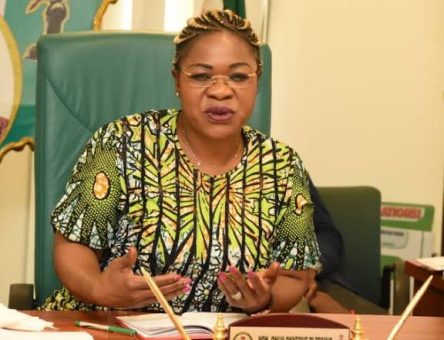
INEC Resident Electoral Commissioner in Ekiti State, Dr Bunmi Omoseyindemi, who spoke at the Central Bank of Nigeria, Ado Ekiti branch, venue of the distribution, assured residents of the commission’s readiness to conduct a credible, free and fair poll.
The governorship election is scheduled to be held across the 16 local government areas of the state.
Omoseyindemi said, “As you can see, we have begun the distribution of sensitive materials for Saturday’s governorship election. The process is being carried out in a transparent manner in the presence of security agencies, political parties, election observers, media and other stakeholders.
“We started with local government areas that are far from the state capital to ensure that the materials get to their destinations on time and without any hitch.”
The REC, who said all necessary arrangements had been put in place for a successful election across the state, said that INEC remained committed to delivering a credible exercise that would reflect Ekiti people’s wishes.
He urged residents to come out peacefully and perform their civic responsibility on election day as he commended the security agencies for their collaboration and support, saying their presence would help guarantee the safe movement of election materials and the overall integrity of the electoral process.
Police deploy operatives
The Commissioner of Police for the Ekiti Governorship Election, Dr Abayomi Shogunle, speaking with newsmen on Thursday, commended the transparency in the distribution of the election materials, as he assured of adequate security on Saturday.
He said the police had put in place a multi-layered security framework to ensure hitch-free exercise.
He declared war against vote-trading, saying the Electoral Act had specific sanctions for the act, which the police would implement by ensuring anyone caught faced the prescribed music.
Shogunle, who assured general security for all, said, “Every unit, every centre, every INEC personnel, every voter, every journalist and every observer would be protected. What we want to achieve is increased voter turnout.”
The police commissioner said the security agencies were on the ground to escort the election materials and ensure security at the various destinations, including the wards and polling units.
He said, “Distribution of election materials to each of the 16 local government areas has commenced. INEC is starting with the faraway local governments.
“We have police officers who are going to escort these materials from here to all the local government headquarters, where the materials will be housed. The police officers will also be on guard to protect all these materials.
“Then, by tomorrow (Friday), we expect the movement of these materials from the various local governments to the Registration Area Centres (wards). Then, from the wards, INEC will get the materials to the polling units, where they will be used on Saturday.
“We have plans in place to ensure that the materials arrive safely at all designated polling units across the state by Saturday morning, very early, to enable the commencement of polling at the stipulated time at the various polling units.”
Shogunle said the police, which is the lead agency in the election security, had, in addition to their intelligence, “considered the risk assessments carried out by different stakeholders and put in place adequate measures to forestall any security issue or apprehension of any individual.”
He said that the police were operating under the operational order of the Inspector General, Tunji Disu, saying, “The operational order is based on a security framework, which is a multi-layered security framework.
“We have identified different elements here, and we are putting in place different measures to take care of the issues that have been identified.”
He said that adequate measures had been put in place with the multi-layered security framework.
The police also said it will deploy a proactive and preventive security model for the election, while movement of persons will be restricted on election day to ensure a peaceful and credible poll.
The Force Public Relations Officer, DCP Anthony Placid, disclosed this in an interview on Thursday, assuring residents of the state’s readiness to provide adequate security before, during and after the election.
Placid said the IGP, Disu, had already deployed sufficient personnel to secure polling units, collation centres and other designated election facilities across the state.
He said, “As we approach the forthcoming elections in Ekiti under the leadership of our admirable Inspector General of Police, IGP Olatunji Disu, I would like to inform you that the Nigerian Police Force intends to utilise a proactive and preventive model in order to ensure a peaceful election.
“Currently, the Inspector-General of Police has deployed adequate personnel to cover polling units, collation centres, and all other designated election facilities. We will provide physical security, personal security, information security, as well as security for all election-related activities and events.”
The police spokesman said the Force would remain neutral throughout the electoral process, stressing that its allegiance was to the Constitution and not to any political interest.
“It’s an enormous task, but our neutrality mandate comes to mind at a time like this to ensure that our loyalty and allegiance are to the Constitution of the Federal Republic and not to any political faction,” Placid stated.
According to him, the police have activated the Inter-Agency Consultative Committee on Election Security to coordinate the activities of all security agencies participating in the election.
“The media have a role to play in collaboration with the police, but for the police and all other security agencies, we have set in motion the Inter-Agency Consultative Committee on Election Security to ensure a uniform command of all the security agencies that will participate in the forthcoming elections,” he said.
Placid further disclosed that security agencies had put in place a three-layer security arrangement and that movement restrictions would be enforced on election day.
“We have also made arrangements for the three concentric layer security zones, and on the election day, in order to have a successful election, there will be restrictions on the movement of persons,” he said.
He urged residents of the state to remain peaceful and participate in the electoral process.
“I urge all good people of Ekiti State to rest assured that the Nigerian Police Force will provide a level playing field for all to come out en masse and exercise their franchise,” Placid added.
Yiaga-Africa warns vote-buyers
With a few hours to the governorship election, a non-governmental organisation, Yiaga Africa, has called on the political parties and their candidates to shun vote-buying and vote-selling during the forthcoming poll.
The group, which noted that the vote-trading remained one of the threats to the integrity of the election, said the political gladiators might capitalise on the economic hardship to exploit the voters.
The Chairman, 2026 Ekiti Election Observation Mission of the group, Dr Aisha Abdullahi, stated this while speaking with journalists in Ado Ekiti on Thursday.
Abdullahi also appealed to the INEC to sustain its commitment to transparency and professionalism, “particularly to the deployment of election materials, the RACs, the accreditation of voters using the Bimodal Voter Accreditation System and the management of election results, including the transmission of results.”
The group urged security agencies to sustain intelligence-led deployment, maintain strict neutrality and professionalism and guarantee the safety of voters, observers, journalists, electoral personnel, party agents, and election materials throughout the voting, counting, transmission and collation processes.
Yiaga Africa urged INEC, in collaboration with security agencies and anti-corruption bodies, to proactively identify, arrest, and prosecute individuals engaged in vote trading on election day.
She said, “Political parties and candidates must publicly renounce vote buying, and voters are encouraged to reject inducements and protect the value of their vote.
“Sustained voter education on the dangers of vote trading remains essential in the days leading up to the election.”
The Yiaga Africa urged the stakeholders and INEC to intensify voter education and mobilisation, with deliberate outreach to women, youth, persons with disabilities, and rural communities.
IPC tasks journalists
The International Press Centre and the Centre for Media and Society charged journalists and other media professionals who would be on duty during the election to adhere to professional standards and be safety conscious.
At a press parley, the Executive Director of IPC, Lanre Arogundade, said the admonition had become necessary in the light of the critical role that the media played during electioneering processes and elections, during which journalists’ safety may be threatened.
He said, “It is very important for journalists covering the Ekiti State election to be safety conscious in the discharge of their duties, and to avoid situations that will put them in harm’s way. Journalists are expected to be non-partisan.
“Being partisan is not only about being a member of a political party, but also includes the use of expressions and/or impressions with statements, tags, symbols and colours that portray or identify with a particular political party or personality,” Arogundade added.
He also admonished journalists covering the election to be well-equipped.
“Journalists who are to cover the elections should ensure that they are fully kitted and accredited to avoid situations wherein security agencies would have to question them or bar them from performing their duties.
“Journalists who are not on election duty should avoid straying into the identified polling units at will during the stipulated period of the election.
“At all times, journalists covering the elections must have their identification card and press/media tag clearly displayed to avoid undue harassment and unnecessary identity checks by the security agencies.
“Other stakeholders, including elections observers, should also proactively provide journalists covering the elections with information to ensure that all work together for the credibility of the electoral process,” Arogundade added.
The Executive Director of CEMESO, a partner organisation in the IPC/CEMESO-Safety of Journalists framework, Dr Akin Akingbulu, underscored the democratic imperative of journalist safety.
Akingbulu noted that the conditions under which journalists were permitted to work constituted a direct measure of a society’s commitment to its own civic values.
“Every election is, at its core, a test of those values and nowhere is that test more visibly administered than in the field,” he said.
On the broader relationship between security forces and the press during elections, Akingbulu called for functional collaboration grounded in mutual respect for institutional roles.
He said, “The relationship between security personnel and journalists during elections has historically been one of the most contested frontiers in Nigeria’s democratic experience, shaped by mutual suspicion on both sides.
“We expect the security forces to note that the media is a critical part of the electoral process and so the media should be accorded due rights and privileges to enable them to carry out their social obligations as partners in enshrining the credibility of the electoral process,” he added.
Among other activities, IPC/CEMESO will, during the election, be partnering with the Ekiti State police command in ensuring the safety of journalists deployed to the field.
As part of initiatives to keep tabs on the safety consciousness of journalists, IPC/CEMESO said that there were safety alert officers whom journalists under threat/attack could report to.
EU, CSOs launch observation hub
The European Union and a coalition of civil society organisations have launched a Joint Election Observation Hub to provide real-time monitoring of the election, in a move aimed at strengthening electoral transparency and boosting public confidence in the polls.
The initiative, under the European Union Support to Democratic Governance in Nigeria programme, will deploy accredited observers across all local government areas of Ekiti State to monitor the conduct of the election and provide verified, evidence-based reports throughout the electoral process, according to a statement by the EU delegation on Thursday.
The coalition comprises Yiaga Africa, IPC, CEMESO, TAF Africa, The Kukah Centre and the Nigerian Women Trust Fund.
Announcing the initiative in Ado-Ekiti, the organisations said the hub would serve as a central coordination platform for receiving, verifying and analysing reports from observers stationed at polling units across the state.
According to the coalition, the observers would monitor critical aspects of the election, including the opening of polls, voter accreditation, voting, vote counting, results collation, media coverage, electoral integrity and compliance with electoral guidelines.
The groups added that special attention would also be paid to the participation of women, young people and persons with disabilities to ensure that the election remained inclusive and reflective of democratic values.
“Verified information from the field will be analysed in real-time and shared through periodic public updates to promote transparency, counter misinformation, strengthen public confidence and encourage peaceful participation before, during and after the election,” the organisations stated.
Speaking on behalf of the EU-SDGN implementing partners, the coalition said the initiative reflected the strength of collaboration among Nigerian civil society organisations in safeguarding democracy.
“The Joint Election Observation Hub reflects the strength of Nigerian civil society working together in the public interest.
“By bringing together our expertise, nationwide networks and election observation efforts, we are able to provide timely, credible and evidence-based information that strengthens transparency, supports peaceful participation and reinforces public confidence in the electoral process,” the statement read.
The organisations stressed that credible elections required the active participation of citizens and the collective commitment of electoral institutions, security agencies, political actors, the media and civil society.
“Every stakeholder has a responsibility to protect the integrity of the electoral process. We encourage citizens to participate peacefully, reject violence and misinformation, and contribute to an election that reflects the will of the people,” they added.
Also speaking, Governance Adviser at the European Union Delegation to Nigeria and ECOWAS, Laolu Olawumi, said the EU remained committed to supporting Nigerian institutions and civil society organisations to deepen democratic governance through locally driven initiatives.
“The European Union is proud to support initiatives that place Nigerian organisations at the forefront of strengthening democracy.
“The Joint Election Observation Hub is significant because it is locally led, locally driven and built on the collective expertise of trusted Nigerian civil society organisations. It reflects our long-term commitment to supporting sustainable democratic institutions while ensuring that Nigerians themselves lead the efforts to protect and strengthen their democracy,” he said.
The Ekiti governorship election has emerged as one of Nigeria’s most closely watched off-cycle elections, with political observers viewing it as an early indicator of the mood of the electorate ahead of the 2027 general elections.
The election will determine whether incumbent Governor Biodun Oyebanji secures another four-year term or whether opposition parties can wrest control of the state.
The election is also expected to test reforms introduced by INEC, particularly the INEC Result Viewing Portal.
Beyond technology, stakeholders are paying close attention to issues of voter turnout, election security, misinformation and the inclusion of women, youths and persons with disabilities in the electoral process.